The Jordan College of Agricultural Sciences and Technology
| Picture |
|---|
 |
 |
 |
 |
 |
 |
 |
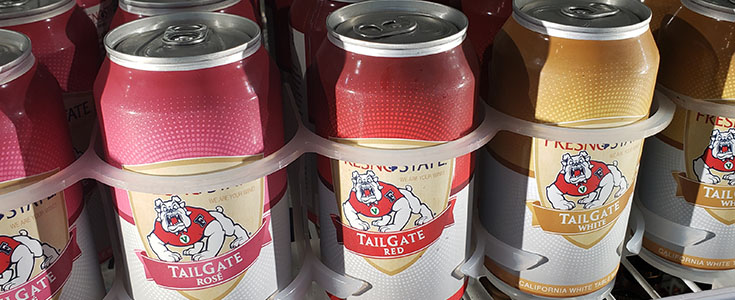
Farm Market joins canned wine market with Tailgate series
(August 28, 2020) -- Enology senior Henry Kampen chose to transfer to Fresno State a year ago because of its national reputation for hands-on experience in all areas of winemaking.
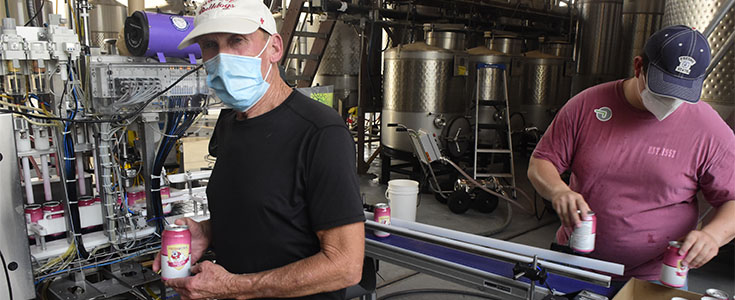
Little did he know that a year later he would help produce the Fresno State Winery’s first canned wine, and in his first month as a full-fledged student winemaker.
“Helping create a new product is a really unique opportunity for our students that they can use for the rest of their careers,” Kampen said. “We’ve proven with the first edition that the taste is on par with traditional bottled methods. Many thought that would be hard to match a few years ago.”
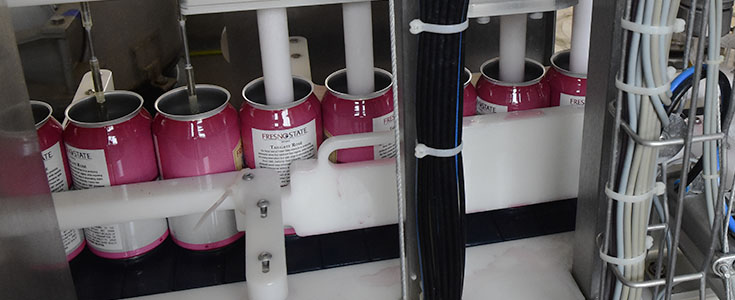
Now Central Valley consumers can get their favorite Tailgate wines in 12.7-ounce cans, half the size of a normal wine bottle, at the Gibson Farm Market. Each can sells for $3.50, or $14.00 for a four-pack.
All three wines used grapes harvested from the 120-acre campus vineyard and processed by viticulture and enology department students, staff and faculty. The red wine is blended from Barbera and Cabernet Sauvignon varieties; the white wine is a mix of Albariño & Muscat varieties; & the rosé is from its Syrah variety.
The cans will also be available locally at restaurants and stores such as the Clovis Meat Market, Fresno Meat Market, Mar Val, The Market and Simonian Farms.
“The new packaging’s biggest benefit is its versatility and portability that are great for outdoor activities such as BBQ’s, beach and camping trips,” said Kevin Smith, the campus winery sales and marketing manager. “When Bulldog athletic events eventually return, it’s perfect for the concession stands, since the size is more appropriate, isn’t breakable like glass, and customers won’t need a corkscrew.”
Campus winemaker Tom Montgomery, a veteran of the California wine industry for more than 40 years, started sizing up production methods last year for the nation’s largest and oldest campus winery.
In May 2019, he and three student assistants assisted in a canning of Uvas Buenas Grenache Rose’ wine produced by Papagni Winery. Montgomery has a close connection to the innovative winery in Madera that is owned by Demetrio Papagni, a Fresno State alum who is also a campus Ag One Foundation board of directors member.
Montgomery then found a can supplier, and did required tests for each wine to guarantee consumer taste quality, liner durability and appropriate acidity levels.
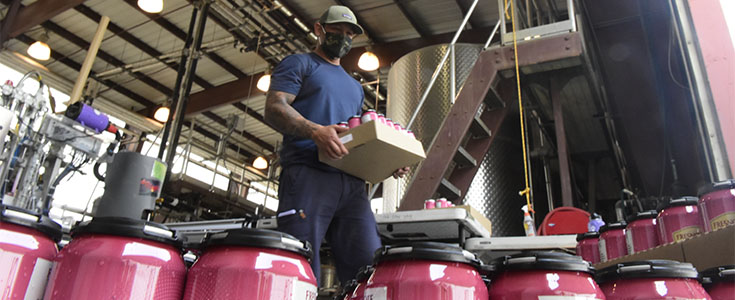
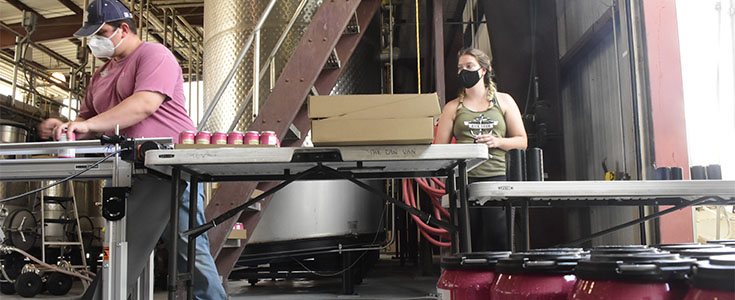
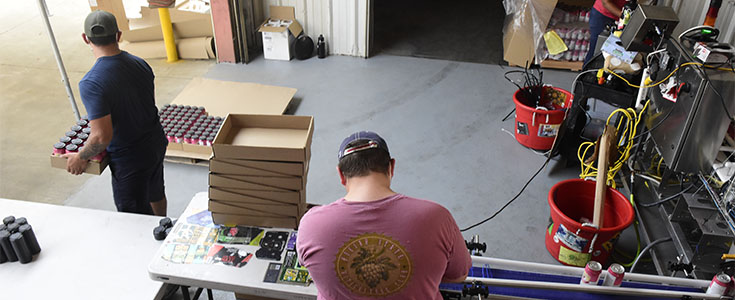
Before a mobile unit arrived in mid-August to process nearly 15,000 cans over two days, his student team continued to monitor the wine’s final stages. That included an extra filtration step to make the wine more stable in various hot and cold storage conditions.
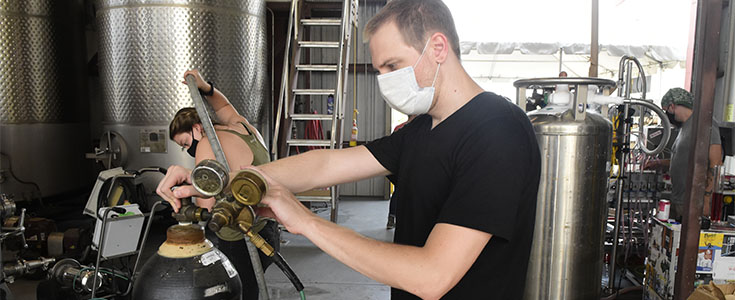
Among other differences on canning day, the wine was kept at cooler temperatures, near 42 degrees Fahrenheit, in refrigerated tanks before the transfer. Liquid nitrogen was also added to make the wine more stable, decrease the potential for oxidation, and keep pH levels from climbing too high.
“Canning is more challenging than bottling,” said Montgomery, “but we were extremely happy with the quality of the product. This has to be one of the most successful projects our student winemakers have done in the three years since I’ve returned.”
Conversely, there are production advantages. Materials are cheaper, lighter, safer to handle, easier to ship, and more likely to be recycled compared to glass bottles.
From a taste standpoint, cans are more resistant to wine degradation from oxidation and light, as well as ‘cork taint’, which can cause undesirable musty or moldy smells and tastes.
Domestic wineries started dabbling in canning nearly two decades ago, but consumer interest has spiked in recent years according to Wine Spectator magazine. In July, national sales for the past year were over $183 million, compared to just $2 million in 2012.
The Tailgate series is a perfect entry point for the campus winery since a growing number of consumers prefer lighter-tasting wines in smaller sizes and with lower alcohol by volume (ABV). Other wineries are springboarding off the new boom and starting to use higher-end varieties, too.
“If consumers enjoy this product, I could see us adding varieties like Muscat Canelli, Pinot Gris and our lighter red wines, too,” said Smith. “One of the great things is that people can try lesser known types of wine more affordably and develop new preferences.”
Millennials have helped spur the new format’s acceptance - something Smith tested last fall when he polled his campus wine marketing class about buyer behavior and its acceptance of canned wine products.
Their input echoed the increasing popularity at local retailers and at the Unified Symposium annual wine and grape conference, the industry’s largest event that is normally held each January in Sacramento.
Students like Kampen, a Visalia native with industry experience from Napa Valley and Sacramento, know that the internationally-recognized California wine industry is always looking for new growth areas.
“The younger market has helped fuel this trend,” Kampen said, “especially since the traditional wine market was a little hesitant, probably since some of the previous boxed wines were slow to catch on. Consumers are now finding that the quality and price of these canned products are very competitive.”
He knows that after receiving an associate degree from Napa Valley College, and working nearby at Rarecat Wines, a smaller, boutique winery, and the renowned Raymond Vineyards.
The bigger challenge came when he took the cans home to his parents, casual wine drinkers, right after the canning.
He set up his own blind taste test between the Tailgate cans and bottles. None of his family members, including himself, could tell the difference.
“For me, this was an incredible experience,” Kampen said. “It’s great that I can be involved in all aspects of the wine processing, as well as the sales and marketing side. My wife (a Napa Valley Wine Academy employee) says not to dismiss any idea at first glance, and she’s right. This is an important experience I might use at my own winery one day.”