The Jordan College of Agricultural Sciences and Technology
| Picture |
|---|
 |
 |
 |
Enology Alumni Reach for Stars
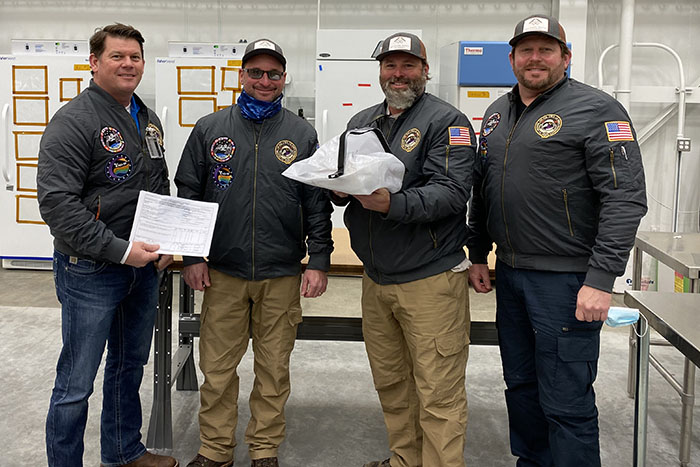
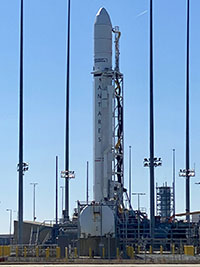
(March 21, 2021) -- Three Fresno State enology alumni had a special front row seat at an international space station rocket launch in mid-February, albeit two miles away from the actual liftoff tarmac with the rest of the Wallops Space Station personnel.
For the Michael David Winery (MDW) employees, it was a magical moment as their research project left Earth to study how Cabernet Sauvignon wine grape juice would ferment over the course of 15 days in space.
Jeff Farthing, a 2004 master’s degree graduate, has overseen the project’s conception after winery co-owner, Michael Phillips, had met another businessman on a flight who mentioned the variety of public sector projects that were being hosted in space.
 That happenstance conversation led Farthing and fellow Bulldog alumni Adam Mettler and Derek DeVries to create an initial proposal in late 2019. Before the proposal was officially accepted,
the trio hosted a team of space station scientists that flew to California to get
more information.
“They had a lot of questions, and grilled us for three hours,” Farthing said. “Luckily, a lot of the questions, and the situation itself, related to my master’s defense, so I was prepared, and could speak their language.”
The fermentation project puts a new spin on his master’s project that he completed in 2004 that compared five, commercial yeast strains in high density formations. The future application of this research goes beyond the grape fermentation process and into the larger realm of food microbiology.
“Until now they’ve looked at growing food in space, but not so much at a subsequent step,” Farthing said. “Studying how microbes react in anti-gravity can hopefully help us better understand what happens to perishable foods in that environment. Right now, they’re mostly eating food that’s dried and vacuum-sealed in space, but for people to eventually live in space, this is a whole new area to consider in the food production cycle.”
The MDW team worked remotely with another company, Common Sense Solutions, last fall and winter that built part of the research project that would be loaded into the Northrop Grumman rocket.
The bicoastal planning process required planning calls and emails at all hours so the project could stay on track. Both teams tried to predict unknown responses in microgravity conditions that would be managed by astronauts with no formal training in fermentation management.
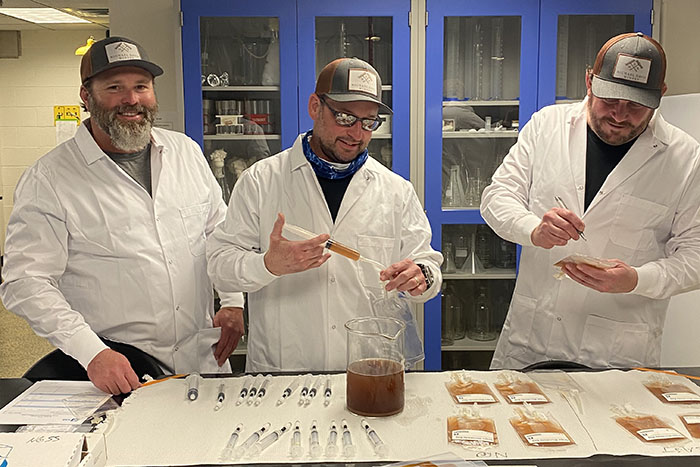
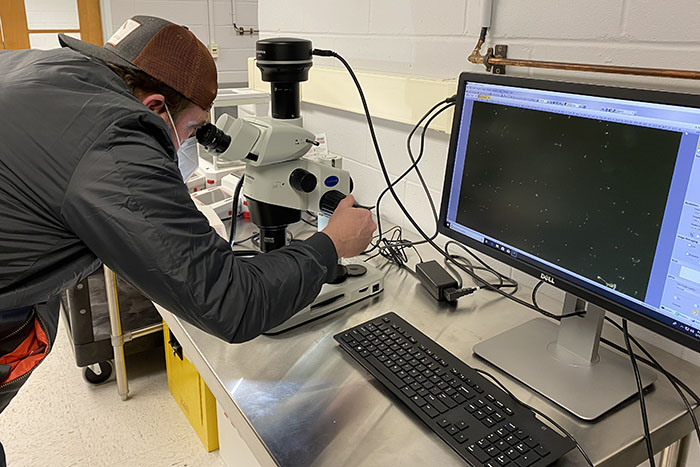
The week before the project blasted off in the CRS15 space mission, the trio traveled to the NASA Wallops Flight Facility on the Virginia coast to perform final project checks in scientific labs at the launch facility. They unfroze their test grapes, put them 70 milliliters in 350-milliliter IV bags, then refroze them at -34 degrees Fahrenheit.
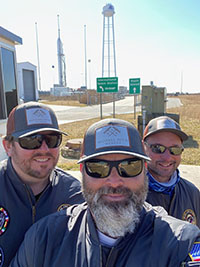 “That was an amazing week,” Farthing said. “It was a huge facility on miles and miles
of land that was extremely controlled. The professionalism and care was very impressive.”
In space, astronauts will thaw the bags and hope to draw five-milliliter samples out of the bags each day for the 15-day experiment so the daily microbial levels can later be compared.
When the final experiment returns to Earth this summer, final results will be studied in conjunction with ETS Laboratories, an independent wine analysis lab in Saint Helena, to analyze the fermented juice.
“I have no expectations of what will happen in microgravity, because nothing happens the same way as it does here,” Farthing said. “The space station circles the globe 17 times each day and travels 17,000 miles per hour, so it’s a little mind-blowing when you start to consider that environment.”
After that data is collected, the MDW teams hope to isolate the space-developed yeasts to compare it with what they see commercially. Farthing, who oversees MDW’s Cabernet Sauvignon wines among 15 MDW wine brands, hopes it may offer new characteristics, and even potentially be used in a special line of wines.
“The wine industry has spent enormous amounts of time testing and mapping different micro-Saccharomyces cerevisiae yeasts," Farthing said. "This project could create something new that we could recover and pure culture and propagate it into our winemaking methods."
Regardless of the results, the year-long lead-up was well-justified.
“Obviously this won’t taste like wine," Farthing said, "but I’m sure we’ll take a sip, just to say we did.”