The Jordan College of Agricultural Sciences and Technology
Wonsun You - Food Science and Nutrition Graduate Student Spotlight
(May 11, 2024) -- Adjusting to a new life in the Central Valley from from South Korea has done little to phase graduate student Wonsun You, who looks forward to becoming a #FresnoStateGrad this week.
Since his arrival in the fall of 2022, he has thrived with the support of our Fresno State Food Science Program faculty, staff and students,. He has been especially active in several research projects, including his graduate project that is developing a red ginseng yogurt.
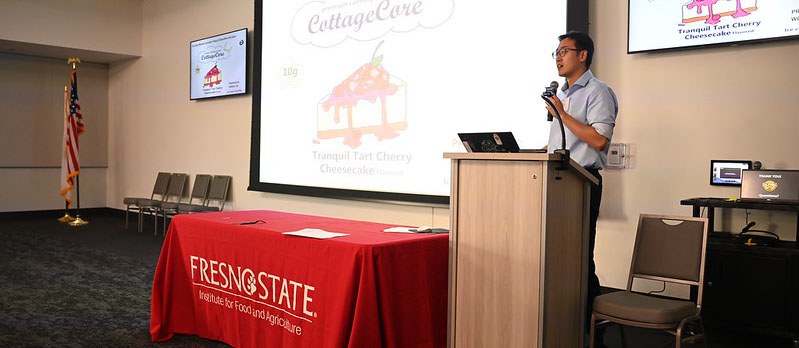
He also helped a team of Fresno State students place second in a national dairy product development contest last year with their high-protein, cottage cheese ice cream (that boasted a cheesecake-like taste and calming properties from its cherry and whey ingredients).
Learn more how he has enjoyed expanding his food science background and his plans to pursue an MBA at Rutgers University in this interview.
Q: Why did you choose to attend Fresno State, and how did you pick your major?
"I'm originally from South Korea, and obtained my bachelor's degree in 2018, and subsequently served as a training officer in the Republic of Korea Army for 2 1/2 years. While in the military, I planned to broaden my perspective by traveling the world after my discharge. I diligently saved money for this purpose. During my military service, I realized that my knowledge in my field of interest had gradually faded, however, I had a keen interest in pursuing a master's degree and re-immersing myself in my chosen field. Consequently, I planned to study for a master's degree and then enter the workforce. To facilitate both travel and study, I chose to study abroad."
"However, upon completing my military service, the global travel plans were disrupted due to the challenges posed by the COVID-19 pandemic. I (eventually) chose California State University, Fresno because California is renowned for its agriculture, and I wanted to experience practical learning by directly engaging with the field, something I had missed out on in theoretical studies back in Korea. The affordability of tuition and other associated costs at Fresno State was also a significant factor in my decision-making process."
"I am majoring in Food Science and Nutrition, which is very similar to my past degree, Food Science and Biotechnology, to continue the previous study I had in Korea."
Q: What do you consider your hometown and /or where are you a native of (& include state/country if applicable)?
"Although I was born in Seoul, South Korea, I moved to Seongnam-Si, a suburb, when I was 7, and my family still resides there. Our city is a meticulously-planned urban area, with all infrastructures accessible within a 30-minute walk or a 20-minute drive. It's quite dense due to the high population density in Korea, so public transportation, such as buses and subways, is highly developed, and I often prefer using it over driving. Sometimes, I even walk to my destination."
"With this background, When I first arrived in Fresno and felt hungry, I opened Google Maps to find a sandwich shop nearby. On that day, with temperatures reaching 110 degrees Fahrenheit, I walked for around two hours under the scorching sun. Since then, I've gained a whole new appreciation for the concept of terrain. Transitioning from living in a city to Fresno, with its vast plains, I find that Fresno has some advantages over Seoul. People here are friendly, and the absence of tall buildings provides a wide and clear view. The air quality is much better than Seoul, and as someone studying food science, the affordability of ingredients here is truly appealing!"
Q: Did you have any other family members graduate or attend Fresno State?
"No it's just me, but my sister just entered the Culinology Institute of America (CIA) in New York!"
Q: Which classes and faculty members have had the biggest influence on you while at Fresno State and why?
"It's really hard to pick the best faculty member or the best class because they all have at least one unique quality, which has influenced my studies and life."
"My advisor is Dr. Sara Griffin, who is a qualified microscopic molecular scientist interested in food product development. In the first semester, I could feel her enthusiasm in guiding me and other students to figure out our true interest with multiple, in-person meetings. While following her guidance, I decided to do a kind of product development, functional yogurt making."
"I want to give a shout out to Drs. Dormedy, Levitt and Pao, too. Some students said Dr. Dormedy is our mother, and Dr. Pao is our father. I think Dr. Levitt’s position is the oldest son. He has a special talent to always make his surroundings bright and happy like a comedian. When he is in statistics class, which is the most powerful field of his, he is an excellent lecturer. I could not make it without their sincere support!"
Q: Have you been involved with research on campus, and how will it benefit your career path?
"Yes, in the first semester, I helped one of my best friends Daniel (Olmos), who is a graduate student in the same major, make wine-soaked cheese. Honestly, I had little knowledge and experience in cheese making but I was there to help. Not only did I get to help him but I personally learned a lot about the creamery, cheese-making process, dairy quality control, and so much more. In my second semester, my teammates and I made a functional ice cream to participate in the 2023 Dairy Management Inc (DMI) New Product Development Contest and got second place overall. The company invited us to one of the biggest food expos in the world, IFT First in Chicago, for the celebration."
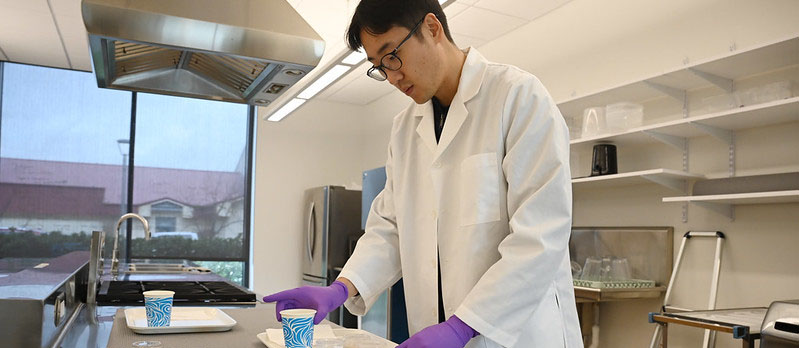
"Afterward, my top priority was my thesis project - ‘Product development: Red ginseng yogurt’. I have tried multiple flavors such as tart cherry, black cherry, chocolate, Earl Grey, matcha, and have standardized the formulation more than 70 times so far. The reason why I tried various flavors is because I wanted to make a new flavor, which can better mask the strong bitterness of red ginseng and meet consumer’s preferences. I decided to make chocolate red ginseng yogurt based on its taste and estimated price and have run a sensory evaluation to better understand Americans' preferences."
"My final goal is being a food factory manager who not only has professional experiences and knowledge but also has management skills, and these experiences will help me achieve my goal."
Q: Describe the research, issues it’s addressing, and anything else that’s important to convey?
"The American population is changing slowly. One demographic report that I referred to addressed that American culture is expanding its diversity and tastes. I connected this information from a report that mentioned we will have more lactose intolerance population in the future. I am making a low-lactose yogurt, reducing around 20-25% of lactose from the original yogurt, and targeting the people who have lactose intolerance."
"Furthermore, when I decided to use red ginseng to input more functionality, I asked my professors, friends, or other employees on campus: “Do you know or have you heard of red ginseng?” and the answers were ‘No’ or ‘Isn’t it a kind of tea?’."
"Koreans have enjoyed ginseng for more than a thousand years, and even now in this more globalized world, people here do not know what ginseng is, even though it is the most popular functional food in Korea. I was shocked and decided to use it after a bunch of paper reviews. However, I needed a fantastic medium to transport the functional benefits of red ginseng to Americans’ taste preferences, and it was yogurt."
"I sought a normal and inexpensive food that can handle the red ginseng taste well and that people have tried already. A hundred years ago, people were seeking safe food, and nowadays, the food industry is quickly developing new, innovative and functional products. I think my project is following this stream and has a nice target consumer audience as well. So far, I have gotten a lot of positive feedback on my yogurt."
Q: What was your background in agriculture before you started at Fresno State?
"My father runs a frozen dough factory in Korea and has a master’s degree in Food Science in Korea, so growing up, I naturally learned what food is and how we make it. Even though I entered my previous university as a food science student, I was more interested in biotechnology and the military. I was a member of ROTC as well as a president of an English reading club."
"I did not put my effort into learning food science there and focused more on building leadership skills and learned about society. I can say I was an earnest student but did not study often. In addition, I think it is unusual, but in Korea, we separate agriculture and dairy farming. Agriculture there is mostly based on plant farming, and dairy farming is more tied to the meat industry. My school in Korea had no meat science professor, so I studied only plant science, biotechnology and microscopic molecules and topics like grain characteristics or manipulating DNA. I feel so grateful that I am able to learn more about dairy science now."
Q: Have you received any scholarships related to campus, the Jordan College or Ag One?
"The biggest one I have gotten so far is a scholarship from ARI (Agricultural Research Institute) that is run by the CSU system. I also got the Ag One Jess & Joan Hansen Award and Dean’s Scholarship Tuition Fee Waiver (DSTW) twice. That financial support was very generous and helpful to me as well as the grant from the DMI competition I mentioned above."
Q: What’s your potential next career step?
"I have applied to competitive MBA programs in America to learn about efficiency and business management, and have decided to go to Rutgers University (in New Jersey). My background has relied on scientific fields so far, but to achieve my final goal, being a food factory manager, I think learning business management could definitely help."
Q: Have you overcome any challenges to get where you are today that have shaped who you are?
"Every time I have encountered challenges, I have gotten sincere counseling or support from my friends, family, and professors while learning English, working on projects, adjusting to America, standardizing the yogurt formulation, writing my thesis, and so on."
"Studying English everyday at the library, including weekends, was a core part of my work. I had to repeat reading three times to barely understand what other students understood the first time. I lived every day as if the library was my home (my friends will agree), but I had a lot of fun during these moments. Those experiences were highly constructive and productive."
"All my supporters and friends told me I am weird whenever I say I do not miss my family, but I do miss my dog. Maybe I am way too concentrated on my work. Sometimes when you have a lot of work to do, you do not have time for your family, and this is my case. In this sense, I have no problem during the semesters, but the breaks were really hard to make it through. Whenever they came, I balanced my life, not only studying and working on my projects, but also watched movies or jogged to refresh my brain."
Q: Are there any other interesting notes about yourself that you would like to include?
"I have more people to be grateful for. Jasmine Cao at the international office on campus is an amazing person who always kindly answers my silly questions. Thanks to her, I've never experienced stress due to visas or taxes during my time in the United States. Dr. Carmen Licon, who is now at Cal Poly San Luis Obispo, has been one of the professors who has wholeheartedly supported me. I also want to express my gratitude to Dr. Susan Pheasant (campus Institute for Food and Agriculture Director), who provided me with opportunities for external presentations. I'd like to take this moment to thank the College for the interview and everyone who took the time to read it. I wish you all a bright future."