The Jordan College of Agricultural Sciences and Technology
 |
 |
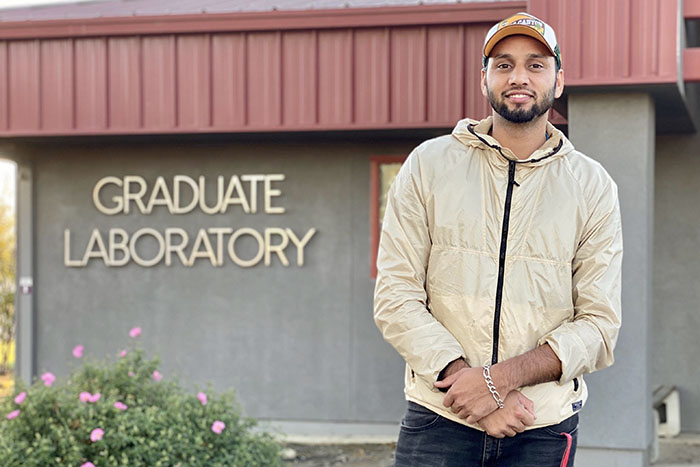
Student Research Spotlight: Simarjeet Singh Maan
Fresno State plant science graduate student Simarjeet Singh Maan is one of the Jordan College's most active student researchers, and is working with faculty and area growers to study one of the area's key agricultural issues, soil salinity, for his master's degree thesis.
It's also an issue that affects growers in Punjab, India where he grew up, and helped inspire him to receive his bachelor's degree from Punjab Agricultural University, Ludhiana - the same university that signed an academic and research collaborative agreement with Fresno State in November 2019.
Read more about the plant science club member and his interesting background and future in this recent interview.
Q: Why did you choose to attend Fresno State?
S. Maan: "I am originally from a small Punjab village named Fatta Maluka in the district of Mansa. Our state is located in North India and to the southwest of great Himalayas. The Central Valley has similar agricultural and climatic characteristics to my home state of Punjab, and both are some of the most fertile lands for ag production. Learning about the agricultural practice systems of each region can help boost the production and sustainability in both areas. I also love the range of trees and crops here in the Valley."
S. Maan: "I'm fortunate to have this opportunity to study here, and I am also grateful for all the scholarships that I've received that include the Graduate Research and Creative Support Activities Award, Verne T. Unger Memorial Grant, Narinder Randhawa Memorial Scholarship, Ag One Dick Markarian Grant, and Ag One 25th Anniversary Ed Rose Scholarship."
Q: Describe your graduate program research project?
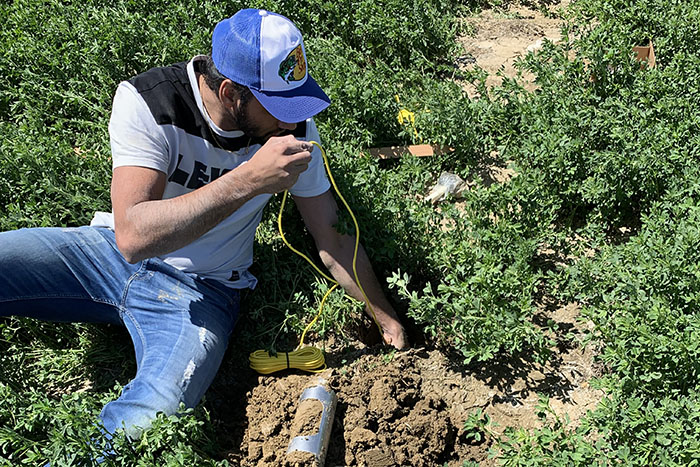
S. Maan: "We are evaluating new salt-bred alfalfa cultivars in saline conditions under a subsurface drip irrigation system. It mainly involves the assessment of spatial and temporal variability of soil salts within the soil profile root zone with electromagnetic soil sensors."
S. Maan: "Soil salinity is the major abiotic stress all around the globe that is a threat to global food security in the near future. Setting accurate salinity threshold levels for crops and adjusting ag practices to sustain ag ecosystems in saline conditions is critical. This research would help the forage industry potentially utilize secondary water resources such as saline and sodic irrigation waters, leaving freshwater for other more economic crops."
Q: Were there any other reasons why you were drawn to that topic?
S. Maan: "Soil salinity problem is increasing day by day in central San Joaquin Valley due to various factors such as continuous drought events, drainage problems, coastal range alluvium parental material, and urban water demands that require the use of alternate water sources such as saline water, treated municipal effluents and desalinated water. All such practices need careful examination of such water resources and their long-term effect on tree physiology and most importantly on soil health."
Q: Which Fresno State faculty member are you working with?
S. Maan: "Dr Sharon E. Benes is a professor specializing in soil science and crop nutrition. She is supervising me in every aspect of my research projects, involving field surveys to the lab analysis along with data analysis. I also help in the soils lab, and that involves setting up various soil experiments such as C:N experiment, soil respiration, Nitrate testing, textural analysis, and many more."
Q: What are some of the most important things you have learned from this research?
S. Maan: "I have learned a lot in these last two years. Research work is very interesting and challenging, and depends on interpreting data and concluding important insights. It is very important to plan ahead before data collection days. Being prepared for all the steps helps you capture the most data possible and will benefit your analysis in the end."
Q: Have you had any internships or part-time jobs, and what did you gain from that experience?
S. Maan: "I am about doing an internship with a local UC cooperative extension advisors, and working on berry chill requirement throughout the winter."
Q: What is your background in agriculture before you started at Fresno State?
S. Maan: "I had an agricultural background as a child, and I used to help manage our fields with my uncles, where we grew wheat and rice mainly. I have always wanted to have my own farm where I would do everything myself, starting from plowing, all the way through harvesting the crop. I got to do this while I was an undergraduate senior. We were given one acre for the whole year, where we had to do everything by ourselves and the profit out of that field was also credited to us. I did the rotation of corn and wheat and earned above-average profit compared to rest of the class of 4000 INR out of the field."
Q: Have you had to overcome any challenges or obstacles to get to where you are today that have shaped you are?
S. Maan: "A small challenge is the language barrier because English is not my mother tongue, but I have loved the process of learning the new language, and I’m getting better."
Q: After graduation, what is your potential next step, and and how will this research help you on your career path?
S. Maan: "I want to work in applied research after I am done with my master's degree. I would love to work as a UC cooperative extension advisor, which helps conduct research on major problems farmers face and providing them with scientific solutions and encouraging efficient and effective farming practices."