The Jordan College of Agricultural Sciences and Technology
| Picture |
|---|
 |
 |
 |
 |
Plant Science Senior Spotlight: Gabrielle Celaya
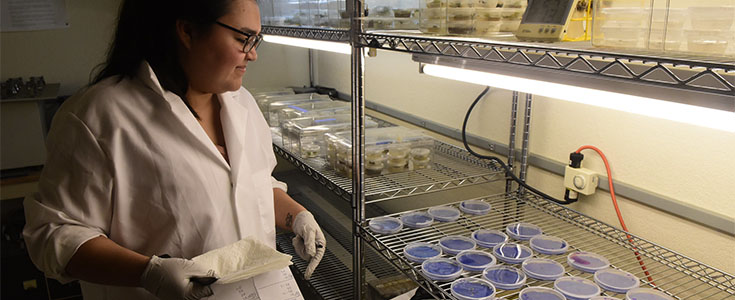
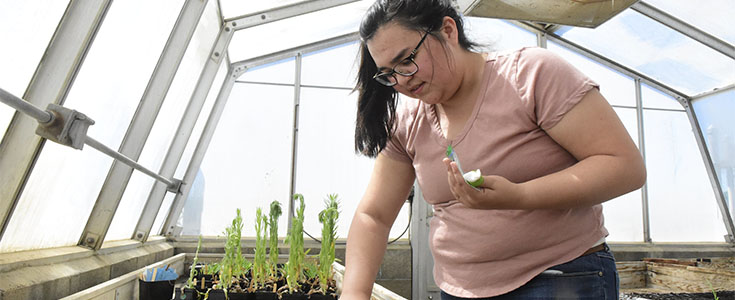
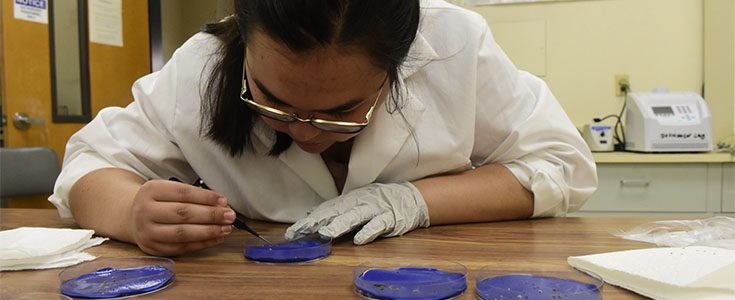
In her two years as a plant science student, graduating senior Gabrielle Celaya has quickly amassed an impressive array of research, so much that she was one of
nine students recently selected nationally for the John Jachetta Undergraduate Research Award.
The Weed Science Society of America (WSSA) honor also includes a $2,000 grant that she can apply to her study of seed germination biology of common waterhemp. The weed is already a major concern in the Midwest and ranked among the top 10 worst weeds in the nation by the WSSA. It is starting to be found in Central California corn fields, so she is studying how it responds to drought and saline soil conditions to help determine its future potential to cause crop damage.
The #FresnoStateGrad from Imperial, California is also a Reedley College transfer, and has benefited from internships with Sun-Maid Growers and the UC Kearney Agricultural Research and Extension Center.
Learn how her international work experience may shape her future career plans in this recent interview.
Why were you drawn to your department/degree field initially?
Celaya: “I grew up in a very agriculturally productive region but my family wasn’t directly involved in agriculture. When I was in high school, I got involved in FFA and was exposed to all the different sectors of agriculture and how much science actually goes into producing food at the level that we do. In my first semester at Reedley College, I was pretty surprised by the permanent crop systems in the Central Valley because almost everything in the Imperial Valley is field crops (like melon, broccoli, spinach, lettuce, onions, hay, etc. ). The more I learn, the more interested in this field I become.”
What was your most memorable / rewarding experience at Fresno State?
Celaya: “This spring, Dr. (Benes) assigned the crop nutrition course to go to the California Soils Conference in Fresno. We had to listen to speakers and write a summary and commentary about the topic. The speaker I wrote about was whole orchard recycling, and I got very interested in that topic. I probably read every paper that speaker wrote about the topic. When I turned in the assignment, I got an A. It wasn’t a huge milestone by any means, but I remember coming to campus for Dog Days and feeling "this was big". Not just the campus, but the idea. I was making a big commitment to perform at a high level for two more years, and it was a little overwhelming. When I got that paper back at the beginning of my last semester here, I kind of felt like "This is big, but I'm doing it well."
What were some of your favorite Fresno State classes?
Celaya: “I really enjoyed integrated pest management with Dr. (Jacob) Wenger. His classes are just usually great in general and in this class, he made sure to expose us to terminology and programs that we're going to need to know about heading into our careers. It was practical and realistic, and I think everyone enjoys reading and learning about things that are useful on a day to day time frame. I also really enjoyed pathology with Dr. (Margaret) Ellis. I had zero experience with fungal or bacterial pathogens, and she did a great job of presenting all the information so that it wasn't too overwhelming. The labs in that class seemed to go by so fast because the material was interesting and the activities were always all hands-on."
Did any other department faculty and staff members have a big influence?
Celaya: “Marlene Miyasaki (department assistant) is an amazing person. She genuinely cares about the students at Fresno State, and she actively works to connect them to the resources they didn't know about. Marlene got me involved with California Women for Agriculture, and she also got me in contact with Dr. Shrestha about his project. Sometimes it’s hard to network or get involved, especially if you don't have roots in the area. She was just incredibly kind to me and encouraged me to get connected. Lilia De La Cerda from Louis Stokes Alliance for Minority Participation (LSAMP) was also very kind. She sat down with me several times and helped me talk through my progress and what I might want for my future. Those conversations coming from another Hispanic woman with a degree in a STEM field were powerful for me.”
What are the next steps in your career path?
Celaya: “I plan to spend a year or two working before I go back for graduate studies. I've been looking for opportunities in research labs and with the farm service. My goal for the next phase is to relax and enjoy putting my education to work. Relaxing and downtime have never been my strong suits. Graduating college was a huge endeavor for me, and I worked really hard for it. I want to take some time to find a field or a practice that I'm very passionate about and then use my master’s program to study that in-depth. For the time being, I work part-time for a local PCA firm, Tim Smith & Company. Tim Smith is also the plant science instructor at Reedley College, and he's been a great mentor to me.”
What was your background in agriculture before you started at Fresno State?
Celaya: “My mom's mom was a harvest supervisor for a while, and she also worked in packing sheds. My mom has worked as an accountant for growers since I was in 8th grade. The Bornt family, her previous employer, was always really supportive of all of my activities in FFA, and without them I probably would've never excelled in that program.”
Have you had any other internships and how did that they help you professionally?
Celaya: “At Reedley College, I found an internship opportunity at Sun-Maid Growers of California. I was there for 18 months, including my first semester at Fresno State, as a food safety intern. That experience introduced me to the processing side of agriculture, and there was so much I didn't know. My job was primarily to assist one of the food safety officers, and seasonally I would input data about growers' pesticide usage. Fernando and Vaughn took time to mentor me and teach me how to be the kind of employee an employer doesn't want to lose. I learned a lot about taking initiative, effective corporate collaboration and how to conduct myself as a professional. I left Sun-Maid because I wanted to get more experience in production monitoring. I also worked under Dr. Houston Wilson at the Kearney Agricultural Research Center. His lab is focused on mating disruption and monitoring of navel orangeworm and leaf-footed plant bug. Working for Dr. Wilson was awesome. He took time to talk with all of us regularly so that everyone felt informed about the research and more confident about their roles. He was a great leader and facilitated great teamwork. I also got to learn about research experiment design and execution. I was enrolled in economic entomology during that semester and so I was able to apply what I was learning in school almost everyday.”
Did you participate in any other outreach events?
Celaya: “I participated in Fresno State Preview Day last year. That was so much fun. I worked at the plant science club booth and spent a whole day talking about how great the faculty are. I also kind of have a "parent face". Parents see me, and they just like me, so I spent a good part of the day talking to moms and assuring them that Fresno State has a great agriculture program. I didn't actually have anything prepared, but it's easy to talk about the amount of pride the community has for Fresno State, and how incredibly supportive they are of the students.”
Explain any other research-related opportunities at Fresno State you helped with?
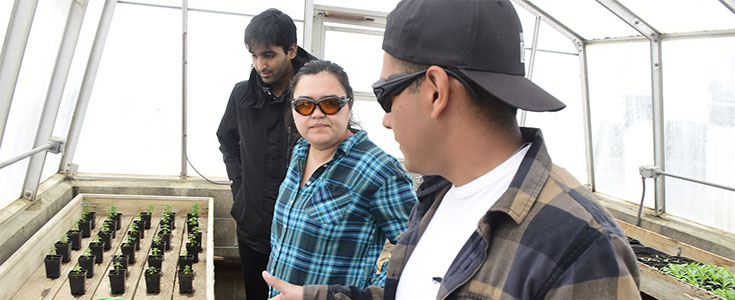
Celaya: “I've only worked on the laser project and a germination study. I had never taken a course with Dr. (Anil) Shrestha when he took me on for this weed germination project. I had heard only great things about him and the students he's mentored in the past, so I was really excited when this opportunity came about. The world is changing its perspective towards food production, so research is going to have to study different methods of monitoring and control in various production systems. Research is what drives innovation and in order for production and distribution to keep up with population increase, agriculture and allied industries are going to have to be more innovative than ever. I like being involved in agricultural research projects because I genuinely feel like I am doing something that adds to the collective knowledge responsible for feeding the world.”
Did you travel to any conferences and make any presentations?
Celaya: “I haven't traveled to any conferences yet, but I will present my germination study at the Weed Science Society of America (WSSA) conference next year.”
Are there any other interesting notes about yourself?
Celaya; “I went to Reedley College for 1 year and then I took 2 years off from college. In that time, I lived in Costa Rica for 15 months before returning to Reedley College. I went to Costa Rica to intern at a Christian summer camp called La Montana (similar to Hume Lake) then found an awesome opportunity at a private school teaching English. Costa Rica is not a third-world country, but parts of the country are still extremely impoverished. The climate is also pretty harsh in some regions and that makes it hard to industrialize or produce on a large scale. While spending time there, I became really passionate about using my skills to help in areas where it's hard to help. I'd eventually like to use the knowledge from my degrees to work for an organization like USAID or a private organization to develop agricultural systems in areas that lack adequate resources.”
Are there people you would like to thank in your family that have been key influences for you receiving your diploma?
Celaya: “I got married just before the start of this school year and my husband, Joshua, has been so supportive and encouraging. I also come from a blended family. My parents and siblings are my primary motivators. I've always wanted to be able to show them my diploma and say, ‘I got to do this because of you.’ I also need to stress that my family handles child raising like a team sport. My parents have been consistently involved in the lives of my cousins, just like my aunts and uncles have been consistently involved in mine. In every adventure I've started, my aunts and uncles (and some of their friends) were there with support and love and I'm very grateful for that. I didn't realize, until I moved away to college, how special my family was. There's no chance I would have made it without them.”