The Jordan College of Agricultural Sciences and Technology
Industrial Technology Department shines in certification report
The Industrial Technology Department received exciting news that it was given the highest possible re-accreditation rating by the Association of Technology Management and Applied Engineering (ATMAE).
The profession’s leading academic certification process was completed in the spring of 2019 and is valid through 2024.
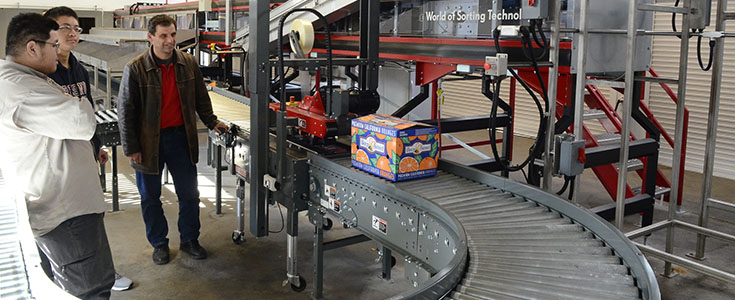
With the addition of equipment like the Bee Sweet Citrus Processing Line and other laboratory renovations, the department received the longest accreditation period possible after receiving a provisional certification in the spring of 2016.
The department rating verifies to employers that students receiving degrees have specific knowledge, skills and experience that will prepare them for professional fields.
The certification was conducted by a three-member accreditation team composed of faculty from similar university programs. The review team gathered information in their report that assessed:
- bachelor’s degree academic hour standards for general education, communications, mathematics, physical sciences, management, and technical courses.
- department’s student enrollment, admission and retention standards, and faculty, administrative, and advising qualifications.
- survey data relating to graduate employment, student and employer satisfaction, career advancement, and certification exam success rates.
In the certification committee’s two-day, on-site review, evaluators toured department laboratories, classrooms, offices, related physical plant areas, observed classes, and interviewed industry contacts and faculty, staff, and administration from the College and President’s office.
Don Austin, a full-time faculty member since 2002, chaired the department’s presentation to the review committee. Austin was well familiar with the review process and now swerves on certification review teams for other university programs.
“I was honored to help spearhead the department's effort to to get accredited again and make any necessary updates,” Austin said. “When I started teaching at Fresno State, our program was accredited by the forerunner of ATMAE, but we were unable to maintain it due to faculty retirements and other issues. The current process is similar to an industry quality assurance audit and knowing that we are providing a quality product in our graduates is extra rewarding. Right now, our department is the strongest it has been since I have been here.”
Austin is one of six full-time faculty members, and additional lecturers that teach 64 different undergraduate classes in the department.
Faculty also work regularly with an industry advisory board that has played a key role in the department for over 50 years. Meeting quarterly, the seven-person committee includes community leaders and corporate executives that help keep the department's curriculum and professional training up to date.
The industrial degree at Fresno State was added more than 60 years ago, and the department was created in 1978 – the first in the CSU system. Today’s degree often focus on management- and technology- related classes that tie in with business, industry, education, and government.
The industrial technology department has its roots in the industrial arts, which were a required part of the university curriculum when it was established in 1911. One of the university’s initial core missions was to provide industrial arts teachers in public schools through the area and state.
The future of the program appears even brighter with the addition of new minors and a concentration related to smart farm technology. Students also get great heads-on experience working with faculty and researchers through campus research partners like the Center for Irrigation Technology.
Student interest in the department has surged in recent years as the 2018 fall enrollment stood at 260 undergraduate and graduate students – more than twice what it was five years earlier in 2013 (111) and almost triple what it was two years earlier before that (93, 2001).
New classes featuring operations management for the citrus processing line and a new nut processing line (that will be operational in the fall) are creating even more interest and opportunities for students from the department and other related agricultural degrees.