The Jordan College of Agricultural Sciences and Technology
Fresno State strengthens ties with area community college ag programs
Through the new “Building Pathways for Student Success” partnership, Jordan College of Agricultural Sciences and Technology faculty and staff are working closely with area agricultural community colleges to improve the transition of agricultural students from community colleges to four-year universities.
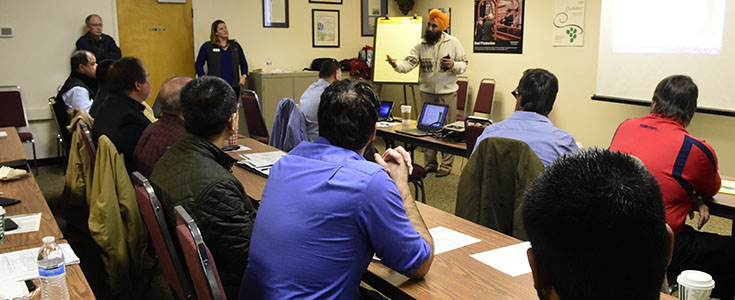
The group’s first forum met in December. The group consisted of administrators and faculty from Fresno State and seven Central Valley Community Colleges who openly discussed ways to collaborate and address the most pressing needs that hinder success for transfer students.
“This new partnership is integral because it creates stronger ties and more opportunities to come together to improve student learning and close achievement gaps,” said. Dr. Athanasios Alexandrou, Jordan College industrial technology department chairperson and the Fresno State coordinator for the event. “We had a great turnout, which helped us get a great start in identifying and addressing several key issues immediately.”
Each fall semester nearly 40 percent of Jordan College’s 500 to 600 new students transfer from local community colleges. Many of the new transfer students have already taken most of their general education courses, but sometimes many of these classes do not count towards their academic major, or they fail to take all of their prerequisites at a community colleges, which would help them graduate more easily in four years.
This is becoming even more important in recent years since Fresno State has reached a maximum student enrollment size, known as impaction. Many popular courses like biology, chemistry, physics and microbiology now have limited space or even waiting lists since they are prerequisites for multiple Fresno State colleges and degrees.
Another key focus area for the meeting was for faculty to discuss syllabi and articulation for similar courses offered at different institutions. Many faculty quickly realized that only slight adjustments to the curriculum could significantly improve the alignment to maximize full credit transfer.
Faculty from the different industrial technology departments also suggested that improved course articulation could aid in more efficient use of the classroom space and specialized resources. Since modern technology and equipment is expensive and requires specially-trained faculty, fully articulated classes could mean that students could take classes or labs at nearby institutions that better fit their schedule.
Another common issue that Fresno State faculty addressed was trying to better educate the transfer students about related degree options for popular but rigorous majors like pre-veterinary science. Reaching these students earlier in the advising process before they take classes for multiple semesters and later change their degree paths would keep them on better track for graduation. This guidance would also waste less faculty resources and student tuition while still pointing students toward meaningful career paths and degrees with better job prospects.
After the larger initial meeting, attendees met in smaller groups for specialties ranging from industrial technology, agricultural business, animal, food and plant science and viticulture and enology. Many of the Jordan College faculty strengthened existing relationships with their community college counterparts as they shared required and elective course roadmaps for graduation. This knowledge could help community colleges adjust or create new courses to better match the curriculum of four-year institutions.
Another representative from Bakersfield College gained vital direction from Fresno State’s nationally-renown viticulture and enology department about incorporating a grape and winemaking academic minor into its new food science and technology program.
“We have been talking about creating a platform like this for over a year, and it’s great to see it come to fruition,” said Gurminder Sangha, a state community college director for advanced manufacturing programs.
“There are many barriers we are immediately addressing that are keeping students from graduating in four years. The platform we created is absolutely essential because it is a systematic method for the Jordan College as a whole to engage with community colleges to ensure the engagements are deliberate and decisions are informed by good data to achieve a common goal of improving student success. We need to continue to work together to create pathways that make sense, that are efficient, and lead to meaningful careers upon graduation in the shortest period of time for our students.”