Dietetic Internship Program Manual
Combined Masters/Dietetic Internship (MS/DI)Program
Food Science & Nutrition Department
Table of Contents
- Introduction and Overview — Section 1
- About the Program Manual / Handbook
- Contact Information
- The California State University, Fresno – Mission Statement
- Jordan College of Agricultural Sciences and Technology – Mission Statement
- Food Science and Nutrition – Department Mission Statement
- Dietetic Internship – Program Mission Statement & Program Overview
- Dietetic Internship – Program Goals and Objectives
- Program Outcomes Data
- Program Policies & Procedures — Section 2
- Admissions Requirements
- Requirements for Program Completion
- Criteria for Issuance of Verification Statement
- Program Retention and Remediation
- Disciplinary/Termination Procedures
- Supervised Practice Documentation
- Medical/Maternity Leave Policy
- Refund Policy & Tuition Fees
- Formal Assessment & Student Learning Procedures
- Grading Policy
- Drug Testing and Criminal Background Check(s)
- Use of Interns to Replace Employees
- Vacations, Holidays, Sick Leave
- Program Calendar & Scheduling Procedures
- Insurance Requirements
- Travel Liability of Dietetic Interns
- Illness or Injury in Practice Facilities
- Professional Liability
- Access to Personal Files
- Assessment of Prior Learning
- Program Expenses
- Grievance/Disciplinary/Termination Policy
- Expectations for Dietetic Acknowledgment Forms
- General Dress Code Standards
- Intern Record of Professional Development
- Professional Portfolio Guidelines & Scoring Rubric
- Interns University Policy & Procedures
- Honor Code / Academic Integrity
- Adding/Dropping Classes
- Cheating & Plagiarism
- Computers
- Copyright Policy
- Disruptive Class Room Behavior
- Students with Disabilities
- Title IV
- Leave of Absence Request Form
- Privacy Rights of Students
- University Services for Students: Associated Students Inc.(ASI), Dream Success Center, Learning Center Information, Student Health & Counseling Center, Graduate Writing Center
- Internship Calendar
- Rotation Evaluation
- DI Curriculum Matrix and Core Competencies
- ACEND Procedure for Filing a Complaint against Accredited Programs
- Appendix - Masters Project: Capstone Handbook
SECTION 1: Introduction and Overview
Introduction
Overview
The demand for Registered Dietitian (RD) or Registered Dietitian Nutritionist (RDN) is expected to grow by 7% between 2021 and 2031, as fast as the average for all occupations according to the Bureau of Labor Statistics. Students who are interested in food, nutrition, and management and have a strong desire to work with the public to promote good health or assist them with disease management are great candidates for the area of study. The RD/RDN professional designation qualifies an individual as the food and nutrition expert to address today’s complex issues surrounding foods and nutrition.
To complete this credential, one must:
- Earn a minimum of a graduate degree from an accredited dietetics program. Classes vary according to program, but in general, coursework covers subjects that may range from food and nutrition sciences, foodservice systems management, business, economics, computer science, culinary arts, sociology and communication to science courses such as biochemistry, physiology, microbiology, anatomy and chemistry. A master's degree is required to be eligible for the RDN exam. Some accredited programs include a master's degree, while other students complete their undergraduate in dietetics and earn a master's degree in another field (e.g. public health, communications, etc.).
- Complete a supervised practice requirement. In addition, individuals must complete at least 1,000 hours of supervised practice to gain real-world experience and apply knowledge learned in the classroom to the context of a variety of work settings.
- Pass a national exam for RDNs. Once you complete your degrees and supervised practice, you may schedule to take CDR's Registration Examination for Registered Dietitians to become a credentialed as registered dietetics nutritionist. This is called "RDN eligibility," meaning you have completed the requirements to become eligible to take the national exam.
- Meet requirements to practice in your state. Many states have regulatory laws (i.e. licensure) for food and nutrition practitioners. All states accept the RDN credential for state licensure purposes.
- Stay up-to-date in dietetics through continuing education. After successfully passing the national exam and earning the credential, RDNs maintain ongoing professional development in order to stay up to date on the latest research, recommendations and best practices.
About the Program Manual / Handbook
The Dietetic Intern program manual/handbook provides important information to help prospective and current students enrolled in the Fresno State DI, understand the requirements for completion as well as the expectations of student conduct while at Fresno State.
This handbook is subject to revision and interns will be notified of any changes through electronic communications (email and posted on the Fresno State Food Science and Nutrition website). An electronic version of this document is available on the Food Science and Nutrition department website under the Post Graduate section: http://www.fresnostate.edu/jcast/fsn/index.html.
Please use this handbook as your first step to answering any questions about the DI program.
The DPD student handbook is supplemental to the current edition of Fresno State’s undergraduate program handbook and the Student Code of Conduct document. Students can access the University undergraduate catalog on the Division of Undergraduate Studies website at http://www.fresnostate.edu/catalog/ and the Student Code of Conduct document on the Office of Student Conduct website http://www.fresnostate.edu/studentaffairs/division/general/studenthandbook/discipline.html. Students should read the contents of these documents and policies in all the above documents.
Contact Information
The Dietetic Internship (DI Program in Dietetics is administered by the Food Science and Nutrition Department within the Jordan College of Agricultural Sciences and Technology.
Food Science and Nutrition Department
5300 N. Campus Drive M/S FF17
Fresno, CA
Office phone: 559-278-2164
Fax: 559-278-8424
Dietetic Internship Director (DI)
Erika Ireland, EdD, MPH, RDN, CDCES
Faculty and DI Director
5300 N. Campus Drive M/S FF17
Fresno, CA 93740
Office phone: 559-278-8005
Fax: 559-278-8424
E-mail: eireland@csufresno.edu
Food Science and Nutrition Administrators and Faculty
| Name | Title | Office | Phone | |
|---|---|---|---|---|
| Dormedy, Erin | Department Chair | FFS 111 | 559-278-8321 | edormedy@csufresno.edu |
| Herzig, Lisa | Full Professor | FFS 103 | 559-278-2043 | lherzig@csufresno.edu |
| Levitt, Jamie | Associate Professor | FFS 111 | 559-278-4692 | jlevitt@csufresno.edu |
| Steven Pao | Full Professor | FFS 303 | 559-278-1624 | spao@csufresno.edu |
| Shabnam Pooya | Associate Professor | FFS 310 | 559-278-5086 | shabnampooya@csufresno.edu |
| Sara Griffin | Assistant Professor | FFS 204 | 559-278-5068 | sshinn@csufresno.edu |
Food Science and Nutrition Staff Assistants
| Name | Title | Office | Phone | |
|---|---|---|---|---|
| Jennifer Trauner | Administrative Assistant | FFS 111 | 559-278-2164 | jtrauner@csufresno.edu |
Jordan College of Agricultural Sciences and Technology Administration
| Name | Title |
|---|---|
| Rolston St.Hilaire | Dean |
| Steven Rocha | Associate Dean |
California State University, Fresno Mission
The university offers a high-quality educational opportunity to qualified students at the bachelor's and master's levels, as well as in joint doctoral programs in selected professional areas. To carry out this mission, the university provides a General Education program and other opportunities, to expand students' intellectual horizons, foster lifelong learning, prepare them for further professional study and instill within them an appreciation of cultures other than their own. The university offers undergraduate degrees and programs in the liberal arts and sciences as well as in a variety of professional disciplines emphasizing agriculture, business, engineering and technology, health and human services, and education, preparing students for productive careers and responsible world citizenship. Building upon the strength of these under-graduate programs, graduate programs provide opportunities for personal and career enhancement through advanced study, preparing students for positions of leadership in the arts, sciences and professions.
The university encourages and protects free inquiry and expression, ensuring a forum for the generation, discussion and critical examination of ideas. By emphasizing the primacy of quality teaching and the close interaction between faculty and students, the university seeks to stimulate scholarly inquiry and discourse, inspire creative activity, heighten professional and technical competencies, encourage and support research and its dissemination, and recruit and develop outstanding teacher-scholars/artists.
The university fosters an environment in which students learn to live in a culturally diverse and changing society. Within that environment, it strives to develop a community founded upon mutual respect and shared efforts, in which individuals can communicate openly and work together to enrich the lives of all and to further the growth and excellence of the university. The university seeks and encourages historically under-represented students to embark upon and complete a university education.
The university serves the San Joaquin Valley while interacting with the state, nation and world. California State University, Fresno is a center of intellectual, artistic and professional activity. Through applied research, technical assistance, training and other related public service activities, the university anticipates continuing and expanding partnership and linkages with business, education, industry and government.
Jordan College of Agricultural Sciences and Technology
Mission
The Jordan College of Agricultural Sciences and Technology offers high quality undergraduate, graduate and continuing education programs and conducts applied research and public service in selected areas of agriculture, food sciences, industrial technology, and family sciences. Programs combine a science, technology and management focus with experiential learning. The College participates in the general education program of the University and seeks to enhance the ability of students to be successful in their chosen careers and to make positive contributions to the quality of life in their communities.
The Jordan College of Agricultural Sciences and Technology pursues its mission through involvement in: direct instruction and student development; research, scholarly and creative activities; and institutional development.
Direct instruction and student development occurs through on-campus undergraduate and graduate course offerings; continuing education programs to industry; advising of students; and development of student skills outside the classroom through student organizations in the various program areas.
Research, scholarly and creative activities involve faculty, staff and students in projects to improve the educational process, discover new knowledge, find solutions to significant societal and industry problems, communicate findings to industry and society at large, and improve and develop new skills.
Institutional development efforts increase the number of students served; raise funds for scholarship and program support; and enhance alumni relations.
Departments
The Jordan College of Agricultural Sciences and Technology includes seven departments:
- Agricultural Business
- Animal Sciences & Ag Education
- Child, Family & Consumer Sciences
- Food Science & Nutrition
- Industrial Technology
- Plant Science
- Viticulture & Enology
The Food Science and Nutrition Department
Undergraduate Program Vision
The faculty of the Department of Food Science and Nutrition are regionally focused food experts who are committed to student success, scholarly activity, and engagement.
Undergraduate Program Mission
The mission of the faculty of the Department of Food Science and Nutrition is to
- Impart food-related knowledge and skills to our students
- Apply food-related knowledge and skills to research and scholarly activity
- Integrate with industry and students to apply food related knowledge and skills to advance the region.
Dietetic Program Mission Statement
Unlocking the potential of future entry-level registered dietitian nutritionists (RDNs) through innovative and diverse post-graduate practice application with a program concentration on health promotion and disease prevention, while uniquely nourishing cultural competency in a variety of dietetic settings within Fresno County, Fresno Metropolitan and the Central San Joaquin Valley.
FRESNO STATE UNIVERSITY DIETETIC INTERNSHIP DESCRIPTION
Overview
California State University, Fresno (Fresno State) is part of the California State University. California State University, Fresno, first established as a two-year normal school in 1911, is the sixth oldest of the 23 campuses in the California State University. Fresno is located in the San Joaquin Valley of California which stretches from Sacramento in the north to Bakersfield in the south and is bordered by the Sierra Nevada Mountains. The service area for Fresno State is the San Joaquin Valley which is an estimated population of one million people. The ethnic mix of the area consists of Caucasian, Hispanic, Asian Pacific, African American and Native American. It is ideally located for offering dietetics education programs. The unique food and nutritional needs of the San Joaquin Valley are found in the diversity of the population. The incidence of diabetes mellitus is greater in Hispanic individuals than any other ethnic group, making this a major concern for nutrition care providers. The immigration of Southeast Asians from Vietnam, Cambodia, Thailand and Laos, has made this the home of the largest group of Southeast Asians outside of their native countries. These individuals have unique challenges to nutrition care providers.
Fresno State enrolls more than 22,000 students and offers 64 baccalaureate degree programs and 49 graduate degree programs. The Jordan College of Agricultural Sciences and Technology (Jordan College) is one of eight colleges / schools at Fresno State. The Department of Food Science and Nutrition is one of seven departments in the Jordan College. The University has offered a DPD program since 1940, beginning with the undergraduate degree program. The DPD is administered by the Department of Food Science and Nutrition. The Accreditation Council for Education in Nutrition and Dietetics (ACEND - formerly known as The Commission on Accreditation for Dietetics Education - CADE) has recognized the Didactic Program in Dietetics (DPD) since 1973. In 1999, CADE granted developmental accreditation to the program; this site visit is for the re-accreditation of the DPD. The DPD program was granted accreditation status in 2003. The PAR was approved in 2008.
The department offers two undergraduate academic programs under the Dietetics Option:
- Bachelor of Science in Human Nutritional Sciences – Dietetics
- Bachelor of Science in Human Nutritional Sciences – Nutritional Science
The DPD is under the umbrella of the Bachelor of Science in Human Nutritional Sciences – Dietetics. The courses that provide learning experiences for developing the Foundation Knowledge and Skills for the Didactic Component are also the courses necessary to complete the requirements for the Certificate in Dietetics. Most of the students are working towards the Certificate in Dietetics option.
The DPD provides a strong foundation in science, foods, and nutrition with a diverse curriculum to meet the Academy of Nutrition and Dietetics (AND) national accreditation standards set by the ACEND. The course work is includes a science-based curriculum, social science offerings, as well as management courses.
The Bachelor of Science degree in Human Nutritional Sciences – Option in Dietetics requires completion of 69 semester units in the major and 51 semester units of General Education (120 semester units’ total). The DPD requirements are the same 69 units in the major required for the degree. Students that have already completed a bachelor’s degree are required to complete only the 69 semester units in the major to complete the DPD requirements.
In order to obtain the RDN credential, graduates of the DPD must successfully complete an accredited pre-professional program in dietetics, known as a dietetic internship program. Dietetic internship programs include a minimum of 1000 hours of supervised practice experience and can take 10 to 13 months to complete if the student attends full-time. See eatright.org for a full listing of the AND and ACEND accredited internships at Dietetic internship programs charge tuition for the supervised practice experience; tuition costs vary between programs. Additional information on dietetic internship programs can be found on the Food Science and Nutrition Department Dietetic Internship Program at Fresno State http://www.fresnostate.edu/jcast/fsn/degrees-programs/post-baccalaureate/dietetic-internship.html. Graduates of Fresno State University DPD have an acceptance rate into dietetic internship programs that fall within the national average.
In the final step to earn the RD credential, students must successfully meet the requirements of the dietetic internship program and pass the national registration examination. However, Effective January 1, 2024, the Commission on Dietetic Registration (CDR) requires a minimum of a master’s degree to be eligible to take the credentialing exam to become a registered dietitian nutritionist (RDN). For more information about this requirement visit CDR's website: https://www.cdrnet.org/graduatedegree. In addition, CDR requires that individuals complete coursework and supervised practice in program(s) accredited by the Accreditation Council for Education in Nutrition and Dietetics (ACEND). Also effective Fall 2022, the CSUF DI has received approval to proceed by adding a degree requirement to the internship program. Graduates who successfully complete the CENTRE-accredited California State University, Fresno (CSUF) Dietetic Internship program at CSUF are eligible to apply to take the CDR credentialing exam; given a verification statement to become an RDN after completing BOTH the degree requirements and supervised practice experiential learning experiences.
Graduates of the Fresno State DI program have a pass rate at one year on the registration examination of 85%. Students who earn their RDN credential and want to practice as Dietitians may need to apply for licensure, before they are eligible practice dietetics and provide nutrition counseling in states that require licensure. Licensing statutes include an explicitly defined scope of practice, and performance of the profession is illegal without first obtaining a license from the state. A list of the states that require licensure is available on the Commission on Dietetic Registration website at http://www.cdrnet.org/certifications/licensure/index.cfm.
DI Program Goals and Objectives:
| Goal | Data Assessed | Objective/Outcome Measures |
|---|---|---|
| 1. To prepare graduates who will advance their leadership skills and be prepared to provide culturally competent health promotion and disease prevention. | % of enrolled interns completing the program & receiving a verification statement | At least 80% of graduates will complete the program in 36 months (150%) of the time planned for completion. |
| 1. To prepare graduates who will advance their leadership skills and be prepared to provide culturally competent health promotion and disease prevention. | Alumni/Graduate Surveys | When surveyed 2-3 months after graduation, at least 90% of graduates, who respond
to the survey will rate overall satisfaction with their experience as at least 3.0
on a scale of 1-5 (where 5.0 is best and 1.0 is worst). When surveyed 12-18 months after graduation, 25% of graduates who respond to the survey will hold a leadership role within local, state or national affiliation of the Academy of Nutrition & Dietetics (AND). |
| 2. At completion, graduates will be masters prepared and registration eligible to become registered dietitian nutritionists (RDNs) and prepared to actively address the evolving health needs of society and address the unique needs of Fresno County, Fresno metropolitan area and the Central San Joaquin Valley. | 3-year average 1st time pass rate and 1-year pass rate | At least 80 % of program graduates take the CDR credentialing exam for dietitian nutritionist
within 12 months of program completion. The program’s one-year pass rate (graduates who pass the registration examination within one year of first attempt) on the CDR credentialing exam for dietitian nutritionist is at least 80%. |
| 2. At completion, graduates will be masters prepared and registration eligible to become registered dietitian nutritionists (RDNs) and prepared to actively address the evolving health needs of society and address the unique needs of Fresno County, Fresno metropolitan area and the Central San Joaquin Valley. | Employer Surveys | When surveyed, 80% of employers of CSUF DI graduates, who respond to the survey will
indicate that program graduates are prepared for entry-level practice. When surveyed, 80% of employers of CSUF DI graduates, who respond to the survey will indicate that program graduates professional competence as satisfactory (3.0 or better) on a scale of 1-5 (where 5.0 is best and 1.0 is worst). |
| 2. At completion, graduates will be masters prepared and registration eligible to become registered dietitian nutritionists (RDNs) and prepared to actively address the evolving health needs of society and address the unique needs of Fresno County, Fresno metropolitan area and the Central San Joaquin Valley. | Alumni/Graduate Surveys | Of graduates who seek employment, 70% are employed in nutrition and dietetic or related
fields. When surveyed 12-18 months after graduation, at least 10-15% of graduates, who respond to the survey will maintain employment in the Fresno metropolitan area and/or Central San Joaquin Valley. When surveyed 12-18 months after graduation, at least 60% of graduates, who respond to survey have indicated that they have participated in at minimum of least one (1) event sponsored by dietetics related professional organization. |
Program Outcomes Data
The outcomes data that show how well the DI program is meeting the 5-year pass rate criteria for the Registration Examination for Dietitians are available upon request. Individuals may request this information from the DI director, Erika Ireland, MPH, RD, CDCES (eireland@csufresno.edu).
Accreditation Status of the DI at Fresno State University
The dietetic internship program is administered by Department of Food Science and Nutrition. In May, 1998, The Accreditation Council for Education in Nutrition and Dietetics (ACEND - formerly known as CADE) recognized the program for developmental accreditation. The first class of ten students was admitted in August, 1998. The fifth internship class graduated in May, 2003. The internship was simultaneously approved on campus as the Certificate of Advanced Study – Dietetics, a post-baccalaureate, non-degree, certificate program. The Self-Study Application for Initial accreditation was submitted August 2003 and the required PAR 2008 was approved after revisions on October 30, 2009. The university underwent the ACEND Self Study site visit, and continued accreditation application process in Nov 2022. On August 12, 2022, the University received notification that the CSUF Dietetic Internship was granted continued accreditation by the ACEND board through 2029. For more information regarding the site visit or Fresno State University’s DI accreditation, please contact:
ACEND, 120 South Riverside Plaza, Suite 2000, Chicago, Illinois 60606-6995
Phone: 312-899-0040 Ext. 5500.
California State University, Fresno Dietetic Internship Programisaccreditedby the AccreditationCouncil forEducationinNutritionandDietetics of the Academy of Nutrition and Dietetics, 120 South Riverside Plaza, Suite 2190, Chicago, IL 60606-6995, (312) 899-0040 ext 5400. Http://www.eatright.org/ACEND.

Section 2: Program Policy & Procedures
PROSPECTIVE INTERNS
Admission Requirements
Please see the Fresno State University Post Graduate Admissions Office http://www.fresnostate.edu/studentaffairs/are/graduate/index.html for information regarding the admissions requirements and other details.
Application Requirements
- Completed a baccalaureate degree from an accredited institution.
- An approved Didactic Program in Dietetics (DPD) verification statement or declaration of intent within the last five years.
- A minimum cumulative and DPD GPA of 3.0. Applicants with lower GPAs are encouraged to contact the DI program director for possible exceptions.
- Submission of three letters of recommendation, a personal statement, and a scholarly writing sample focused on nutrition and dietetics.
- A minimum TOEFL score of 560 (paper-based) or 241 (computer-based) is required ONLY for students who do not hold/or will have a degree from an English-speaking university before starting the program.
Application Process:
- Apply through DICAS by January 15 at 11:59 p.m. CST.
- Post-appointment after March 15, accepted students must apply to the CSU Cal Apply graduate program, which includes an application fee.
- The Dietetic Internship Program Director will provide more guidance after acceptance.
- Completion of criminal background checks, immunization clearance (including COVID-19 vaccine/booster), a 10-panel drug screen, and fingerprinting after acceptance and before the program starts.
The California State University, Fresno Dietetic Internship is a face to face two (2) year program of study (33 units) that includes 1,088 hours supervised practice / experiential learning.
Upon completion of BOTH the 30-units and the supervised practice, students will receive a verification statement. The course are sequential, as written in a 2 year course schedule along side the supervised practice occurring over 3 semesters.
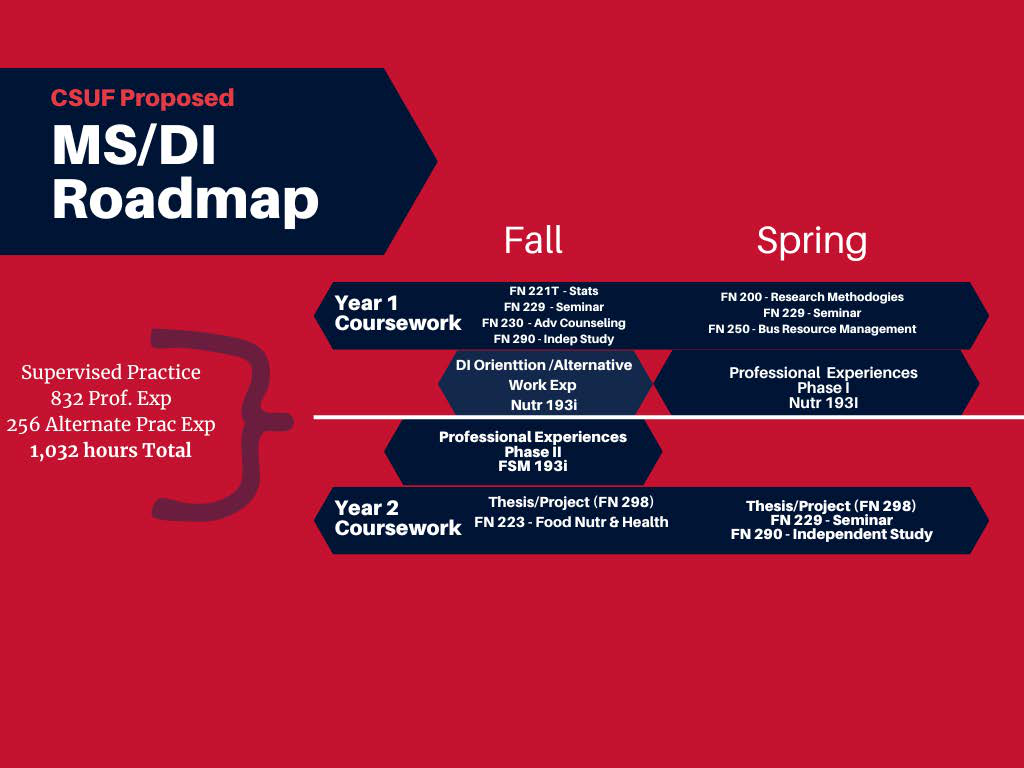
Once accepted to the DI program, in order to begin the internship, the following will be required:
- Verification statement from your didactic program
- Original degree posted transcript, when it is available
- Proof of medical and automobile insurance (explained in more depth in this section)
- Completion of a background check with AmericanDatabank.com (required by supervised practice facilities)
- Pre-internship physical, background check, 10-panel drug screen, and immunizations
- Smart Technology such as Laptop/Tablet and hotspot (can be checked out from Library: https://library.fresnostate.edu/tech/tech-lending/student/
Conditions for Program Completion
Requirements for Program Completion & Issuance of Verification Statement
The following requirements must be met for satisfactory completion of the California State University, Fresno Dietetic (MS/DI) program:
- Satisfactory completion of a minimum of 1,000 hours of supervised practice.
- Satisfactory completion of all rotations assigned by the Dietetic Internship Director.
- Satisfactory completion of all assignments in each rotation.
- Satisfactory completion of all additional assignments made by the Dietetic Internship Director.
- Earn a minimum of 70% (C grade) in all required graduate courses.
- Fulfill program requirements to earn Masters of Science (Food & Nutritional Sciences) 30 unit degree.
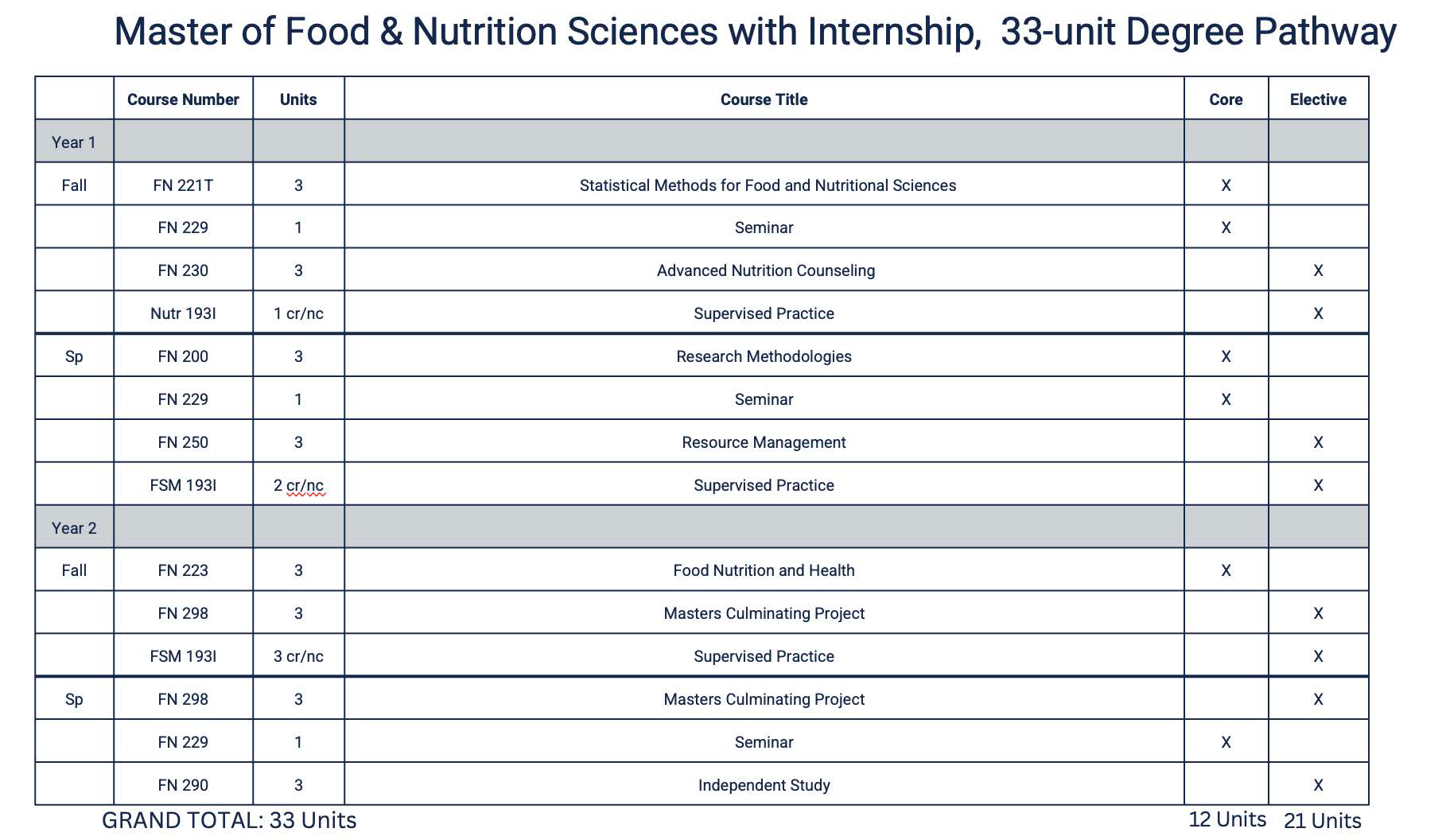
- Maintain a minimum of 3.0 GPA
- Complete ALL program requirements mentioned above
- Course requirements include: 33 units of graduate credit
- To review more about the Food Science and Nutrition masters degree requirements, student can go to the course catalog: http://www.fresnostate.edu/jcast/fsn/degrees-programs/post-baccalaureate/masters-program.html
Criteria for Issuance of Verification Statement
A verification statement will only be issued with BOTH the Masters Degree requirement and the supervised practice hours have been completed and conferred.
Program Retention & Remediation
In the event an intern is not able to complete the dietetic internship as indicated (in accordance with university policy) and/or performance and progress is unsatisfactory. As a direct effort for program retention, it is at the discretion of the DI directors to allow remediation. Please also see RETENTION & GRIEVANCE FORMS (pg 28-30) for additional policy information. The University Learning Center also offers tutoring to students. Remediation efforts must be completed in a timely manner and not exceed 150% of the program duration. In the case of CSUF Dietetic Internship:
Calculate the maximum program completion time in months: 24 months Normal Program Length x 1.5 = 36 months Max. Program Completion
The intent of the program is to help interns successfully complete the program by the determined graduation date. If remediation measures satisfactorily met after two fails, the intern will then be terminated from the program. Interns who have minimal chances of success in the Dietetic Internship will be counseled into career paths appropriate to their ability.
A dietetic intern may be terminated from the program for unsatisfactory performance which would include but not be limited to inability or unwillingness to complete assignments or quality of performance below standard set by the affiliating institution. The procedure for termination from the program due to unsatisfactory performance is as follows:
- The dietitian in the affiliating institution will notify the dietetic intern of his/her unsatisfactory performance.
- The dietitian in the affiliating institution shall notify the Director of the Dietetic Internship of a dietetic intern’s unsatisfactory performance.
- A conference will be held including the dietetic intern, the affiliating institution’s dietitian and the Director of the Dietetic Internship. At this time a written plan for improvement identifying specific knowledge and skills that must be satisfactorily demonstrated and the expected time frame for completion will be developed and signed by all the parties at the conference.
- The Director of the Internship Program will explore possible tutorial support and remedial instruction available to the intern. The intern will also be informed of any student support services available to them that have the potential to be of assistance.
- If performance improves to an acceptable level during a time span agreed upon by the involved parties, the dietetic intern will be allowed to continue in the internship program.
- If there is no improvement, the dietetic intern will be dismissed from the program.
- If there is a second written notification of unsatisfactory performance, the dietetic intern will be terminated from the program.
Disciplinary/Termination Procedures
Compliance with Fresno State and affiliating institution policies will be required by the dietetic intern. Failure to comply with these policies may result in the intern being placed on probation or being terminated from the program.
Infractions of affiliating institution policies will result in the intern being notified verbally and in writing by the Director of the Dietetic Internship Program. A formal meeting with the Dietetic Internship Program and the dietitian in the affiliating institution will be scheduled to address the infraction. Documentation of the infraction and the meeting will be placed in the interns file as a permanent record. Depending upon the infraction, and as deemed necessary the Director of the Internship may consider probation or termination for the intern based on policies and guidelines outlined by University Policy which can be accessed at http://www.fresnostate.edu/academics/academicintegrity/reducing/honorcode.html. Examples of policy infractions include but are not limited to: failure to meet academic/internship requirements, failure to pay tuition/fees, breech of patient or facility confidentiality, unethical behavior, substance abuse, and violent behavior. The procedures related to probation and termination can be found at http://www.fresnostate.edu/catalog/academic-regulations/index.html.
Supervised Practice Documentation
The program procedures for tracking individual interns’ supervised practice hours in the professional work settings, stimulations, case studies and role-playing encompass the university academic integrity policy. Interns will track hours of supervised practice for each rotation using the provided “intern tracking log” excel spreadsheet available in Canvas that is submitted to the program director every semester. The program director will audit document and confirm supervised practice hours completed as part of graduate courses.
Medical/Maternity Leave Policy
If it is determined that a student needs to take a leave of absence, they must complete appropriate paperwork required by the university. See this link for more information on voluntary and involuntary leaves of absence as related to academic coursework: https://studentaffairs.fresnostate.edu/registrar/student-records/planned-ed-leave.html
Written applications should be submitted to the DI Program Director and the University. For a leave of absence from supervised practice in the internship program, students can take up to an 8 week leave with the understanding that the time would need to be made up after the scheduled end of the internship program. The university cannot guarantee that preceptors and/or a site would be available to supervise students; this would require an individualized request and approval. If more than 8 weeks are needed, the student must apply for an extended leave of absence (maximum of a one-year period). If the leave exceeds that period, then the student will automatically be withdrawn from the program and would need to reapply.
Refund Policy for Tuition & Other Fees
When applying for a tuition refund, it is the student's responsibility to drop courses, regardless of the reason, by the published deadlines to avoid charges and be eligible for a full or prorated refund. Failure to do so may result in charges and holds preventing Student Accounts from processing a refund.
Students who no longer plan to attend Fresno State, if at all possible, should drop all courses before the first day of instruction to avoid tuition charges. Refer to the Class Schedule for important information about dropping classes.
All refunds will be subject to a $5.00 administrative fee.
In reference to Title 5, Section 41802, students should check the Refund Deadline Dates on the university website to determine the eligibility of refund status. The website can be accessed at: https://adminfinance.fresnostate.edu/accountingservices/students/springrefunds.html
Formal Assessment & Student Learning Procedures
Students are expected to complete all requirements for a class by the end of the semester unless an incomplete is permitted by the instructor in accordance with university policy.
All faculty members shall provide students at the beginning of each semester a syllabus or outline stating course goals and objectives including grading methodology, types and number of projects, written assignments, tests, experiments, etc. in accordance with university policy.
Evaluation forms for each rotation in the internship are found on the university Learning Management System (LMS). They consist of Part A, which an evaluation of competencies demonstrated, intern’s strengths and objectives for future rotations and Part B which an evaluation of assignments completed.
At the completion of each rotation, the interns will be evaluated by the preceptor and will complete a self-evaluation of the rotation. This evaluation will be discussed with the intern by the preceptor. The intern will give both completed evaluations to the DI director on the Monday following the completion of the rotation.
Evaluations will be maintained by the DI director and secured in a locked file. These will be used to assess interns’ progress which will be discussed with each intern at period progress review sessions.
For further information on university grading policies, consult the general catalog under academic regulations at www.csufresno.edu.
Drug Testing and/or Criminal Background Check(s)
Drug testing and/or criminal background checks may be required by facilities, preceptors, and/or the university. These tests are typically required before the intern begins the internship, however due to fluctuations of preceptors and/or just cause, it is the right of the program to request drug and/or criminal background check at any time during the internship. It is the financial responsibility of the intern to pay for all services unless otherwise specified.
Use of Interns to Replace Employees
The purpose of educational supervised practice is to PREVENT the use of interns to replace employees. In general, interns should not be brought into a workplace if the sole reason is to provide free labor when paid employees are absent. Individuals acting as primary preceptor are expected to take steps to assure that absent employees are replaced by a paid substitute and not to take interns away from scheduled learning activities. However, interns should also recognize that there are expectations (as outlined in the Expectations for Dietetic Interns Agreement) that in some cases one might be expected to give back something in return for the time, attention and resources which the faculty and/or preceptor site have devoted to their educational hands-on learning.
A professional attitude toward work in health care sometimes requires that an intern not get paid for every task performed, or work beyond normal hours, especially if patients are in need of care. In unexpected circumstances, help may be needed and an intern is expected to volunteer as a part of professionalization. If an intern feels the “unexpected circumstances” are being abused by the faculty and/or preceptor, it is the intern’s responsibility to notify the DI director, so the situation can be brought up/resolved to the faculty and/or preceptor site.
Vacation, Holiday, Sick Leave
See the current Internship Schedule for the Academic Calendar which lists holidays and class schedule for the current academic year. Internship schedule and holidays correspond with this schedule except as stated. No additional time-off or holidays are allowed in the program.
Students are expected to attend class and field experience activities and must notify the internship director and preceptors regarding any absences. It is the responsibility of the intern to contact the preceptor, the moment they know that are ill, but no less than 30 minutes prior to a scheduled shift. It is mandatory for the intern to email and call the preceptor AND the dietetic internship director when an absence will occur. Failure to do this can lead to disciplinary action.
A plan for make-up of missed days of field experience due to illness or other emergency will be developed by the internship director in consultation with the facility preceptor and the student.
Any make-up work or missed assignments remain the responsibility of the student and must be made up to remain eligible for the Academy of Nutrition and Dietetics (AND) verification statement. For longer absences, students should seek guidance from the program director for policy on taking "Incomplete - I" grade and/or please see the university policy page for Leave of Absence Request.
Program accreditation is based on completing of all required rotations, assignments and learning experience. All assigned hours must be completed to qualify for program completion. Hours missed will be added to the end of the program.
Program Calendar and Scheduling Procedures
The current academic year program begins on/about mid-August and ends on/about mid-May. The DI program fall semester is from August through December. The DI elective is from January 1 – for three weeks. The spring semester is on/about late-January mid-May. An intern calendar can be found on the CSUF DI website.
Interns will be schedule in medical nutrition therapy, food service management and community nutrition rotations. Interns will be scheduled to rotate through each facility in the program for the time specified in the summary of rotations (found in section 3 of this manual). Specific assignments will vary to be equal to the number of interns each facility can accommodate.
Insurance Requirements
Limited health services are provided by the University Health Center (UHC). A mandatory fee for UHC services are included in the total registration fees for the university. Services are provided by the UHC are listed in the General Catalog. Services are available 8:00am to 5:00pm Monday through Friday.
In addition, dietetic interns are required to have health insurance to cover minimum of the following:
- Hospital benefits
- Medical, surgical and related services for any illness or accident
Students may purchase and insurance plan through an independent company such as, Associated Students Inc.
Students are required to provide the DI director with appropriate documents showing proof of health/medical coverage prior to the start of the internship program calendar.
Travel Liability of Dietetic Interns
Dietetic inters are liable for any accident, injury, motor vehicle violation, or moving violation occurring related to travel to an assigned practice site for themselves and any passengers traveling with them.
The State of California requires the following minimum automobile liability coverage:
- $ 15,000 per person / $ 30,000 per accident for bodily injury AND
- $ 5,000 for property damage
If a licensed driver is driving an automobile owned by someone other than themselves, the driver is responsible for assuring that the automobile is covered with the minimum liability coverage.
California State University Fresno and any and its entire faculty, staff, agents and agencies assume NO liability for dietetic intern safety in travel to assigned practice sites.
Illness or Injury in Practice Facility
Liability for injury incurred associated with an assigned rotation in the DI program is the responsibility of the intern (see the following policies: Health Insurance Requirements for dietetic interns, Professional Liability Insurance Requirements for Dietetic Interns; and Travel liability for Dietetic Interns)
If an injury or illness occurs while a dietetic intern is at the assigned facility, the intern shall follow the policies and/or procedures established by the facility. The supervising dietitian will provide policies and procedures to the dietetic intern on the first day of the rotation.
The dietetic intern is responsible for contacting the supervising dietitian AND the DI director as soon as possible to report the illness or injury.
If the dietetic intern is absent from the rotation due to excused illness or injury, the time will need to be made up at the discretion of the DI director and site preceptors.
Professional Liability
All dietetic interns are covered under CSU provided professional liability insurance while enrolled in supervised practice course (NUTR 193 & FSM 193).
Students will be charged a course fee of approximately $8.00 per semester when they enroll in these courses.
Access to Personal Files
All student records of the California State University, including California State University, Fresno, are kept in accordance with the provisions of the Family Educational Rights and Privacy Act of 1974. Public law 93-380, section 438 (A)(1)(2), (B)(1)(2).
A student may request access to personal records, must consent to the release of those records (except to those agencies entitled to access under provisions of the act) and may request a copy of records which he/she has requested or consented to be released. Full explanation of this policy is located in the Schedule of Courses.
Particular questions with respect to a student’s prerogative under the Family Educational Rights and Privacy Act of 1974 should be directed to the Vice President for Student Affairs or the Director of Admissions and Records.
Assessment of Prior Learning
All rotations will be completed by all interns despite prior learning or work experience. In the case of significant prior work or learning experience; the intern, preceptor, and DI director will collaborate to design more challenging experiences and assignments. If required graduate classes have been taken prior to the internship, another class of equivalent units will be required and/or subsitituted. The instructor, intern, and DI director will collaborate to agree on an appropriate class to substitute in the Certificate of Advanced Study plan.
Program Expenses
Tuition and Fees: Information about the tuition rates, housing and other fees associated with Fresno State are available on the Graduate Admissions Office website at: http://www.fresnostate.edu/catoffice/current/fees.html (use the Post-Baccaluarette 7+units)
Books, materials and supplies: Required books, software, and printing fees for course materials are estimated to be approximately $400 per semester. The most updated costs can be found on the programs website under cost tab, the numbers provided below are estimations.
- Health Service Fee: $93 (included in Tuition)
- Professional liability insurance: course fee of $16 (included in Tuition)
- Personal Health Insurance (varies)
- Background / Fingerprinting (varies per preceptor, usually $175 total)
- Immunizations: Fees vary (Quantiforn test not usually covered by many insurances)
- Academy of Nutrition and Dietetics membership dues: $58.00 (due in May) – automatically become a member of the California Dietetic Association
- Central Valley Dietetic Association: $15.00 student rate (but could be subject to change)
Students are encouraged, but not required, to attend professional meetings in dietetics. Students will be responsible for covering the registration, housing, and travel costs associated with these meetings. These costs will vary depending on the type and location of the meeting.
Post-baccalaureate Tuition and Fees
Students who attend a dietetic internship after graduating from the Didactic Program in Dietetics will be expected to pay tuition and fees as part of the program costs. The tuition and fees vary between programs. They can range from $5,000 to $28,000 depending. Our program lists fees by semester on the website: http://fresnostate.edu/adminserv/accountingservices/money/regfee-fall.html. Candidates/students should review the Post-baccalaureate 7+ unit category for each semester to calculate entire program fees.
Technology-mediated and/or distance learning instruction and online testing
Courses may use technology for instruction, enhancement of student learning, supplementing or replacing face-to-face interaction, and extending access to students. Courses and programs using instructional technology are technology-mediated. Technology-mediated courses may be synchronous (using broadcast, video or web conferencing, or other technology), asynchronous or a blend. Student learning outcomes of technology-mediated courses are equivalent to those of traditional courses. Online course activity beyond 20% of the entire course, instructors complete 15-20 hours of online course design training through or recognized by the Center for Faculty Excellence.
All university courses use a Learning Management System (LMS) called Canvas. Within this platform students are required to have a username and password with dual authentication, which helps ensure student safety as well as academic integrity that it is the student who is completing the work. Additionally, the university also uses Respondus Lockdown Browser, some instructors may require that students use this custom browser that locks down testing environment in canvas. For more information on this please see the University Policy Page Technology-Mediated Pages.
Use of Technology and Distance Learning Requirement
As outlined above, the university expectation is for for all students to use the LMS called Canvas for courses, having access to reliable smart technology such as a laptop/tablet and/or Wi-Fi will be expected. Students who may not have these devices can barrow these resources through our university lending library. More information can be found here: https://library.fresnostate.edu/tech/tech-lending/student/
While this combined masters and dietetic internship is a Face-to-Face program, there may be times when a student could be asked to use a distance education component. There may be instances where students will be asked to join class via a live synchronous or asynchronous event. In addition, it is highly possible that during a rotation with a preceptor affiliate agency that the student may be asked to work remotely in a distance capacity, like telehealth etc. This is not the norm, however in certain situation this could occur. The program has an Addition of Distance Education Delivery on file with the Accreditation Council for Educators in Nutrition and Dietetics (ACEND) that is in compliance with the United States Department of Education (USDE), definition of Distance Education, where instruction is being delivered to students who are separated from the instructor/program director and that supports regular and substantive interactions between the student and the instructor, no more than 1-49% of the entire program via distance education including coursework or distance supervised practice (SP).
Accommodations for Use of Technology and Distance Learning
While this program is established as a Face-to-Face model, distance education is not the primary mode of education, there may be situations in which students may be asked to participate in distance learning education. Protection and privacy has been taken by the university to ensure compliance protecting both students and the university. Students will be asked to use the universities single sign on (SSO) dual authentication when logging into the LMS, Canvas or during Zoom virtual meeting spaces for distance learning education. This feature ensures that students are their authentic selves (identity) for on-line testing or when identification is needed as a participant in a virtual meeting.
Should a graduate student need additional resources during distance learning. Student support includes but not limited to university programs:
- Office of Innovation and Digital Excellence for Academic Success (IDEAS), which has LIVE tech support, DISCOVERe devices and lending, Canvas Student Orientation, Canvas Login. More information can be found: https://academics.fresnostate.edu/ideas/index.html
- The Student Support Center - which includes, the Learning Center (tutoring, workshops, academic coaching, study space and supplemental instruction); the Graduate Writing Center (writing and statistics, 1-on-1 or small writing groups); Services for Students with Disabilities (SSD); Career Developmental Center; Social Support such as the Student Cupboard food and hygiene pantry, clothing closet, Student health and counseling center,and office of financial aid and scholarships. Student Support Services (SSS) can be found at: https://studentaffairs.fresnostate.edu/transfersuccess/transfersupportservices.html
- Also see section "Student Intern Retention " as further support may also be provided when necessary.
- See "University Services" page in this handbook for even more support options.
General Dress Standards
As a representative of the CSU Fresno Dietetic Internship Program, your appearance reflects on you and the program. For this reason, interns are to dress and groom professionally at all times.
Acceptable Women’s Attire
- Professional dresses, suits, coordinated pant outfits and skirts with matching or coordinated tops.
- Skirts are to be no more than 3 inches above the knee.
- Comfortable, closed toed shoes
Acceptable Men's Attire
- Shirts with collar and slacks.
- Polo shirts are acceptable. Business suit, coordinated slacks and sport coat. Jackets optional.
- Dress shirt and tie.
- Dress shoes and socks required
Casual Dress Days (Class day only) – If guest speaker, please be mindful
Acceptable
Regular business attire is acceptable.
Shorts, casual or tennis shoes, casual sportswear, stirrup slacks, denim pants.
Unacceptable
- Cutoffs or extremely short shorts.
- Ripped or torn pants or jeans.
- Dirty or torn shoes.
- Exercise apparel
Other requirements
Facilities may have additional requirements. Specific information for each rotation provided in manual.
Have hairnet with you at all times in food service facilities.
CSUF Intern Record of Professional Development
In addition to supervised practice experience, dietetic interns are expected to attend at a minimum of 16 hours of professional education. A copy of the form is available on Blackboard (NUR 193) for Download. It is the responsibility of the intern to keep track of all professional development.
This form should reflect all additional activities that are NOT part of regularly scheduled rotations: professional meetings (CDA-CVD, CDA, FNCE), seminars/webinars, and continuing education presentations in the community. This form shall be reviewed with DI Director at each progress review and a completed form will be turned in at the end of the internship in May.
| Activity / Seminar | Sponsor | Date | Hours |
|---|---|---|---|
Total Hours Completed:_______
CSUF Intern Record of Community Outreach
In addition to supervised practice experience, dietetic interns are expected to participate in a minimum of 40 hours of community outreach. A copy of the form is available on Blackboard (NUR 193) for Download. It is the responsibility of the intern to keep track of all outreach activities.
This form should reflect all additional activities that are NOT part of regularly scheduled rotations. This form shall be reviewed with DI Director at each progress review and a completed form will be turned in at the end of the internship in May.
| Outreach Activity | Target Audience | Date | Hours |
|---|---|---|---|
Total Hours Completed:_______

GRIEVANCE/DISCIPLINARY/TERMINATION CONTRACT
The student should be aware that satisfactory completion of the course(s) of the CSUF Dietetic Internship is based on satisfactory performance in all of the Academy of Nutrition and Dietetics Performance Requirements as determined by rotation evaluation by the site preceptors. Evaluations are shared with the student and Internship Director. If either the site preceptor or the student is concerned about a negative performance outcome of the experience, they must notify the Internship Director. The degree of discipline applied will be consistent with that necessary to call behavior changes to the interns’ attention rather than to inflict punishment for unsatisfactory behavior. Disciplinary action more serious than a warning must be documented in writing. For the protection of both parties, records of these actions will be stored in a locked filling cabinet in the dietetic internship director’s office. Disciplinary procedures should include the following:
- Verbal warning with counseling
- Written reprimand with counseling
- Dismissal
A meeting will be arranged as soon as possible involving the student, preceptor and Internship Director to resolve any difficulties. If the problem is unsatisfactory student performance, the preceptor and Internship Director will set forth activities and performance criteria for the student to meet within a specific timeline for continuance in the Dietetic Internship. Grounds for dismissal will include but are not limited to: mistreatment of patients, clients, preceptors, facility staff, other interns or the public; drug or alcohol use during working hours; excessive absenteeism and tardiness; failure to maintain appropriate or professional standards of dress or hygiene; disclosing confidential information and inability to meet internship requirements. If academic scores fall below 70%, strong efforts will be made to provide additional assistance and individualized experiences to help the intern to succeed. If after a reasonable amount of remediation (1 month during rotations, or 3 months for academic work) the intern is still not able to achieve an average of 3 (satisfactory) rating in performance evaluation and an average of 70% on academic work, the intern will be removed from the program
Grievance: A dietetic intern or preceptor should provide in writing any concerns regarding the dietetic internship program to the Director of the Internship Program. Following the receipt of the complaint, a meeting will be scheduled between the intern or preceptor and Director of the Dietetic Internship Program. If the intern or preceptor feels the Director of the Internship Program does not satisfactorily address the concerns, the intern or preceptor can make an appointment with the Chair, Department of Food Science & Nutrition. If the intern or preceptor is still not satisfied, a meeting can be arranged with the Dean of the Jordan College.
All intern complaints will be retained for a period of seven years and include documentation regarding resolution of complaints. The records will be kept in the Director of the Dietetic Internship office.
A dietetic intern can request a review and reconsideration of disciplinary action taken against him/her. The dietetic intern will notify the Director of the Dietetic Internship in writing of his/her challenge to the prescribed disciplinary action. If after meeting with the Chair, Food Science & Nutrition and the Dean of the Jordan College, if the intern is not satisfied, the dietetic intern will follow the Standard Appeal Procedure in the University’s Academic Policy Manual. This procedure is available from the Graduate Catalog which can be accessed at http://www.fresnostate.edu/academics/facultyaffairs/policies/apm/index.html.
The intern or preceptor is protected from retaliation as a result of filing a complaint related to the dietetic internship program.
_____________________________________ _____________________________________ _______________
Student’s Name (print) Student’s Signature Date

STUDENT INTERN RETENTION ACKNOLWDEGMENT FORM
- The intent of the program is to help interns successfully complete the program by
the determined graduation date. This will be accomplished by:
- Providing clear expectations for each rotation.
- Promoting feedback by preceptors regarding intern performance during rotations.
- Preceptors completing evaluations for intern supervised practice experiences. This is will be reviewed between intern and preceptor, with a copy of the evaluation provided to the program.
- Communication of intern’s progress discussed between preceptor(s) and DI Leadership during the internship.
- Addressing any issues as they are identified during any rotation.
- Completion of rotation report and self-evaluation form by the intern for rotations.
- Completion of all assignments in a manner that is satisfactory to both Internship director and preceptors.
- Remediation Measures
- If an intern does not satisfactorily meet a rotation’s learning objectives, the preceptor will contact the Internship Director, and a decision will be made regarding a full/partial repeat of the rotation and/or if supplement reading assignments are warranted. Rotations will be scheduled for repeat purposes at the convenience of the preceptors. Repeating rotations may result in delayed graduation. The Internship Director will work closely with the intern and the preceptor in such instances to make sure the repetition of the rotations takes place before the start of the next class of interns. Interns will be given two opportunities to complete rotations. If the intern fails the rotation after two attempts, the intern will then be terminated from the program, without tuition reimbursement and verification form.
- Interns will be required to revise assignments and other non-rotation projects until they meet the satisfaction of the Internship Director and the preceptor. Interns will be granted three weeks from the due date to make necessary revisions and complete the assignments to the satisfaction of the Internship Director and preceptor. Failure to do so on the part of the intern will result in intern being terminated from the program without tuition reimbursement and verification form.
- Revisions to work will be completed outside of supervised practice hours.
All graduation requirements must be successfully completed for the verification form to be issued. There will be no waiver for any requirement.
Interns who have a minimal chance of success in the Dietetic Internship will be counseled into career paths appropriate to their ability.
_____________________________________
Student’s Name (print)
------------------------------------------------------------ --------------------
Student’s Signature Date

Expectations for Dietetic Interns
The Dietetic Internship at California State University, Fresno has set high standards for interns in the program. The internship year is a critical observation period during which interns must prove themselves to be competent and suited to the dietetics profession. Interns must “put their best foot forward” at all times during the year, both at work and in situations away from the facility.
- Interns will conduct themselves as professionals at ALL times. Interns are no longer college students or “kids” and need to conduct themselves as professionals.
- Interns will behave in an ethical manner at all times.
- Interns will keep in mind that, to the public, they represent California State University, Fresno, the Dietetic Internship Program, and the sponsoring facilities. Interns will conduct themselves in an appropriate manner so as to reflect positively on the sponsoring entities.
- Interns will willingly do whatever is asked of them, recognizing that they are expected to give back something in return for the time, attentions and resources which the faculty and/or preceptors have devoted to them. However noting that the educational purpose of supervised practice is to prevent the use of interns to replace employees and must notify the DI director if this occurs.
- Interns will present a positive attitude at all times when on duty or out in the community.
- Interns will behave as “team players”, i.e., putting as much priority on the needs of the group, the department or facility as on their own individual needs.
- Interns are both students and employees, Departmental commitments will, at times; take precedence over homework and academic commitments.
- Interns will deal with problems and resolve conflicts in an open, direct and assertive (NOT Aggressive) manner.
- Interns will take the initiative in the learning process, seeking out information and answers, rather than waiting for them to be given
- Interns will make their needs know to the faculty, DI Director, preceptors and to each other in an assertive but tactful manner.
- Interns will follow through on all assigned responsibilities and will complete all tasks on or before the deadline(s).
- Interns will perform to the best of their abilities in ALL rotations, classes, assignments, presentation or other activities.
- Interns will give appropriate feedback to faculty and DI director regarding ways in which the program can be improved.
- Interns will be ON-TIME, appropriately dressed and groomed and prepared to work each time they report for duty.
- Personal business, personal problems and the like will be attended to during OFF-DUTY hours, insofar as is possible, and should not unduly interfere with performance, work responsibilities or the learning environment. If interns need special consideration or assistance with personal issues, these should be brought to the attention of the DI Director immediately.
- Interns will NOT fraternize, date or socialize on personal time with non-management, non-professional staff of any of the food service departments in the program. The employees are to be treated with respect and friendliness, but interns are not the “buddy” of the employees.
- Interns will not date each other, or any member of any facility food service / nutrition department in the program.
I have read the Expectations of Dietetic Interns and understand them. I realize I will be held responsible for fulfilling these expectations, and that failure to do so will result in corrective action, which may include discharge from the program.
Name (print):____________________________ Signature: __________________________ Date: ______________
UNIVERSITY POLICIES
Students with Disabilities: Upon identifying themselves to the instructor and the university, students with disabilities will receive reasonable accommodation for learning and evaluation. For more information, contact Services to Students with Disabilities in the Henry Madden Library, Room 1202 (278-2811).
The following University policies can be found at:
- Adding and Dropping Classes
- Cheating and Plagiarism
- Computers
- Copyright Policy
- Disruptive Classroom Behavior
- Honor Code
- Students with Disabilities
- Title IX
- Leave of Absence Request
- Privacy Rights of Students
UNIVERSITY SERVICES
The following University services can be found at:
- Associated Students, Inc.
- Dream Success Center
- Learning Center Information
- Student Health and Counseling Center
- Writing Center
Technology-mediated Course/ Distance Learning and/or Online Testing
Learning Management System - CANVAS:
https://fresnostate.edu/academics/canvas/students/#:~:text=When%20students%20use%20the%20Respondus,they%20submit%20it%20for%20grading.&text=Students%20use%20their%20own%20computer,sessions%2C%20all%20without%20leaving%20Canvas
Respondus Lockdown Browser:
http://www.fresnostate.edu/academics/cfe/toolsforteaching/respondus.html
2023-2025 Dietetic Internship Calendar
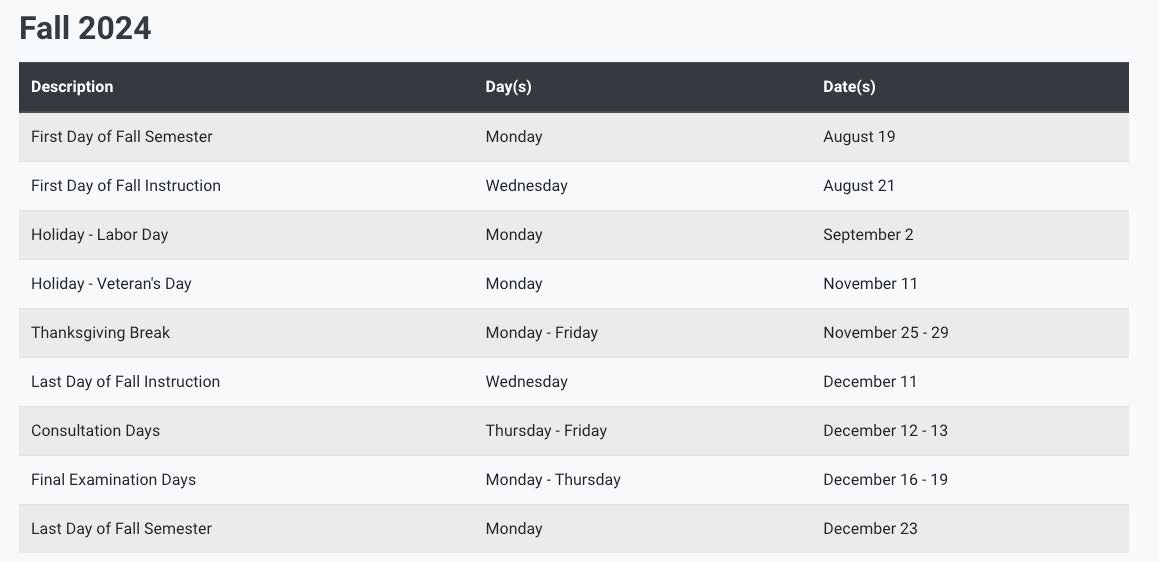
Winter Break: Dec 23, 2024 - Jan 17, 2025
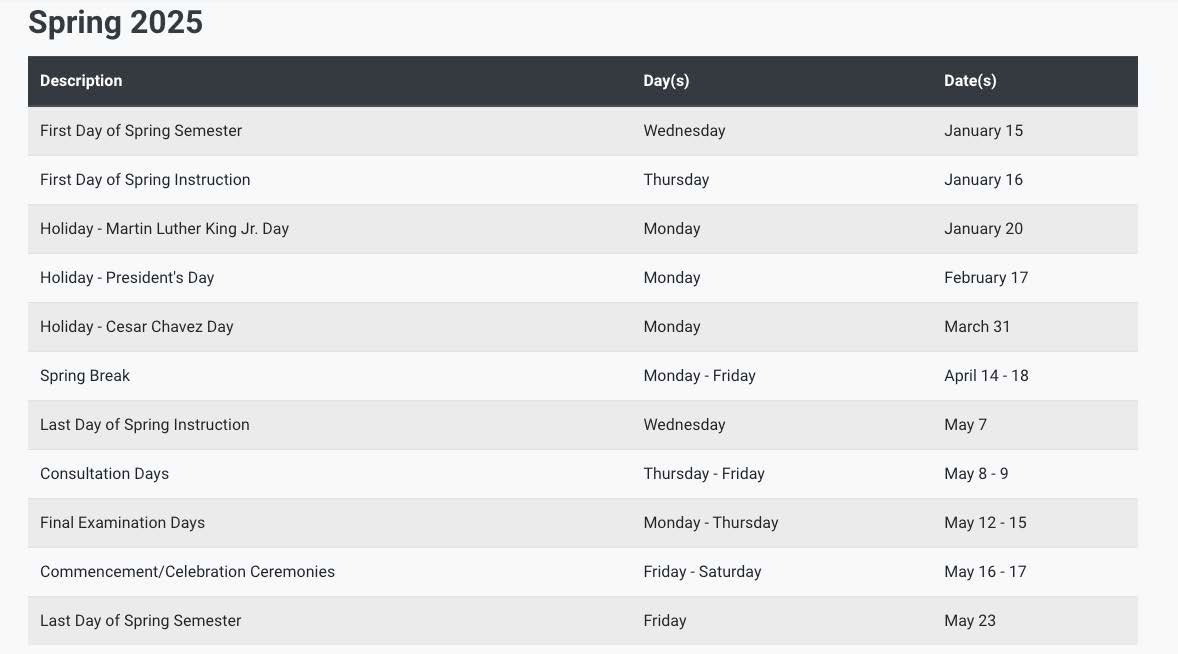
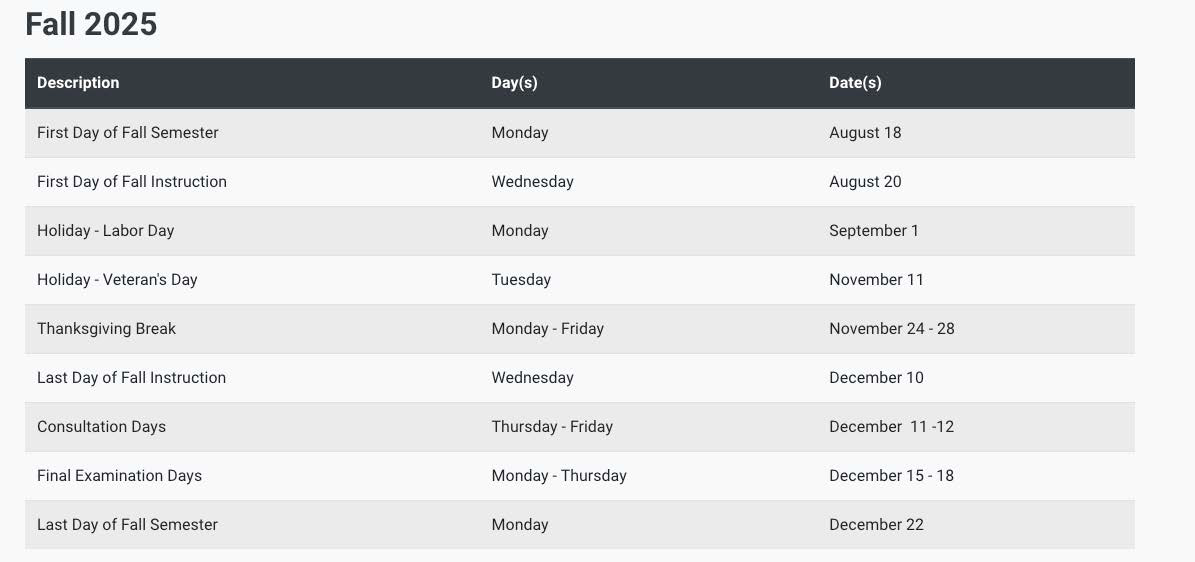
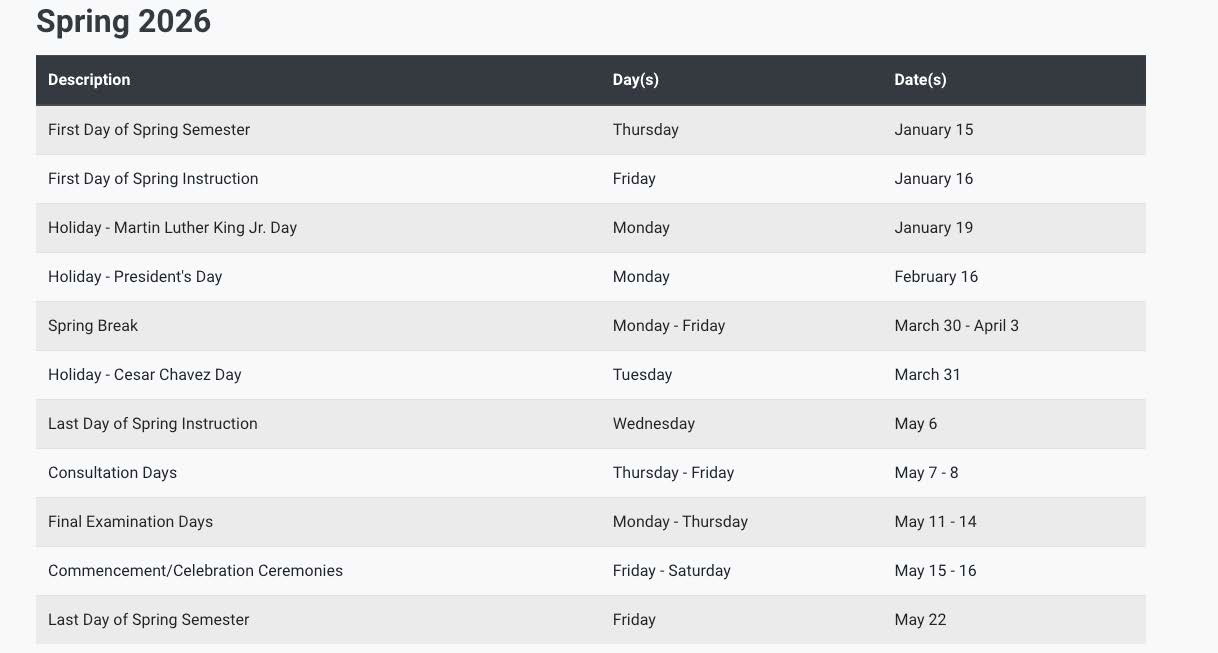
The MS/DI student will have a 3-week elective between Fall 2025 and Spring 2026, that is likely to run tentatively Jan 1 - Jan 26, 2026.
Rotation Summary 2025
| SEGMENT | ROTATION | WEEKS | FACILITIES |
|---|---|---|---|
| Medical Nutrition Therapy 12 weeks Professional Rotation(s): 384 hours 3 weeks alternative/simulation study: 96 hours Total Time: 480 hours |
Acute Care | 7 | a) Community Medical Center Clovis b) Community Regional Medical -Downtown c) Fresno Heart and Surgical Center d) St. Agnes Medical Center (SAMC) e) Veterans Administration (VACCHCS) |
| Medical Nutrition Therapy | Clinical Specialty Area | 3 | a) Pediatrics (CRMC) b) Diabetes (DCC and SEA) c) Skilled Nursing / Consulting Dietetics VACCHCS |
| Medical Nutrition Therapy | Diabetes | 1 | VACCHCS |
| Medical Nutrition Therapy | Out-Patient Counseling | 1 | VACCHCS |
| Medical Nutrition Therapy | Simulation Study – MNT/NCP | 1 | Self-Study |
| Medical Nutrition Therapy | Simulation Study - Renal | 1 | Self-Study |
| Foodservice Systems Management 7 weeks Professional Rotation(s): 224 hours Total Time: 224 hours |
Hospital-Large | 2 | VACCHCS or SAMC |
| Foodservice Systems Management | Community Food Service | 1 | Fresno-Madera EOC Kitchen |
| Foodservice Systems Management | School Food Service | 2 | Kings Canyon Unified or Clovis Unified |
| Foodservice Systems Management | Prison | 2 | State Prison |
| Community Nutrition 10 weeks Professional Rotation(s): 320 hours Total Time: 320 Hours |
Health and Wellness | 2 | University Health and Psychological Services |
| Community Nutrition | Nutrition Education | 3 | a) Fresno County Public Health Department b) Fresno State CalFresh Healthy Living |
| Community Nutrition | WIC | 2 | Fresno County EOC or United Health Cntr |
| Community Nutrition | Student Teaching | 3 | California Health Sciences University (CHSU) Medical School or Fresno City College (FCC) |
| Elective 3 weeks Professional Rotation: 96 Hours Alternative/simulation in Coursework: 96 hours Total Time: 192 Hours |
3 weeks of Elective 96 hours | 3 | Interns Seek/Find their own Elective – FN 230 Adv. Counseling: students will create a culturally appropriate screen assessment tool for a said disease and/or counselling style FN 250 Business Resource Mgt: Business Research/Team Task Assignment and Business Presentation Pitch. |
34 weeks of Tue-Friday rotation schedule = 1,088 hours
Hours of Community Outreach Activity = 48 hours (may be alternative work experiences depending on COVID guidelines)
Hours of Professional Development = 16 hours
TOTAL HOURS: 1,184 SUPERVISED HOURS
(1,024 PROFESSIONAL HOURS + 160 ALTERNATIVE PRACTICE EXPERIENCE)
| Course Number | Title | Semester Units |
|---|---|---|
| Year 1 | ||
| FN 229 (fall) | Graduate Seminar - CORE | 1 |
| FN 230 (fall) | Advanced Nutrition Counseling - Elective | 3 |
| FN 221T(fall) | Statistics – CORE | 3 |
| Nutr 193I (fall) | Elective: Supervised Work Experience - Elective | 1 / Cr/NC |
| FN 229 (spring) | Graduate Seminar - CORE | 1 |
| FN 200 | Research Methodologies - CORE | 3 |
| FN 250 (spring) | Food & Nutrition Resource Management - Elective | 3 |
| FSM 193I (spring) | Supervised Work Experience - Elective | 2/Cr-NC |
| Year 2 | ||
| FN 298 (fall) | Culminating Experience (Thesis/Project) | 3 |
| FN 223 (fall) | Food Nutrition and Health - CORE | 3 |
| NUTR 193I (fall) | Supervised Work Experience – Elective | 3/Cr-NC |
| FN 229 (spring) | Graduate Seminar - CORE | 1 |
| FN 298 | Culminating Experience (Thesis/Project) | 3 |
1 Some rotations use 2-4 facilities, accommodating 5 interns at each facility. The facilities are selected and the experiences are planned to be comparable. See appendix for the capstone MS Project Handbook (FN 298).
Facility Descriptions and contact information can be found inside the Learning Management System (CANVAS) for each rotation site.
Rotation Evaluation Forms
Use the personal web link provided to you by the Dietetic Internship Director
One web link is for you to give to each preceptor on/or before your last day of rotation. Your preceptor completes the evaluation and you will receive an email copy. Each intern is responsible for providing the preceptors with the proper weblink
One web link is for each intern to complete about the experience of each internship rotation. These are shared collaboratively and anonymously with the preceptor at the end of the academic year by the internship director.
**Each intern should keep track of these surveys (both one themselves and of each preceptor) as these need to be completed on or before graduation day. Failure to complete these documents, could lead to not processing verification statements and/or full completion of the internship.
California State University Fresno Combined Masters & Dietetic Internship (AKA Fresno State MS/DI)
CRDN Curriculum Map (Required Elements 3.1/3.2)
Supervised Practice Rotations Aligned with Core Competencies for the RDN (DI, ISPP)
Background: The CRDN Curriculum Map is used to identify the rotations in which students are being taught ACEND Core Competencies (CRDN).
Directions: List rotations in chronological order or by category (Food Service Management, Clinical, Community, etc). Next, using rotation descriptions, learning objectives and assignments, identify which ACEND Core Competencies occur in a rotation and place an ‘X’ in the appropriate column. Add additional rows as needed.
| Rotations | CRDN 1.1 | CRDN 1.2 | CRDN 1.3 | CRDN 1.4 | CRDN 1.5 | CRDN 2.1 | CRDN 2.2 | CRDN 2.3 | CRDN 2.4 | CRDN 2.5 | CRDN 2.6 | CRDN 2.7 | CRDN 2.8 | CRDN 2.9 | CRDN 2.10 | CRDN 2.11 | CRDN 2.12 | CRDN 2.13 |
|---|---|---|---|---|---|---|---|---|---|---|---|---|---|---|---|---|---|---|
| Hospital MNT (224 hours) | X | X | X | X | X | X | X | X | ||||||||||
| Choice MNT (96 hours) | X | X | X | X | X | X | ||||||||||||
| Outpatient MNT (32 hours) | X | X | X | X | X | X | X | X | X | X | X | X | ||||||
| Outpatient DM MNT (32 hours) | X | X | X | X | X | X | X | X | X | X | X | X | ||||||
| Simulation / Alternative | ||||||||||||||||||
| Hospital FSM (64 hours) | X | |||||||||||||||||
| School FSM (64 hours) | X | X | X | X | X | X | X | X | X | X | X | X | X | X | ||||
| Large Kitchen FSM (32 hours) | X | X | X | X | X | |||||||||||||
| Student Health Center (64 hours) | X | X | X | X | X | X | X | X | X | X | ||||||||
| Student Teaching (96 hours) | X | X | X | X | X | X | X | |||||||||||
| CalFresh Healthy Living (96 hours) | X | X | X | X | X | X | X | X | X | X | X | X | ||||||
| WIC (64 hours) | X | X | X | X | X | X | ||||||||||||
| Elective (96 hours) | ||||||||||||||||||
| Coursework | X | X | X | X | ||||||||||||||
| Rotations | Core Competencies (CRDN 3.1–3.14, 4.1–4.10, 5.1–5.8) |
|---|---|
| Hospital MNT (224 hours) | CRDN 3.1, 3.2, 3.3, 3.12; CRDN 4.1 |
| Choice MNT (96 hours) | CRDN 3.10 |
| Outpatient MNT (32 hours) | CRDN 3.1, 3.2, 3.6, 3.7, 3.10, 3.11, 3.12, 3.13, 3.14; CRDN 4.4, 4.10; CRDN 5.2, 5.4, 5.5, 5.6, 5.8 |
| Outpatient DM MNT (32 hours) | CRDN 3.1, 3.3, 3.4, 3.7, 3.9, 3.10, 3.12, 3.14 |
| Simulation / Alternative | |
| Hospital FSM (64 hours) | CRDN 3.8, 3.11, 3.13, 3.14; CRDN 4.1, 4.2, 4.3, 4.5, 4.8 |
| School FSM (64 hours) | CRDN 3.14; CRDN 4.1, 4.2, 4.3, 4.4, 4.5, 4.6, 4.7, 4.8, 4.9, 4.10; CRDN 5.1, 5.2, 5.6 |
| Large Kitchen FSM (32 hours) | CRDN 3.8, 3.9, 3.10, 3.12, 3.13, 3.14; CRDN 4.2, 4.3, 4.4, 4.6 |
| Student Health Center (64 hours) | CRDN 3.1, 3.9, 3.10, 3.12; CRDN 4.3 |
| Student Teaching (96 hours) | CRDN 3.1, 3.11; CRDN 4.6, 4.8; CRDN 5.4, 5.6 |
| CalFresh Healthy Living (96 hours) | CRDN 3.9, 3.11, 3.12, 3.13; CRDN 4.4; CRDN 5.6, 5.8 |
| WIC (64 hours) | CRDN 3.8, 3.9, 3.10; CRDN 4.1 |
| Elective (96 hours) | |
| Coursework | CRDN 3.1, 3.2, 3.3, 3.4, 3.5, 3.6, 3.7; CRDN 4.7, 4.10; CRDN 5.1, 5.2, 5.3, 5.4, 5.5, 5.7, 5.8 |
Fresno State MS/DI
CSUF Combined MS/DI Program
California State University Fresno Combine Masters & Dietetic Internship Program
RDN Competency Assessment (Required Element 4.1 and 4.2) DI
| Core Competency Statement | List course and course number or supervised practice rotation in which the competency is assessed | List specific, required assessment method(s) (exam, rubric, project, etc.) used to measure student/intern achievement of competency |
|---|---|---|
| Domain 1. Scientific and Evidence Base of Practice: Integration of scientific information and translation of research into practice. | ||
| CRDN 1.1 Select indicators of program quality and/or customer service and measure achievement of objectives. | Nutr 193I/FSM 193I Food Service, Community, and Clinical Rotations |
Intern evaluation of Service Improvement Project Form |
| CRDN 1.2 Evaluate research and apply evidence-based guidelines, systematic reviews and scientific literature in nutrition and dietetics practice. | FN 229: Grad Seminar | Research Project Evaluation Rubric |
| CRDN 1.3 Justify programs, products, services and care using appropriate evidence or data. | Nutr 193I/FSM 193I Food Service, Community, and Clinical Rotations |
Preceptor evaluation using Qualtrics survey rubric |
| CRDN 1.4 Conduct projects using appropriate research or quality improvement methods, ethical procedures and data analysis utilizing current and/or new technologies. | FN 229: Grad Seminar | Research Project Evaluation Rubric |
| CRDN 1.5 Incorporate critical-thinking skills in overall practice. | Nutr 193I/FSM 193I Food Service, Community, and Clinical Rotations |
Preceptor evaluation using Qualtrics survey rubric |
| Domain 2. Professional Practice Expectations: Beliefs, values, attitudes and behaviors for the nutrition and dietetics practitioner level of practice. | ||
| CRDN 2.1 Practice in compliance with current federal regulations and state statutes and rules, as applicable, and in accordance with accreditation standards and the Scope of Practice for the Registered Dietitian Nutritionist, Standards of Practice, Standards of Professional Performance, and Code of Ethics for the Profession of Nutrition and Dietetics. | Nutr 193I/FSM 193I Food Service, Community, and Clinical Rotations |
Preceptor evaluation using Qualtrics survey rubric |
| CRDN 2.2 Demonstrate professional writing skills in preparing professional communications. | Nutr 193I/FSM 193I Food Service, Community, and Clinical Rotations FN 229: Grad Seminar |
Preceptor evaluation using Qualtrics survey rubric |
| CRDN 2.3 Demonstrate active participation, teamwork and contributions in group settings. | Nutr 193I/FSM 193I | Preceptor evaluation using Qualtrics survey rubric |
| CRDN 2.4 Function as a member of interprofessional teams. | Nutr 193I/FSM 193I Food Service, Community, and Clinical Rotations |
Preceptor evaluation using Qualtrics survey rubric |
| CRDN 2.5 Work collaboratively with NDTRs and/or support personnel in other disciplines. | Nutr 193I/FSM 193I Food Service, Community, and Clinical Rotations |
Preceptor evaluation using Qualtrics survey rubric |
| CRDN 2.6 Refer clients and patients to other professionals and services when needs are beyond individual scope of practice. | Nutr 193I/FSM 193I Food Service, Community, and Clinical Rotations |
Preceptor evaluation using Qualtrics survey rubric |
| CRDN 2.7 Apply change management strategies to achieve desired outcomes. | Nutr 193I/FSM 193I Coursework |
Conflict resolution assignment (Getting to Yes). |
| CRDN 2.8 Demonstrate negotiation skills. | FN 230 Adv Counseling | Counseling Video Assignment Rubric |
| CRDN 2.9 Actively contribute to nutrition and dietetics professional and community organizations. | Nutr 193I/FSM 193I Food Service, Community, and Clinical Rotations |
Students Completion of Tracking Log for minimum of 48 hours of professional development and community service |
| CRDN 2.10 Demonstrate professional attributes in all areas of practice. | Nutr 193I/FSM 193I Food Service, Community, and Clinical Rotations |
Preceptor evaluation using Qualtrics survey rubric |
| CRDN 2.11 Show cultural humility in interactions with colleagues, staff, clients, patients and the public. | Nutr 193I/FSM 193I Coursework |
Cultural humility activity reflection inside DEI safe paced module |
| CRDN 2.12 Implement culturally sensitive strategies to address cultural biases and differences. | Nutr 193I/FSM 193I Coursework |
Implicit bias activity w reflection inside DEI safe paced module |
| CRDN 2.13 Advocate for local, state or national legislative and regulatory issues or policies impacting the nutrition and dietetics profession. | Nutr 193I/FSM 193I Coursework |
Participation in Public Policy Education Day and reflection summary submission |
| Domain 3. Clinical and Client Services: Development and delivery of information, products and services to individuals, groups and populations. | ||
| CRDN 3.1 Perform Medical Nutrition Therapy by utilizing the Nutrition Care Process including use of standardized nutrition terminology as a part of the clinical workflow elements for individuals, groups and populations of differing ages and health status, in a variety of settings. | Nutr 193I/FSM 193I Clinical Rotation(s) |
Preceptor evaluation using Qualtrics survey rubric |
| CRDN 3.2 Conduct nutrition focused physical exams. | Nutr 193I/FSM 193I Coursework Clinical Rotation(s) |
Completion of module activities w self-reflection Preceptor evaluation using Qualtrics survey rubric |
| CRDN 3.3 Perform routine health screening assessments including measuring blood pressure, conducting waived point-of-care laboratory testing (such as blood glucose or cholesterol), recommending and/or initiating nutrition-related pharmacotherapy plans (such as modifications to bowel regimens, carbohydrate to insulin ratio, B12 or iron supplementation). | Nutr 193I/FSM 193I Coursework Clinical Rotation |
Practicum in Human Nutrition Assessment Lab with student demonstration (hands-on learning)
of procedure conducting waived point-of-care blood glucose or cholesterol testing. Preceptor evaluation using Qualtrics survey rubric, if applicable. |
| CRDN 3.4 Provide instruction to clients/patients for self-monitoring blood glucose considering diabetes medication and medical nutrition therapy plan. | Nutr 193I/FSM 193I Coursework Clinical Rotation(s) |
Diabetes 101/Diabetes 102. Completion of Canvas assignment activities (explain the
Ominous Octet and Medications that work on the eight areas, Diabetes 101 Case Study
Discussion post) and Nutrition Care Pro – Case study #3, Type 2 Diabetes Mellitus. Preceptor evaluation using Qualtrics survey rubric. |
| CRDN 3.5 Explain the steps involved and observe the placement of nasogastric or nasoenteric feeding tubes; if available, assist in the process of placing nasogastric or nasoenteric feeding tubes. | Nutr 193I/FSM 193I Coursework Clinical Rotation |
Practicum in Human Nutrition Assessment Lab with student demonstration with hands-on
learning. (Passing Oral and Visual Observational Checklist of student’s ability to
explain the steps involved in placement of nasogastric or nasoenteric feeding tubes). Preceptor will send student intern to observe nursing/medical staff placing NG feeding when applicable and debrief with preceptor. |
| CRDN 3.6 Conduct a swallow screen and refer to the appropriate health care professional for full swallow evaluation when needed. | Nutr 193I/FSM 193I Coursework Clinical Rotation |
Practicum in Human Nutrition Assessment Lab on steps and options for conducting a
swallow screen. If hospital protocol allows, preceptor can evaluate (using the Qualtrics rubric) the intern conducting a swallow screen. |
| CRDN 3.7 Demonstrate effective communication and documentation skills for clinical and client services in a variety of formats and settings, which include telehealth and other information technologies and digital media. | Nutr 193I/FSM 193I Clinical Rotation |
Preceptor evaluation using Qualtrics survey rubric |
| CRDN 3.8 Design, implement and evaluate presentations to a target audience. | Nutr 193I/FSM 193I Food Service, Community, and Clinical Rotations |
Preceptor evaluation using Qualtrics survey rubric |
| CRDN 3.9 Develop nutrition education materials that are culturally and age appropriate and designed for the literacy level of the audience. | Nutr 193I/FSM 193I Food Service, Community, and Clinical Rotations |
Preceptor evaluation using Qualtrics survey rubric |
| CRDN 3.10 Use effective education and counseling skills to facilitate behavior change. | FN 230: Advanced Counseling Nutr 193I/FSM 193I Food Service, Community, and Clinical Rotations |
Development of Counseling assessment tool Assignment Rubric Preceptor evaluation using Qualtrics survey rubric |
| CRDN 3.11 Develop and deliver products, programs or services that promote consumer health, wellness and lifestyle management. | Nutr 193I/FSM 193I Food Service, Community, and Clinical Rotations |
Preceptor evaluation using Qualtrics survey rubric |
| CRDN 3.12 Deliver respectful, science-based answers to client/patient questions concerning emerging trends. | Nutr 193I/FSM 193I Food Service, Community, and Clinical Rotations |
Preceptor evaluation using Qualtrics survey rubric |
| CRDN 3.13 Coordinate procurement, production, distribution and service of goods and services, demonstrating and promoting responsible use of resources. | Nutr 193I/FSM 193I Food Service, Community, and Clinical Rotations |
Preceptor evaluation using Qualtrics survey rubric |
| CRDN 3.14 Develop and evaluate recipes, formulas and menus for acceptability and affordability that accommodate the cultural diversity and health needs of various populations, groups and individuals. | Nutr 193I/FSM 193I Food Service Rotation(s) |
Preceptor evaluation using Qualtrics survey rubric |
| Domain 4. Practice Management and Use of Resources: Strategic application of principles of management and systems in the provision of services to individuals and organizations. | ||
| CRDN 4.1 Participate in management functions of human resources (such as training and scheduling). | Nutr 193I/FSM 193I Food Service Rotation Coursework |
Preceptor evaluation using Qualtrics survey rubric Interview panel or application review of DICAS applicants and write a reflection summary |
| CRDN 4.2 Perform management functions related to safety, security and sanitation that affect employees, clients, patients, facilities and food. | Nutr 193I/FSM 193I Food Service | Preceptor evaluation using Qualtrics survey rubric |
| CRDN 4.3 Conduct clinical and client service quality management activities (such as quality improvement or quality assurance projects). | Nutr 193I/FSM 193I Food Service, Community, and Clinical Rotations | Intern evaluation of Service Improvement Project Form |
| CRDN 4.4 Apply current information technologies to develop, manage and disseminate nutrition information and data. | Nutr 193I/FSM 193I Food Service | Preceptor evaluation using Qualtrics survey rubric |
| CRDN 4.5 Analyze quality, financial and productivity data for use in planning. | FN 250 Business Resource Mgt | Business Plan Project Assignment Rubric |
| CRDN 4.6 Propose and use procedures as appropriate to the practice setting to promote sustainability, reduce waste and protect the environment. | Nutr 193I/FSM 193I Food Service | Preceptor evaluation using Qualtrics survey rubric |
| CRDN 4.7 Conduct feasibility studies for products, programs or services with consideration of costs and benefits. | FN 250 Business Resource Mgt | Business Plan Project Assignment Rubric |
| CRDN 4.8 Develop a plan to provide or develop a product, program or service that includes a budget, staffing needs, equipment and supplies. | FN 250 Business Resource Mgt | Business Plan Project Assignment Rubric |
| CRDN 4.9 Engage in the process for coding and billing for nutrition and dietetics services to obtain reimbursement from public or private payers, fee-for-service and value-based payment systems. | Nutr 193I/FSM 193I Clinical & Food Service | Preceptor evaluation using Qualtrics survey rubric |
| CRDN 4.10 Analyze risk in nutrition and dietetics practice (such as risks to achieving set goals and objectives, risk management plan, or risk due to clinical liability or foodborne illness). | Nutr 193I/FSM 193I Food Service, Community, and Clinical Rotations | Intern evaluation of Service Improvement Project Form |
| Domain 5. Leadership and Career Management: Skills, strengths, knowledge and experience relevant to leadership potential and professional growth for the nutrition and dietetics practitioner. | ||
| CRDN 5.1 Perform self-assessment that includes awareness in terms of learning and leadership styles and cultural orientation and develop goals for self-improvement. | Nutr 193I/FSM 193I Coursework | Learning assessment (VARK) with reflection summary |
| CRDN 5.2 Identify and articulate one’s skills, strengths, knowledge and experiences relevant to the position desired and career goals. | Nutr 193I/FSM 193I Coursework | ACEND Salary Negotiation Activities with reflection summary |
| CRDN 5.3 Prepare a plan for professional development according to Commission on Dietetic Registration guidelines. | Nutr 193I/FSM 193I Coursework | CDR Portfolio and Career Goals Assignment |
| CRDN 5.4 Advocate for opportunities in professional settings (such as asking for additional responsibility, practicing negotiating a salary or wage or asking for a promotion). | Nutr 193I/FSM 193I Coursework | ACEND Salary Negotiation Activities with reflection summary |
| CRDN 5.5 Demonstrate the ability to resolve conflict. | Nutr 193I/FSM 193I Coursework | Conflict resolution assignment (Getting to Yes). |
| CRDN 5.6 Promote team involvement and recognize the skills of each member. | Nutr 193I/FSM 193I Coursework | Reflection of teamwork on Culminating Project (FN 298 coursework with partner). |
| CRDN 5.7 Mentor others. | Nutr 193I/FSM 193I Coursework | Nutr 61 Assignment Reflection Peer Mentorship Reflection Assignment |
| CRDN 5.8 Identify and articulate the value of precepting. | Nutr 193I/FSM 193I Coursework | Nutr 61 Assignment Reflection Peer Mentorship Reflection Assignment |
CSUF Combined MS/DI Program
ACEND Procedure for Filing a Complaint against and Accredited DI program.
Programs
Programs
Complaints related to ACEND standards can be filed with ACEND directly (if not resolved with the Director, Department Chair or university) by filling out a complaint investigation form and mailing to: Accreditation Council for Education in Nutrition and Dietetics (ACEND), 120 South Riverside Plaza, Suite 2190 Chicago, IL 60606-6995
The Accreditation Council for Education in Nutrition and Dietetics (ACEND) has established a process for reviewing complaints against accredited programs. The ACEND board does not intervene on behalf of individuals or act as a court of appeal for individuals in matters of admissions, appointment, promotion or dismissal of faculty or students. It acts only upon a signed allegation that the program may not be in compliancewiththeaccreditationstandardsorpolicies. See the Procedure for Complaints against Programs here. All complaints related to the ACEND accreditation standards, including the resolution of complaints will be kept on file for a minimum of 7 years.
The End
Appendix - Masters Project


Capstone Handbook
Combined Master of Science in Food and Nutritional Sciences – Dietetic Internship
Table of Contents
- General Information
- Capstone Project
- Examples of Capstone Projects
- General Steps
- Formation of the Capstone Project Committee
- Final Document
General Information
The Capstone Project is the culminating academic experience for the MS in Nutrition graduate program. The scope and presentation of the Capstone Project must demonstrate the student’s skills in a variety of areas including, formal academic and technical writing, the research process, and the application of nutrition principles in the public health arena.
MS students must complete a Capstone Project reflective of 6 credit hours to meet graduation requirements.
Capstone Project
The Capstone Project must demonstrate your mastery of nutrition skills and concepts. The Capstone Project proposal requires approval from the student’s Capstone Project advisor, who may be a different faculty member than the student’s primary Dietetic Programs advisor.
The final Capstone Project document is submitted to members of a Capstone Project Committee for final approval.
Capstone Handbook: MS in Food and Nutritional Sciences – Dietetic Internship, Revised April 2023
Capstone Project
Capstone Projects allow students to apply nutrition skills and concepts and further develop competencies essential to dietetics practice. Project topics and formats are varied and allow students the flexibility to investigate salient nutrition topics under the guidance of their Capstone Project committee chair—usually also serves as the Capstone Project advisor. Many students take advantage of the opportunity to dovetail a work project.
Examples of formats or designs for the Capstone Project are detailed below. Other Capstone Project options that are not listed below are possible. However, these alternative formats must be approved by the student’s Capstone Committee Chair and faculty advisor.
Examples of Capstone Projects
| OPTION | DESCRIPTION |
|---|---|
| Grant Writing and Submission |
|
| Data Analysis |
|
| Mini-research Project |
|
| Literature Review |
|
| Interprofessional Care Model |
|
| Program Evaluation Plan |
|
| Policy Analysis |
|
Capstone Handbook: MS in Food and Nutritional Sciences – Dietetic Internship, Revised April 2023
General Steps
Capstone Project Identification
Students are encouraged to think about a potential focus for their Capstone Project as soon as they are enrolled in the MS in Food and Nutritional Sciences – Dietetic Internship program. This strategy lets you begin to do some legwork for the Capstone Project. For example, you might select topics for papers you do for other courses that are related to your Capstone Project.
Not sure what topic to focus on? Your academic advisor and other faculty in Dietetic Programs are good sounding boards for potential topics.
Formation of Capstone Project Committee
See information below on the formation of Capstone Project Committee. Once your topic is decided on you need to choose your committee members.
Topic Approval
Students must select a Capstone Project topic no later than the beginning of the second semester of coursework.
Human Subjects Training
If your Capstone Project involves surveying people, you must complete human subject training through the Fresno State Committee for the Protection of Human Subjects. The Collaborative Institutional Training Initiative (CITI) is a web- based training program that addresses research with human subjects. This training will also explain additional steps you’ll need to take to gain approval for conducting your research. Your advisor will inform you which training meets your project’s requirements.
Final Project Preparation
If the proposed Capstone Project involves human subjects, the student must submit an IRB application to the Fresno State Committee for the Protection of Human Subjects before data can be accessed, collected, and/or analyzed.
Information about submission of IRB applications can be found on their website (https://academics.fresnostate.edu/humansubjects/index.html#:~:text=The%20Committee%20for).
An online platform named Kuali is used to submit and manage IRB applications.
Capstone Handbook: MS in Food and Nutritional Sciences – Dietetic Internship, Revised April 2023
Final Project Document
Capstone Project implementation and preparation of the final project document will be completed by the student under the guidance of the Capstone Project Committee Chair.
Final Project Presentation
After the final project document is completed, the student will present an overview of the project to the Capstone Project Committee for approval. The student will send the final project document to all Capstone Project Committee members at least two weeks before the project defense date, and will coordinate a meeting to present it orally.
The defense includes:
- Candidate presentation
- Capstone Project Committee questions and discussion with candidate
- Capstone Project Committee vote
Formation of the Capstone Project Committee
The Capstone Project Committee needs to be formalized when the student has chosen the topic. The Capstone Project Committee consists of three faculty members. At least one member of the Capstone Project Committee must be a full-time member of the Department of Food Science and Nutrition. All members of the Capstone Project Committee approve the final project document and oversee the final presentation of the capstone project.
Project Committee Chair
The Capstone Project Committee Chair is selected by the student under the guidance of the department faculty. The Chair is typically a full-time member of the Department of Food Science and Nutrition.
The Capstone Project Committee Chair guides the student through the project proposal development. This will involve multiple meetings, multiple paper submissions, numerous revisions, etc.
Second Project Committee Member
The second project committee member is selected by the student under the guidance of the project committee chair.
Responsibilities of Involved Parties
| Party | Responsibilities |
|---|---|
| Student |
|
| Project Committee Chair |
|
| Second Project Committee Member |
|
Final Document
Final Project Document
The project document should be written in the format and bibliographic style of the current edition of the APA Publication Manual or other capstone advisor approved publication format. The document should be approximately 20-30 double-spaced pages of text, not including references, tables, and figures.
Capstone Handbook: MS in Food and Nutritional Sciences – Dietetic Internship, Revised April 2023
This HTML version was generated with AI assistance and may contain errors or omissions. The original approved PDF remains the official document of record. An alternative accessible format is available upon request from the document creator in accordance with Title II of the ADA.