Update Spring 2011
Spring 2011
Update
California Agricultural Technology Institute
Leading the way in agricultural research
CALIFORNIA STATE UNIVERSITY, FRESNO
In this issue:
- 2 Cattle crossbreeding explored
- 3 Farm production analyzed
- 4 USDA grant released
- 6 Alternative weed controls eyed
By-products plan to serve as soil nutrient guide for growers
Fresno State soil scientist Sajeemas “Mint” Pasakdee oversees soil sampling in Stanislaus County, California as part of a study of the impacts of food processing by-products application on farmland.
A four-year research study led by soil scientists from Fresno State and Cal State Stanislaus has resulted in a new set of protocols to guide the application of food processing by-products on agricultural land.
Principle author of the best management practices manual is Sajeemas “Mint” Pasakdee, from Fresno State’s California Agricultural Technology Institute (CATI).
“The application of by-products to farmlands has become increasingly widespread,” Pasakdee said. “Well-regulated practices are important not only for properly recycling nutrients back into the soil, but also for managing elements of concern – such as sodium – that would otherwise be concentrated elsewhere.”
“The major goal of the manual is to enable growers to effectively use by-products as a soil amendment, causing the least detrimental impacts to soil and groundwater quality,” Pasakdee said.
Most of the soil sampling work for the study was done in Stanislaus County, located in California’s northern San Joaquin Valley. The county is home to several corporations that process peaches, grapes, pears and other fruits, as well as vegetables. In processing fruits for canning or freezing, common treatments include a lye bath to remove the skin. Leftover material from the bath, mixed with culls and other unusable fruit parts, comprise the by-product that companies must dispose of.
Since the amount of by-product is too great for landfills, Stanislaus County established a program in 1978 allowing farmers and ranchers to have truckloads of by-products applied to their fields to serve as an organic soil amendment.
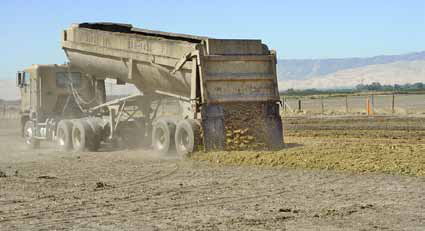
The material is typically loaded into trailers at the processing plant and then hauled to participating agricultural sites around the county. It is unloaded onto fields, spread out by a grader and allowed to dry, and within a few days disked into the soil.
See By-products on Page 7
Cattle crossbreeding study draws industry attention
In Angus herd, Hereford-sired cattle showed seven-percent increase in pregnancy rates
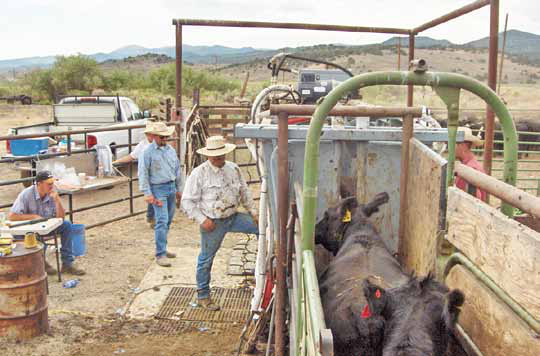
A crossbreeding study conducted by animal science researchers at California State University, Chico has suggested that the current commercial beef cattle market, dominated by the Angus breed, could be better served by implementing crossbreeding strategies.
David Daley, associate dean of the College of Agriculture and administrator of Chico State’s University Farm, directed the three-year study, which found an economic advantage to using Hereford bulls over Angus bulls in a predominately straight-bred Angus cow herd. His published results have generated significant national interest in crossbreeding programs.
“In recent years Angus cattle have been effectively marketed to consumers for quality grade (marbling) and tenderness,” Daley noted. Crossbred animals, however, are generally expected to exhibit hybrid vigor resulting in advantages in traits such as longevity, health and reproductive fitness, which directly affect net profitability to the producer.
The hypothesis of the project was that there would be an economic advantage to crossbreeding, especially in the finishing phase, Daley said. The study was conducted on ranches in central and eastern California. Angus cows were mated to both Hereford and Angus bulls under typical western range conditions.
Pregnancy rates increase
Pregnancy rates on yearling heifers that had been identified back to Hereford or Angus sires were collected in years two and three, Daley reported. In both instances, there was a seven-percent advantage in pregnancy to the Hereford-sired cattle (93 vs. 86 percent) in a relatively short breeding season where heifers were bred with artificial insemination.
“The long-term implications of higher pregnancy in yearling heifers are dramatic,” Daley said. “This allows for deeper culling of either mature cows or replacement heifers and/or the opportunity to grow the cow herd because of a higher calving rate.”
The economic data suggest crossbreeding has the potential to significantly boost return in a vertically coordinated marketing system, Daley said.
The research was funded in part by the California State University Agricultural Research Institute (ARI), with additional support from the American Hereford Association, Lacey Livestock, Harris Ranch Feeding Co. and Harris Ranch Beef Co.
As a result of the study, the American Hereford Association and other breeders donated cattle and embryos to help launch a Hereford program at CSU, Chico, Daley reported.
The breeding program also offers another area of field experience for university students, said Daley, giving them the opportunity to interact with industry professionals.
For more information about the study, contact Daley at 530-898-6343 or e-mail him at ddaley@csuchico.edu.
Update is published quarterly by the California Agricultural Technology Institute at California State University, Fresno
Jordan College of Agricultural Sciences and Technology
Joe Bezerra, CATI Director of Operations
Steve Olson, Publications Editor
Phone 559-278-2361 • Fax 559-278-4849
Web http://cati.csufresno.edu
Update Spring 2011
Publication #110401
Center for Agricultural Business (CAB)
Study shows strength of U.S. farm exports
Newly-released figures on agricultural production in the United States show that despite the recent economic downturn, U.S. agricultural trade remained relatively healthy.
The information was outlined recently in a report prepared by Mechel Paggi, director of Fresno State’s Center for Agricultural Business (CAB), and shared at the annual meeting of the Southern Agricultural Economics Association.
“Our analysis was the result of a request to look at the nation as a whole and regionally,” Paggi said. “It shows that agricultural trade provides a significant contribution to the U.S. economy and creates positive effects in the non-farm sectors as well.”
In compiling his report, Paggi researched information from various U.S. export and trade agencies, including Global Ag Trade Statistics; the U.S. Department of Agriculture’s Foreign Agricultural Service; and Foreign Trade Statistics.
“We found that the United States is a net exporter of agricultural products, and this trade surplus helps offset a portion of the U.S. non-farm trade deficit,” Paggi said.
For example, in 2009, despite a fall in commodity prices, U.S. agricultural exports were valued at $98.5 billion, second largest amount in history. With imports valued at $71.7 billion, the agricultural trade sector recorded a positive trade balance of $26.8 billion that year.
Compare that with the nation’s deficit in non-farm trade, Paggi said: In 2009 nonfarm exports were worth $957.6 billion, while imports cost the country more than $1.4 trillion, creating a trade deficit of about $530 billion.
| Sector | Economic activity |
|---|---|
| Farm | $80 billion |
| Food Processing | $65 billion |
| Services | $67 billion |
| Manufacturing | $44 billion |
| Trade & Transportation | $22 billion |
Farm product values increase
Another phase of the report showed that farm product values, as a proportion of total U.S. exports, have increased steadily in the past decade. In 2000 for example, agriculture exports accounted for 6.6 percent of total U.S. exports, Paggi reported. That figure has grown annually to where in 2009, farm products made up 9.3 percent of total U.S. exports.
In another phase of his report, Paggi outlined the positive impact of agricultural production and exports on other sectors that support the flow of farm commodities.
Using an established input-output model for determining community-impact analysis, Paggi determined that the $98.4 billion in farm exports generated an additional $280 billion in economic activity in the United States (see chart above left for details).
| Sector | Jobs |
|---|---|
| Farm | 742,000 |
| Food Processing | 112,000 |
| Manufacturing | 70,000 |
| Trade & Transportation | 172,000 |
| Services | 457,000 |
Employment resulting from agricultural exports included direct farm employment of 742,966 jobs, as well as related non-farm employment of 812,852, for a total of 1.6 million jobs (see chart above for details).
“These jobs resulting from agricultural exports reflect the economic activity that is stimulated as farmers purchase inputs for production, and as commodities are harvested, transported and stored,” Paggi said.
The U.S. Congress is currently considering trade agreements with Korea, Colombia and Panama, as well as a Trans-Pacific Partnership that would create new markets for U.S. farm exports, Paggi noted.
In addition, the successful completion of the Doha Development Agenda is important because of potential economic gains associated with increased exports, Paggi said.
For more information on trade, contact Paggi at mpaggi@csufresno.edu.
Upcoming events
Nov. 10 – 30th Annual Agribusiness Management Conference at the Radisson Hotel and Conference Center in Fresno, California. For more information, call 559-278-4405.
For more information on these and other upcoming events related to agricultural business and labor issues, visit Fresno State’s Center for Agricultural Business website at http://www.csufcab.com.
Center for Food Science and Nutrition Research
USDA grant bolsters student opportunities
Funds enable purchase of new equipment, enhancing capacity for research
Food science and related research programs at Fresno State received a boost this year thanks to a $245,000 grant from the U.S. Department of Agriculture.
The funds will support the acquisition of new equipment for the Graduate Laboratory, which operates as part of the Jordan College of Agricultural Sciences and Technology (JCAST).
“Modernizing our Graduate Laboratory will help us to train the next generation of scientists and technologists to address California and the nation’s research and development needs,” stated Gour Choudhury, professor in the Department of Food Science and Nutrition and principle author of the grant application.
To sustain growth and remain competitive in a global market, California agriculture and the food processing industry need extensive research and development activities, Choudhury explained. Unfortunately, a wide gap exists between these needs and the availability of scientists and technologists. “Extensive investment will be required to close the gap,” he said.
In keeping with Fresno State’s strategic plan to promote world-class agriculture and to solve regional issues, Choudhury has led efforts in the Jordan college to design graduate programs that link student research experiences to solving food and agricultural problems faced in California’s Central Valley.
“These programs are critical for growth and development of the industry,” he said.
The college’s Graduate Laboratory has been operating since 1994, and much of the original high-quality equipment has become worn or simply outdated.
Choudhury teamed with lab director Denis Bacon and plant science Professor Sharon Benes to seek the new equipment funding from several sources, including the USDA’s Hispanic-serving Institutions program, which responded with the award.
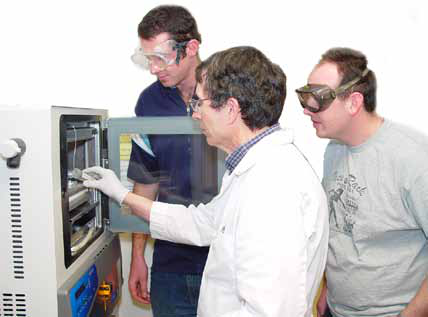
Upgrading the laboratory and its equipment “will bring about significant improvement in the instructional capability of four graduate programs in our college, and it will enable faculty to deliver advanced training emphasizing recent advances in food and agricultural sciences,” Choudhury said.
Other benefits of the upgrade include the ability to attract high-level graduate students to JCAST programs, to showcase the facility as a potential partner for regional and international programs, and to enhance the potential of grant funding for graduate research.
The major pieces of equipment purchased and installed include an atomic absorption spectrophotometer ($50,000), a freeze dryer ($31,000), a microwave digester ($25,000), and a fat extractor ($23,000).
Additional equipment includes an ultra-low freezer (to -86C), a viscometer, a digital colony counter, a laminar flow hood, a micro centrifuge and a shaking water bath.
The reorganized lab with its new equipment will only enhance the university’s ability to collaborate with industry partners seeking solutions to industry challenges, Choudhury said.
“Our improved infrastructure will enhance our academic environment for such collaborations. With this grant, graduate education has an excellent future in our college,” he said.
Center for Irrigation Technology
Center Pivot set up for demonstration
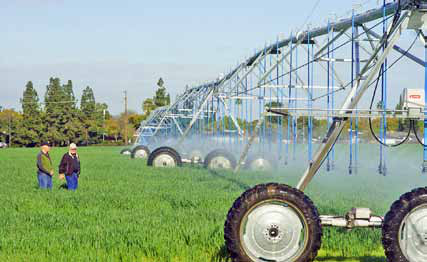
CIT agricultural engineer Ed Norum (left) and mechanized agriculture professor Ken Heupel monitor progress of the new center pivot system installed on the university farm.
Water use experts from Fresno State and a major irrigation equipment manufacturing company hope that a new system installed on the university farm will attract positive attention from the Central Valley’s agricultural industry.
The center pivot system, donated by Valmont Irrigation based in Valley, Nebraska, was installed to serve as a research and educational tool for the university and a promotional exhibit for the company, which distributes all over the United States and the world.
“The flood irrigation mentality is ingrained in people in this area, and I think that many in agriculture don’t have the feel for what it takes to run a central pivot system,” stated Ed Norum, agricultural engineer for the Center for Irrigation Technology (CIT), which is partnering in the project. “This demonstration plot will show what a pivot system can do.”
The technology of the center pivot system goes back decades, and it is used extensively in the Southwest and Midwest United States. For a variety of reasons, it has not been widely adopted in California, Norum said. One reason may be that canal and ditch delivery systems which crisscross the state encourage growers to stay with flood irrigation – a traditional and relatively reliable system, he noted.
In the center pivot system, the unit operates from a pivot point in a field. A galvanized steel framework lined with hanging sprinklers rotates around the center pivot; drive wheels which move the frame are powered by electric motors. A main pipe attached to the center pivot carries the water under pressure to the sprinklers. The water can come from a well on site, a reservoir, or other source. A single pivot system can irrigate anywhere from 10 to 450 acres. Most cover about 130 acres, Norum said.
“Our intent in bringing the system to Fresno State was to get a current, state-of-the-art machine at the university for training and demonstration,” said Ray Batten, California territory manager for Valmont. “The California market has had a low adoption rate up until now, partly because they’ve had such a reliable water delivery system,” he noted. “However, all those things are changing. Growers are getting more interested in our equipment for reducing costs and enhancing efficiency.”
Pumping efficiency program continues with new direction
The Agricultural Pumping Efficiency Program (APEP), directed by Fresno State’s Center for Irrigation Technology (CIT), has changed its name to better reflect its targeted clientele; it is now called the Advanced Pumping Efficiency Program.
The Pacific Gas and Electric Company is funding APEP through 2012 using the Public Purpose Programs Fund under the auspices of the California Public Utilities Commission.
Eligibility for the program extends to all owners or users of a non-residential PG&E electric or natural gas account that is primarily used for pumping water for the following: production agriculture; landscape or turf irrigation; municipal purposes, including potable and tertiary-treated (reclaimed) water, but excluding pumps used for industrial processes, raw sewage, or secondary-treated sewage.
APEP continues to offer free education and technical assistance (though no site-specific engineering is provided), subsidized pump efficiency tests, and incentives for retrofit of inefficient pumps. Incentive rates increased slightly in 2011.
More information on the revised program, including important qualifying requirements, is outlined on the APEP website at http://www.pumpefficiency.org. Customers may also call the main program office at 1-800-845-6038.
Viticulture and Enology Research Center
Researchers explore alternative weed management strategies
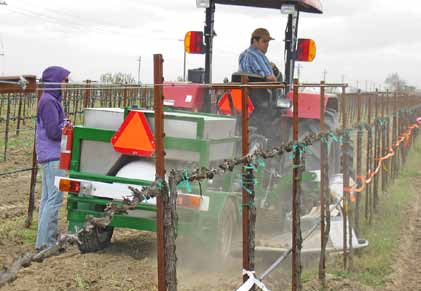
A Stinger steam weed control machine is being driven by undergraduate student Andrew Beebe as graduate student Nathalia Mourad monitors the computer settings.
Prompted by market forces and environmental considerations, many wine, table and raisin grape growers in the San Joaquin Valley are considering converting their operations from conventional to organic or other production systems with less reliance on pesticides.
Because such systems have to rely on alternatives to conventional herbicides, weed management is often one of the greatest challenges and can result in increased production costs. In response to industry requests for help in addressing this problem, a research team led by Fresno State plant science specialist Anil Shrestha has stepped up to examine some alternative weed control methods to determine their efficacy, environmental impacts, and cost-effectiveness for larger operations.
“Mechanical weed removal or hand weeding can be effective but prohibitively expensive, and cultivation may generate dust, which is a regulatory issue in the San Joaquin Valley,” Shrestha said.
As part of his study, Shrestha is examining three organically-acceptable methods of weed control: thermal, mechanical, and organic herbicide application.
Thermal involves the use of steam, accomplished by a mechanical device called a Stinger. The mechanical method features a French plow as well as a Bezzerides cultivator, specially designed for use in vineyards. An organically accepted herbicide also has been included in the study.
A key part of the project will include determining the overall energy use of each weed control method.
“In recent years, assessment of ‘carbon footprint’ or greenhouse gas emissions from farm operations has been considered an important component in determining the sustainability of agricultural cropping systems,” Shrestha said. “Grape growers in California are increasingly interested in better understanding its footprint.”
The experimental treatments are being conducted in grape vineyards of two industry cooperators – Sunmaid in Kingsburg and West Coast Grape Farming in Madera.
Treatment plots have been established in each location. In addition to regular measurements of weed species biomass, researchers have been carefully tracking vine growth and crop yield, Shrestha said.
See Weed Control on Page 8
VERC director’s paper addresses wine astringency
A leading international academic journal has published a review of the role of tannins in wine coauthored by James A. Kennedy, Ph.D., recently-appointed director of Fresno State’s Viticulture and Enology Research Center (VERC).
Kennedy, along with Jacqui M. McRae of the Australian Wine Research Institute, published the review in the March issue of Molecules, an open access journal of synthetic organic and natural product chemistry.
The paper addresses how tannins in grapes and wine interact with human salivary proteins to produce the sensation of astringency. Better understanding of these relationships will enable wine makers to use methods such as micro-oxygenation and fining to further improve the quality of wines, Kennedy said.
To access the article, visit the journal website at http://www.mdpi.com/1420-3049/16/3/2348.
By-products: Guide will have broad application
from Page 1
Geologist Horacio Ferriz from Stanislaus State oversaw measurements of irrigation water infiltration through different types of soils, as well as the movement of salts.
“Water and salts carried by the by-products do move through the soil,” Ferriz observed, “but the impact can be minimized by careful selection of sites where the by-products are applied, and by efficient irrigation management.”
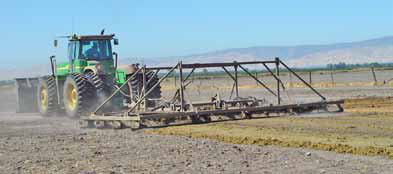
Food processing by-product is dumped onto agricultural fields and spread out to dry before it is disked into the soil.
While all participants agree that by-product application enhances soil quality, county and state water quality officials wanted to ensure that salts or metals contained in the by-products do not reach high levels, where they could eventually leach into groundwater aquifers.
“The bottom line is, we are treating by-product application as part of a grower’s soil fertility program,” Pasakdee said. “The manual outlines practices that must be followed to ensure that a nuisance is not created and that there are adequate protections of both surface and groundwater as well as soil quality.”
The publication discusses the permitting process required to apply by-products in Stanislaus County, site preparation, soil and plant sampling, record keeping, methods to minimize challenges associated with by-product application, and other issues.
It is titled “Manual of Best Practices for Application of Food Processing By-products on Farmlands” and is available free of charge to growers, food processors and other interested persons. The practices outlined in the manual are applicable beyond the Stanislaus County geographic area, Pasakdee said. For more information or to obtain a copy, contact Pasakdee at spasakdee@csufresno.edu or call CATI at 559-278-2361.
Other partners in the study were Dellavalle Laboratory, where soil samples were analyzed, and the Stanislaus County Department of Environmental Resources.
Industry partners included Mape’s Ranches & Lyons’ Investments, and Del Monte Foods. Partial project funding was provided by the California State University Agricultural Research Institute (ARI).
Organic farming workshop set for April 28
The latest techniques and information related to organic farming will be discussed at the upcoming Organic Farming Workshop and Field Day, set for Thursday, April 28, at California State University, Fresno.
The event will feature presentations by specialists in organic farming. Topics include weed and pest control, and soil fertility management.
The workshop begins with registration at 8:30 a.m. and includes a free lunch, followed by field demonstrations and a tour of the organic farm.
Event sponsors include Fresno State’s California Agricultural Technology Institute (CATI) and Big Tree Organic Farms. The classroom presentations will be held at the CATI conference room, located on the Fresno State campus at 2910 E. Barstow Ave.
Walk-in registration is welcomed; however, pre-registration is requested for lunch. DPR credits are approved for this workshop. To register, visit http://www.Organicalmond.info or email info@bigtreeorganic.com.
Research Day planned
The Jordan College of Agricultural Sciences and Technology (JCAST) will host a Faculty Research Display from 11- 5 p.m. May 4 at the Claude Laval WET (Water & Energy Technology) Incubator, JCAST Graduate Laboratory and Viticulture and Enology Research Center at Fresno State. For details, visit http://jcast.csufresno.edu/researchday.
Weed control: ‘Footprint’ of methods to be measured
from Page 6
Comprehensive results for the different treatments will include effectiveness of weed control method, impact on crop yield and quality, economic costs, and greenhouse gas emissions.
“Based on the results of each practice, we will develop recommendations based on efficacy and cost,” he said.
The study began last spring and will continue for two seasons, Shrestha said. Once completed, findings will be disseminated to California grape growers through research and extension reports, as well as presentations at local and regional conferences and meetings.
For more information, Shrestha may be contacted at ashrestha@csufresno.edu. Partial funding for this project is from the California State University Agricultural Research Institute (ARI). Among the collaborators on the project are viticulture specialist Mathew Fidelibus from the University of California, Davis.
Center Pivot: Switch over to new system will require ‘culture change’ for growers
from Page 5
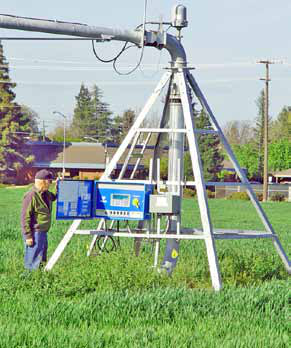
CIT agricultural engineer Ed Norum monitors control panel for new center pivot irrigation system at Fresno State’s University Farm.
Batten said a center pivot can rival drip for efficiency. However, it’s a different type of system – with lots of large metal parts, and it moves – which involves a “culture change” for growers intending to adopt it.
A center pivot system typically requires less mechanical maintenance than a linear self-propelled system and has a longer lifespan than drip systems, Norum said. It is adaptable to many types of crops, including most field and grain crops, even trees in some cases.
As part of the contract agreement between the university and Valmont, CIT irrigation specialists will oversee demonstrations, as well as tests comparing the center pivot system to flood and other types of sprinkler and drip irrigation systems. Tests will address water use efficiency, energy use and crop performance.
Individuals interested in demonstrations or training should contact Norum at edwardn@csufresno.edu for more information. For more info about the equipment, contact Batten at rbatten@valmont.com or call 214-727-8535.
Address Return Requested
California State University, Fresno
California Agricultural Technology Institute
2910 E. Barstow Ave., M/S OF115
Fresno, California 93740-8009
Non-Profit Organization
U.S. Postage
PAID
Fresno, CA
Permit No. 262
This HTML version was generated with AI assistance and may contain errors or omissions. The original approved PDF remains the official document of record. An alternative accessible format is available upon request from the document creator in accordance with Title II of the ADA.