Update Winter 2010-11
Winter 2010-11
In this issue:
- 2 Examining muscle mechanisms
- 4 Thriving on research
- 5 Addressing West Side salinity
- 8 Controlling tadpole shrimp
In composite image at left, Francisco Barraza, farm manager for Paramount Farms, places protective cover on newly-planted pomegranate tree in experimental plot in Parlier, California.
Pomegranate trials examine irrigation needs of “emerging” crop
A team of irrigation research specialists from the U.S. Department of Agriculture has joined with Fresno State’s Center for Irrigation Technology (CIT) to launch a new study on the irrigation needs of pomegranate.
The project aims to help California’s agricultural industry respond to growing consumer demand for the distinctive, tough-skinned fruit, stated James Ayars, research agricultural engineer for the USDA’s Agricultural Research Service based in Parlier, California, a few miles east of Fresno.
Pomegranates have been grown worldwide for as long as most people can remember but haven’t been widely popular simply because they are difficult to peel and eat. A tough, leathery skin surrounds clusters of pulp-covered seeds that have to be plucked out individually to be eaten. Yet pomegranates are known to be a good source of antioxidants, and that feature has attracted new consumers looking for natural ways to improve their health.
“As the general population becomes more health conscious, there is an emerging need to find crops that will provide improved nutrition and health benefits,” Ayars stated. Pomegranate, identified as a fruit with many nutritional and health benefits, has been recognized as an emerging crop in California. Pomegranate is also thought to be drought and salt tolerant, which makes it attractive to farmers with saline soils and facing water shortages.
“However, very little is known about the water requirements for pomegranate or the effects of soil quality on production,” Ayars said.
“Since surface irrigation may be inefficient, production with alternative methods needs to be evaluated,” he said. Drip irrigation has been characterized as very efficient and is gaining wide acceptance for perennial cropping in California. “Studies are needed to evaluate the water requirements for pomegranate and to determine its suitability for production on a range of soil types using alternative irrigation systems.” Ayars said.
As part of the project, Ayars has overseen establishment of a three-acre surface-drip-irrigated test plot of pomegranate at the San Joaquin Valley Agricultural Sciences Center – USDA-ARS facility in Parlier. Researchers will use two large weighing lysimeters to determine specific crop water requirements for the trees during crop development.
Each weighing lysimeter is planted with two trees and irrigated with drip irrigation. The scale can accurately record the amount of water applied to and used by the trees it holds.
“The lysimeters will help us to determine water requirements and crop coefficients for newly-planted pomegranate trees,” Ayars said. “These data will be suitable for use in irrigation scheduling and water allocation by irrigation districts.”
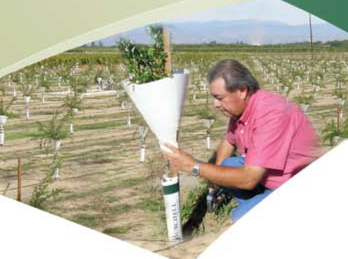
Photo shows one of two weighing lysimeters that will record water use of two trees.
Partial funding for this project was provided by the California State University Agricultural Research Institute (ARI), with additional support by Paramount Farms. For more information on this project, contact Ayars at james.ayars@ars.usda.gov.
Examining muscle mechanisms
Study of Paylean effects on pigs may provide new insights into growth of human muscle tissue
A research specialist from California State Polytechnic University, Pomona is delving deep into the muscle fibers of pigs in an effort to help pigs, and humans, turn the food we consume into more healthy lean muscle instead of fat.
Biology Professor Robert Talmadge is studying the mechanisms by which muscle is built with the support of a grant from the California State University Agricultural Research Institute (ARI). His work is focused on the effects of Paylean®, a feed supplement used to increase growth efficiency in the swine industry.
“A feed supplement has been developed that changes the way nutrients are used, in that calories normally stored as fat are shifted to lean muscle tissue,” Talmadge said.
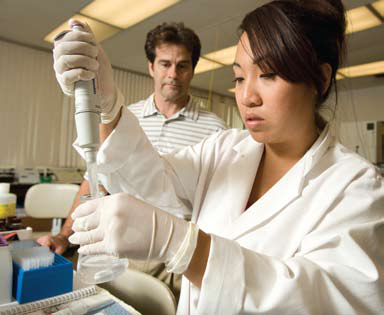
Cal Poly Pomona biology student Cathryn DeGuzman assists Professor Robert Talmadge in preparing to examine the effects of Paylean on pig muscle tissue.
“The net effect is a larger animal that has a leaner body.”
Paylean has been approved by the federal Food and Drug Administration for use in the swine industry. It contains ractopamine hydrochloride, a small molecule that increases muscle protein growth and improves feed efficiency.
The net effect of Paylean supplementation is a larger animal that has a leaner body, Talmadge said. However, questions remain about exactly how it works.
“There are multiple cellular and molecular pathways by which the accumulation of muscle mass may be stimulated. We have designed experiments in pigs that will show which of these pathways are the targets of Paylean,” Talmadge said. If the feed additive targets a single pathway, this opens the possibility of developing a supplement that will target a different pathway.
“This could further benefit feeding efficiency with the net result being increased productivity while perhaps minimizing the environmental impacts of feedlots,” he said.
Work has broader application
Talmadge’s work has implications beyond the barnyard. Studies have shown that all mammals, including humans, use the same pathways to build muscle mass and store calories as fat or muscle; thus his findings from the pig study should open new insights into what might work in the human diet.
Paylean use is not without controversy. Some members of the swine industry have contended that Paylean is harmful, causing muscle distress and other health problems. Label instructions for the drug warn it is not for human use and advise handlers to use protective coverings when mixing or handling. Based on those warnings, some consumers have questioned the safety of pork that has been exposed to Paylean.
Talmadge said that his work is specifically focused on pig muscle fibers and how they respond to Paylean. Safety concerns for humans are legitimate and must also be addressed before the drug would ever be approved for human use.
Another potential benefit of Paylean could be for those who suffer from muscular atrophy due to various conditions or diseases, the researcher noted. For more information on this work, Talmadge may be contacted at rjtalmadge@csupomona.edu.
Update is published quarterly by the California Agricultural Technology Institute at California State University, Fresno
Jordan College of Agricultural Sciences and Technology
Joe Bezerra, CATI Director of Operations
Steve Olson, Publications Editor
Phone 559-278-2361 • Fax 559-278-4849
Web http://cati.csufresno.edu
Update Winter 2010-11
Publication #110101
Center for Agricultural Business
India cotton study aims to aid California producers
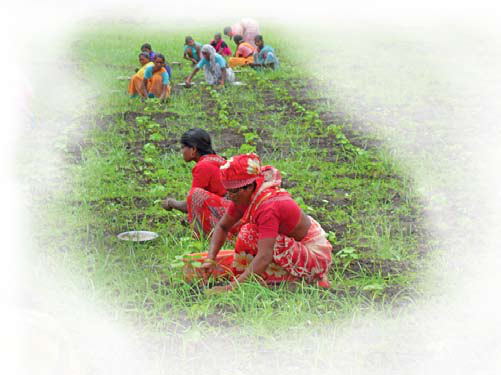
Women field workers plant cotton seedlings in Gujarat province, India.
Economics specialists from Fresno State’s Center for Agricultural Business (CAB) have engaged in an effort to help U.S. cotton farmers – by studying production costs in India.
The work has resulted in a report titled “Indian Government Policy and Producer Profitability in Gujarat and Maharashtra: Implications for U.S. Cotton Exports.” The study was funded in part by a grant from Cotton Incorporated, the producer-financed research and promotion organization.
Coauthoring the document are Agricultural Business Department Assistant Professor Srinivasa Konduru, CAB senior research economist Fumiko Yamazaki, and CAB Director Mechel Paggi.
India is major global exporter
“Recent technological advances and trade liberalization have increased India’s role as a major player in international cotton markets,” Paggi said in outlining the study. “It is a direct challenge to U.S. cotton exports, especially in markets like China. A better understanding of the Indian cotton production system will allow U.S. cotton producers to assess their competitive position and allow for long-term strategic marketing planning.”
Though the U.S. and India are in competitive positions, colleagues in the two largest Indian cotton producing provinces of Gujarat and Maharashtra assisted the Fresno State researchers in their visit to the area and the survey of production costs and practices, Paggi said.
“You might call it ‘overt’ intelligence gathering, when we are allowed to examine their production practices,” Paggi said.
The primary objective of the study was to determine what factors influence the profitability of Indian cotton production, Paggi said. In some cases it may be government support payments. But other factors also come into play, such as the cost of labor and other inputs like water, pesticides and fertilizer.
Dual degree program graduates first class in Beijing, China
The Jordan College of Agricultural Sciences and Technology (JCAST) is anticipating its first class of graduates from the China 1+2+1 Dual Degree Program this spring. The program provides an opportunity for Chinese students to attend their own university for one year in China, study two years in the United States and then finish their final year back home. The Fresno State program, initiated in 2008, has enrolled 10 students, four of whom will graduate in Beijing this spring after spending two years at Fresno State, said Bill Erysian, manager of grants and international projects for JCAST.
“The 1+2+1 Dual Degree Program is one of the premier educational opportunities currently available to Chinese university students, and Fresno State’s Jordan College is proud to be an active partner,” Erysian said. “The program provides a great opportunity for our students to interact with their Chinese counterparts and brings a new level of diversity to our campus.”
The dual degree program is part of a larger university effort to better prepare both Fresno State and Chinese students for new opportunities in agricultural trade between the two countries, noted Mechel Paggi, director of the Center for Agricultural Business (CAB).
CAB supports not only the dual degree program but also other new efforts focusing on Chinese agriculture and food issues, such as the development of the Agricultural Business Department’s study abroad program in China. The overall goal is to help prepare undergraduate students for opportunities in global business markets, Paggi said.
Center for Food Science and Nutrition Research
Thriving on research...
Graduate students in food science program emerge ready, willing and highly qualified for entry into industry positions
Research activities overseen by Fresno State’s Center for Food Science and Nutrition Research (CFSNR) provide an important educational pathway for Fresno State students who have earned their bachelor’s degree. Graduate-level research enhances the development of professional-level problem-solving skills that will be required for entry into industry positions.
“Advancing graduate education has been identified as one of the goals of the university’s Strategic Plan for Excellence,” noted Gour Choudhury, CFSNR director and one of the lead researchers in Fresno State’s Department of Food Science and Nutrition. “In keeping with this goal, the center has invested considerable resources in advancing the graduate program in food science and nutrition.”
In the spring and summer of 2010, the center oversaw master’s degree work for nine students. One of those, Fredie Pacudan, was honored as dean’s medalist from the Jordan College of Agricultural Sciences and Technology upon his graduation in May 2010. Another grad student, Preetam Sarkar, was recently admitted to a Ph.D. program at Purdue University, where he will pursue his advanced degree in nanoscience.
Addressing industry issues
According to Choudhury, Fredie played a key role in developing and testing an “eco-friendly” lye peeling system that Choudhury has been working on for several years with industry partner Wawona Frozen Foods of Clovis, California. The goal of the project is to significantly reduce fresh water consumption and discharge during peach processing.
Fredie served as the lead research technician for the project, running processing line experiments at Wawona, collecting samples and conducting data analysis at the CFSNR lab at Fresno State, Choudhury noted.
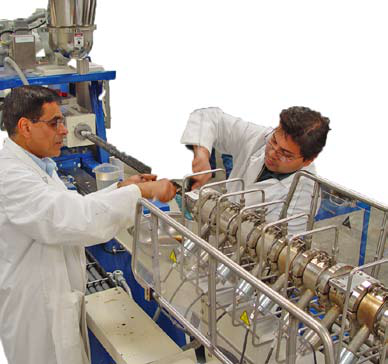
Food science Professor Gour Choudhury (left) adjusts extruder settings with the help of graduate student Preetam Sarkar during a recent demonstration for pistachio industry representatives.
Graduate students work on various projects that aim to enhance the efficiency, safety and profitability of the regional food processing industry, Choudhury said. For example, student Christina Bawana is seeking to develop an edible coating that can be sprayed on fresh fruit to expand its supermarket shelf life. The treatment has the potential to prevent skin oxidation, preserve firmness, control moisture loss and reduce microbial growth.
Other graduate student research includes development of a yogurt beverage containing enhanced nutritional properties; analysis of pistachio shells and hulls as a media base for mushroom production; and development of new food products from prickly pear using extrusion technology.
The CFSNR’s investment in graduate student research has paid off not only for the students, but for the regional food processing industry.
Wawona recently hired one of Choudhury’s students direct from graduation into its own product development department, reported Duncan Dowdle, director of quality assurance and technical services.
“We have found that the students in Dr. Choudhury’s program are well disciplined achievers,” Dowdle said. “The majority of them have come out very well prepared. They have been exposed to industry issues and are problem solvers. They know how to handle the day-to-day mechanics of industry issues and problems,” he said.
For more information about food science research opportunities through the CFSNR or the Department of Food Science and Nutrition, contact department chair Sandra Witte at 559-278-2164 or center director Choudhury at gchoudhury@csufresno.edu.
Center for Irrigation Technology
Remote sensing addresses West Side salinity problems
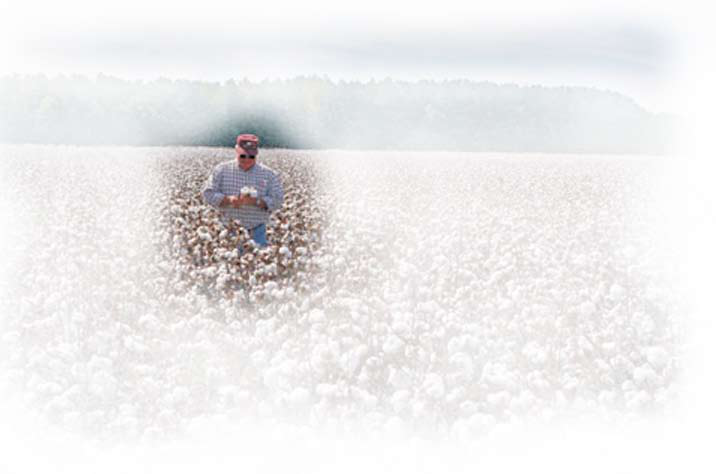
Farm producers on the San Joaquin Valley’s West Side and in other areas affected by poor soil quality have more tools to help them improve their farming techniques, thanks to recent studies by soil specialists with Fresno State’s Center for Irrigation Technology (CIT).
Soil scientist Florence Cassel Sharma recently concluded a study of remote sensing techniques for improving soil and crop management practices. The study featured the use of soil-salinity measuring technology pioneered at CIT in recent years, combined with aerial imaging to measure plant growth and vitality.
“Soil salinity is a critical problem in many farmlands of the San Joaquin Valley,” Cassel Sharma said. “Salinity affects crop production and has to be managed. Soil salinity surveys and vegetation maps can help identify and characterize this spatial variability.”
As part of her work, Cassel Sharma conducted salinity surveys of several cotton and pistachio fields exhibiting soil salinity problems on the West Side near Lemoore, California. The six fields surveyed are farmed by Azcal Farm Management, the industry partner in the project.
The research team used a Mobile Conductivity Assessment (MCA) system developed at CIT to determine soil salinity levels at multiple locations in each field. Following development of the soil salinity profiles, aerial images characterizing plant vigor were obtained for each field and compared with salinity maps.
Overall study results showed that the use of remote sensing techniques, i.e., electromagnetic induction and aerial imagery, improved the knowledge of salinity and plant vigor variability across fields. These techniques can help growers and the agricultural industry conduct site-specific cultural and irrigation management practices at the field scale in order to reduce the effects of soil variability and to homogenize yields, Cassel Sharma stated.
For more information and technical details of the study, contact Cassel Sharma at fcasselss@csufresno.edu. This work was partially funded by California State University Agricultural Research Institute (ARI).
Pomegranate: Findings will aid growers in developing irrigation schedules
from Page 1
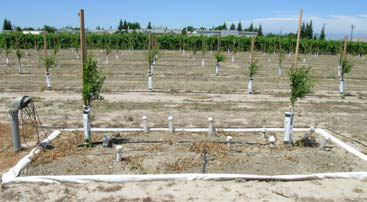
Each weighing lysimeter is planted with two trees and irrigated with drip irrigation. The scale can accurately record the amount of water applied to and used by the trees it holds.
“The lysimeters will help us to determine water requirements and crop coefficients for newly-planted pomegranate trees,” Ayars said. “These data will be suitable for use in irrigation scheduling and water allocation by irrigation districts.”
Partial funding for this project was provided by the California State University Agricultural Research Institute (ARI), with additional support by Paramount Farms. For more information on this project, contact Ayars at james.ayars@ars.usda.gov.
Viticulture and Enology Research Center
Study reveals no correlation between “hang time” and wine grape quality
A study to determine whether prolonged “hang time” of red wine grapes will enhance wine quality has indicated no such correlation in warmer regions such as Fresno, California, according to a recent report from scientists at Fresno State’s Viticulture and Enology Research Center (VERC).
The effects of what the industry calls “hang time” have been a topic of discussion for many years, noted VERC viticultural research specialist and professor Sanliang Gu in releasing findings from a two-year study of the effects of hang time.
“Delayed harvesting with hang time beyond 24-25 Brix has been widely discussed and practiced by some in recent years to obtain more fully developed fruit flavors and to enhance wine quality,” Gu said. “Our overall goal was to determine if hang time improves wine grape fruit quality while monitoring its impact on vine health in the region.”

Results of the study did show higher fruit levels of Brix, pH, amino-nitrogen and potassium in grapes when harvest was delayed. However, negative effects included reduced levels of anthocyanins, tannins and phenolics, which provide essential color and flavor to wine.
“We determined that hang time does not improve and could possibly lower wine grape fruit color and flavor components while reducing yield,” Gu said. “Since it does not offer any significant benefit but possible negative impacts, hang time to delay harvesting beyond commonly accepted Brix of 24-25 should be avoided.”
For details, Gu may be contacted at sanliang@csufresno.edu. Partial funding for this project was provided by the California State University Agricultural Research Institute (ARI), with additional support from the wine grape and irrigation industries.
Upcoming events
A new series of workshops will focus on how to influence berry development and flavor through vineyard management. The series is hosted by Fresno State’s Department of Viticulture and Enology (DVE) and Viticulture and Enology Research Center (VERC). Cosponsors include the San Joaquin Valley Winegrowers Association, Allied Grape Growers, and other industry partners. Advance registration fee for all three workshops is $125, or $50 in advance for individual sessions. For more information, contact Cynthia Wood at cynthiaw@csufresno.edu or visit the San Joaquin Valley Winegrowers at www.idrinkwine.net. Dates and topics are as follows:
- Feb. 11 – “Understanding berry development and how berries develop flavor.” James Kennedy, Ph.D., VERC director and DVE chair, will discuss general berry development and associated issues.
- May 5 – “Managing your vineyards for this season’s flavor.” Kaan Kurtural, Ph.D., Bronco Wine Company viticulture chair for VERC, will present research findings and discuss irrigation and canopy management strategies that influence berry flavor.
- Oct. 20 – “Berry sensory analysis and training for growers and winemakers.” Speaker to be determined.
International experts to share insights at wine microbiology symposium
The 2nd Annual International Wine Microbiology Symposium set for March 29 and 30 at Tenaya Lodge Yosemite will feature national and international experts from five continents of the world discussing key issues of wine making.
Sponsored by Fresno State’s Department of Viticulture and Enology and key regional grape and wine industry partners, the event will feature two days of discussions led by enologists and microbiologists from France, Italy, Spain, Chile, Sweden, Denmark, South Africa, Canada, New Zealand and Australia, as well as specialists from key wine-making regions of California.
Discussion topics will include microbial metabolism, malolactic fermentation, microbial ecology and yeast selection.
“The conference will feature speakers from all aspects of wine microbiology and highlight the latest discoveries by academic and industrial researchers, and it will provide a forum for winemakers to express what developments they would like to see in wine microbiology,” said Roy Thornton, Ph.D., Fresno State microbiologist and chair of the organizing committee.
General registration fee for the event is $699. However, significant discounts are available for early registration and for students.
For additional information on the conference and accommodations at Tenaya Lodge, visit Fresno State’s viticulture and enology website at http://jcast.csufresno.edu/ve/ winemicro.
Jimenez-Flores presses forward in dairy research
The Dairy Products Technology Center at Cal Poly San Luis Obispo has become a recognized hub of dairy science research for California and the nation, thanks to the ongoing work of a dedicated professor and an inspired ensemble of faculty, staff and student research partners.
In honor of his work, fellow faculty and administrators recently awarded dairy science Professor Rafael Jimenez-Flores with the university’s Distinguished Scholarship Award. The honor is given to two faculty members per year in recognition of outstanding achievements in research, creative work and professional development activities.
Jimenez-Flores has been a leader in research seeking to better understand the nutritional components of milk and dairy products and how they can improve the human diet. Since joining the Cal Poly faculty in 1995, he has directed nine projects funded by the California State University Agricultural Research Institute (ARI).
More recently Jimenez-Flores has focused on applications of molecular biology and physical chemistry to a key component of milk called the milk fat globule membrane (MFGM). New methods of studying this component at the molecular level, called proteomics, show promise for unleashing additional nutritional benefits of dairy products.
According to Susan C. Opava, Ph.D., dean of Research and Graduate Programs at Cal Poly, Jimenez-Flores has successfully advanced practical knowledge through applied science while bringing creativity to newer fields such as molecular biology.

Dairy science Professor Rafael Jimenez-Flores (left) accepts congratulations upon receiving Cal Poly San Luis Obispo’s Distinguished Scholarship Award.
A key to his winning this year’s award is Jimenez-Flores’ ability to develop relationships with fellow faculty and students who share his passion for research.
“He involves so many different faculty across campus in his work,” Opava said. “He has really been a leader in getting faculty to work together and leverage their collective expertise to bring in project funding, as well as funding for the acquisition of major resources.”
Jimenez-Flores has authored more than 70 peer-reviewed papers and 10 book chapters and holds three patents. In the last year he has served as advisor for seven graduate students and two postdoctoral fellows.
Cotton: Study findings will help U.S. to clarify trade negotiation strategies
from Page 3
Other inputs like water, pesticides and fertilizer.
“For example, fertilizer prices can be subsidized and help to reduce growers’ production costs,” Paggi said. “The question we were asking is, ‘How profitable would the farmer be without these subsidies?’”
As part of the study, Paggi and Konduru met with farmer focus groups in the two study regions and discussed production methods and costs. The researchers also were given access to government production records. The result is a summary of findings that adds more light to the issues affecting Indian export cotton prices.
“We found that the government’s minimum support price hasn’t really done that much lately given the recent run up in world cotton prices,” Paggi said. “But it shows that without the fertilizer subsidies, farmers will incur almost double the expenditures to what they are incurring with the subsidies.”
Information of this type is critical for officials to know when it comes to discussions about domestic and trade policies, Paggi pointed out.
“This way, when it comes to trade negotiations, we’re able to discuss the full range of policies whether they are direct government price support payments or something else,” he said.
For a copy of the study report, or for more information on global trade issues regarding cotton, contact Paggi at CAB at 559-278-4405 or via email at mpaggi@csufresno.edu.
Patent pending for tadpole shrimp control
California rice growers are soon going to lose one of the most reliable products on the market for controlling tadpole shrimp, a small invasive pest that can have devastating impacts on rice fields and continues to be a threat to the industry.
The good news is that when copper sulfate is phased out of the market – due to federal hazardous materials regulations – a new, effective and safe agent will likely be available in its place.
Fresno State professor and biologist Brian Tsukimura recently submitted provisional and U.S. patent applications for a compound that will control tadpole shrimp without the “hazardous chemical” label.
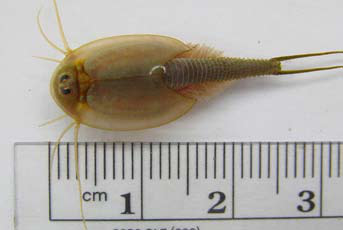
Methyl farnesoate pellets were effective in reducing the reproductive capacity of tadpole shrimp, pictured at left.
“We have been studying the regulation of reproduction in the tadpole shrimp through hormonal control,” Tsukimura stated in a recent report to the California State University Agricultural Research Institute (ARI). “We have developed a pellet that is useful for both laboratory studies of reproduction and for field control of tadpole shrimp reproduction.”
The key compound in the pellet, methyl farnesoate (MF), has been found to inhibit ovary development in juvenile tadpole shrimp, essentially preventing the crustacean pest from reproducing. The patent includes a special food packaging of this crustacean hormone within the pellets that the shrimp eat.
Tsukimura and his research team, which has included more than a dozen Fresno State graduate and undergraduate students, began searching for an alternative to copper sulfate in 2000 at the request of the California Rice Board, which co-funded the work along with ARI.
“We are working with a local agricultural company to develop the data necessary to acquire Environmental Protection Agency (EPA) and Cal/EPA certifications,” Tsukimura said. “We are also acquiring USDA registration for organic status for the product.” The goal is to go into production by 2013, he said.
Additional cooperators in the research included Koda Farms of Dos Palos, California and the University of California Cooperative Extension.
For updates on the final processing work and production timelines, contact Tsukimura at briant@csufresno.edu.
Address Return Requested
California Agricultural Technology Institute
California State University, Fresno
2910 E. Barstow Ave., M/S OF115
Fresno, California 93740-8009
Non-Profit Organization
U.S. Postage
PAID
Fresno, CA
Permit No. 262
This HTML version was generated with AI assistance and may contain errors or omissions. The original approved PDF remains the official document of record. An alternative accessible format is available upon request from the document creator in accordance with Title II of the ADA.