Update Summer 2010

Summer 2010
In this issue:
- 2 Tracking coastal forest disease
- 4 Adding value to pistachios
- 5 Targeting saline soils
- 7 Going organic
Basic training in agriculture
U.S. Marines learn basic agricultural principles during training hosted by Fresno State’s Center for Agricultural Business. They will work with farming communities in war-torn provinces in Afghanistan to encourage problem solving, more efficient farming practices and food security.
The Center for Agricultural Business (CAB) is expanding its global networking capabilities through a new alliance with the California State University Consortium for International Development (CID).
CAB and the CID cemented their partnership recently and will work together to further similar goals — enhancing agricultural and economic development at home and in countries around the globe.
CAB specializes in agricultural economics research, training and information sharing, while the CID, established in 2005, focuses on developing international partnerships.
The pairing under CAB’s administration seemed the perfect step to boost program efficiency and effectiveness, said CAB director Mickey Paggi.
Networking nets early results
One of the first positive outcomes of the new partnership occurred recently when Fresno State provided a week of basic training in agriculture to a small detachment of U.S. Marines. They are part the 3rd Civil Affairs Group of the 11th Regiment of the 1st Division stationed at California’s Camp Pendleton, and they are charged with a special mission in Afghanistan: to take some of the key practices they learned at Fresno State to some of the war-torn provinces in Afghanistan, where they will work with farming communities to encourage problem solving, more efficient farming practices and food security.
Bill Erysian, program coordinator for the CID, invited the service personnel to Fresno State based on a relationship he developed two years ago when a delegation of Iraqi agriculturalists visited the university escorted by a unit of Marines.
“The Marines were impressed with what we offered here,” Erysian said. So when the CID designed a rapid training program for Afghanistan, they quickly accepted.
“Just about everything that grows in Afghanistan happens to grow here in the Central Valley, so we were at a very good learning location for this project,” Erysian said.
See Training on Page 3
Pathogen threatens coastal forests
Research team monitors disease spread, seeks to develop control methods
An invasive forest pathogen is threatening millions of native oak trees along the central and northern coast of California and in southwest Oregon. It’s a water mold species called Phytophthora ramorum; and according to scientists tracking its spread, it has caused epidemic levels of a disease called “sudden oak death” in the coastal regions mentioned above.
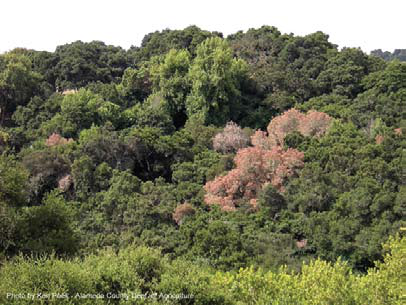
Research specialist Walter R. Mark, professor of natural resources management at California Polytechnic State University, San Luis Obispo, is part of a team of California scientists not only tracking sudden oak death, but looking for ways to stop it. His work has been supported by funding from the California State University Agricultural Research Institute (ARI).
“Phytophthora is a large genus of widely distributed water molds that cause many economic and ecological problems in agriculture and forestry,” Mark said in outlining his research.
More than 40 plant species are potential hosts for the mold, enabling it to inhabit a variety of forest and ornamental plants. Among its host species, P. ramorum causes two forms of disease: lethal branch or stem infections, and non-lethal foliar and twig infections.
The lethal form of the disease kills several important trees, including tan oak, coast live oak, black oak, canyon live oak and Shreve’s oak.
Although it can take several years to fully infect a tree, once that happens, the tree’s leaves can “suddenly” turn brown within weeks, thus the name sudden oak death. Thousands of trees have been infected in coastal forest areas north of San Francisco as well as in Santa Cruz and Monterey counties.
From host plants, the mold typically spreads through rainsplash and wind, in stream water, and in soil transported by animals or humans. It is believed to have arrived in California through contaminated nursery stock brought in from outside the state.
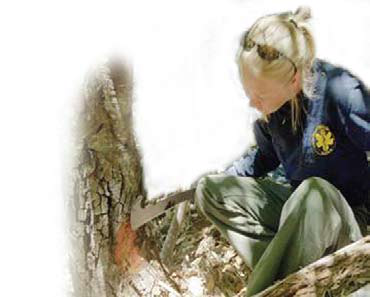
“It is critical that we gain an understanding and ability to predict disease spread in order to develop effective strategies for detection, management, and prevention,” Mark said. A process called spatial modeling is one method scientists have used for detection. Spatial modeling involves physically observing plant material in specially mapped grids and recording host infections. Spread of the mold to other plants is then monitored, along with other factors such as wind, rainfall, temperature and humidity.
As part of the mapping project, Mark oversaw student and staff research teams which plotted transects of five
See Infestation on Page 8

Update is published quarterly by the California Agricultural Technology Institute at California State University, Fresno
Jordan College of Agricultural Sciences and Technology
Joe Bezerra, CATI Director of Operations
Steve Olson, Publications Editor
Phone 559-278-2361 • Fax 559-278-4849
Web http://cati.csufresno.edu
Update Summer 2010
Publication #100701
Center for Agricultural Business
Ag business units join forces

The new partnership between Fresno State’s Center for Agricultural Business (CAB) and Consortium for International Development (CID) will enable university experts in business and agriculture to collaborate with industry professionals in a variety of worldwide settings.
The consortium is backed by faculty from five California State University campuses with strong agricultural and business programs. The campuses include Fresno State, Cal Poly San Luis Obispo, Cal Poly Pomona, Chico State and Humboldt.
“An obvious strength of the consortium is that the five campuses are located in different agricultural regions, each with its own horticulture production profile,” noted coordinator Bill Erysian. “Consortium experts offer farmer-to-farmer technology transfer on a variety of horticulture commodities including orchards, vineyards, grains, fruits and vegetables.”
In addition to horticulture, the CID also is a resource for advanced technologies in the areas of irrigation and water resource management, animal health, animal science, forestry, natural resource management, and conservation education.
The CID maintains a database of more than 400 faculty and industry specialists with international development experience. Industry representatives and educators are encouraged to contact Erysian or CAB Director Mickey Paggi with ideas of possible collaborative ventures involving research and technology transfer in agricultural business.
For more information visit the CAB website at http://cab.cati.csufresno.edu. Contact Erysian at berysian@csufresno.edu or Paggi at mpaggi@csufresno.edu, or call the CAB office at 559-278-4405.
Training outlines principles for aiding Afghan allies, cont’d from pg. 1
During their training week in June, the civil affairs team learned about key crops grown both here and in Afghanistan. Instructors included Paul Sommers of Cal Poly Pomona, who discussed table and raisin grapes, almonds, pomegranates, vegetables and wheat. Participants also learned about soils, irrigation systems, livestock, marketing, and post-harvest crop treatments.
Included among the presenters were Paggi, who gave a market overview of Afghanistan agriculture and rural development, and Cal Poly San Luis Obispo animal science specialist Robert Rutherford, who discussed livestock issues.
Horticulturist Paul Sommers from Cal Poly Pomona explains orchard crop development.
Several Fresno State researchers from the Center for Irrigation Technology shared information on soil salinity, fertilizers and irrigation systems.
“We’re not trying to make Afghan farmers American farmers,” Erysian said, “but we’re working to earn the trust of the Afghan people by offering useful information they can use in growing their crops.”
For more information about the CID, visit http://www.csucid.com
Center for Food Science and Nutrition Research
Extrusion adds value to pistachio
Scientists at Fresno State’s Center for Food Science and Nutrition Research (CFSNR) are using innovative food processing systems to invent new products for on-the-go consumers.
Professor Gour Choudhury is seeking to convert pistachio nuts into tasty new snack foods using extrusion technology.
“American consumer demand for convenience-type foods that combine nutrition with desirable sensory characteristics is increasing rapidly,” Choudhury stated in outlining his work. While ready-to-eat (RTE) food products are rapidly replacing traditional products in supermarket aisles, consumers are increasingly aware of the health and nutritional importance of food constituents, Choudhury noted.
Pistachio nuts contain vitamins, minerals, protein and fiber, as well as antioxidants. Following harvest, nuts are normally processed, packaged, then sold as roasted, coated, sliced and diced nuts. However, the product range in this category is limited because of fixed composition and geometry of the nut, Choudhury said.
“Such limitations can be overcome by converting the solids into flour and using it as a nutrient-dense ingredient for extruded food products,” he said.
Extrusion involves a form of pressure cooking. First a food product is rendered into a dry flour mixture. Water is added to form a dough; then the mix is piped through a series of chambers, where nutrients and other ingredients are added to bring new flavors and character. What emerges is a dried, puffed product.
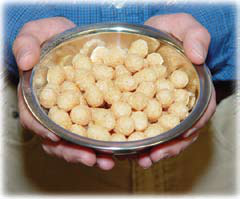
“Laboratory experiments are being carried out to determine compatibility of pistachio flour with other ingredients that influence final product appearance, color, texture and flavor,” Choudhury said.
Different extrusion products will be analyzed for appearance, texture, flavor, and potential for use as snack foods or additives to other products.
Donations of equipment, cash and in-kind services for the work indicate strong interest by the regional food processing industry in value-added pistachio products, Choudhury said.
“A new generation of ready-to-eat food products will position the pistachio industry to market its product in new areas,” he said.
Project work is being conducted in the CFSNR’s pilot-plant at Fresno State. First product reports and analyses are to be completed later this year, Choudhury said. For more information, contact the CFSNR at 559-278-5924 or Choudhury at gchoudhury@csufresno.edu.
Fresno State student research technicians Preetam Sarkar (left) and Fredie Pacudan operate software that manages the pistachio extrusion process.
Center for Irrigation Technology
Targeting saline soils
Researchers test new approach for developing crop coefficients
A team of plant and soil scientists from Fresno State and the University of California is working to provide new water-use estimates for crops grown under saline conditions on the West Side of California’s San Joaquin Valley.
Leading the work at Fresno State is Diganta Adhikari, an irrigation scientist for the Center for Irrigation Technology (CIT). Among several key partners in the work is biometeorology specialist Richard Snyder of the Department of Land, Air and Water Resources at UC Davis.
The goal of the project is to develop a portable weather station that West Side water districts, or large growers, can use to directly measure crop evapotranspiration (ET). This would improve irrigation efficiency with water containing high levels of salt, boron and selenium.
“Crop evapotranspiration data is already available for most crops,” Adhikari noted. “But when salinity comes into the picture, everything changes. ET (evapotranspiration) for crops can be lower if the soil or water salinity is high enough to substantially reduce growth. We basically do not have those numbers.”
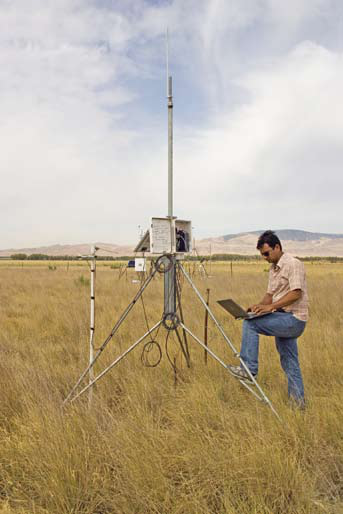
To develop accurate ET information for a crop, scientists use data gathered from an agrometeorology weather station placed in a nearby grass field. The station measures air temperature, humidity, wind speed and other environmental conditions. The weather data are used to estimate reference evapotranspiration (ETo), which is roughly equal to the ET of a well-watered pasture grass. In California, the California Irrigation Management Information System (CIMIS) provides ETo information for most agricultural areas.
Considerable research to determine crop coefficient (Kc) values has been conducted over the years. However, a key need for the West Side is salinity coefficients to account for high salinity soils or crops irrigated with water high in salts, Adhikari said.
“The water districts started calling us, saying ‘we know how much water is needed under normal conditions, but we want to know the needs under saline conditions,’” he said.
Water conference info now accessible on line
A wealth of water information is available as a follow-up to the 2010 Water Technology Conference.
The event focused on innovations that will help to enhance water use efficiency. Sponsors included Fresno State’s International Center for Water Technology (ICWT) and the Center for Irrigation Technology (CIT).
Major areas of discussion and talks included agricultural, urban, and water treatment and supply issues. Speakers provided PowerPoint files highlighting main points and details of their presentations, and those files are available on the ICWT website. To access them, visit the website at http://www.icwt.net and click on the link to the 2010 conference.
The research team is working to refine a measurement method developed more than 15 years ago by Snyder and colleagues at UC Davis. Called “surface renewal,” the method features a portable weather station that uses energy balance data to estimate the actual ET.
The team is using the surface renewal system to develop crop coefficient (Kc) and salinity coefficient (Ks) values for ‘Jose’ tall wheatgrass and creeping wildrye, both salt-tolerant forage grasses being studied for use as a feed supplement for cattle and other livestock.
The ultimate objective of the project is to provide West Side growers with ET estimates for crops grown under saline conditions, Adhikari said. Project conclusions are expected to be released next year. For more information, contact him at diganta@csufresno.edu.
Viticulture and Enology Research Center
Grape Day coming in August
Grape Day 2010 is set for August 10 at California State University, Fresno’s Viticulture and Enology Research Center (VERC) and the 1,000-acre University Farm.
Known as one of the premier viticulture and enology events in the central San Joaquin Valley, Grape Day attracts growers and winemakers from across California and the West. The purpose is to disseminate results of the latest research in viticulture, enology and grape microbiology. Presenters will include faculty, staff and student researchers from VERC and the Department of Viticulture and Enology.
“Our goal is to make a positive impact on the grape and wine industry by providing programs that will make a difference in the daily operations of the growers and winemakers who attend,” stated Cynthia Wood, event coordinator for VERC.
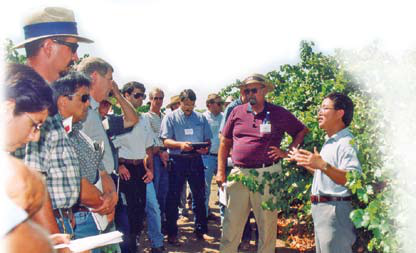
Presentations will outline viticulture research projects being directed by Kaan Kurtural, who holds the Department of Viticulture and Enology’s Bronco Wine Co. Viticulture Chair. Kurtural is overseeing research on various new approaches to canopy management, including mechanical pruning and deficit irrigation. Grape varieties used in various trials include Cabernet Sauvignon, Pinot Grigio and Shiraz.
Another viticulture research scientist, Sanliang Gu, will oversee several presentations. Gu, who holds the Ricchiuti Chair of Viticulture at VERC, is conducting research on application of abscisic acid to vines to determine its effects on tannins, phenolics, and ultimately color.
Microbiologist and research scientist Roy Thornton will present results of recent work on quantification of grape rot by Fourier Transform Infrared Spectroscopy (FTIR) and the use of Raman Spectroscopy.
Other Grape Day activities will include wine sensory analysis training by wine microbiologist Susan Rodriguez and tours of the Fresno State Winery led by award-winning winemaster, researcher and professor Ken Fugelsang.
Grape Day 2010 is a half-day event concluding with lunch. For more information about Grape Day or related events, visit the Department of Viticulture and Enology website at http://jcast.csufresno.edu/ve.
Scientists study new methods to evaluate microbial rot on grapes
California’s wine industry continues to search for improved methods for evaluating the condition of wine grapes ready for delivery to the winery.
Fresno State microbiologists Roy Thornton and Susan Rodriguez are assisting in that effort by developing new methods for evaluating microbial rot that is caused by various types of fungi, yeast and bacteria that can permeate the skin of the grape berry.
At harvest time most wineries have “sugar stands” where grapes can be measured for sugar content and other characteristics. Since the quality of the grapes helps to determine the price paid to the grower by the winery, inspections at these stands must be accurate.
While sugar content can be precisely measured using state-of-the-art equipment, analysis of microbial rot is a much more complicated task.
So with the support of the Wine Grape Inspection Program through the American Vineyard Foundation, along with the California State University Agricultural Research Institute (ARI), Thornton and Rodriguez are evaluating new instruments that may provide consistent and accurate measurements of microbial rot.
The researchers’ student associates will present preliminary details of research results at the upcoming Grape Day 2010, to be held at Fresno State’s Viticulture and Enology Research Center Aug. 10.
Chico State dairy goes organic
Research focuses on nutrition intake, pasture feeding
Awards have begun to arrive for high quality organic milk production at the Chico State dairy.
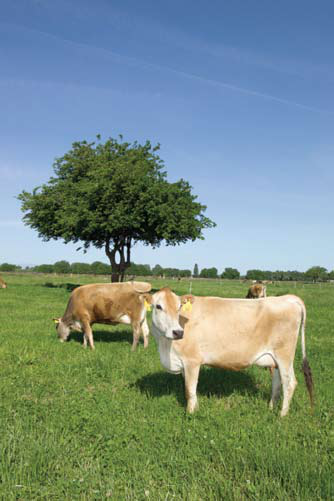
For the second straight year, the facility has been honored with a Silver Milk Quality Award by Organic Valley, a farmer-owned cooperative that promotes organic farming.
Located on the university farm near campus, the Chico State dairy converted to organic production in 2007 under the leadership of animal science Professor Cynthia Daley.
“Organic dairy farming in the United States continues to gain momentum,” Daley said in outlining her initial vision for the conversion project.
“While sales trends continue to climb for organic dairy products, little information is available on production practices, economics and marketing,” she said.
With support from the university’s College of Agriculture, Daley launched the effort to create a teaching and research unit for organic dairy production. Its purpose is to “lay a foundation for economic and applied research to support sustainable dairy production practices in the West.”
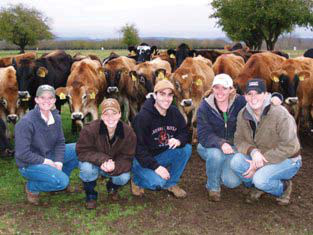
Gaining funding support from the California State University Agricultural Research Institute (ARI), Daley began a conversion process which involved changing the nutrient and supplement mix of the animals’ daily feed ration. Part of the process included grazing the cows on pasture adjacent to the dairy.
A second project objective was to assess marketability of the organic label through local retail sales, consumer surveys and consumption patterns, and to determine the actual value of the organic label with regard to dairy products.
Efforts bring success
The operation is succeeding in both areas, Daley said. The milk quality award from Organic Valley is based on low somatic cell count in the milk, indicating healthy cow udders. The Chico dairy also is showing a profit — its milk is purchased by a regional farmer-owned cooperative for distribution to local organic outlets, and sales indicate there is a market for the product.
According to Daley, the organic dairy unit seeks to involve students in meaningful niche marketing, and to expose students to a new production paradigm. In addition to student education, the unit involves the community and industry in applied research and education.
Continuing ARI-supported research at the dairy includes a study of nitrate leaching in irrigated pasture used for grazing.
“The dairy industry is in need of alternative production models that exemplify ‘Best Practices’ to prevent environmental contamination and guarantee clean water for generations to come,” Daley said. “There is considerable European data to support the notion that organically farmed soils leach less nitrogen, provide for more efficient biological nutrient cycling, and produce less runoff and soil erosion as compared to conventional farming practices. We think this is an interesting model to study here in the United States, to see how this system fits with sustainable production practices in Western ecosystems.”
Results of the nitrogen-leaching study are expected to be released next year. For more information, contact Daley at cdaley@csuchico.edu.
Infestation: No-host barriers may be built in effort to halt disease spread
from Page 2
by 150 meters in both public and private forest lands in Santa Barbara County through San Mateo County. The teams then walked and inspected every tree and plant within each plot for presence of infection. In all, 2,000 transects were plotted statewide. The data were input into software programs and combined with geographic information systems (GIS) data to produce statewide models predicting disease spread.
Findings based on three years of data collection and analysis indicated that multiple factors influence spread of the pathogen, including forest species and density, soil moisture, rainfall, air temperature and humidity, Mark said. Researchers noted that in some cases the higher forest density was due to human fire suppression activities which enhanced forest microclimate conditions and increased foliar pathogen hosts.
The spatial models predict that without changes in conditions, the pathogen will continue to spread southward along the coast, into San Luis Obispo and Santa Barbara counties. Mark said that he is now part of a team representing several state agencies, formulating strategies aimed at stopping or slowing the spread. Strategies for commercial and/or residential areas include spraying potential host trees with pesticides that help prevent infection.
In larger wildlife areas, the task is more daunting. One method involves bringing work teams into infected areas to cut down and burn infected trees. Mark is also working on a plan to develop a no-host barrier in San Luis Obispo County. It would consist of a contiguous strip of forest land 15 kilometers long and 10 wide; all foliar host plants in the strip would be cut and cleared to halt spread of the pathogen any further south.
“We are still doing survey research on this project. It will be costly, but if we don’t do anything, it will continue to spread,” Mark said. The original research team was comprised of plant scientists and forest management specialists from the California State University, the University of California, and the U.S. Forest Service. Cooperation between the same entities is continuing.
For more information on this project, contact Mark at wmark@calpoly.edu.
Address Return Requested
California State University, Fresno
2910 E. Barstow Ave., M/S OF115
Fresno, California 93740-8009
California Agricultural Technology Institute
Non-Profit Organization
U.S. Postage
PAID
Fresno, CA
Permit No. 262
This HTML version was generated with AI assistance and may contain errors or omissions. The original approved PDF remains the official document of record. An alternative accessible format is available upon request from the document creator in accordance with Title II of the ADA.