Update Fall 2010
In this issue:
- 2 Balloon assists in air study
- 5 Water plan gets federal boost
- 6 Winery supports research
- 7 VERC welcomes new leader
Canopy management trials help to restore wine grape harvest
The growing popularity of two relatively new California wine varieties has brought a boost to the wine grape growing industry in the San Joaquin Valley.
The cultivars Pinot Grigio and Shiraz have seen strong sales in recent years; and since more than 70 percent of grapes for those wines are grown in the valley, growers and bottlers have seen positive returns on their investments in these varieties.
A potentially serious production problem has arisen, however, and has prompted leading producers to request assistance from Fresno State viticulture research specialist Kaan Kurtural.
“What’s happening is that these large vineyards are not producing like they used to,” Kurtural said.
“It’s due to the lack of available labor to keep up canopy management in large-acreage commercial vineyards, after dormant pruning is done.”
Mechanical pruning is faster and more economical than hand pruning, but the settings used for controlling bud development in Pinot and Shiraz have proven suspect.
“During growing season we have seen a canopy that’s excessive, with too much vegetation, and they have had yield losses,” Kurtural said. “In some fields we saw production decline from 12 to 13 tons per acre to just three or four in a matter of five years,” he said. Also, the berries don’t get enough light, affecting quality.
Through the American Vineyard Foundation, industry leaders requested Kurtural to develop and test some new methods that could bring production back up for these varieties. So in consultation with a viticultural specialist from Bronco Winery and a mechanical pruning technician from Oxbo International, Kurtural developed several treatments to be incorporated and tested over the 2009-10 growing season in commercial fields managed by Bronco.
See Trials on Page 6
Balloon raises hopes for improved air quality
Years of study by Fresno State researchers attracts USDA attention, support for additional work
A big orange balloon in the sky... that’s what residents in Fresno spotted recently above the Fresno State campus.
While it may have looked like big kids playing with a great helium-filled toy, it was in fact a team of faculty and student researchers conducting sophisticated data recordings that will help to provide cleaner air in Fresno and the San Joaquin Valley.
Fresno State chemistry Professor Alam Hasson and assistant geography Professor Segun Ogunjemiyo are collaborating on the project. Hasson explained more:
“We’re using the balloon to try and understand more about how agricultural facilities such as dairies affect air quality in the region," he said. "We collect air samples, then we analyze the samples to try to understand the chemistry involved and what’s going on in the atmosphere.”
Using a weighted base stand and winch, research team members control the ascent and descent of the balloon with a thin steel cable. They attach different types of sensors and sample collection devices, such as vacuum canisters, to the cable.
Once the air samples are analyzed, researchers draw conclusions about what types of compounds may have been released into the air, and how temperature, humidity and wind flow affect their dispersion. Air samples also are simultaneously taken upwind of dairies to serve as a control for comparison of downwind samples, Hasson said.
Earlier research bears fruit
Fresno State professor Charles Krauter led initial air quality investigations in 2003 upon learning that dairy emissions data used by the California Air Resources Board was seriously outdated, leading regulators to faulty conclusions about emissions from dairies. Much has been learned since then, Hasson stated. In fact, recent studies have shown that animal feed rather than animal waste is the major emissions source from dairy facilities, he said.
The work at Fresno State, partially supported by the California State University Agricultural Research Institute (ARI) and the California Air Resources Board, attracted the attention of the U.S. Department of Agriculture, which invested $600,000 in the current work being conducted on campus.
“The USDA is interested because we don’t understand much about animal feeding operations. There’s not a lot of information out there,” said Steve Trabue, a visiting research chemist based at the Agricultural Research Service office in Ames, Iowa.
“Some of this information will be used to help us understand reaction mechanisms of the compounds emitted from dairy operations, and what potential they have for forming ozone,” Trabue said.
According to Hasson, Fresno state students, at both the graduate and undergraduate levels, have played an integral role in the project.
“We’re involving students from across multiple colleges. We’re giving them the opportunity to go out and work at USDA and get some experience there, so it’s really having a beneficial effect on the university and ultimately the region,” he said. "Over this and the next two years we’re looking at 30-plus students who will be positively impacted by this.”
Air quality research is extremely complex, Hasson noted. That's why partnerships are so important to help scientists understand what affects regional air quality, then make recommendations on what we can do to help improve it.
Those recommendations are coming regularly through research such as the sampling recently conducted at Fresno State. Reporting done for the Air Resources Board and other agencies will help in policy-making and regulation enforcement that will ultimately result in better air quality.
For more information on his air emissions research, contact Hasson via email at ahasson@csufresno.edu.
Fresno State students Julie Steele (in red) and Stacy Brown prepare to raise sensory equipment for air emissions study.
Fresno State students Kennedy Vu and Stacy Brown display a vacuum canister that will be raised to collect air
See Balloon on Page 8
Publication information
Update is published quarterly by the California Agricultural Technology Institute at California State University, Fresno
Jordan College of Agricultural Sciences and Technology
Joe Bezerra, CATI Director of Operations
Steve Olson, Publications Editor
Phone 559-278-2361 • Fax 559-278-4849
Web http://cati.csufresno.edu
Update Fall 2010
Publication #101001
Center for Agricultural Business
Economic outlooks top list of issues to be addressed at annual ag business conference
Economic uncertainties, international market instability, changing water supply policies, health care reform, food safety issues, pest and disease control programs: Add them up and you have a dizzying display of issues facing California’s agricultural industry.
Specialists in these key areas will do their best to sort out and explain them at the 29th Annual Agribusiness Management Conference set for Tuesday, Nov. 9, in Fresno, California.
“It seems every year we face a world of opportunities and challenges in the agricultural industry, and 2010 had not disappointed us,” stated Mechel Paggi, director of Fresno State’s Center for Agricultural Business (CAB). “The conference is a chance to examine where we have been and where we might be headed, and to help identify where our opportunities lie.”
Returning as opening speaker will be economics expert John B. Penson Jr., Ph.D., who will offer a macroeconomic outlook for California’s agricultural industry.
Penson is the Regents Professor and Stiles Professor of Agricultural Economics at Texas A&M University and an award-winning specialist in finance and economics.
Adding to Penson’s insights in a second address will be James Christie, president and managing partner of Bryant Christie Inc. (BCI). Christie has led a wide range of international marketing projects on behalf of BCI clients and has helped secure access for U.S. agricultural products in Australia, Mexico, China, Japan, and Chile. He will discuss global opportunities for California agriculture.
Following Christie will be George H. Soares, managing partner with Khan Soares & Conway, LLP, who will discuss the significance of the message and the messenger in the representation of agricultural interests in today’s multi-dimensional world. Under Soares' leadership his firm has been involved in drafting and influencing thousands of legislative and regulatory proposals affecting California agricultural interests.
The conference will shift from individual speakers to panel presentations in addressing the question: “No Water Bond – What Now?”
Offering one view will be Mario Santoyo, assistant general manager of the Friant Water Authority. Santoyo’s perspective arises from more than two decades of work on valley water issues and a leadership role in the California Latino Water Coalition. Joining him will be Jim Verboon, a Central Valley water farmer, former chair of the California Farm Bureau Water Committee and past chair of the bureau’s Natural Resources Committee.
Moderating the panel will be David Zoldoske, director of Fresno State’s Center for Irrigation Technology and executive director of water resources and policy initiatives for the California State University.
The final panel will discuss “New Policies, Programs and Dubious Issues” that can affect agriculture. Topics will include health care reform, food safety and traceability initiatives, and quarantine program impacts and options.
The half-day conference will be held at the Radisson Hotel and Conference Center and will conclude with lunch. It is organized by CAB and cosponsored by the Bank of America and California Agricultural Technology Institute (CATI).
Early registration fee is $100. Late or walk-in is $125. For details, call 559-278-4405 or visit the CAB web site at http://cati.csufresno.edu/cab.
Center for Food Science and Nutrition Research
Nutrition study features pistachio plan
Strengthened ties between California’s pistachio industry and Fresno State research programs have prompted a new line of research focused on improving human health.
Food Science and Nutrition Professor Lisa Herzig is seeking to build on previous work showing the value of nuts in human diets. She recently completed a study measuring the effects of pistachios on reducing health risk factors of individuals prone to certain diseases.
“In the United States alone, an estimated 47 million people are diagnosed with metabolic syndrome (METs), a multi-factorial risk factor for heart disease and diabetes,” Herzig said in outlining her study. Diet plays a key role in development of METs; underlying risk factors for the condition are obesity, inactivity, and poor eating habits.
“Finding new methods and approaches for prevention of METs is important as the numbers continue to increase,” Herzig said. Dietary interventions have proven to be beneficial, including studies that include the positive effects of walnuts, cashews, and almonds. However, insufficient research is available in relationship to the effects of pistachios on METs risk factors, she noted.
Pistachio research at Fresno State already is being conducted by Food Science Professor Gour Choudhury, Herzig noted. Choudhury’s work, supported by the Western Pistachio Association, is focused on developing value-added pistachio products using extrusion technology.
Through those established ties, Herzig gained association support for her study, which was to determine the effects of pistachios as a source of calories and nutrition in place of other commonly-eaten foods.
The eight-week regime included two diet programs to which volunteer participants were randomly assigned. One was a "heart healthy diet" (a specific regimen limiting calories and requiring certain nutritious food) with pistachios, and the other the same diet without pistachios.
Before and after the study, participants underwent health examinations that included measurements of blood pressure, blood glucose levels, lipid count, resting heart rate, weight and waistline.
Results from this initial study were not definitive, Herzig said. While results were positive for reduced lipid counts in cells, the numbers did not reach statistical significance.
“We did see an improvement in fasting plasma glucose levels in our pistachio treatment group, which is notable,” she said. “And we saw similarities with other studies concerning the lipid panels. That leaves us with some further hypotheses that we will have to explore.”
The 16 individuals who served as study subjects were recruited in the Fresno area through advertisements at local medical clinics. Under the diet plan, the participants were required to keep detailed records of foods consumed during the study period.
Students help to design study
Six Fresno State students from the food science program participated administratively, Herzig said. They helped to design the study, worked with the participants, and helped to run the health tests. Two students, Michelle Carrick and Mary Perez, completed master's thesis work as part of the study.
Herzig said she will explore further research on the value of pistachios in the diet as a way to improve human health. She also has plans to bring additional students in on childhood obesity prevention projects that are being developed.
The study was partially funded by the California State University, Agricultural Research Institute (ARI).
For more information on diet-related research and programs, contact Herzig at lherzig@csufresno.edu.
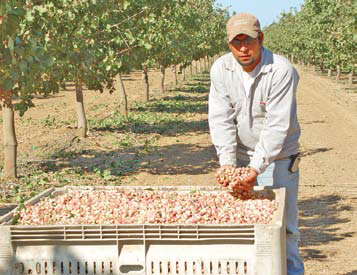
A representative of a commercial harvesting company shows pistachios harvested from an experimental orchard on Fresno State's university farm.
Center for Irrigation Technology
Irrigation methods will travel
CIT staff visit to Africa confirms universal need for testing to verify quality standards
The value of testing protocols as a tool for improving irrigation equipment has been proven worldwide, but sometimes and in some areas that concept needs reinforcement.
That was among the observations of Center for Irrigation Technology (CIT) staff in the African country of Malawi this summer on a mission to evaluate irrigation systems and equipment.
Ed Norum, agricultural engineer for CIT, was recruited by the U.S. State Department to travel to Malawi to consult with local engineers, government officials and farmers regarding their irrigation methods.
“I was asked to see what could be done to make their systems more effective,” Norum said.
Situated in the southeast of Africa, Malawi is about the size of California and borders Lake Malawi, the ninth largest lake in the world. The country enjoys annual rainfall averaging between 30 and 70 inches per year, depending on the region. About 85 percent of its people depend on agriculture for their livelihood, according to U.S. State Department figures.
While water sources are plentiful, farm production is conducted mostly on a small scale, often on family farms of less than an acre, with water directed to individual sections from canals and streams using human-powered treadle pumps or other types of pumps.
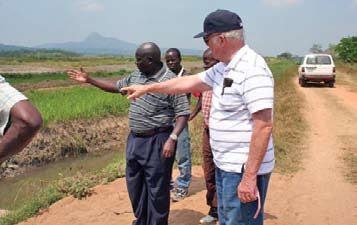
CIT agricultural engineer Ed Norum (right) joins with Malawi irrigation officials to examine water delivery systems in the African country.
One problem for the country is that most irrigation equipment is imported, and local dealers often make purchase decisions based solely on the quality claims of the importer. Then, when malfunctions or breakdowns occur, parts are seldom available. This is a common problem with different types of pumps.
One of Norum’s recommendations was for the government to mandate a quality control system enabling buyers to determine whether equipment they are purchasing has been tested and found to meet minimum quality standards.
“What we’re seeing is that recognized testing protocols need to be in place for the equipment brought in,” Norum said. “There has to be a seal of approval from a recognized independent, third-party agency.”
A key component of CIT’s mission is its testing and certification services, Norum said. Irrigation equipment manufacturers from across California and the United States regularly send equipment for testing in the CIT hydraulics laboratory.
As a designated representative agency of the Irrigation Association, CIT consults in the development of international irrigation equipment standards. Visitors from across the globe travel to Fresno State and CIT to learn about testing and certification, as well as CIT’s research and development programs.
For more information on testing programs, visit the center website at http://cati.csufresno.edu/cit.
See Irrigation on Page 8
San Joaquin Valley water plan gets $1 million federal boost
A $1 million federal Bureau of Reclamation grant has provided a needed boost to the development of a critical water use management plan being formulated for the San Joaquin Valley.
The plan is known as the San Joaquin Valley Integrated Regional Water Management Plan (IRWMP), an effort to meld dozens of varied interest groups, government agencies and business coalitions into one voice that will speak to both state and federal governments on behalf of valley water needs.
The IRWMP will merge entities from eight valley counties including San Joaquin, Stanislaus, Merced, Madera, Fresno, Tulare, Kings and Kern.
Work on the plan began in 2005. The recent federal funding allocation will support efforts for up to four more years, reported Sarge Green, water program specialist for the California Water Institute and project director for the IRWMP.
Eight San Joaquin Valley counties will be represented by the IRWMP.
“The bureau likes what we’re doing here, integrating all these local plans into larger regional plans and then to a valley plan,” Green said.
The next phase of work will involve creating entities with legal authority.
“We are facilitating umbrella efforts to join these agencies together. Once that’s accomplished, we will have an authority that speaks for the valley,” Green said.
Persons desiring more information or interested in participating may contact Green by calling 559-278-8653 or via email at sgreen@csufresno.edu.
Viticulture and Enology Research Center
Commercial winery supports research
Bronco's Cottonwood Creek facility designates space for trial wines
A new partnership between Fresno State’s viticulture and enology research program and Bronco Wine Co. has provided a commercial facility for wine-making research in the San Joaquin Valley.
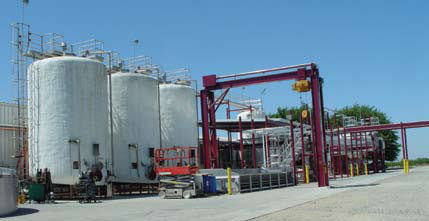
Bronco, the nation’s fourth largest winery, has provided space in its Cottonwood Creek facility for several research projects that will impact the wine industry in the region, reported Kaan Kurtural, viticulture research specialist for the university’s Viticulture and Enology Research Center (VERC).
Recently refurbished and expanded, Cottonwood Creek now maintains a 600,000-gallon annual production capacity, making it a medium-to-large-sized winery for the region, Kurtural said. It is located approximately 15 miles northwest of Fresno, California.
As part of an ongoing partnership (see article on Page 1), the winery is allotting space this year for several different trial wines which total about 70,000 gallons, more than 10 percent of the winery’s capacity. Bronco is based in Ceres, California.
Trials restore yields back up to 11 tons per acre, cont’d from pg. 1
They set up three dormant pruning treatments, including both hand and mechanical pruning and a combination of the two; three levels of mechanical shoot-thinning, and mechanical leaf removal during growing season.
Through all treatment combinations, the goal was to reduce canopy size and to provide more sunlight to the grape clusters, Kurtural said. The first season’s results were eye-opening.
“We brought up yields from four to five tons per acre to 11,” he said. “And we also saw better fruit color and smaller berry size. It looks like we have better fruit quality overall.”
Another positive result of the work was the number of Fresno State viticulture and enology students who were able to gain valuable research experience through the project. Over the last year 10 students, at both graduate and undergraduate levels, helped to set up field treatments, conduct sampling, and do analysis work in the laboratory. In August they were involved in the harvest and crush. Now several of them are involved in the wine-making process.
The final phase of the research is to test the wines made from the various treatments. Once all the wines are finished, samples will be collected and saved for chemical and sensory evaluation.
Researchers are seeking additional support to refine pruning techniques and to verify the positive results obtained in the first year, Kurtural said. For more information on this project, Kurtural may be contacted at kkurtural@csufresno.edu.
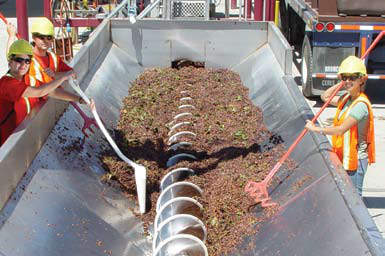
Fresno State students help in all phases of grape harvesting and wine making, including helping with the crush, shown below.
New VERC director recalls ag roots
The new director of Fresno State’s Viticulture and Enology Research Center (VERC) has invested in both the academic and commercial aspects of the grape and wine industry. Now he hopes to see that investment pay off for California and the San Joaquin Valley.
James Kennedy assumed his position in August, just in time for the harvest and crush of the 2010 season. He feels right at home, he said, having been involved in the grape and wine industry for more than 15 years on a professional level and virtually all his life – counting the recreational level.
“Where I grew up, our home was adjacent to the campus farm at University of California, Davis,” Kennedy recalls. “I used to play in the fields with my friends. I think that’s where I caught the ag bug,” he said.
His fervor for the industry seems only to have grown since then. After graduating from UC Davis with a chemistry degree in 1987, Kennedy worked in the pharmaceutical industry for several years before joining Ridge Vineyards as a quality control manager in 1993. Not long after, with a growing interest in the chemical complexities of grapes and wine, he decided to pursue doctoral studies at UC Davis, earning his Ph.D. in agricultural and environmental chemistry in 1999.
Following several years of teaching and research as a faculty member in the Food Science and Technology Department at Oregon State University, Kennedy accepted the position of research manager for chemistry at the Australian Wine Research Institute in Australia. But the pull of California agriculture proved strong, and he ended up relocating to the Central Valley to take the VERC director position.
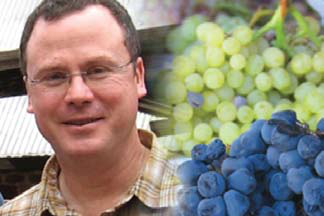
James Kennedy, director, Viticulture and Enology Research Center.
Established industry ties
Kennedy already has established ties with the region through his work as a wine chemist and as a researcher while at Oregon State. He likes what he sees and would like to see continued improvement in fruit quality without increasing production costs.
“My research goal while at Fresno State is to contribute to this effort,” he said.
What impressed Kennedy most about the viticulture and enology program at Fresno State is its connection to the industry.
“The program is ‘real’ here. Students and faculty seem to understand the real industry-world and how to operate in it. That’s what impresses me.”
Kennedy wants to build even stronger industry ties through continued improvements in VERC research programs, focusing not only on wine grapes, but also table and raisin grapes.
“State support for programs has dwindled, and the industry has been asked for additional support. Their expectations are high, and they should be high. I will work to meet those expectations,” he said. “In addition, I want to attract high-quality graduate students and high-level faculty to fill open positions. I plan to do everything I can to further enhance the reputation of our program.”
In his new role, Kennedy will devote about one quarter of his time to administrative duties and about 10 percent to teaching, he said. Approximately 30 percent of his time will go to industry outreach, and another 30 percent to research.
Kennedy takes over for former VERC director Bob Wample, who retired last year. For more information about VERC program research, visit the web site at http://cati.csufresno.edu/verc.
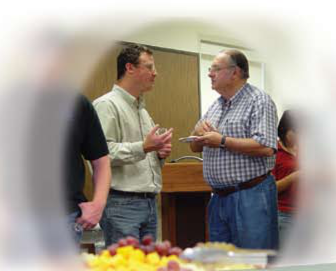
New VERC Director James Kennedy (left) visits with Roger Kerneur of California Growers Laboratory during a welcome reception in September.
Irrigation methods improve with testing, cont’d. from pg. 5
“What we’re seeing is that recognized testing protocols need to be in place for the equipment brought in,” Norum said. “There has to be a seal of approval from a recognized independent, third-party agency.”
A key component of CIT’s mission is its testing and certification services, Norum said. Irrigation equipment manufacturers from across California and the United States regularly send equipment for testing in the CIT hydraulics laboratory.
As a designated representative agency of the Irrigation Association, CIT consults in the development of international irrigation equipment standards. Visitors from across the globe travel to Fresno State and CIT to learn about testing and certification, as well as CIT’s research and development programs.
For more information on testing programs, visit the center website at http://cati.csufresno.edu/cit.
Balloon: Students gain experience
from Page 2
According to Hasson, Fresno state students, at both the graduate and undergraduate levels, have played an integral role in the project.
“We’re involving students from across multiple colleges. We’re giving them the opportunity to go out and work at USDA and get some experience there, so it’s really having a beneficial effect on the university and ultimately the region,” he said. "Over this and the next two years we’re looking at 30-plus students who will be positively impacted by this.”
Air quality research is extremely complex, Hasson noted. That's why partnerships are so important to help scientists understand what affects regional air quality, then make recommendations on what we can do to help improve it.
Those recommendations are coming regularly through research such as the sampling recently conducted at Fresno State. Reporting done for the Air Resources Board and other agencies will help in policy-making and regulation enforcement that will ultimately result in better air quality.
For more information on his air emissions research, contact Hasson via email at ahasson@csufresno.edu.
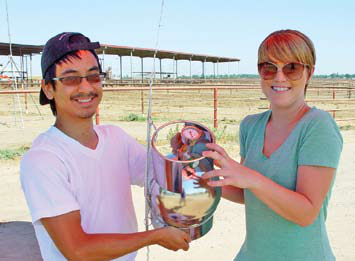
Fresno State students Kennedy Vu and Stacy Brown display a vacuum canister that will be raised to collect air
Address and mailing information
Address Return Requested
California State University, Fresno
California Agricultural Technology Institute
2910 E. Barstow Ave., M/S OF115
Fresno, California 93740-8009
Non-Profit Organization
U.S. Postage
PAID
Fresno, CA
Permit No. 262
This HTML version was generated with AI assistance and may contain errors or omissions. The original approved PDF remains the official document of record. An alternative accessible format is available upon request from the document creator in accordance with Title II of the ADA.