Update: Winter 2009-10
California Agricultural Technology Institute
Winter 2009-10
California State University, Fresno
In this issue...
- Paramount Citrus Lab........... 2
- Ag transportation study ........ 3
- Pump testing services........... 4
- Sustainable farm practices.... 6
Field research addresses mealybug infestation
Farm employees trained to recognize insect, set and inspect traps across more than 1,000 acres
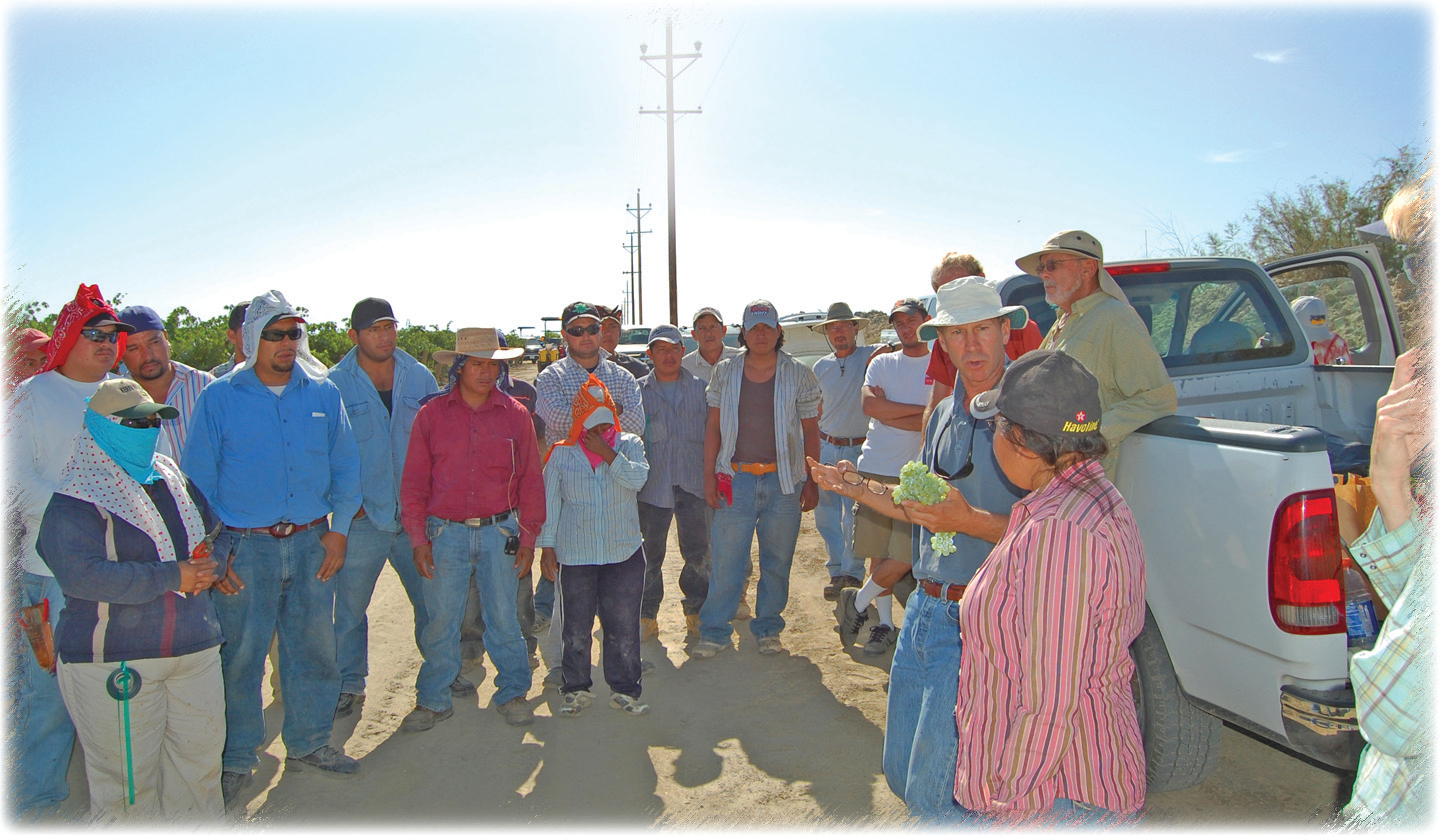
Above: University of California Cooperative Extension research specialist Kent Daane (in white hat, gesturing) leads a field training session for employees at Wolf Run Vineyards in Arvin, California. Employees were trained to identify damage to Zinfandel grape clusters.
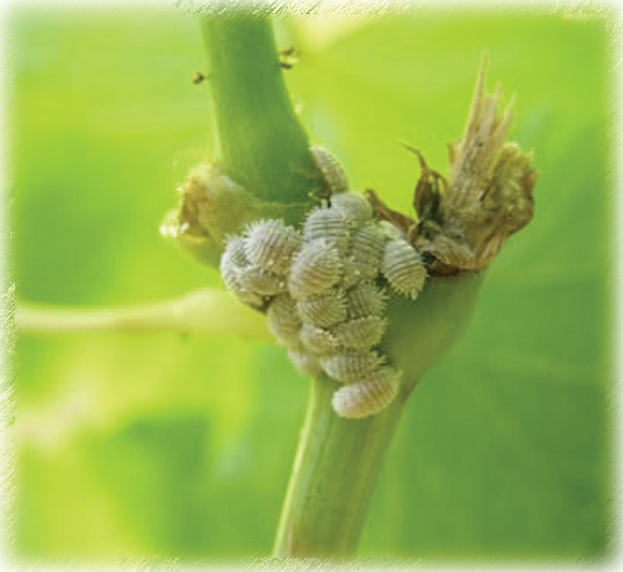
Closeup of vine mealybugs (photo courtesy of Vaughn Walton).
Tiny scale insects called grapevine mealybugs have become a costly nuisance for the wine grape industry in California’s central and southern San Joaquin Valley – so much so that one of the area’s largest wine grape growers, Bronco Wine Co., has sought help from Fresno State and the University of California, Berkeley in controlling the pests.
The result has been one of the largest field research experiments in recent years in the valley, covering 1,200 acres and employing up to 200 people in production and experimental control efforts.
Cooperating on the project for Fresno State is associate professor and viticulture research specialist Kaan Kurtural, Ph.D., who holds the Bronco Wine Co. research chair at Fresno State’s Viticulture and Enology Research Center (VERC). Co-leading the effort from the University of California, Berkeley is Kent Daane, Ph.D., cooperative extension specialist in entomology.
“Grapevine mealybug has become more detrimental to wine grapes in the San Joaquin Valley than Pierce’s disease,” Kurtural said in outlining the seriousness of the insect’s spread in this region. “It originally was more common in table and raisin grapes, but now it has found its way into wine grape vineyards as well.”
Grapevine mealybugs live on many types of plants, latching onto trunks and stems to suck the sap out. Besides weakening a plant’s health, the bugs excrete a sticky, waxy residue which can build up on stems, leaves, and fruit. On grapes, the residue, called honeydew, covers the fruit clusters and make the grapes unsuitable for wine-making.
Because mealybugs cover themselves in their own honeydew and hide in the bark and even in the roots of grape vines, they are costly to control.
“They are very difficult to spray, and the pesticides are expensive and very tightly regulated. Controls are costing millions of dollars,” Kurtural said.
At the request of and with financial support from Bronco, Kurtural teamed with Daane to devise and carry out experiments using biological controls as a supplement to or in place of traditional pesticide sprays, Kurtural said.
See Pheromone, Page 5
Experimental citrus plot dedicated
Paramount partnership will bolster university research, production
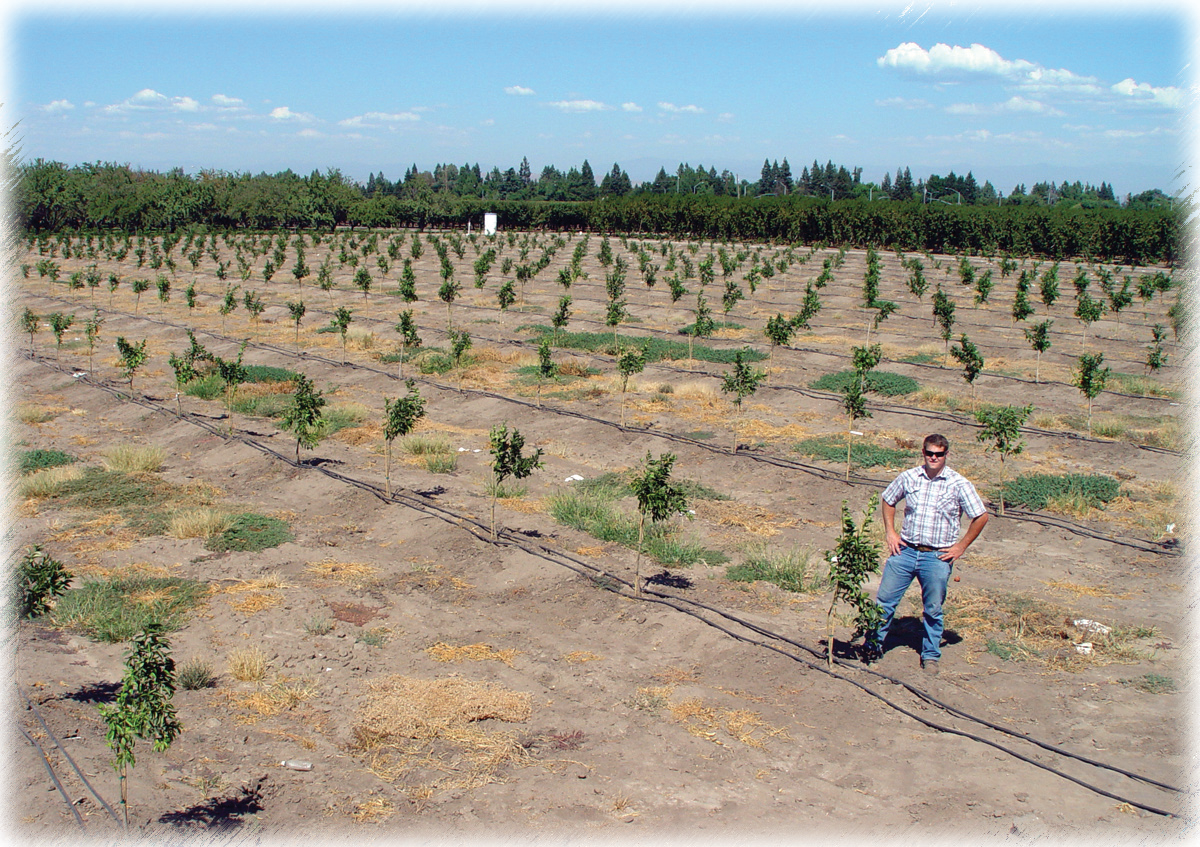
Above: Fresno State student Matthew Smith shows a section of the new experimental citrus block planted on Fresno State’s University Farm.
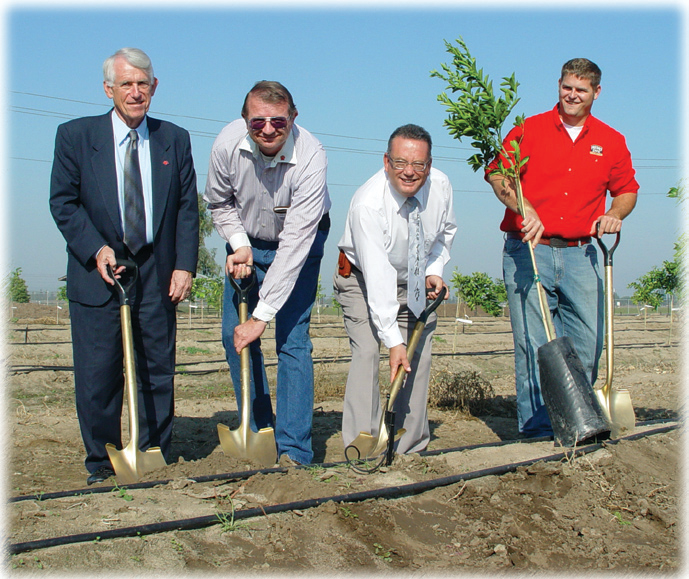
Above: University and Paramount leaders join Smith to plant the final tree during a ceremony this fall. From left are Fresno State President John Welty, Kevin Olsen of Paramount Citrus, and Charles Boyer, dean of the Jordan College of Agricultural Sciences and Technology.
The largest citrus production and shipping operation in the United States is partnering with Fresno State to test new cultivars and irrigation systems on the university farm.
Paramount Citrus, a division of Paramount Farms centered in California’s southern San Joaquin Valley, has donated 1,800 citrus trees including six different cultivars and also has helped to fund installation of a new irrigation system to maintain them.
In addition, Paramount is supporting maintenance of the project for five years by funding a student fellowship dedicated to the citriculture lab. Total support for the project is valued at $200,000.
Holding the student fellowship position this year is Matthew Smith, a Fresno State senior majoring in plant health.
“The citriculture lab will provide a testing ground for new citrus cultivars that have promise for commercial production in the San Joaquin Valley”
“The citriculture lab will provide a testing ground for new citrus cultivars that have promise for commercial production in the San Joaquin Valley,” Smith said of the project. Of the 20 acres newly planted, eight are dedicated specifically to research, featuring new varieties and hybrids of navel oranges, seeded and seedless tangerines, and tangelos.
The lab also is being used for irrigation trials based on the different soil types found on the citrus acreage, Smith said. The two main soil types are a sandy loam, which allows more rapid drainage of irrigation water, and a sandy clay loam, which holds water longer. The types were determined by Paramount soils specialists who conducted extensive soil analyses before the trees were planted.
Using computer-based GPS technology, the survey team created soil maps which are being used as a basis for different irrigation regimes, Smith said. The regimes will include smaller applications at more frequent intervals to the sandy loam soil to avoid losing water by percolation through the soil. On the sandy clay loam, greater water applications will be made, but at fewer intervals because the soil holds the water longer.
“This is one of the most advanced citrus irrigation systems in California,” Smith said. “We are using two regimes to apply water to the two soil types. Now it will boil down to economics. What will be the most economic system to use?”
That question will be answered over the next several years as irrigation costs and water use are compared to yields from trees in the different soil types. The aim is to build a system that generates the best yield-to-production-cost ratio.
The Paramount partnership was birthed in 2007 under the direction of former plant science Professor Todd Einhorn, who, together with Paramount representatives, mapped out a plan for a collaborative citrus research and production operation at Fresno State.
See Citrus, Page 7
Center for Agricultural Business
Study to focus on specialty crop transportation
Agricultural economics team will survey agencies, industry to pinpoint problems, recommend fixes

Agricultural economics specialists from Fresno State and a partnering university are conducting an in-depth analysis of California’s transportation system infrastructure. Their aim is to pinpoint problems and to explore possible solutions on behalf of the state’s specialty crop industry.
Heading the effort from Fresno State is Mickey Paggi, Ph.D., director of the Center for Agricultural Business (CAB). Paggi will be partnering with Jay Noel, Ph.D., director of the California Institute for the Study of Specialty Crops based at California Polytechnic State University, San Luis Obispo. The project has been spurred by growing concerns in the specialty crop industry over California’s aging transportation infrastructure.
“California specialty crop producers face major challenges in ensuring maintenance of an efficient, timely and competitive agricultural transportation system,” Paggi said in outlining the study. “Emerging problems for shippers include inadequate rail service, scarce and expensive trucking services, deterioration of roads, and shortage of refrigerated containers,” he said.
A trend perhaps amplifying the problem is increased specialty crop shipments due to higher foreign market demand, Paggi noted.
“Income growth and changes in food preferences overseas have spurred an unmistakable, more than decade-long increase in the importance of U.S. agricultural exports of specialty crops such as fruits and vegetables,” he said. And while specialty crops can command high prices, they have a shorter shelf life than bulk commodities and typically require more care in shipping.
Continued success in exporting these products will require maintenance of an efficient and cost-effective transportation system, Paggi noted.
In response to this need, the economics team has devised a study that will examine the forces shaping transportation markets and technology. Specific issues to be addressed include current and future supply of trucking services; trucking costs; highway infrastructure and congestion; ocean port congestion; ocean freight technology and rates; and railroad transportation rates.
The researchers will begin by collecting data on the strengths and weaknesses of farm product transportation systems, Paggi said. This will involve interviews with representatives and staff personnel from the trucking, rail and export industries. A follow-up survey of truck, rail, brokerage and freight-forwarder firms will provide additional information. Finally, the researchers will obtain secondary information from federal and state agencies that gather product market and transportation market data.
Following collection and organization of the data, the team will create a computer-based spatial competitiveness model that will enable researchers to correlate changes in industry competitiveness with changes in farm transportation infrastructure and technologies.
Reports of results will be provided to policy-makers and transportation system leaders with suggestions on maintaining or improving regional and international competitiveness of California specialty crop industries through changes and improvements in existing transportation mode services, Paggi said.
Work is expected to be completed and published in 2011. For more project information, contact Paggi at mpaggi@csufresno.edu.
Risk management seminar set for March
Specialists in cotton production and pricing trends will present information and outlooks for the coming year at a seminar planned for March at the Harris Ranch in Coalinga, California.
The event will focus on cotton price risk management and pricing strategies. Speakers will outline market-based strategies for managing price risk. Issues to be discussed include options on cotton futures and hedging strategies.
The lead speaker will be Carl Anderson, Ph.D., from Texas A&M University, who will discuss when and how to use option strategies such as fences, 3-ways and calendar back spreads.
Other presentations will be “Production Cost Outlook” by John Robinson, Ph.D., Texas A&M University; and “Market Outlook” by O.A. Cleveland, Ph.D., cotton marketing specialist, and Jarral Neeper of Calcot Ltd.
The seminar date has not been finalized. Contact Kay Wriedt at 919-678-2271 for up-to-date information. Attendance will be free of charge and lunch will be provided.
The seminar is sponsored by Cotton Incorporated in cooperation with Calcot Ltd. and Fresno State’s Center for Agricultural Business.
Center for Irrigation Technology
Testing services enhanced
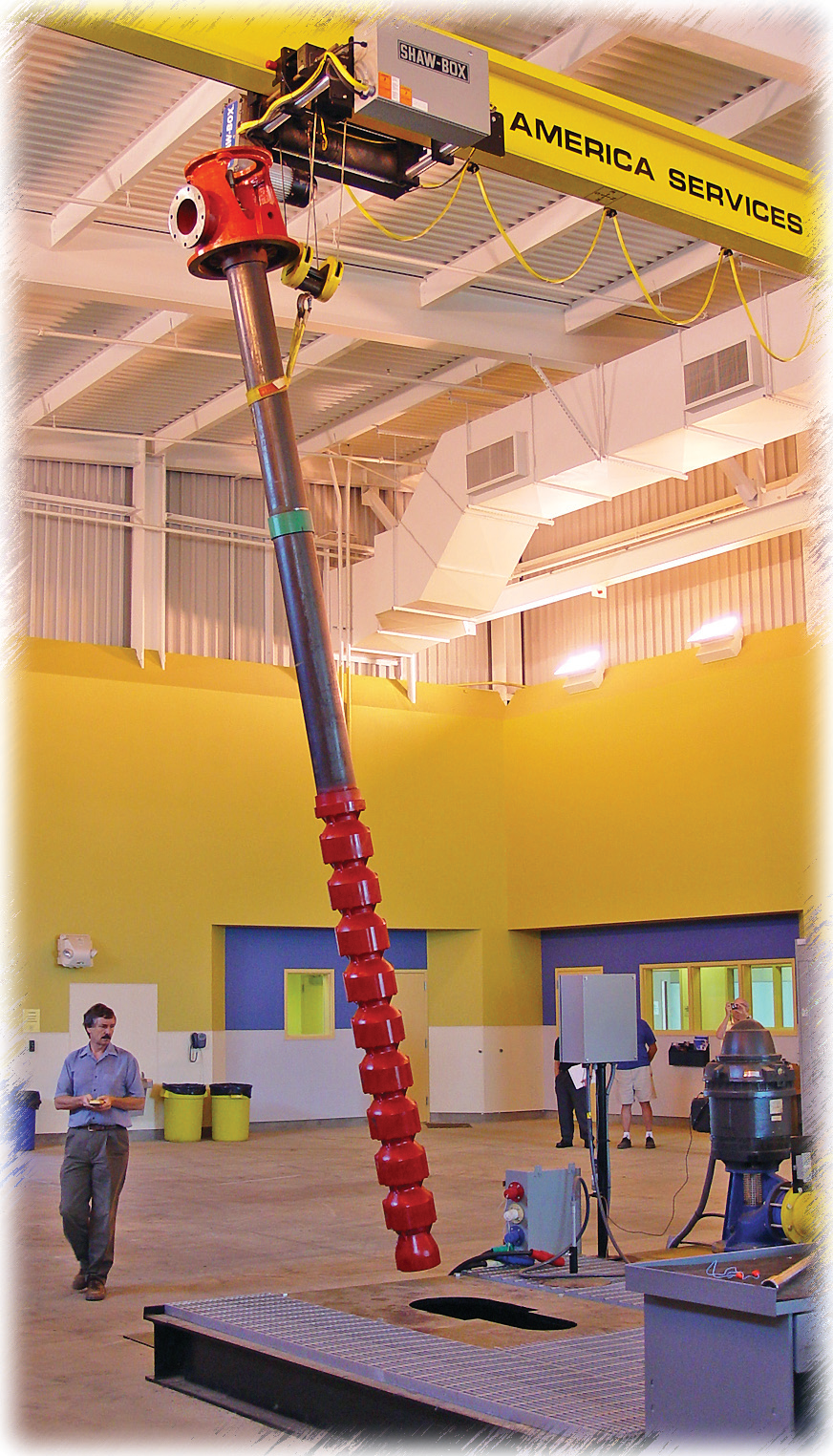
Testing services for the water technology industry have been enhanced since the opening of Fresno State’s International Center for Water Technology (ICWT).
Housed in the ICWT facility is the Claude Laval Water and Energy Technology (WET) Lab, a solar-powered hydraulic testing and certification laboratory boasting a 30,000-gallon, 28-foot-deep water chamber capable of testing pumps of up to 300 horsepower.
“For more than 25 years Fresno State has been a center of product testing for irrigation and water flow technology products,” said Theresa Sebasto, WET Lab communications specialist. “Now, our state-of-the-art lab is available for high-volume pump and water-flow technology testing.”
The WET lab uses calibrated motors, meters and certified testing methods – according to recognized standards and specifications. Staff technicians provide reliable and impartial verification of product specifications through a variety of full-scale testing scenarios.
“Anyone who has a piece of equipment they think we can test for them can contact us, and after reviewing specifics of what needs to be tested, we can let them know if it is something that will fit within our capabilities,” Sebasto said.
For details on testing, contact Kaomine Vang at 559-278-2066 or visit the ICWT website at http://www.icwt.net/labquote.
CIT Hydraulics lab director Joe Oliphant prepares to install a nine-stage 100-horsepower pump for testing at the WET Lab at Fresno State.
Upcoming events
For details on times and locations of the January, March and April events, visit http://www.californiawater.org/irrigationtech.
Jan. 14 – WATERIGHT Web-based Irrigation Scheduling. Hands-on workshop will help growers learn more about using the program.
Feb. 11 – Irrigation Seminars sponsored by CIT and the Irrigation Association during the World Ag Expo in Tulare, California. Visit http://www.worldagexpo.com for more information.
March 10 – Irrigation System Spring Cleaning and Maintenance. Field demos on flushing drip lines, maintaining filter stations, etc.
April 14 – Water Sources: Wells and Surface Water covering basic well drilling and construction, screens, filtration, and other issues.
Science to meet technology at upcoming water conference
Planning is under way for the 2010 Water Technology Conference sponsored by Fresno State’s International Center for Water Technology (ICWT) and the Center for Irrigation Technology (CIT).
Theme of the event is “Where Water, Science & Technology Connect.” It will focus on water technology innovations and science that can help make best use of future water supplies for California, the region and the world.
Specialists in water technology will present information and outlooks; scientists will offer research and poster presentations; irrigation system manufacturers and service providers will host exhibits displaying their products.
Sponsors and exhibitors are being sought to help support and to participate in this event. For information visit the ICWT website at http://www.icwt.net or call (559) 278-2066.
This will be the second major water conference sponsored by the ICWT. The first was held in April 2007 and drew nearly 500 participants and exhibitors.
The ICWT is a public-private partnership supporting development and application of advanced technologies that enhance water use for urban, environmental and agricultural purposes.
Through applied technology, the ICWT’s goal is to provide efficient first use and effective reuse of water supplies worldwide.
Viticulture and Enology Research Center
Director Wample concludes service at VERC

Honors were abundant for Robert L. Wample, director of Fresno State’s Viticulture and Enology Research Center (VERC) this past fall during receptions acknowledging his retirement after nine years of service to the university.
Wample served a dual role as not only VERC director but also as chair of the Viticulture and Enology Department, which he helped to form shortly after his arrival in the spring of 2000.
Wample brought viticulture production into new research realms by organizing the study of differential wine grape harvesting using a combination of global positioning systems (GPS) and geographical information systems (GIS) technologies. He also raised the university’s viticulture and enology education program to higher global prominence, in one case by fostering a student study program in partnership with the Engineering School of Enology at the University of Applied Sciences of Western Switzerland.
Wample raised more than $500,000 of industry funding for research, giving credit to the grape and wine industry for supporting Fresno State. He oversaw a major gift from the Boswell family to build the World Cooperage Barrel House at the Fresno State Winery, as well as a gift from the Bronco Wine Co. to establish a viticulture chair position.
In honor of his accomplishments, VERC has established the Robert L. Wample Viticulture and Enology Endowment Fund to support the Jordan College of Agricultural Sciences and Technology’s viticulture and enology program.
A nationwide search is under way for Wample’s successor. For more information, visit the Jordan College of Agricultural Sciences and Technology website at http://cast.csufresno.edu.
Biology Professor James Prince was named the interim department chair for viticulture and enology. Charles Boyer, dean of Jordan College, will oversee the VERC position during the transition.
Pheromone dispensers prove to be effective tool
from Page 1
The method features the use of a new pheromone developed by the Suterra Co., which also is supporting the research.
“The pheromone dispensers are placed in the vineyard by hanging them on the vines. The smell disrupts the mealybug reproduction process by confusing the insects,” Kurtural said. “The control treatments have been proven effective in the laboratory but now need to be confirmed in the field,” he said.
Experimental plots were mapped out in commercial vineyards owned by Bronco – one 300-acre plot near Bakersfield and another of similar size in the Lodi-Chowchilla area. Grape varieties included Zinfandel and Pinot Gris on 1103 Paulsen rootstock. Trial plots included a control with no pheromone dispensers, and three treatments of 150, 200 and 250 dispensers per acre.
Effectiveness of the treatments was determined by sampling fruit clusters in July prior to harvest. Results are positive, Kurtural said.
“It looks like we have a very promising method to control grapevine mealybug,” he said. “The mating disruption worked. We found all clusters were usable for wine-making in the initial year of the trial.”
In some of the trial plots the pheromone treatments were applied in addition to conventional pesticide sprays, and in some they were not, Kurtural noted. Therefore more study must be conducted to determine which combination of pesticide-pheromone is most effective and most cost-efficient, he said. Plans are to request funding from additional sources besides the industry groups that supported the first year of study, he said.
Because of the size of the experimental plots, both students and industry employees were recruited as research technicians, trained to set and monitor pheromone dispensers and to sample grape clusters. It was truly a major research event and turned out to be a successful cooperative effort among Fresno State, the regional grape and wine industry and the University of California.
For more information on initial results or plans for continuing work, contact Kurtural at kkurtural@csufresno.edu.
Upcoming events
Jan. 20 – Grape Grower Workshop on Innovative Grape Growing Solutions, at the Viticulture and Enology Research Center. For more info, call 559-278-2089.
Jan. 27 – Annual Fresno State Alumni and Friends Reunion during the Unified Wine & Grape Symposium, at 6:30 p.m. at the Hyatt Regency in Sacramento. For symposium details, visit http://unifiedsymposium.org/index.html. For reunion info call 559-278-2089.
March 5-7 – 9th Annual Fresno State Winemasters Weekend at the Tenaya Lodge at Yosemite. Event features a Friday evening reception, three workshops and gourmet dinner on Saturday. For more info visit the Department of Viticulture and Enology website at http://cast.atinet.org/ve/.
University farm welcomes sustainable practices
’Green’ enhancements will help increase irrigation efficiency, reduce dairy emissions
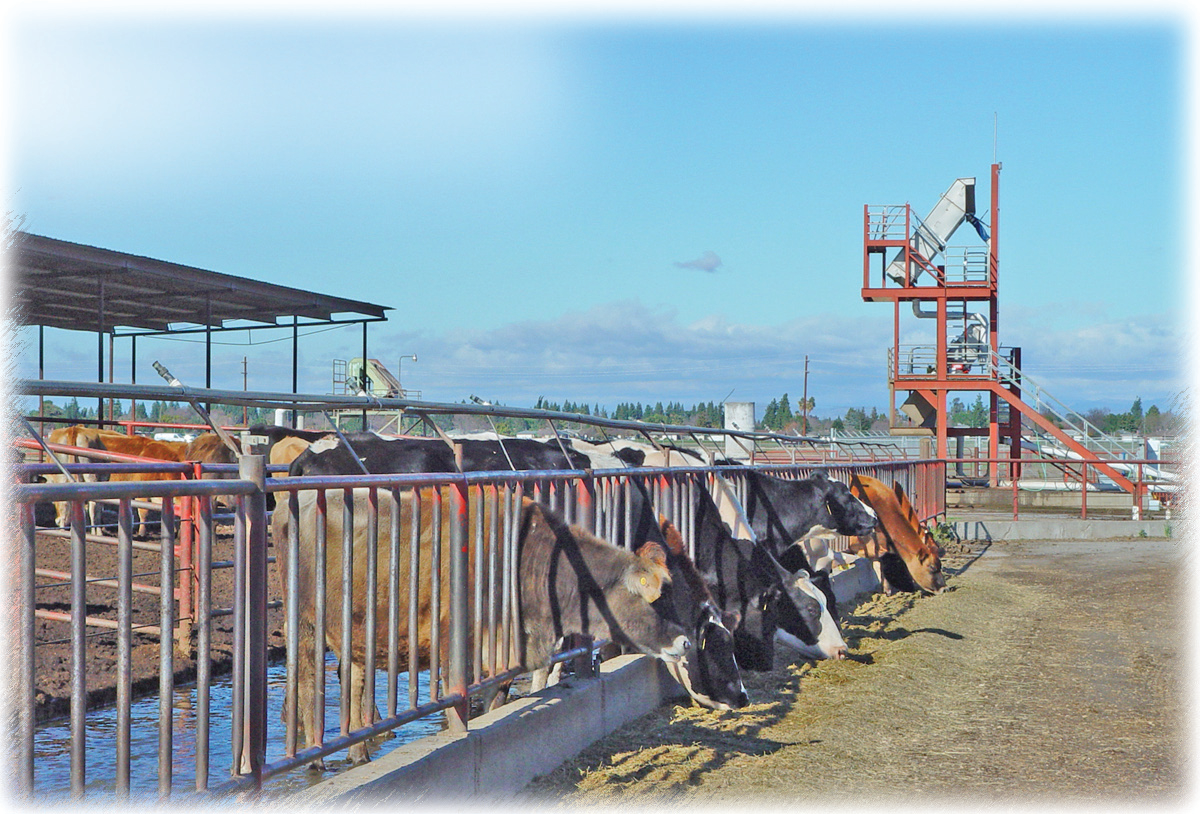
Towers in background comprise new Fresno State dairy separator system employing the latest technologies to separate solids from liquids, providing filtered water for reuse in flushing stalls.
Green practices are being implemented on the University Agricultural Laboratory (Campus Farm) at California State University, Fresno to increase sustainability.
According to Mike Mosinski, coordinator of farm maintenance and a member of the campus sustainability subcommittee, the list of sustainable measures is growing significantly.
“I believe our farm sustainability efforts will soon extend beyond Fresno State as we make an impact on our environment locally and as our students take what they have practiced here to their careers after graduation,” Mosinski said.
The farm is using new composting technologies, irrigation methods designed to get more crop-per-drop, a comprehensive nutrient management program involving dairy waste management technology, conservation tillage, GPS-monitored precision agriculture and a small student-managed organic plot.
An electric forklift in the Fresno State Winery and improved energy-saving lighting in the dairy parlor are other sustainability measures.
A new dairy waste-management system combines various technologies on one site that permits separation of solids and liquids using gradient and separation screens that provide filtered water for reuse in the dairy’s flush system. This cuts water usage and provides high-quality bedding material for the dairy, along with valuable nutrients that can be applied to campus feed crops.
More green practices are anticipated. Plans are in the works to put solar panels atop farm buildings and feed storage units for generating electricity, said Mosinski. In 2007, the university and Chevron Energy Solutions partnered in a project to install solar panels over a parking lot to generate 20 percent of Fresno State’s energy demand.
The 1,000-acre university farm also hosts 25 student-run enterprises where agriculture students apply what they learn in classrooms of the Jordan College of Agricultural Science and Technology.
For more information, contact campus farm director Ganesan Srinivasan at 559-278-2011 or gsrinivasan@csufresno.edu.
Recent farm sustainability installations
Several recent projects have enhanced sustainability on the Fresno State University Farm. They include the following:
- A computerized, variable irrigation system, installed in citrus orchards with funding from Paramount Corporation, provides precise water and nutrient delivery to different parts of the field based on soil type and fertility.
- A new center-pivot irrigation system donated by Valmont Irrigation Inc. is installed in a 25-acre field at the northeast corner of Cedar and Bullard avenues. It uses a remote-controlled computer and GPS technology to provide crops with water when and where they need it using soil and climate data.
- Covered Aerated Static Pile composting of university farm and other organic materials, which captures 99 percent of volatile organic compound emissions compared to wind row composting.
ARI program wins federal 2010 funding
California State University, Fresno, three other CSU campuses (San Luis Obispo, Pomona and Chico) and the CSU’s numerous research partners are celebrating the inclusion of $693,000 for the Agricultural Research Initiative (ARI) in federal appropriations for 2010.
The ARI focuses on new and promising technologies that have the potential for improving food safety, environmental stewardship, economic performance and long-term sustainability of California’s agriculture industry. The initiative also helps to foster and build upon university-industry partnerships while increasing the reach of publicly-funded research.
The funding approved by Congress last fall represents part of a sustained commitment to ARI by the federal government, which has awarded the program nearly $3 million over the past five years. The steady level of support enhances state and industry investments in ARI and indicates the importance of this field of study and the work of the initiative. The agricultural appropriations bill was sent to President Barack Obama and was expected to be signed.
The California Agricultural Technology Institute (CATI) has been charged with administration of ARI programs. Based at California State University, Fresno, CATI was established as a permanent part of the California State University system in 1985 and was given the responsibility to oversee applied agricultural and environmental research and development.
For more information, call CATI administration at 559-278-5680 or visit http://cati.csufresno.edu.
Citrus lab will benefit students
from Page 2
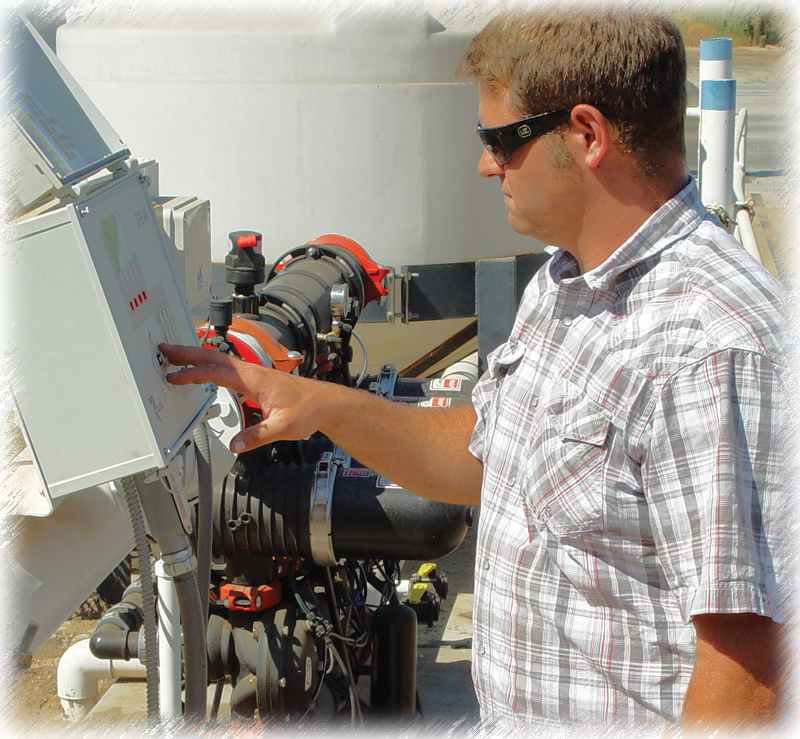
Fresno State plant science student Matthew Smith operates the main electronic controller for the Paramount Citrus Lab acreage on the university farm. The controller operates 10 valves serving 20 acres of several citrus varieties.
Not only will the operation provide a plot for the industry to observe new variety development, it will allow students to become involved in innovative research and production practices, noted Charles Boyer, dean of Fresno State’s Jordan College of Agricultural Sciences and Technology.
“We are grateful for the role these industry partners are playing in developing the knowledge base of Fresno State plant science students who are engaged in the study of citriculture,” Boyer said.
Paramount is a major citrus grower, packer and shipper which owns and farms approximately 20,000 acres of Clementine mandarins, navel and Valencia oranges, lemons and other citrus varieties in the San Joaquin Valley and Ventura County. The company farms another 10,000 acres of citrus, nuts and other permanent crops in Central California through its S&J Farm Management subsidiary.
Citrus from the Paramount production block will be sold on the Fresno State campus through the Rue and Gwen Gibson Farm Market, as well as on the commercial market.
ARI/CATI on the Web!
The California State University Agricultural Research Initiative (ARI) oversees applied agricultural, agribusiness and natural resources research on behalf of California agriculture. For information on our research and project results, visit our website at http://ari.calstate.edu.
The California Agricultural Technology Institute (CATI) administers ARI funding and oversees additional applied agricultural research. For more information about CATI and its research centers, visit us at http://cati.csufresno.edu, or at our centers:
- Center for Agricultural Business (CAB) – cati.csufresno.edu/cab
- Center for Food Science and Nutrition Research (CFSNR) – cati.csufresno.edu/cfsnr
- Center for Irrigation Technology (CIT) – cati.csufresno.edu/cit
- Viticulture and Enology Research Center (VERC) – cati.csufresno.edu/verc
- Agricultural Technology Information Network (ATI-Net) – cati.csufresno.edu/atinet
New abscission agents tried on table olives
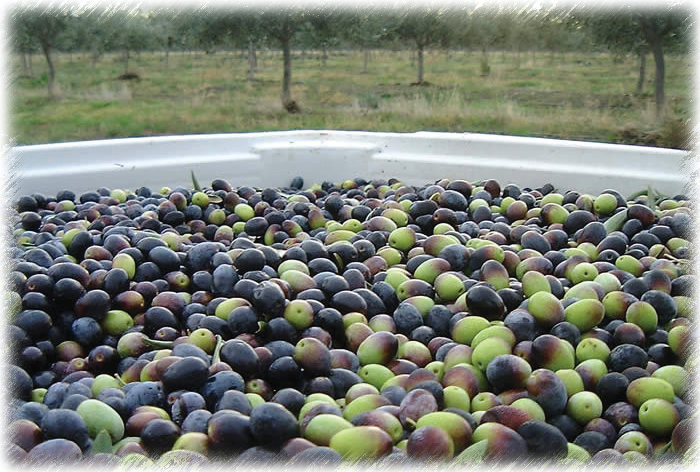
The California table olive industry still relies exclusively on hand harvesting of its primary ’Manzanillo’ cultivar.
California State University, Chico specialist in crop physiology is revisiting the use of ethylene-based compounds in an effort to improve results of mechanical olive harvesting.
The California table olive (Olea europaea L.) industry still relies exclusively on hand harvesting of its primary ’Manzanillo’ cultivar, noted College of Agriculture Professor Richard Rosecrance in explaining his recent research. However, because of increasing costs of hand labor, the industry has renewed focus on abscission agents that can be used to loosen the olives prior to mechanical harvest and thus increase removal rates.
“Trunk-shaking mechanical harvesters have been evaluated for decades but to date have been unable to harvest table olive fruit efficiently and without damage,” Rosecrance reported. “Fruit damage is an industry concern because bruising may compromise quality of the final canned product. New canopy-shaking mechanical harvesters are currently under development and show promise when combined with the use of fruit-specific abscission agents that facilitate fruit removal by lowering the mechanical force required to harvest the fruit.”
Because of problems with ethylene-based compounds such as ethephon, research in the United States had remained stalled until recent work with oil olives in Spain found that foliar sprays with a proprietary mix of monopotassium phosphate with ethephon reduced fruit retention in olive with minimal leaf drop.
With those new insights, Rosecrance obtained financial support from the California State University Agricultural Research Initiative (ARI), the California Olive Commission, and the University of California Cooperative Extension to begin a new line of research on the use of ethylene-based compounds along with the latest tree-shaking technologies.
“We have also worked with a number of antioxidants and had some success with reducing the effects of bruising with post-harvest drenches,” Rosecrance said. “Our future work will focus on maximizing the potential of abscission agents for olive mechanical harvesting and further screening of additional candidates for abscission and maintenance of fruit quality.”
Full project details are available in the final report, accessible on the ARI website at http://ari.calstate.edu. The project is titled “Facilitating Olive Mechanical Harvest with Abscission Materials,” (ARI Project No. 06-5-094).
In the event of incorrect address information or extra copies to your workplace, please return this address label by mail or fax with your requested changes. CATI fax number is (559) 278-4849.
Update publication information
Update is published quarterly by the California Agricultural Technology Institute
Jordan College of Agricultural Sciences and Technology
California State University, Fresno
Winter 2009-10
CATI Publication #100101
Voice number: (559) 278-2361
Fax number: (559) 278-4849
Director of Operations: Joe Bezerra
Publications Editor: Steve Olson
Address Service Requested
California State University, Fresno
2910 E. Barstow Ave. M/S OF115
Fresno, California 93740-8009
Non Profit Organization
U.S. Postage PAID
Fresno, CA
Permit No. 262
This HTML version was generated with AI assistance and may contain errors or omissions. The original approved PDF remains the official document of record. An alternative accessible format is available upon request from the document creator in accordance with Title II of the ADA.