CATI Update: Spring 2008
CALIFORNIA AGRICULTURAL TECHNOLOGY INSTITUTE
SPRING 2008
California State University, Fresno
In this issue...
- Cuba visited ....................... 2
- China markets eyed ............ 3
- Hang time evaluated ........... 5
- Texas bluegrass examined ... 8
‘Incubating’ company partners in viticulture research project
Lift-off. That could be the best word to describe recent developments for the PureSense irrigation system management company housed at the Claude Laval Water and Energy Technology Incubator (WET Incubator) on the Fresno State campus.
PureSense is one of five new companies using the WET Incubator as a launching pad for development of water and energy technologies in the San Joaquin Valley. The big boost for PureSense came in March, when company leaders announced a capital commitment of $4.5 million by local and regional investors to help the business grow.
The PureSense irrigation management system uses information obtained from the company’s free-standing, solar-powered monitoring stations that acquire data on soil moisture, weather conditions and plant vitals. On-board station computers transmit the data over cell networks to secure servers linked to the Internet.
Through a combination of software and firmware, the data, which is transmitted every 15 minutes, is converted into a user-friendly interface that a grower can use to monitor soil moisture and plant growth.
The technology used in the interface emerged from improved communications systems developed by the federal government at NASA Ames following the 9-11 terrorist attacks in New York City. PureSense obtained user rights through a special licensing agreement with NASA, reported Matt Angell, the company’s head of market and sales development.
Key to the PureSense system’s power is the ability of the monitoring station to capture and integrate data on climate conditions, plant health and sub-surface soil moisture conditions, Angell said. Analysis is presented on a web-based interface that gives growers real-time snapshots of crop reactions to changing environmental conditions including temperature, humidity, wind speed, solar radiation and, perhaps most importantly, soil moisture.

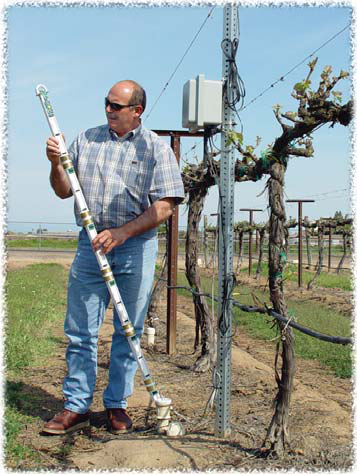
Right: Matt Angell, vice president of sales for PureSense, displays a five-foot-long soil moisture sensor pulled from its underground sleeve. Above: Close-up of on-board computer at top end of sensor.
See Partners, Page 4
No-cost training to address motor vehicle safety
Farm employers throughout California now have access to free training and support materials designed to improve farm worker motor vehicle safety associated with farm operations.
Fresno State’s Center for Agricultural Business (CAB) is offering the support as part of its continuing Farm Worker Motor Vehicle Safe Driving Education Program. The purpose of the program is to reduce motor vehicle crashes, fatalities and injuries suffered by farm workers and other rural residents. Project funding has been provided by the Occupational Safety and Health Administration (OSHA) Susan Harwood Training Grant Program.
“We asked the agricultural industry about priority issues,” reported Kimberly Naffziger,
See Safety, Page 7
California ag products: Destination Cuba!
Jonnalee Henderson is a contract policy analyst for the California Agricultural Technology Institute (CATI), based at the California Department of Food and Agriculture in Sacramento. She aided California export companies on market research and outreach during the first-ever California agricultural trade mission to Cuba in January. Her account of the trip follows.
In 2000 Congress passed a law allowing the United States to sell agricultural goods to Cuba despite the embargo on other products. Little did I know that this decision would years later lead me on an agricultural trade mission to this Caribbean nation as a CATI-contracted employee.
The mission team, led by California Secretary of Agriculture A.G. Kawamura on January 21-25, included 18 individuals representing 13 California companies and organizations with experience in international trade. Some participating companies included Constellation Brands, Hilmar Cheese, Limoneira Co., Mariani Nut Co., the Nunes Co., Pandol Brothers, Sierra Orchards and Valley Fig Growers.
Many surprises awaited me in Cuba: riding in a 1955 Buick taxi, wading in Caribbean waters, and walking in the once-glorious but currently falling-apart Spanish/French Victorian structures throughout Havana. I also got my first glimpse into a beautiful country with its history written on the faces of its people, on the walls of the government buildings and on the pro-revolution propaganda billboards lining the highways.
As A.G. Kawamura said, “We found a country shaped by a rocky past, yet optimistic about future stability and growth, and an eagerness for California agricultural products.”
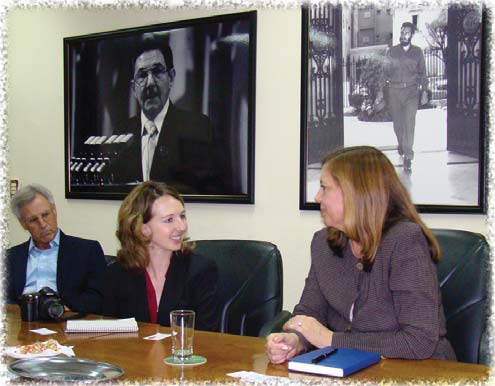
Jonnalee Henderson (center), a policy analyst for the California Agricultural Technology Institute, visits with Cuban trade officials in Havana. (Note wall photos of Castro brothers).
Despite the lifted embargo for agricultural products, California exported only an estimated $735,000 worth of food products to Cuba in 2006. This contrasts with Cuba’s $180 million worth of global imports of California-type commodities such as fruits, vegetables, nuts, dairy products and wine. Our mission’s goal was to capitalize on the opportunity this stark contrast offers our state. In addition, we wanted to learn the intricacies of Cuban business, including their import procedures, quality standards and sanitary and phytosanitary requirements.
Within hours of stepping onto Cuban soil, we met with the government agency – Alimport – tasked with all food buying decisions for the country. This agency has been mandated to secure a food supply for 11 million Cubans by sourcing from anywhere in the world. Alimport officials proved that they are experts in doing business with the United States.
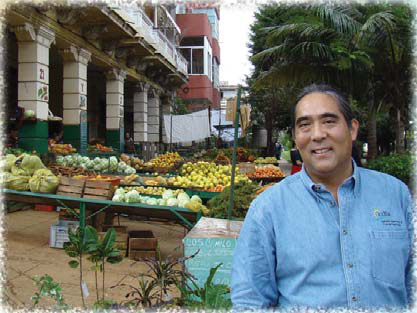
California Secretary of Agriculture A.G. Kawamura visits an open-air produce market in Havana, Cuba.
Cuba’s minister of agriculture explained that although Cuba’s agricultural industry boasts privately owned co-ops, urban gardens and state-owned land, some of their challenges include the fact that their most modern tractors are 25 years old, their tropical climate hinders them from growing many types of food, and their infrastructure system needs drastic improvements. For these reasons, the United States – particularly California – is a logical supplier to meet their food needs.
Securing contracts with Cuban officials takes time, but the participating California delegates expect that the relationships built and the information gained from this trip will lead to future formal contracts for many California agricultural businesses.
Center for Agricultural Business
China city markets offer opportunities
International trade specialist sees potential for niche market access using airborne transport
California agricultural producers have opportunities to break into overseas markets in China using the international airline industry.
Previous reports published by the Center for Agricultural Business (CAB) have outlined strategies for using the “backhaul” mode of transport, i.e., exporting agricultural produce to foreign countries in the holds of passenger or freight airliners on their return flights to their countries of origin.
Further research in this area has revealed specific opportunities in China, states international trade consultant Jock O’Connell in a new report published by CAB. The report is titled, “Taking the Fast Plane to China: An Expanded Role for Air Freight in Increasing California’s Fresh Fruit and Vegetable Exports to China.” The work follows two studies in which O’Connell collaborated with Fresno State economists to explore airborne agricultural exports from California to foreign countries.
The most recent report explores the use of air freight services more extensively, at least on an interim basis, to supply California-grown fruits and vegetables to what U.S. foreign trade officials have identified as China’s emerging city markets (ECMs).
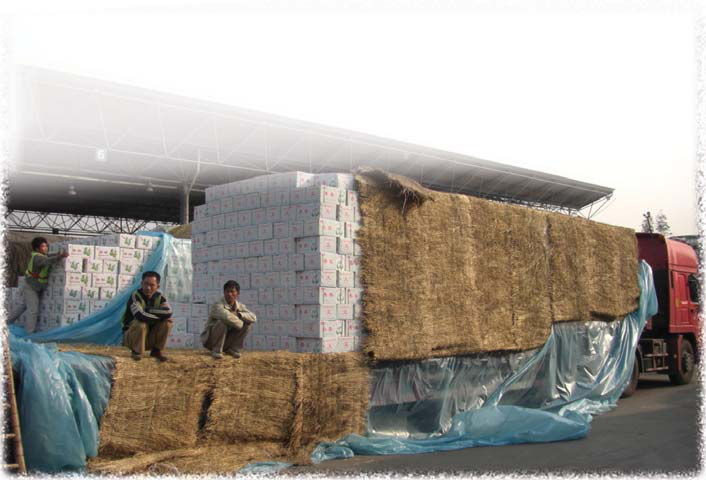
Delivery vehicle at the Jiangnan wholesale market in Guangzhou illustrates limited cold storage facilities.
These city markets, 14 in all, consist of highly populated urban centers. While most are along China’s coastline, the roster includes several in its interior provinces.
“With an increasing number of direct and indirect flight connections available between California and China, exporters of perishable fruits and vegetables should take a new look at air freight’s potential in overcoming severe shortcomings in China’s cold-chain systems,” O’Connell states.
The cold-chain system consists of truck and train services that deliver produce from China’s small farms in outlying areas into the urban centers. Dependable cold-chain transport is lacking. According to a recent report by the Pacific Economic Corporation Council, spoilage rates as high as one-third occur on shipments of fresh fruits and vegetables from China’s farms to its urban markets.
“The scale of economic loss is overshadowed only by the threat posed to food safety and public health,” O’Connell said.
These food safety concerns, combined with growing ranks of upper-middle class consumers and increased presence of western-style food retailers, could open doors to California shippers.
“Exporters may benefit from the relatively low air freight rates being charged by airlines eager to have cargo to carry to the Far East on the ‘backhaul,’ he said.
O’Connell said his research suggests that fruit, rather than vegetables, provide the most opportunities for backhaul export to China. However, both organic fruits and vegetables could also see demand there.
“The opportunities and logistics are both there to be exploited,” he said.
The complete report on backhaul trade opportunities in China is available for viewing or downloading from the CAB website, located at http://cati.csufresno.edu/cab. For additional information about agricultural economics research and/or related events, call the CAB office at 559-278-4405.
Funding for this study was made available by the Governor’s “Buy California” Initiative, the California Department of Food and Agriculture, and the U.S. Department of Agriculture, through the California State University Agricultural Research Initiative (ARI).
Upcoming events
April 29 – Motor Vehicle Safety Training for Spanish-speaking Workers – Train-the-Trainer Class, in Calistoga, in English and Spanish. No fee. For details, call 559-278-4405.
May 1 – Farm Labor Contractor Education Institute from 8 a.m. to 5 p.m. at the Piccadilly Inn Airport in Fresno. Presented in English and Spanish. For details, call 559-278-4677.
May 22 – Motor Vehicle Safety Training for Spanish-speaking Workers – Train-the-Trainer Class, in Salinas, in English and Spanish. No fee. For details, call 559-278-4405.
May 28 – Safety Breakfast meeting on “Snake, Spider and Scorpion Identification and Worker Safety,” in Calistoga. Call 559-278-4405.
June 11 – Agricultural Labor and Employment Summit at 8 a.m. at the Harris Ranch in Coalinga. Call 559-278-4405 for details.
Center for Irrigation Technology
Partners: Industry, company will see benefits
from Page 1
snapshots of crop reactions to changing environmental conditions including temperature, humidity, wind speed, solar radiation and, perhaps most importantly, soil moisture.
“We’re used to decision-making based on what we see above the ground,” Angell said. “We want to help growers also understand what’s going on under the ground. Until we were able to measure soil moisture, we weren’t able to do that.”
In setting up the system, one or more five-foot-long soil moisture sensors are strategically placed in the field or fields to be monitored. Placement is made in the dominant soil type of the area. The patented sensors are equipped not only with moisture measuring devices every 12 inches, but also with an on-board minicomputer that records and transmits data every 15 minutes.
“With this type of sensor, at each level you can see the soil moisture, and you can make predictions of when and where water will be needed based on where the water went,” Angell said.
The web-based interface features graphic images of soil conditions – formatted for quick interpretation. Recognizable images like a fuel gauge indicate subsurface water supply, plant consumption, and requirements for targeted crop yield and quality.
Funding validates growth mission
The recent capture of more than $4 million in investment funding by the PureSense irrigation system management company is cold green proof of how a good idea can turn into capital.
It’s also the first of what leaders of the Water and Energy Technology (WET) Incubator hope will be many more success stories of businesses launched at the facility, housed together with the International Center for Water Technology (ICWT) on the Fresno State campus.
“The basic idea of the partnership between the ICWT and the WET Incubator is to assist start-up companies during the critical ‘incubation’ phase,” said David Zoldoske, director of the Center for Irrigation Technology (CIT). “Attracting $4.5 million in venture shows the strength of the product and management team.”
Key goals of the ICWT are to promote water use efficiency and to bolster economic development in the San Joaquin Valley. The growth and success of PureSense would be a great example of this effort, Zoldoske said.
“Anytime we can create an economic base locally, it will provide multiple benefits to the region. Synergy develops among companies, with potential allied or spin-off efforts,” Zoldoske said. “Additionally, these companies create technical and marketing jobs locally, which provides great opportunities for our students to take advantage of local career opportunities.”
“The PureSense product not only has the potential to improve water use efficiency in California agriculture, but the world,” he added.
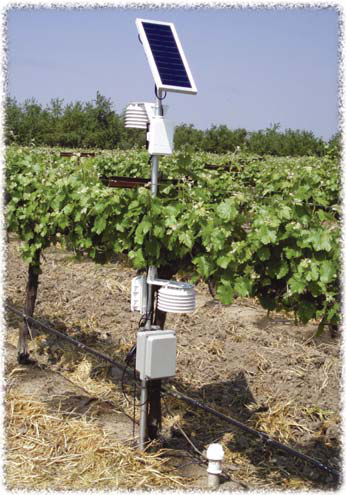
Patented PureSense field monitoring station collects and relays continuous data on changes in soil, water and climate conditions.
PureSense is currently teaming with scientists from Fresno State’s Viticulture and Enology Research Center (VERC) to help manage an experiment evaluating delayed wine grape harvest with vines under deficit irrigation treatments. The partnership developed through a meeting with PureSense representatives and VERC director Robert Wample last year. According to Wample, the collaboration is a win-win for all involved.
“This association with PureSense will expose us and our students to this new technology,” Wample said, “and it will help PureSense in building their model for decision-making.”
According to Angell, PureSense is built to serve growers by providing them with the most up-to-date information possible on soil and climate conditions.
“It lets you harness the power of real-time data to meet your production management goals, and it eliminates the risk of not knowing or taking action at the right time in the right place,” he said.
For more information on PureSense technology, contact Angell at mangell@puresense.com, or visit the company’s website at http://www.puresense.com.
Upcoming events
April 22 – Agricultural Pumping Efficiency Program Municipal Pump Workshop, on pump efficiency and variable frequency drives, from 8:30 a.m. to 1 p.m. in Irwindale, California. Call 800-336-2822 for details.
Viticulture and Enology Research Center
Hang Time
Scientist studies how time on the vine affects sugar level, quality of wine grapes
A scientist from Fresno State’s Viticultural and Enology Research Center (VERC) will soon join the “hang time” debate with San Joaquin Valley wine grape growers.
Viticulture research specialist Sanliang Gu is examining several “regulated deficit irrigation” (RDI) strategies using extended hang time in a study to determine how the methods affect quality and color of grapes grown for wine in the valley.
Hang time refers to the point at which the grapes are ready for harvest but are allowed to “hang” a few days longer, resulting in increased sugar content and further accumulation of acids and color, Gu said in explaining his research. The right combination of these characteristics can make for a successful fermentation and outstanding wine. A hang time that’s too long can result in grapes with a sugar content too high, prompting sluggish or “stuck” fermentations and a loss of wine quality.
Grower opinions on hang time vary from being “required” for better wine quality regardless of variety, location, and vintage, to it being absolutely unnecessary, with only negative impacts on fruit quality and vine health, Gu noted.
Little research has been done in the San Joaquin Valley to determine the relationship between hang time, fruit quality and vine health, Gu said. One reason is because premium wine grape growing is relatively new to the valley, and summer weather conditions here can make hang time management especially challenging.
“Under the stressful temperatures and humidity conditions during and beyond the ripening period in this region, hang time may negatively impact the grapevine’s capacity and functionality, especially under regulated deficit irrigation, which has become a common practice throughout the wine grape industry in California,” Gu said. His goal is to maximize fruit sugar development with color and flavor using regulated deficit irrigation and a minimum amount of hang time.

The experiment is being conducted in two locations: a 10-acre vineyard of Cabernet Sauvignon on Fresno State’s university farm, and a 75-acre block of Syrah farmed by a cooperating grower in the Fresno area. Treatments will include conventional drip and regulated deficit irrigation.
Trials will include the use of a pioneering computer-based technology that will govern the irrigation system (see related article on the PureSense irrigation management system on Page 1). The goal will be to reduce water use by 30 to 60 percent of conventional irrigation practices, Gu said.
Regulated deficit irrigation offers other benefits in addition to potentially better wine quality, he noted.
“A reduction in water use means less electricity needed to pump water and pressurize the irrigation system, and therefore represents an economic incentive for the grower. In addition, when managed properly, RDI results in less shoot growth and generally more open canopies that increase the exposure in the fruit zone to sunlight and air movement,” Gu said. “This exposure results in better fruit color and flavors, while decreasing the potential for diseases and pests.”
Results of the study will help to answer questions and concerns about hang time with sound scientific research and justification for the practice. Gu anticipates release of results and analysis next year. Overseeing the study, along with Gu, is VERC director Robert Wample.
For more information on the project, Gu may be contacted via email at sanliang@csufresno.edu.
Upcoming events
April 19 – 6th Annual Vino Italiano Event at the Fresno State Winery. Wine tasting features Italian varietals produced by Fresno State students. Call 559-278-6619 for info.
May 15 – Annual Viticulture and Enology End-of-Year Dinner for Fresno State students, faculty, staff, alumni, and members of the grape and wine industry. For location and details, call 559-278-2089.
June 1 – A Celebration of Wine from 3 to 6 p.m. at Rancho Vista del Rio in Madera, California. Annual wine tasting and fundraiser is for the Vincent E. Petrucci Library. For tickets, call 559-244-5741 or visit www.acelebrationofwine.com.
June 18-20 – Annual Society of Enology & Viticulture Annual Meeting in Portland, Oregon. For info, call 530-753-3142 or visit http://www.asev.org.
California Irrigation Management Information System

Standard data protocol eyed for ET info
APRIL 2008
CIMIS was initially designed to help agricultural growers and turf managers develop water budgets. But the CIMIS user base has expanded over the years. In addition to agricultural and large scale turf users, the ranks of those using CIMIS data has grown to include local water agencies, university researchers, consultants that provide CIMIS data to their clients, fire fighters, pest control managers, school teachers and students, construction engineers, hydrologists, state and federal agencies, weather agencies, and more.
With the advent of new irrigation technologies, such as weather based automated ET controllers, the demand for more and better CIMIS data and services continues to grow.
In October of 2007, Assembly Bill 566 was passed requiring the Department of Water Resources (DWR) to continue the operation of CIMIS to allow evapotranspiration data to be generated and made available to all regions of the state. Furthermore, the bill instructs DWR to develop a standard data protocol for evapotranspiration and weather data to ensure the data is available in an easily accessible and usable format throughout the state and obtainable through CIMIS.
As a result of this legislation, the DWR and collaborating water agencies throughout the state are working on the development of a standard data protocol for the transmission of evapotranspiration (ET) data that can be readily used by irrigation controllers and other end users.
Additionally, this project will be integrated with the Geostationary Operations Environmental Satellite (GOES) Project being developed by UC Davis and DWR. The integration with GOES will provide ET data, coupled from existing CIMIS stations, for the entire state of California, based on a two-square-kilometer grid.
This enhancement will greatly improve ET accuracy, coverage and accessibility. The system will also be accessible using a windows-based software application and will be able to deliver ET data based on GPS coordinates, zip codes or by the user’s selection of a geographical area of interest. The DWR anticipates that the enhancements will be operational some time in 2009.
Completing the development of a standard format for ET data and enhancing statewide coverage of CIMIS data will allow significant improvement in landscape water management and irrigation scheduling, thereby saving significant amounts of water and energy.
Visit the CIMIS home page at http://www.cimis.water.ca.gov
Weekly ETo Comparisons for Fresno
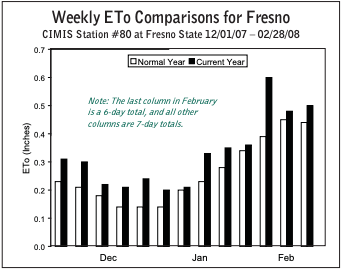
CIMIS Station #80 at Fresno State 12/01/07 – 02/28/08
Normal Year Current Year
Note: The last column in February is a 6-day total, and all other columns are 7-day totals.
ETo (Inches)
Chart shows ETo variation from normal over last three months.
For more CIMIS information...
CIMIS information is published quarterly in the CATI Update newsletter. Articles are provided by the California Department of Water Resources, CIMIS program staff.
For more information about CIMIS or its programs, contact any of the following representatives at these offices:
- Northern District
Mark D. Rivera
(530) 529-7301
mrivera@water.ca.gov - San Joaquin District
Steve Ewert
(559) 230-3334
sewert@water.ca.gov - Central District
Kim Rosmaier
(916) 651-0737
krosmaie@water.ca.gov - Southern District
Sergio Fierro
(818) 543-4652
sergiof@water.ca.gov
Safety: Program offers employee, supervisor sessions
from Page 1
program development specialist for CAB and project director of the driving education effort. “Growers and supervisors expressed interest in a program like this,” she said.
“We asked farm managers, ‘How often do you have your workers change locations while on the job? How many times in a season, in a week, in a day?’”
The answer was – fairly frequently. And employers acknowledge that workers often must find their own way when traveling to different job sites.
“We realize it’s a fact that, many people doing the driving don’t understand the rules or the meaning of various traffic signs,” Naffziger said.
To help educate drivers on safe driving habits, the CAB team developed a multi-phase program offering training and materials at no charge, through September 2008, Naffziger said (see Upcoming Events on Page 3).
Training will include on-farm sessions for workers. A bilingual CAB program trainer will travel to a grower’s site to discuss topics such as traffic signs, traffic rules and regulations, and farm equipment driving or towing.
Another phase will include “train-the-trainer” sessions held at selected locations around the state through the summer. At these sessions, CAB program specialists will train managers and supervisors on how to conduct their own training using the free materials.
While the program is offered free of charge, the materials and training are limited in amount and times, so scheduling and distribution will be on a first-come, first-served basis, Naffziger said.
In addition to OSHA, the California Highway Patrol’s Central Division and the federal Railroad Administration provided support for the project. To request materials or training, contact the CAB office at 559-278-4405.
New biological control proves effective against tadpole shrimp
In Central California rice fields, the tadpole shrimp, Triops longicaudatus, is an invasive pest that can have devastating effects on rice yields. Copper sulfate, a Class I Hazardous Material, is the standard means of tadpole shrimp control, but it is becoming more expensive, and for organic farmers, has been restricted by the USDA.
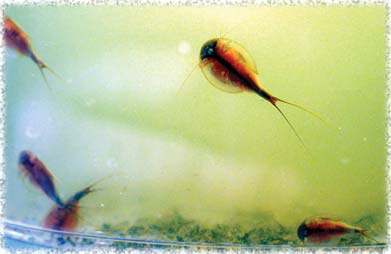
The tadpole shrimp is a freshwater crustacean that damages rice by consuming the planted seedlings.
With increasingly harsher laws against chemical use, an organic means of pest control is both desirable and a possible necessity.
To help resolve this issue, Fresno State biology professor Brian Tsukimura has spent several years developing a hormone-based pellet that reduces reproductive capacity of tadpole shrimp. In his most recent work, the hormone, methyl farnesoate (MF), was incorporated into standard crustacean protein pellets that can be fed to tadpole shrimp. Laboratory studies indicated that small doses (0.75 µg/g) are effective in reducing tadpole shrimp fecundity, thus limiting future generations of these crustacean pests.
In an attempt to increase the shelf life of the MF pellets, Tsukimura incorporated MF into liposomes, thus reducing the hormone’s oxidation. Further experiments confirmed the presence of the enzyme, Farnesoic Acid O-methyl transferase, which is the final enzyme required in the synthesis of MF.
The work was funded in part by the California State University Agricultural Research Initiative (ARI), based at the California Agricultural Technology Institute (CATI) at Fresno State.
Full project details, including technical information and data tables, are available in the final report, accessible on the ARI website at http://ari.calstate.edu. The project is titled, “Control of Tadpole Shrimp by Methyl Farnesoate Inhibition of Reproduction” (ARI Project #04-2-021).
ARI/CATI on the Web!
The California State University Agricultural Research Initiative (ARI) oversees applied agricultural, agribusiness and natural resources research on behalf of California agriculture. For information on our research and project results, visit our website at http://ari.calstate.edu.
The California Agricultural Technology Institute (CATI) administers ARI funding and oversees additional applied agricultural research. For more information about CATI and its research centers, visit us at http://cati.csufresno.edu, or at our centers:
- Center for Agricultural Business (CAB) – cati.csufresno.edu/cab
- Center for Food Science and Nutrition Research (CFSNR) – cati.csufresno.edu/cfsnr
- Center for Irrigation Technology (CIT) – cati.csufresno.edu/cit
- Viticulture and Enology Research Center (VERC) – cati.csufresno.edu/verc
- Agricultural Technology Information Network (ATI-Net) – cati.csufresno.edu/atinet
Texas bluegrass hybrid thrives in irrigation trials
A plant science specialist from California State Polytechnic University, Pomona recently completed tests of a new turf grass hybrid that shows promise for residential applications because of its potential to withstand high temperatures and drought stress.
Professor and researcher Sowmya Mitra, of the Department of Horticulture and Plant and Soil Science, examined Texas bluegrass (Poa arachnifera Torr.) under several irrigation treatments and determined it has the potential to withstand high temperatures and drought stress without going dormant during the summer.
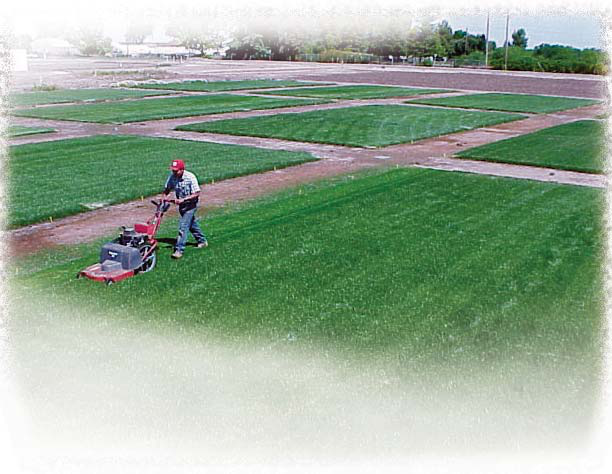
The hybrid was developed to increase resistance primarily to leaf rust and leaf spot diseases, Mitra noted in a recently published report. However, other qualities have emerged: Not only does Texas bluegrass maintain good color throughout the year; it also doesn’t produce a lot of clippings, he said.
Mitra’s objective in the experiment was to compare the frequency of mowing and clippings production of Texas bluegrass as compared to Kentucky bluegrass and tall fescue.
Data collected during the course of the study included germination/establishment rates, clippings production, turf color and quality, and tolerance to rust and summer patch diseases, all under different fertilization treatments.
Results show that even under low fertilization (1.5 kg/100 sq. m/year), the Texas bluegrass hybrids maintained a dark green color and produced fewer clippings compared to traditional tall fescue cultivars.
“Generally, Texas bluegrass provides an excellent color and quality comparable to some of the Kentucky bluegrass varieties, and it is more heat and drought tolerant than other bluegrasses,” Mitra said.
Because of its qualities, the hybrid can be used in lawns, parks and low maintenance sports fields in warm growing conditions, said Mitra.
The work was funded in part by the California State University Agricultural Research Initiative (ARI), based at the California Agricultural Technology Institute (CATI) at Fresno State.
Full project details, including technical information and data tables, are available in the final report and research report, accessible on the ARI website at http://ari.calstate.edu. The project is titled, “Does a New Hybrid Texas Bluegrass have the Potential to Become the Turf Grass of Choice for Landscape in California?” (ARI Project #04-4-099).
In the event of incorrect address information or extra copies to your workplace, please return this address label by mail or fax with your requested changes. CATI fax number is (559) 278-4849.
Update publication information
Update is published quarterly by the California Agricultural Technology Institute
College of Agricultural Sciences and Technology
California State University, Fresno
Spring 2008
CATI Publication #080401
Voice number: (559) 278-2361
Fax number: (559) 278-4849
Director of Operations: Joe Bezerra
Publications Editor: Steve Olson
Student Assistant: Megan Jacobsen
Address service information
Address Service Requested
California Agricultural Technology Institute
California State University, Fresno
2910 E. Barstow Ave. M/S OF115
Fresno, California 93740-8009
Fresno, California
Non Profit Organization
U.S. Postage PAID
Permit No. 262
Fresno, CA
This HTML version was generated with AI assistance and may contain errors or omissions. The original approved PDF remains the official document of record. An alternative accessible format is available upon request from the document creator in accordance with Title II of the ADA.