Update Winter 2007-08 | California Agricultural Technology Institute
CALIFORNIA AGRICULTURAL TECHNOLOGY INSTITUTE
WINTER 07-08
California State University, Fresno
In this issue...
- Mushrooms cultivated ........ 2
- Specialty crops evaluated ... 3
- Swiss connection eyed ........ 5
- Healthy cookies baked........ 8
Valley leaders seek unified voice for water
Water issues specialist will help to craft regional plan to address San Joaquin Valley needs
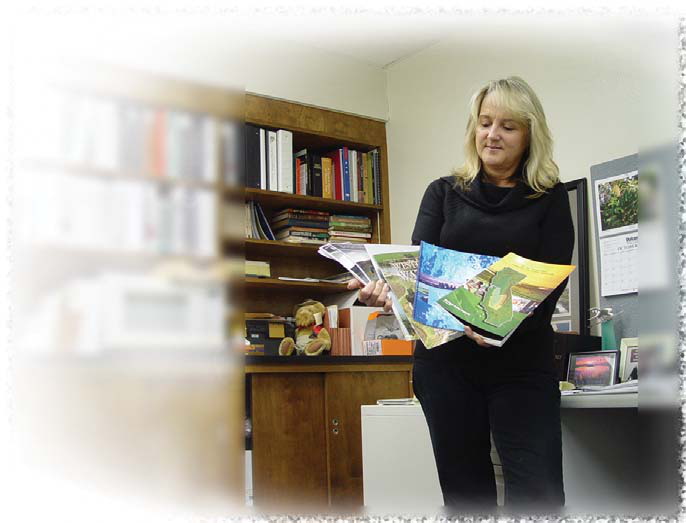
Federal, state and San Joaquin Valley leaders in water-related issues have recently joined to focus years of sometimes disparate planning and strategizing into a single, regional water management plan for the San Joaquin Valley.
The new plan is called the San Joaquin Valley Integrated Regional Water Management Plan (IRWMP). Directing the building effort is Kathy Wood, a U.S. Bureau of Reclamation water issues specialist “on loan” to Fresno State for approximately two years. Wood normally supervises the work of the bureau’s Resources Division for South Central California. Prior to that, she worked with wildlife and water-related issues in the southwestern United States. Her most significant work involved coordinating a public-private partnership between the U.S. Fish and Wildlife Service and five states overlying a geographic area known as the Ogallala Aquifer.
According to David Zoldoske, director of Fresno State’s Center for Irrigation Technology (CIT), Wood was recruited because of her knowledge and experience in water issues. Her location at Fresno State will enable her to tap the resources of three key water agencies located on the campus: CIT, the International Center for Water Technology (ICWT), and the California Water Institute (CWI).
Wood’s assignment is to help build a single water-management coalition representing eight San Joaquin Valley counties, from San Joaquin in the north extending to Kern in the south. Though representing many different local interest groups, the coalition would be able to speak with one voice to state and federal governments in order to reach goals of increased water-use efficiency and continuing economic development.
“You turn on your tap at home and get water. You go to the supermarket and you can buy veggies. We want to be able to sustain that.”
See Water, Page 4
Annual conference targets ag safety
California’s premier annual agricultural safety conference will return to the central California coast again this February, featuring accomplished speakers, short courses and training sessions, and a new program in agricultural supervision.
The 2008 AgSafe Conference will be held Wednesday, Feb. 27, through Friday, Feb. 29, at the Hyatt Regency Hotel in Monterey.
Included among the more than 90 workshops will be those for the new Ag Supervision Development Program (ASDP), noted Kimberly Naffziger, CAB program management specialist and one of the conference organizers.
“First-line supervision is crucial to smooth operations and the control of various risks besides illness and injury,” Naffziger said. “A supervisor’s effectiveness depends not only his or her knowledge and skills, but also on managerial policies and practices at higher levels. So this program is designed both to help strengthen one’s abilities and to enhance communication with others on the management team.”
There is a special requirement for participating in the program’s supervisory short course conducted in Spanish, so those interested should see the brochure or call the registration number for more information, Naffziger said.
The conference will open Wednesday morning with a keynote address by Steve Gilliland, known internationally for his motivational skills and his motto, “If you take care of people, the business will follow.” He will open three days of programming with his presentation, “Leading with Heart.”
Conference workshops will include the California Safety Certificate Program, Safety Essentials, Upper Division Safety, Workers’ Compensation, Food Safety, Environmental Safety, and Train-the-Trainer courses. New this year are sessions on human resources, along with safety and industry roundtables. Several courses geared for management will include How to Prepare for a Cal/OSHA Appeal, Managing Outside Contractors, and the 5 W’s of Performance Reviews.
Among the many workshops will be 25 classes presented in Spanish, Naffziger said. Some of those include Lock Out/Tag Out, Light Duty Programs, Investigating Accidents, and the California Agricultural Safety Certificate Program.
Conference participants will be able to visit exhibits featuring safety products, services and equipment, and to meet others with the shared mission of workplace safety and health at Wednesday evening’s reception and Thursday evening’s awards banquet.
Two special events are planned for Feb. 26, the day before the conference. One is the Ag Tour sponsored by the California Farm Bureau Federation and the Monterey County Farm Bureau. The other is the first annual AgSafe Golf Tournament on the historic Old Del Monte Golf Course.
Registration for the entire conference is $395 for AgSafe members or $495 for nonmembers. One- and two-day packages also are available. Registration fees include continental breakfast, lunch, the reception, and awards dinner. The Ag Tour and the golf tournament require additional fees.
Sponsors include Fresno State’s Center for Agricultural Business (CAB), the California Agricultural Technology Institute (CATI), the UC Center for Occupational and Environmental Health, and the UC Farm Safety Program.
For more information or a conference brochure, visit the AgSafe website at http://www.agsafe.org or call 559-278-4404.
Fruit by-products evaluated as growth medium for mushrooms
An abundance of by-product from central California’s vibrant fruit processing industry has prompted researchers at California State University, Fresno to explore using the processing leftovers as a growth medium for another plant food – mushrooms.
“With its massive range of fruit crops, optimal growing conditions, and demand for healthy and convenient food products, California is at the forefront of consumer driven value-added fruit processing activities,” reported food science researcher and professor Gour Choudhury. As a result, the industry has been generating increasing amounts of by-product, up to 20 percent of the raw material in a fruit processing plant.
These materials have traditionally been trucked away for use as animal feed supplements or soil amendments on farmlands. However, increased regulatory requirements have made the practice more complicated and costly.
“Efficient by-product utilization is becoming an economic necessity. It calls for innovative technology in the use of this resource.”
“Efficient by-product utilization is becoming an economic necessity. It calls for innovative technology in the use of this resource,” Choudhury said.
According to recent consumer studies, increased interest in the nutritional and health benefits of mushrooms has resulted in increased production in the United States.
Since food processing by-products are relatively high in carbohydrates – an important nutritional need for mushrooms – they could make an excellent medium for mushroom production, Choudhury stated. In addition, the spent media left after mushroom harvest could serve as a high-quality compost for use in general crop production.
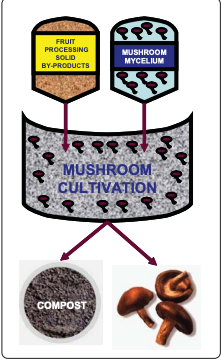
Figure above illustrates co-production cycle of gourmet mushroom and high-quality compost from fruit processing solid by-products.
A partnership has been established with a local fruit processing company for the work, Choudhury said. The company will supply the by-product, which will be evaluated and then conditioned for use as a medium. Different mushroom varieties will be tested under different production treatments. Finally, the composition of spent bed after harvest will be analyzed to determine suitability as compost.
The trials are to extend for two years. At that time, Choudhury hopes to have obtained results that will be good news for the fruit processing and mushroom production industries.
Funding for this project was made available by the Governor’s Buy California Initiative, the California Department of Food and Agriculture, and the U.S. Department of Agriculture. Work is being conducted under Fresno State’s Center for Food Science and Nutrition Research, which is a unit of the California Agricultural Technology Institute (CATI).
For more information, Choudhury may be contacted via his email at gchoudhury@csufresno.edu.
Scientists design research to address climate change
Several dozen agriculture and air quality scientists joined leading government policymakers and agency regulators at Fresno State last month to discuss the influence of climate change on agriculture.
Included among the presenters were Fresno State plant science professor and researcher Charles Krauter and soil scientist Gary Banuelos, from the USDA Agricultural Research Service’s Water Management Research Unit based in Parlier, California. Both Krauter and Banuelos are conducting air emissions-related research funded in part by the California State University Agricultural Research Initiative (ARI).
Various federal and state agencies, as well as private and nonprofit organizations, are working to provide information and help to agribusinesses in addressing climate change issues. Internet resources include websites of the U.S. Environmental Protection Agency, at http://www.epa.gov/climatechange, and the California Climate Change Portal, at http://www.climatechange.ca.gov.
Event sponsors included the USDA and the California Agricultural Technology Institute.
Center for Agricultural Business
New report offers specialty crop models
A cost of production study conducted by several research agencies has resulted in a new report offering updated economic analyses and forecasts for 20 specialty crops grown in California.
The work was led by Mechel Paggi, director of Fresno State’s Center for Agricultural Business (CAB), with support from economists from CAB, Cal Poly San Luis Obispo, and the University of California Cooperative Extension (UCCE).
The report is titled, “Specialty Crop Representative Farm Models: Forecasts, Policy Analysis and International Comparative Studies.” It was developed by compiling basic economic information provided by the UCCE, then augmenting it with data from the U.S. Department of Agriculture, area grower associations, and producer surveys.
The report includes a “representative” production operation for each of 20 selected specialty crops. The model operations are the most common types found in the industry for that type of crop, in terms of acreage, production and overhead costs, yield, and other features. Based on these models, profitability can be projected for operations of different sizes and configurations.
“These models can be used for several purposes,” Paggi said. “They simulate the producer’s income statement, cash flows, and balance sheet as well as any financial indicator calculated from those three statements. The models can determine the impact a change in production practices may have on the producer’s financial statements prior to actually changing practices.”
One key feature of the modeling approach was to use a method called “stochastic simulation,” one that can generate a large random sample of outcomes, Paggi said. Those outcomes depend on the historic variation in variables such as crop yield and price.
The report contains actual profitability projections for the different specialty crops over the next three years. For example, results of the model simulations indicate that Chardonnay wine grapes in the Sonoma north coast region will have the largest average projected return of $5,262 per acre for the period of 2007-2009.
The crop with the lowest outcome was processing tomatoes, with projected annual returns averaging $57 per acre over the next three years.
Actual projections for all crops will vary based on the specific costs and yields of each operation, Paggi said.
| Crops | Crops | Crops | Crops |
|---|---|---|---|
| Almond Apricot Apple Avocado Broccoli |
Cantaloupe Cherry Fresh carrot Fresh tomato Orange Nectarine |
Peach Pear Plum Processing carrot Processing tomato Strawberry |
Table grape Thompson seedless grape Walnut Wine grape |
The report was funded by the California Institute for the Study of Specialty Crops (CISCC), based at Cal Poly San Luis Obispo.
For more information on obtaining the report, visit the CAB website at http://cati.csufresno.edu/cab or the CISCC website at http://cissc.calpoly.edu.
Funding for this project was made available by the Governor’s Buy California Initiative, the California Department of Food and Agriculture and the U.S. Department of Agriculture.
Upcoming events
- Jan. 30 – Farm Labor Contractor Education Institute (FLCEI) at the Piccadilly Inn Airport in Fresno. Call 559-278-4677.
- Feb. 27-29 – 2008 AgSafe Conference at the Hyatt Regency Hotel in Monterey, California. For details, call 559-278-4404 or email safeinfo@agsafe.org.
- March 20 – FLCEI at the Stockton Grand Hotel in Stockton. Call 559-278-4677.
- April 9 – FLCEI at the Courtyard by Marriott in Oxnard. Call 559-278-4677.
- May 1 – FLCEI at the Piccadilly Inn Airport in Fresno. Call 559-278-4677.
Contractor course continues in 2008
The Center for Agricultural Business (CAB) is offering a new round of classes this year to help California farm labor contractors and others qualify to obtain or retain a state Farm Labor Contractor (FLC) license.
The California Labor Code requires every person applying for or renewing an FLC license to complete at least eight hours of relevant educational classes each year. The CAB Farm Labor Contractor Education Institute course meets this requirement.
The course covers a variety of topics, including workers’ compensation, unemployment insurance, wage and hour rules, pesticide safety, and sexual harassment in the workplace. Classes are held in English and Spanish.
The regular advance registration rate for the one-day course is $200. For more information, call 559-278-4677, or visit the CAB website at http://cati.csufresno.edu/cab.
See the “Upcoming Events” box at left for courses this spring.
Center for Irrigation Technology
Water: Plan aims to benefit all valley groups
from Page 1
efficiency and continuing economic development.
It’s a big job.
“You turn on your tap at home and get water. You go to the supermarket and you can buy veggies. We want to be able to sustain that,” Wood said in summarizing the San Joaquin Valley’s need to have a unified water plan.
The combination of increasing statewide population growth, multiple drought years, and an aging water storage and conveyance infrastructure has placed an unprecedented strain on California water supplies.
“The system is crashing” is not an overstatement, she said.
Many people recognize it and for years have been working to correct the problems. However, much of the San Joaquin Valley work has been self-serving, conducted by local entities, agencies, and groups seeking to protect their particular interests above others.
The goal of IRWMP is to equally promote and benefit all interests in the valley, and ultimately to help the state resolve broader water issues.
The effort has required both legal and financial support supplied at the federal and state levels. Work first began in 2005 when San Joaquin Valley congressmen Dennis Cardoza, Jim Costa, George Radanovich and Devin Nunes initiated development of a San Joaquin Valley Water Management Plan. The work was augmented later that year when Gov. Arnold Schwarzenegger signed an executive order creating the California Partnership for the San Joaquin Valley. The governor’s plan focused on developing a prosperous economy, a quality environment, and improved social equity over the next 10 years.
As water is a key element in achieving the partnership goals, the federal and state efforts were combined to help ensure success.
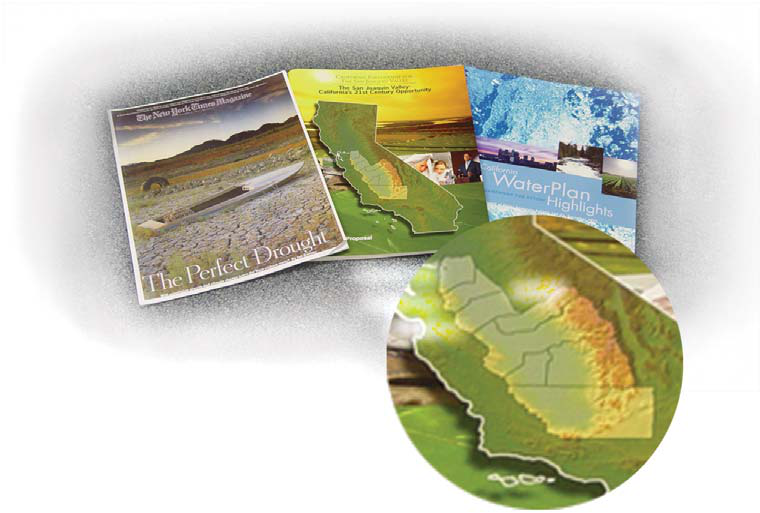
Close-up at right shows the eight San Joaquin Valley counties supporting the Integrated Regional Water Management Plan.
Working groups representing different stakeholders already have been established and are meeting to discuss all water issues to be addressed under the valley master plan, Wood said.
A number of general priorities have been established by the working groups. One is to strengthen the levees in the Sacramento-San Joaquin Delta and the San Joaquin Valley. Since the delta conveys a significant portion of irrigation water from northern California into the San Joaquin Valley, keeping that system intact is critical.
Other identified valley objectives are to augment surface and groundwater banking programs, develop and implement water quality and salinity management systems, expand environmental restoration and management strategies, expand agricultural and urban water-use efficiency programs, and improve water conveyance systems.
The overriding goal is to “make this effort an implementation solution, not just another plan for the shelf,” Wood said.
Stakeholders participating in plan development so far include irrigation district managers, water agency members, water resource engineers, government officials, agribusiness representatives, public works managers, representatives of industries and communities relying on water, and environmental groups.
Leaders have committed to have a formal IRWMP ready to deliver to the governor in December 2008. Work will continue with input from all working groups through that time.
“This is a big project,” Zoldoske said. “With all the projected water shortages ahead, it is imperative that we put together a comprehensive plan to address this issue.”
For information on becoming involved in the process, visit the California Partnership for the San Joaquin Valley website at http://sjvpartnership.org, or visit the CWI website at http://www.californiawater.org, or contact Wood via email at kawood@csufresno.edu.
Upcoming events
The Agricultural Pumping Efficiency Program operated by the Center for Irrigation Technology (CIT) hosts an assortment of seminars and conferences during the year. Visit the website at http://www.pumpefficiency.org/ for dates and information on specific events.
Viticulture and Enology Research Center
Swiss Connection
Fresno State students gain opportunity to study winemaking overseas
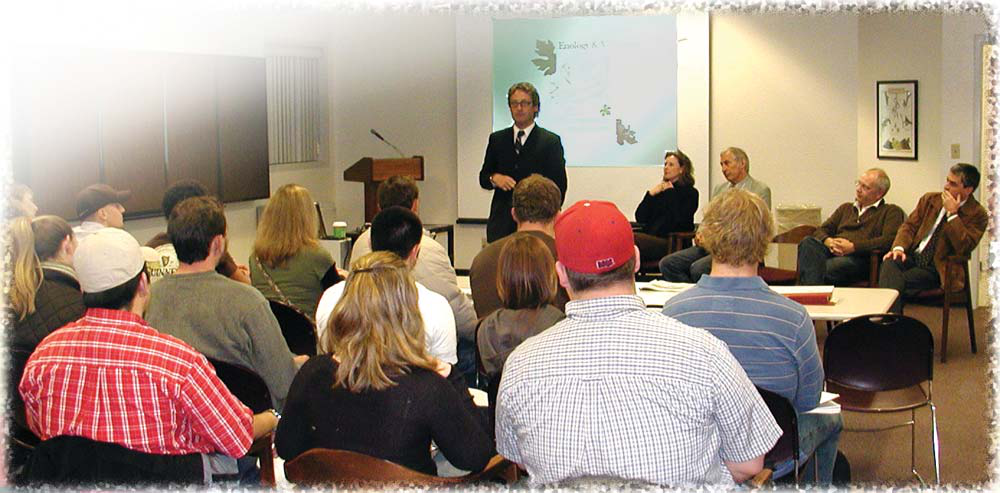
A prominent Swiss university has invited Fresno State viticulture and enology students to participate in a new international grape and wine-related educational program to be held in Europe this summer.
The announcement was made by Robert Wample, director of Fresno State’s Viticulture and Enology Research Center (VERC). The partnership was initiated by leaders of the Engineering School of Enology at Changins, part of the larger Universities of Applied Sciences of Western Switzerland.
Like Fresno State, the Swiss school oversees viticulture and enology research and has a winemaking facility. Officials there contacted Wample because of Fresno State’s international reputation for high-quality research and educational programs.
“Yes, they contacted us and invited us to participate. And we think this program will provide an opportunity for our students to gain a rich international experience,” Wample said.
The program will feature an annual four-week course held in the summer. The first course will include a week of classes at the Changins campus focusing on Swiss grape-growing techniques and winemaking. Activities will include both classroom lectures and practical work in labs and in the experimental winery.
Following that will be a one-week study tour of wine grape growing regions in Italy at the Universitá Cattolica Del Sacro Cuore in Piacenza, a one-week study-tour of the Burgundy region of France, and finally a one-week series of seminars back at the Changins campus.
A delegation from the Swiss school visited VERC in December to fine-tune the partnership agreement with Fresno State officials.
According to the Swiss school leaders, the purpose of the course is “to bridge the gap between North America and Europe and facilitate students from the ‘New’ and ‘Old’ winemaking worlds to come and work together, share ideas and learn from each other.”
Wample agreed. “This is a key opportunity for participating North American universities to discover Swiss and European wine culture and winemaking techniques,” he said.
Students from universities in other European countries also will be invited, the Swiss officials said.
The first course will be held in 2008 in Switzerland, in the heart of Europe, where winemaking culture is ancient and highly varied from “New World” styles.
Two other North American universities also were invited to send students, Wample said. They include Cal Poly San Luis Obispo, and Brock University in Ontario, Canada, both of which also have either viticulture and enology or winemaking programs.
The Swiss also want to learn more about California wine-growing and winemaking traditions, Wample noted. Part of the partnership agreement is to have the summer seminar hosted by different participating universities each year. Cal Poly will host the program in 2009, Changins in 2010, and Fresno State in the summer of 2011, Fresno State’s centennial year. Faculty from represented schools will share in the teaching and demonstrations.
Wample said the application process for students already has proven to be competitive. An informational session for potential applicants in December drew 17 viticulture and enology students. The deadline for summer 2008 applications was December 18. Up to 12 Fresno State students, based on the quality of their applications, could be selected, Wample said.
Announcement of selections will be made in late January.
See Swiss, Page 7
Upcoming events
- Jan. 30 – Annual Fresno State Viticulture and Enology Alumni and Friends Reunion at the Unified Wine & Grape Symposium, at the Hyatt Regency in Sacramento.
- Feb. 21-22 – 11th Annual Central Coast Viticulture and Enology Issues Conference: Energy and Water Issues for Growers and Winemakers, at the Embassy Suites Hotel and Conference Center in San Luis Obispo.
- Feb. 29-March 2 – 7th Annual Fresno State Winemaster’s Weekend, featuring Fresno State wine and agricultural products, at the Tenaya Lodge in Yosemite.
For more information on these and other upcoming events related to viticulture and enology, call 559-278-2089 or visit Fresno State’s Department of Viticulture and Enology website at http://cast.csufresno.edu/ve.
California Irrigation Management Information System
Study on ‘non-ideal’ stations under way
Visit the CIMIS home page at http://www.cimis.water.ca.gov
Weather stations within the CIMIS network that do not conform to the basic definition of reference stations are commonly known as non-standardized or Non-Ideal sites. The non-ideal sites could be situated on surfaces other than grass but still need to have sufficient upwind fetch and uninterrupted solar radiation.
CIMIS, in cooperation with the California Urban Water Conservation Council (CUWCC), is conducting a statewide study to investigate the possibility of installing stations in non-ideal environments and converting the collected data into a reference ETo.
This is to be achieved by comparing the non-ideal stations with standard reference stations in a given study area. The goal is to take data from the non-ideal sites and develop correlations with the corresponding data from the standard reference sites. These correlations will then be used to convert the non-ideal data into equivalent reference data after the completion of the study.
Non-ideal stations are desirable because urban environments are likely to have a shortage of standardized reference sites due to space limitations for adequate grass fetch. Weather data from non-standardized sites are likely to be erroneous in representing the microclimates of irrigated surfaces. Air temperature on warm summer days, for example, can be higher in an urban environment compared to adjacent vegetated surfaces with no water stress.
Because of the increased demands for CIMIS data from nonagricultural sectors and the difficulty of finding standardized sites in these areas, it has become necessary to undertake non-ideal site studies comparing non-ideal and reference weather stations.
Equipment requirements for non-ideal stations are quite similar to standard CIMIS stations. A basic non-ideal station costs approximately $4500, but most cooperators upgrade to include all CIMIS sensors for an additional $900. Currently there are two fully functional non-ideal stations up and running. Over the course of the next several months, six more stations are scheduled to come on line.
CIMIS and CUWCC welcome any one or any group interested in taking part in this important investigative study and encourages those interested to contact Cayle Little at (916) 651-7218, or Kent Frame at (916) 651-7030.
For more CIMIS information...
CIMIS information is published quarterly in the CATI Update newsletter. Articles are provided by the California Department of Water Resources, CIMIS program staff.
For more information about CIMIS or its programs, contact any of the following representatives at these offices:
| District | Representative | Phone | |
|---|---|---|---|
| Northern District | Mark D. Rivera | (530) 529-7301 | mrivera@water.ca.gov |
| San Joaquin District | Steve Ewert | (559) 230-3334 | sewert@water.ca.gov |
| Central District | Kim Rosmaier | (916) 651-0737 | krosmaie@water.ca.gov |
| Southern District | Sergio Fierro | (818) 543-4652 | sergiof@water.ca.gov |
Weekly ETo Comparisons for Fresno
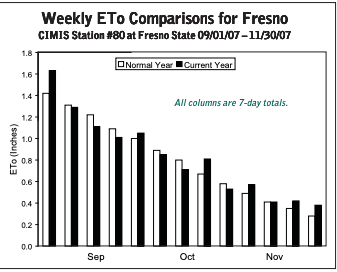
CIMIS Station #80 at Fresno State 09/01/07 – 11/30/07
All columns are 7-day totals.
Chart shows ETo variation from normal over last three months.
Safety: New ag supervision program offered
from Page 1
smooth operations and the control of various risks besides illness and injury,” Naffziger said. “A supervisor’s effectiveness depends not only his or her knowledge and skills, but also on managerial policies and practices at higher levels. So this program is designed both to help strengthen one’s abilities and to enhance communication with others on the management team.”
There is a special requirement for participating in the program’s supervisory short course conducted in Spanish, so those interested should see the brochure or call the registration number for more information, Naffziger said.
The conference will open Wednesday morning with a keynote address by Steve Gilliland, known internationally for his motivational skills and his motto, “If you take care of people, the business will follow.” He will open three days of programming with his presentation, “Leading with Heart.”
Conference workshops will include the California Safety Certificate Program, Safety Essentials, Upper Division Safety, Workers’ Compensation, Food Safety, Environmental Safety, and Train-the-Trainer courses. New this year are sessions on human resources, along with safety and industry roundtables. Several courses geared for management will include How to Prepare for a Cal/OSHA Appeal, Managing Outside Contractors, and the 5 W’s of Performance Reviews.
Among the many workshops will be 25 classes presented in Spanish, Naffziger said. Some of those include Lock Out/Tag Out, Light Duty Programs, Investigating Accidents, and the California Agricultural Safety Certificate Program.
Conference participants will be able to visit exhibits featuring safety products, services and equipment, and to meet others with the shared mission of workplace safety and health at Wednesday evening’s reception and Thursday evening’s awards banquet.
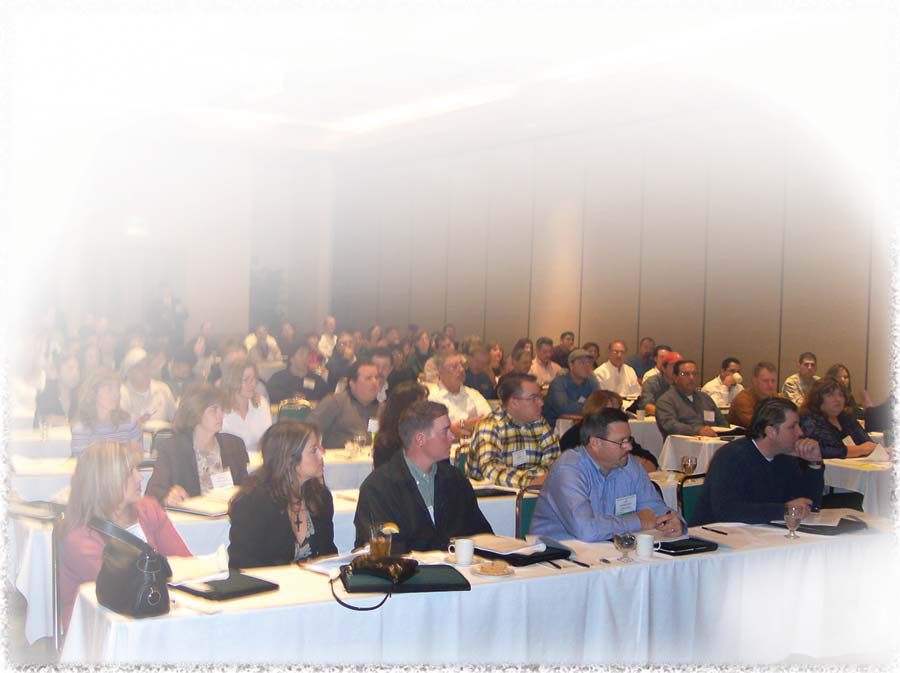
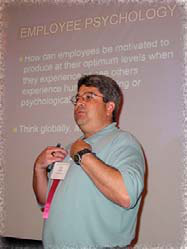
An AgSafe speaker discusses workplace psychology at a recent conference.
Two special events are planned for Feb. 26, the day before the conference. One is the Ag Tour sponsored by the California Farm Bureau Federation and the Monterey County Farm Bureau. The other is the first annual AgSafe Golf Tournament on the historic Old Del Monte Golf Course.
Registration for the entire conference is $395 for AgSafe members or $495 for nonmembers. One- and two-day packages also are available. Registration fees include continental breakfast, lunch, the reception, and awards dinner. The Ag Tour and the golf tournament require additional fees.
Sponsors include Fresno State’s Center for Agricultural Business (CAB), the California Agricultural Technology Institute (CATI), the UC Center for Occupational and Environmental Health, and the UC Farm Safety Program.
For more information or a conference brochure, visit the AgSafe website at http://www.agsafe.org or call 559-278-4404.
Swiss: Selections to be made in January
from Page 3
year. Cal Poly will host the program in 2009, Changins in 2010, and Fresno State in the summer of 2011, Fresno State’s centennial year. Faculty from represented schools will share in the teaching and demonstrations.
Wample said the application process for students already has proven to be competitive. An informational session for potential applicants in December drew 17 viticulture and enology students. The deadline for summer 2008 applications was December 18. Up to 12 Fresno State students, based on the quality of their applications, could be selected, Wample said.
Announcement of selections will be made in late January.
ARI/CATI on the Web!
The California State University Agricultural Research Initiative (ARI) oversees applied agricultural, agribusiness and natural resources research on behalf of California agriculture. For information on our research and project results, visit our website at http://ari.calstate.edu.
The California Agricultural Technology Institute (CATI) administers ARI funding and oversees additional applied agricultural research. For more information about CATI and its research centers, visit us at http://cati.csufresno.edu, or at our centers:
- Center for Agricultural Business (CAB) – cati.csufresno.edu/cab
- Center for Food Science and Nutrition Research (CFSNR) – cati.csufresno.edu/cfsnr
- Center for Irrigation Technology (CIT) – cati.csufresno.edu/cit
- Viticulture and Enology Research Center (VERC) – cati.csufresno.edu/verc
- Agricultural Technology Information Network (ATI-Net) – cati.csufresno.edu/atinet
Kids in nutrition study find barley cookies tasty

A research team at Cal Poly Pomona developed cookies using Sustagrain™ barley containing nine grams of total fiber and four grams of soluble fiber per one-ounce serving.
A pair of California State Polytechnic University, Pomona researchers has taken steps to address the current obesity problem in America by developing healthier food products.
They chose to use a nutritious grain, barley, in developing new snack foods that would be attractive to two consumer groups: children and young Hispanics.
Studies show that between 55 to 90 percent of children are not meeting the recommended daily fiber intake, reported Professor Douglas Lewis of the Department of Human Nutrition and Food Science, in explaining the project.
His objective was to produce a high-fiber barley cookie that is highly palatable, accepted by schoolchildren and up to USDA standards. Through a cooperative agreement with ConAgra Inc., Lewis used Sustagrain™ barley, which contains nine grams of total fiber and four grams of soluble fiber per serving. Field testing of experimental cookies revealed excellent acceptance by school age children, Lewis reported.
The success of the project demonstrated the feasibility of using a highly unpalatable food ingredient (Sustagrain™ barley) to make a palatable snack food product that can be used to increase dietary fiber intake, Lewis said.
In a similar study, Professor Maria Botero Omary, also from the Human Nutrition and Food Science Department, sought to develop healthy, convenient and palatable energy bars that contain whole grain barley flour and other cereal sources that appeal to Hispanic youths.
Market research of the snack category was conducted in both Hispanic and conventional stores to identify products to be used during development. Based on surveys and recommendations by food services representatives of area schools, graham cracker prototypes instead of energy bars were selected for development.
Unfortunately, preliminary experimentation with young consumers resulted in descriptions of a chewy texture. More research may be conducted as funds become available.
These projects were funded in part by the California State University Agricultural Research Initiative (ARI), based at the California Agricultural Technology Institute (CATI) at Fresno State. For more information on ARI research, visit the website at http://ari.calstate.edu.
In the event of incorrect address information or extra copies to your workplace, please return this address label by mail or fax with your requested changes. CATI fax number is (559) 278-4849.
Update publication information
Update is published quarterly by the California Agricultural Technology Institute
College of Agricultural Sciences and Technology
California State University, Fresno
Winter 2007-08
CATI Publication #080101
Voice number: (559) 278-2361
Fax number: (559) 278-4849
Director of Operations: Joe Bezerra
Publications Editor: Steve Olson
Student Assistant: Megan Jacobsen
Address Service Requested
California State University, Fresno
2910 E. Barstow Ave. M/S OF115
Fresno, California 93740-8009
U.S. Postage PAID
Non Profit Organization
Permit No. 262
Fresno, CA
CALIFORNIA AGRICULTURAL TECHNOLOGY INSTITUTE
This HTML version was generated with AI assistance and may contain errors or omissions. The original approved PDF remains the official document of record. An alternative accessible format is available upon request from the document creator in accordance with Title II of the ADA.