Update: Summer 2007
Taste study aims to aid wine industry
Knowledge of genetic taste sensitivities will enable marketing specialists to target consumer groups
An enology research team from Fresno State’s Viticulture and Enology Research Center (VERC) is looking for supertasters: people who may have an unusual genetic trait that enables them to “supertaste” certain types of foods and flavors.
The search is part of a research study aimed at providing the wine industry with information helpful for marketing different types of wines. Leading the effort is VERC enology scientist Susan Rodriguez.
“We have to know what consumers want,” said Rodriguez in explaining the project. “There are different taste sensitivities within the market and we will have a lot better marketing strategy if we know and can fulfill what the consumer desires.”
The “world of taste” is more complex that once believed, and based on expressed sensitivity to certain chemical compounds, people can be divided into three genetic taste groups: nontasters, tasters and supertasters, Rodriguez said.
Some of the first scientific insights into these aspects of taste came in 1931, when researchers discovered, serendipitously, that some people could taste the compound phenylthiocarbamide, or PTC, as extremely bitter, while others could not taste it at all. Subsequent research revealed that approximately two-thirds of the American public can taste PTC, while one third cannot.
Then in 1980, another compound called 6-n propylthiouracil (PROP) replaced PTC for bitterness research. Scientists determined that approximately 25 percent of the Caucasian population cannot detect a taste in a solution of PROP. Then came the categorizing: Yale University researcher Linda Bartoshuk labeled such people as “nontasters.”
Since then it has been established that approximately 50 percent of the population, who are identified as “medium-tasters,” perceive PROP as quite bitter. The remaining 25 percent perceives PROP as extremely bitter – they are termed “supertasters.”
Bartoshuk correlated PROP tasting with the density of fungiform papillae – one of three kinds of small “bumps” on the tongue that contain taste buds – and the perception of bitterness in foods. Furthermore, the sense of “pain” that high alcohol or hot pepper elicits is due to a nerve associated with these taste buds. Therefore, supertasters should also be more sensitive to high alcohol wines, Bartoshuk concluded.
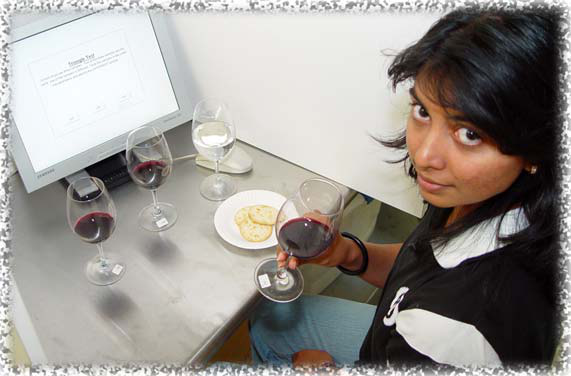
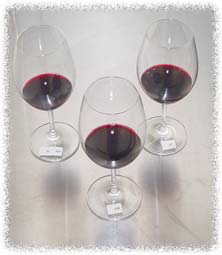
Master’s degree enology student Amita Shingre demonstrates a typical triangle test of wines in the Sensory Laboratory at Fresno State’s Viticulture and Enology Research Center.
See Taste, Page 5
Advancing the fig industry
Project team oversees nutrition study; directs upgrades in marketing, inspection practices
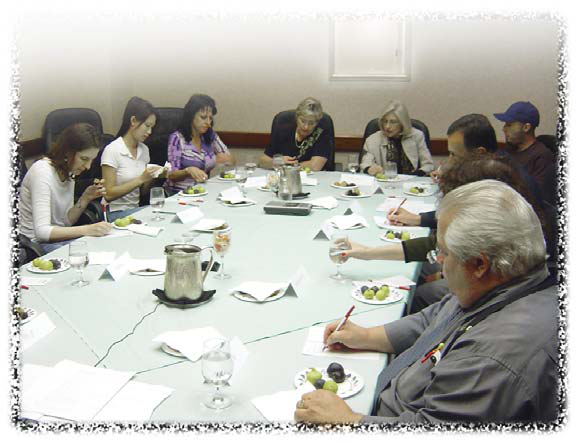
Members of a taste panel take notes as they sample different types of figs during a tasting session. The work was organized by the California Fig Advisory Board with support from the ARI program.
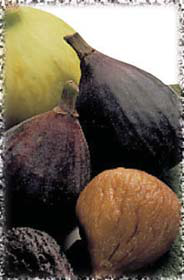
Representatives of the California Fig Advisory Board have gained support from California State University’s Agricultural Research Initiative (ARI) program to help revitalize the California fig industry.
The goal of the project is to advance the long-term interests of the fig industry by expanding market opportunities and updating industry practices, reported Richard Matoian, manager of the California Fig Advisory Board, based in Fresno. The project is being conducted in partnership with Fresno State’s Viticulture and Enology Research Center (VERC).
The first phase of the effort included improving the inspection data collection and dissemination system for dried figs through development of a customized software program, Matoian said.
“The electronic inspection system is user friendly and growers have adapted relatively easily to this process,” Matoian said.
“All dried figs are required to undergo mandatory inspection for grade and quality,” he said. Under the new software program, once an inspection is complete, growers receive an email indicating that it is available via a secured website. Once logged on, the grower can access their individual inspection, thereby receiving results almost as they occur.
A second project phase featured research regarding consumer attitudes about fresh and dried figs. Focus groups were formed in order to obtain information regarding consumer buying habits and trends that might enable improved target marketing and promotion activities.
The research results suggest there is a significant opportunity to increase consumption of fresh figs in the United States through effective marketing communications, Matoian said. The focus groups indicated that a number of people are receptive to purchasing figs more often, especially fresh figs.
A final phase of the research has focused on determining the potential health benefits associated with fig consumption, specifically the potential for reducing heart disease, Matoian said. Because coronary heart disease continues to be a major health problem and the leading cause of death in the United States, strategies for reducing risk have included lowering levels of total cholesterol or LDL (low density lipoprotein) cholesterol.
A study was commissioned through the Loma Linda University Adventist Health Sciences Center to determine if dried figs in the diet would have a lowering effect on LDL cholesterol. A panel study of hyperlipidemic adults was conducted. Participants consisted of 138 males and females between the ages of 30 and 78. In the study, half the panelists received dried figs on a daily basis for six weeks and half received none. Then after a one-week break, the diet regimes were reversed.
The first six-week results were positive and showed reductions of LDL cholesterol and triglyceride levels by at least 10 percent in participants consuming the fig diet. The second six week results, however, were inconclusive, leading project directors to suggest a third study, which is being conducted this year, Matoian said.
Ultimately, project directors hope that the information provided to the fig industry through the different phases will enable it to successfully advance its long-term economic interest in California and the United States.
Funding for this project was made available by the Governor’s “Buy California Initiative,” the California Department of Food and Agriculture, and the U.S. Department of Agriculture, through the ARI Program.
Center for Agricultural Business
Report assesses market trends for concentrate
Market analysis, sample enterprise budgets provide insights to help growers develop production strategies
A newly published report addressing California’s grape juice concentrate industry provides market analysis and sample enterprise budgets that researchers hope will aid growers in developing production and marketing strategies in the coming years.
The report was produced by an economics research team led by Mickey Paggi, director of Fresno State’s Center for Agricultural Business (CAB), and Fumiko Yamazaki, CAB senior research economist. Enterprise budget analysis expertise was provided by the University of California Cooperative Extension. Additional information was provided by the UC Agricultural Issues Center, along with grower and industry cooperators.
The two-year research effort was undertaken to aid producers who have been frustrated by a highly volatile market during the last seven years, Paggi said. Following several years of relatively stable prices in the 1990s, reaching $200 per ton for raisin-type grapes for crush in 1999, market prices took a nose-dive, falling to approximately $80 per ton in 2002. Declining prices prompted decisions by many growers to pull vines, resulting in the removal of some 100,000 acres over the next two years.
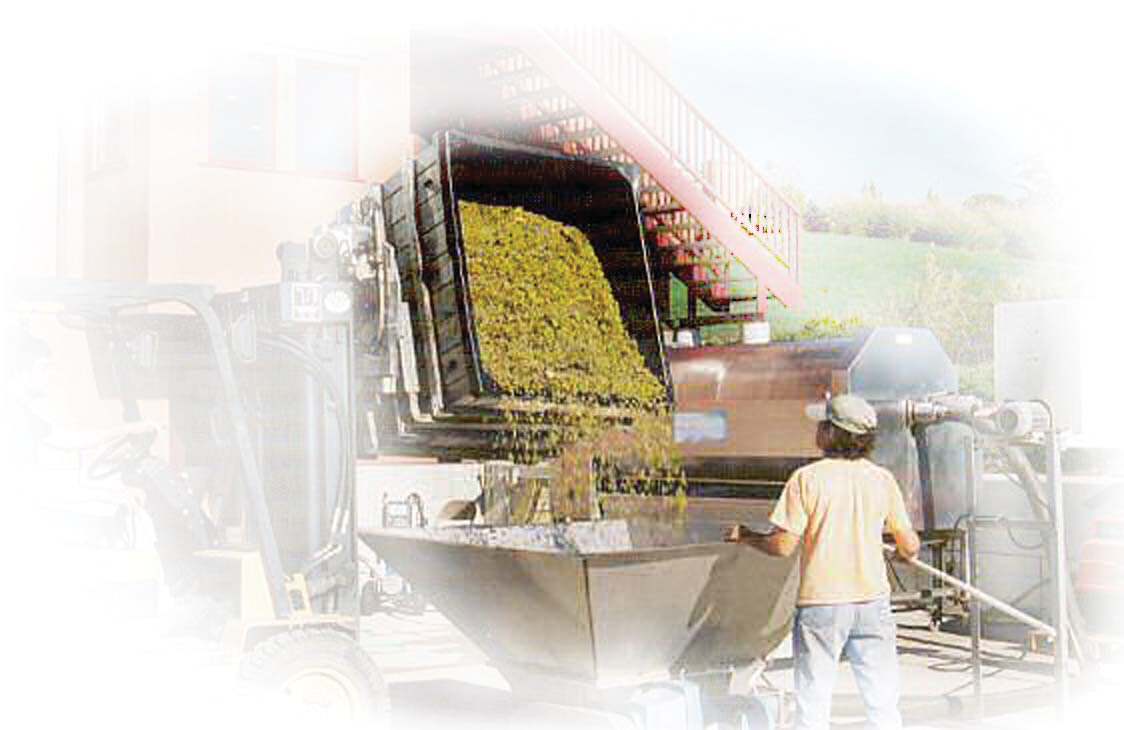
Although prices rebounded in 2003 and reached the $200 per-ton level again in 2004, prices declined again in 2005, leaving market watchers wondering just what was going to happen next.
A number of factors have played into the market variations, Paggi notes in the new report. Among the positive trends has been a steady increase in consumer consumption of products that contain juice concentrate: U.S. Department of Agriculture statistics reveal a steady increase in non-citrus juice consumption in the United States during the last two decades, from about 1.7 gallons per person per year in 1980 to three gallons per year in 2004.
On the downside, increased concentrate production from world suppliers such as Argentina has buoyed supplies, keeping prices down.
In addition, there is continuing competition from the apple and pear juice industries, both domestic and abroad, Paggi noted.
“Apple and pear juice concentrate are the major substitutes to grape juice because of their neutral taste in blending, availability of supply, and competitive prices,” Paggi said. And foreign production of those commodities also is growing. “Imports, primarily from China, have increased substantially,” he said.
While industry sources suggest that grape juice concentrate remains a preferred ingredient due to its unique qualities as a blending agent, growers must seek ways to increase production efficiency and yield in order to remain resilient in the face of market changes.
To aid growers develop such planning strategies, Paggi’s report offers two key sections: one is a detailed profile of the California grapes-for-concentrate industry, including the dynamics of international competition. The second is a grapes-for-concentrate economic budget analysis.
“The information allows growers to examine the cost and return parameters relative to their own operations and to determine bottom-line outcomes under alternative scenarios regarding crop prices and yields,” Paggi said.
The report, entitled “An analysis of the Market for Grape Juice Concentrate: Implications for Central California Grape Growers,” is expected to be available later this summer. To obtain a copy at no charge, contact CAB at 559-278-4405 or visit the CAB website at http://www.cati.csufresno.edu/cab.
This study is part of an initiative by the Central California Winegrowers with funding made available by the California Department of Food and Agriculture’s “Buy California Initiative” and the U.S. Department of Agriculture, through the California State University Agricultural Research Initiative (ARI) Program.
Upcoming Events
- July 11 – Supervising for Success: Leadership Strategies and Techniques – seminar in Calistoga, California. For info, call 559-278-4404.
- Aug. 7 – Supervising for Success: Leadership Strategies and Techniques – seminar in Santa Maria. For details, call 559-278-4404.
- Aug. 8 – Ag Safety Breakfast Briefing at 7:30 a.m. in Calistoga. For details, call 559-278-4405.
- Aug 23 – Farm Labor Contractor Education Institute from 8 a.m. to 5 p.m. at the Double Tree Hotel in Bakersfield. Presented in English and Spanish. For details, call 559-278-4677.
- Oct 24 – Farm Labor Contractor Education Institute from 8 a.m. to 5 p.m. at the Piccadilly Inn Airport in Fresno. Presented in English and Spanish. For details, call 559-278-4677.
Center for Irrigation Technology
New water center opens for business
Leaders expect regional economic boost as water technology center responds to international needs
Local supporters of the new International Center for Water Technology (ICWT) were treated to tours, speeches and networking opportunities during grand opening ceremonies of the facility March 29.
Upon opening its doors for business on the campus of California State University, Fresno, the ICWT sets out on a mission with global implications, noted Center for Irrigation Technology (CIT) director David Zoldoske, also acting as interim director of the ICWT.
“The ICWT is dedicated to the development and application of advanced technologies that will enhance water use for urban, environmental and agricultural purposes,” Zoldoske said. “The center’s mission is to help enable efficient first use and effective reuse of water supplies worldwide.”
As a public-private partnership, The ICWT will provide technical review and evaluation of emerging water and clean energy technologies for both public and private sectors, Zoldoske noted.
“This will include technology development assistance, research, development, industry testing, certification, education and training.”
In addition to pursuing its mission objective, the ICWT also houses the Claude Laval Water and Energy Technology (WET) Incubator, a partnership between the Central Valley Business Incubator (CVBI) and the ICWT. The WET Incubator is named in honor of Laval, a Fresno area water technology industry leader who cast a vision years ago for Fresno to become a center for business and economic development related to water technology.
“The WET incubator is a very important piece of our region’s economic development,” said Craig Scharton, CVBI chief executive officer. “The facility will launch new businesses that will help us to manage our water and energy resources and to clean the environment.”
The CVBI will operate the WET Incubator along with its other efforts to foster economic growth through entrepreneurship, Scharton noted. Five member businesses are currently housed at the ICWT facility as members of the CVBI program. The developing businesses will enjoy on-site support such as administrative and clerical services. Also available will be water laboratory services for use in developing and testing new products.
Following a stay of from 12 to 36 months, current members will move to other facilities, providing space for new companies to rotate in.

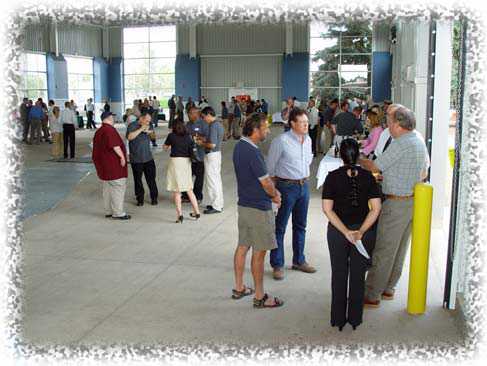
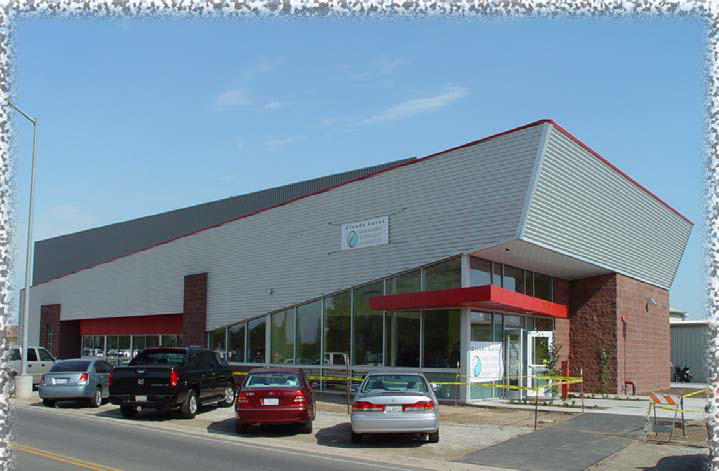
Left: Front view of the new International Center for Water Technology building, located on the Fresno State campus at the corner of Chestnut and Barstow avenues. Above left: One of three rows of solar panels on the roof of the building, providing 50 kilowatts of electrical power. Top. Members, friends and supports gather in the main, enclosed laboratory section of the building during a recent open house.
The ICWT facility is a cornerstone in the effort to build the Central Valley as a world leader in water technology, resulting in better products with increased water and energy efficiency,
See Water, Page 7
Viticulture and Enology Research Center
Sabbatical travels provide global research perspective
Viticultural research specialist Sanliang Gu undertook world travel and also engaged in some restful activities during a sixth-month sabbatical leave last year.
Gu, who holds the Ricchuiti Chair of Viticulture Research for Fresno State’s Viticulture and Enology Research Center (VERC), took advantage of his leave to visit grape growing regions in California, New Zealand, Chile and China.
“I wanted to see what was happening in the ‘new world’ of wine grape production,” Gu said, referring to areas outside of the traditional European growing regions. “I found that some countries were fairly advanced in their production technologies and others weren’t. However, each region had their advantages and share of problems.”
Since 1999, when he joined the VERC program, Gu has been conducting research to help advance California’s grape and wine industries. His work has also helped to shape undergraduate and graduate level curricula in Fresno State’s viticulture program. In 2005 Gu earned the title of associate professor with tenure and was recognized for his service and outstanding performance as a research scientist, viticulture instructor and graduate advisor.
Gu’s first stop in his sabbatical travels was New Zealand, where he attended the Sixth International Cool Climate Symposium for Viticulture and Enology. The event focuses on the challenges of wine grape growing and wine making in cool climate regions such as New Zealand and Oregon.
During his travel and discussions in New Zealand, Gu was impressed by the ample research funding, along with an excellent public support system for grape and wine production. On the other hand, the region is challenged by a short growing season and bird damage all over the country.
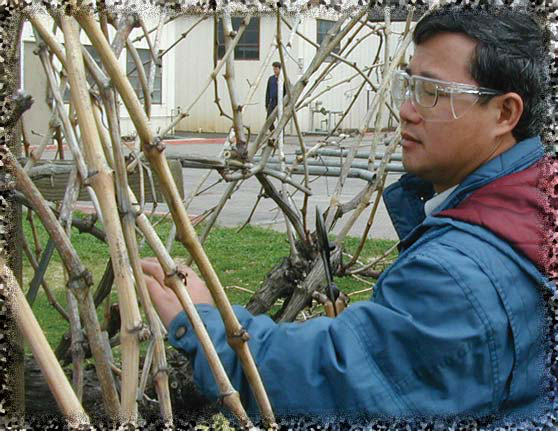
Fresno State viticulture researcher Sanliang Gu examines pruning techniques on the university farm.
New Zealand was followed by a two week exploration of Chile, Gu recalled. Through contacts he made with university researchers there, Gu was able to observe production methods in a country still developing its viticulture skills.
“I would say that Chile’s diverse and favorable climate in different regions is the best thing for the country,” he said.
Gu’s final sabbatical stop was his home country, China, which is seeking to become a major player in the wine grape marketplace.
“China is just beginning to expand their wine grape production. They have a lot of things against them, specifically the lack of a dry growing season and mild winters in most of the production areas. However, the availability of cheap labor is a great advantage,” he said.
“The sabbatical leave offered me an opportunity to see the new world of wine gape production, and it was certainly mind and eye opening.” Gu said.
Taste: Project seeks volunteers for tasting panels
from Page 1
Establishing this type of biological and genetic population segmentation enables scientists to better understand the predispositions consumers may have to bitterness, sweetness, astringency, and perhaps to aroma compounds, Rodriguez said. By understanding how these taste sensitivities affect wine consumers, wineries may be able to market certain wines to specific target populations.
“The results of this research could promote the increased wine consumption that is wanted and needed,” she said. “It will also enable the industry to make distinctive wines that can compete successfully on the international level.”
The first step in this effort is to establish panels of wine tasters with the specific genetic traits, Rodriguez said.
She and the graduate student on this project, Caryn Chachulski, are currently recruiting and preparing to train two eight-person panels, one of supertasters and one of nontasters. The initial objective is to determine whether supertasters and nontasters perform differently in descriptive analysis of the same wines.
As of mid-June Chachulski was still seeking individuals to serve on the panels. She said people who are 21 and older and are familiar with red and white wines may apply. Tasting sessions will be weekly over a period of two to three months. For more information, e-mail Chachulski at winemonkey00@yahoo.com.
California Irrigation Management Information System
Estimating evaporation rates from open water surfaces
CIMIS regularly receives inquiries on how to use its reference evapotranspiration (ETo) data to estimate the amount of water that evaporates from a pond, a lake, a swimming pool, or any other open water surface (E). This article was therefore prepared to address this question in the hope that many Update readers can benefit from it.
There are similarities and differences between the two processes. ETo is a loss of water to the atmosphere through the combined processes of evaporation and transpiration from a reference grass surface on which the weather station is set up. Although the evaporation component of ETo is similar to evaporation from a free water surface, the transpiration component is different in that it involves the movement of water from soils to the atmosphere through the plant system.
Visit the CIMIS home page at http://www.cimis.water.ca.gov
Moving water from the soil to the atmosphere through plants requires energy to overcome the natural resistance to flow. Because of this additional resistance (commonly known as canopy resistance) for the entire transpiring vegetation, ETo is usually less than E.
Evaporation from an open water surface depends mainly on the depth of the evaporating water and its turbidity. Therefore, the amount of water evaporated from two water bodies can be different even when they are in the same microclimate. Also, depth and turbidity of the same water body can vary, temporarily resulting in different amounts of evaporation. These factors make it difficult, although not impossible, to develop conversion factors (coefficients) between ETo and E.
When CIMIS was developed in 1982, it was decided that CIMIS data users would be better served if average coefficients were derived. Accordingly, researchers at the University of California, Davis determined that, on average, a factor of 1.10 can be used statewide to convert CIMIS ETo to evaporation from open water surfaces. In other words, CIMIS ETo is multiplied by 1.10 to obtain a rough estimate of evaporation from a pond or a lake in the same microclimate as the CIMIS station.
Project managers who need a more accurate estimation would need to directly measure E and develop a correlation of their own between the two estimates.
Interested readers can use Leaflet 21427 of the UC Cooperative Extension publication for reference. A copy of the Leaflet can be ordered either from the UC Cooperative Extension or from CIMIS.
For more CIMIS information...
CIMIS information is published quarterly in the CATI Update newsletter. Articles are provided by the California Department of Water Resources, CIMIS program staff.
For more information about CIMIS or its programs, contact any of the following representatives at these offices:
- Northern District
Mark D. Rivera
(530) 529-7301
mrivera@water.ca.gov - San Joaquin District
Steve Ewert
(559) 230-3334
sewert@water.ca.gov - Central District
Marc L. Anderson
(916) 227-7603
marcla@water.ca.gov - Southern District
Sergio Fierro
(818) 543-4652
sergiof@water.ca.gov
Weekly ETo Comparisons for Fresno
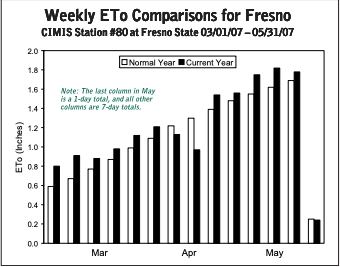
CIMIS Station #80 at Fresno State 03/01/07 – 05/31/07
Note: The last column in May is a 1-day total, and all other columns are 7-day totals.
Chart shows ETo variation from normal over last three months.
Water: Testing will provide data for industry
from Page 4
Scharton said.
“The economic rewards of this effort will create jobs, support the local tax base and focus international attention on our community,” he stated.
The ICWT building itself is being called a model of environmental technology. Its roof is covered in solar panels that generate 50 kilowatts of electricity. That amount will not only meet all the needs of the ICWT building, but will provide extra power to be returned to the university’s power grid for campus-wide use.
One side of the ICWT building contains the main entrance and reception area, a conference room, and office space for the five developing businesses that are members of the WET Incubator (see sidebar article at left for names and descriptions of businesses).
The laboratory section of the ICWT building features a large indoor equipment testing area, including a 22-foot deep, 53,000-gallon sump. The sump will be used as a water source and testing facility for pumps of up to 300 horsepower, as well as for pipes, valves and other types of flow technology.
ICWT invites both individuals and corporations to be on its general membership list. Members will be apprised regularly of operations and activities through a newsletter and other communication methods. For more information about the ICWT, including testing and certification programs, call 559-278-4540 or visit the website at http://www.icwt.net.

Visitors observe the flow from a 50 horsepower water pump in the ICWT laboratory. The pump sits over a 22-foot deep sump that holds 53,000 gallons of water. The pump is driven by solar energy derived from panels on the roof.
ICWT laboratory houses five new water businesses
The initial class of on-site WET Incubator members includes the following:
PureSense Environmental Resource Management – This software company provides real-time, decision-making information through a network of sensors that measure crop performance, allowing users to reduce pumping costs through better water management strategies. Benefits include improved crop quality and reduced water use.
WorldWater & Power Corp. – This solar energy and water management company uses patented technology that enables pumps to operate independently of the existing electric power grid, providing blackout protection. The firm will convert diesel pumps to solar power, helping farmers economically while reducing air pollution.
Full Circle Energy – is currently constructing a prototype ultra-clean coal-plasma power plant, the first if its kind in the world. The plant will mix coal and organic material such as municipal waste and convert it to a clean synthetic gas that generates electrical power, ethanol for engines and hydrogen for fuel cell technology.
Golden State Enviro-Pure Water – uses steam technology to purify water and eliminate chemicals and contaminants found in raw water. The company aims to provide service first to segments of the local community, then later to national and international markets.
OXYPRO – is developing a diesel fuel extender (DFX), an alternative fuel additive that allows vegetable oil to be mixed with diesel fuel to conserve energy, reduce fuel costs and enable equipment to burn cleaner.
ARI/CATI on the Web!
The California State University Agricultural Research Initiative (ARI) oversees applied agricultural, agribusiness and natural resources research on behalf of California agriculture. For information on our research and project results, visit our website at http://ari.calstate.edu.
The California Agricultural Technology Institute (CATI) administers ARI funding and oversees additional applied agricultural research. For more information about CATI and its research centers, visit us at http://cati.csufresno.edu, or at our centers:
- Center for Agricultural Business (CAB) – cati.csufresno.edu/cab
- Center for Food Science and Nutrition Research (CFSNR) – cati.csufresno.edu/cfsnr
- Center for Irrigation Technology (CIT) – cati.csufresno.edu/cit
- Viticulture and Enology Research Center (VERC) – cati.csufresno.edu/verc
- Agricultural Technology Information Network (ATI-Net) – cati.csufresno.edu/atinet
Researchers attempt riparian restoration
A research team from California State University, Chico has completed work on a project that will help growers and ecologists interested in establishing riparian plantings.
Associate Professor Patricia Delwiche led the study to investigate specific methodologies expected to make riparian restoration more efficient. Through studies of plant growth on a 25-acre parcel along the Sacramento River in Tehama County, Delwiche refined the techniques used to establish and nurture native plants in order to enhance their survival and growth.
Researchers approached the project using the simplest techniques possible; in the end they demonstrated that restoration can be accomplished relatively inexpensively from the back of a pickup truck.
“They demonstrated that restoration can be accomplished relatively inexpensively from the back of a pickup truck.”
Results based on observation of different planting and treatment regimens suggested that oak trees can be established as effectively using acorns as they can using one-year-old seedlings as planting material.
Following the study of different irrigation treatments, it was determined that temperature of irrigation water does affect plant performance, and it could be controlled by affordable means. Researchers also found that a cost-effective treatment of oak saplings with Irish Spring® soap deterred deer browsing more effectively than did several more costly and less-easily available treatments.
Furthermore, the research team determined that they could apply the standard planting methods for oaks to a variety of native plant species, with a survival rate of at least 33 percent, and that native grasses could be seeded using “seedballs” under closely-controlled conditions.
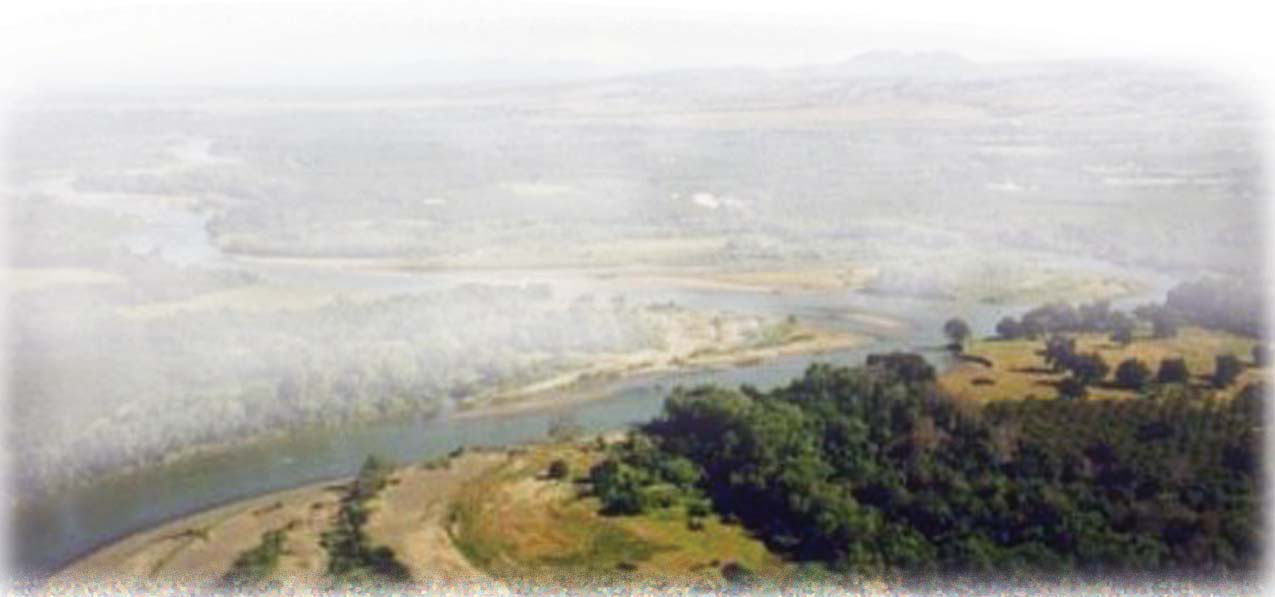
In the process of planting and maintaining these 25 acres over the course of approximately five years, researchers developed a protocol that they believe has wide applicability across locations and species.
This research study was funded in part by the California State University Agricultural Research Initiative (ARI), administered by Fresno State’s California Agricultural Technology Institute (CATI). The project was entitled, “Enhancement of Plant Establishment in Restoration Sites” (ARI Project #00-5-009). To access the complete final report, or for additional information on this project and other related research, visit the ARI website at http://ari.calstate.edu.
Update publication information
Update is published quarterly by the California Agricultural Technology Institute
College of Agricultural Sciences and Technology
California State University, Fresno
Summer 2007
CATI Publication #070701
Voice number: (559) 278-2361
Fax number: (559) 278-4849
Director of Operations: Joe Bezerra
Publications Editor: Steve Olson
Student Assistant: Megan Jacobsen
In the event of incorrect address information or extra copies to your workplace, please return this address label by mail or fax with your requested changes. CATI fax number is (559) 278-4849.
Address Service Requested
California State University, Fresno
2910 E. Barstow Ave. M/S OF115
Fresno, California 93740-8009
Non Profit Organization
U.S. Postage PAID
Fresno, CA
Permit No. 262
California Agricultural Technology Institute
California State University, Fresno
This HTML version was generated with AI assistance and may contain errors or omissions. The original approved PDF remains the official document of record. An alternative accessible format is available upon request from the document creator in accordance with Title II of the ADA.