Update Fall 2007
CALIFORNIA AGRICULTURAL TECHNOLOGY INSTITUTE
FALL 2007
California State University, Fresno
In this issue...
Airborne exports eyed ........ 3
Irrigation with air tried....... 4
Winery’s 10th celebrated .... 5
Drought issues discussed ..... 6
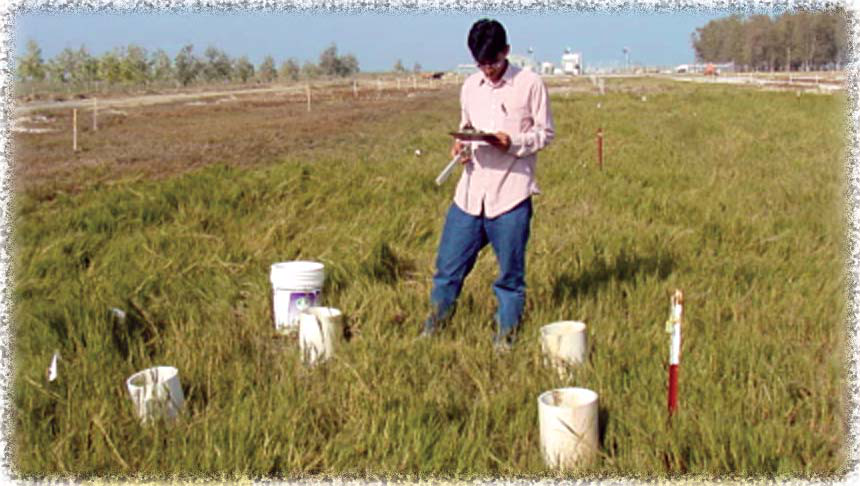
Fresno State soil scientist Diganta Adhikari examines an experimental plot of saltgrass during irrigation trials in California’s western San Joaquin Valley.
New ARI projects address soil salinity, air emissions issues
Faculty researchers from Fresno State and other California State University (CSU) institutions are arranging their schedules for coming-year research that will include monitoring air emissions, analyzing the properties of soils and plants, and evaluating the success of new harvesting technologies – all with the aim of improving the profitability, sustainability and long-term global competitiveness of California agriculture.
The work is being sponsored by the California State University Agricultural Research Initiative (ARI) program, supported by private industry and an assortment of other state and federal organizations and agencies with a stake in California agriculture.
The ARI, which is administered by the California Agricultural Technology Institute (CATI), awards $4 million a year for applied agricultural and environmental research. One of its key objectives is to focus the collective expertise of the CSU’s four colleges of agriculture collaboratively with that of qualified faculty and research scientists from other universities and appropriate research organizations on finding immediate and practical solutions for priority issues challenging California agriculture, the environment and consumer health and safety, noted ARI Executive Director Joe Bezerra.
The four member campuses are California State University, Fresno; California Polytechnic State University, San Luis Obispo; California State Polytechnic University, Pomona; and California State University, Chico.
Annual conference to highlight ag issues, leadership
Issues will be discussed and honorees commended at a combined event once again this year as Fresno State’s Center for Agricultural Business and the Greater Fresno Area Chamber of Commerce host a regional conference to address agricultural issues and present leadership awards.
The 26th Annual Agribusiness Management Conference and the 2007 Agriculturalist of the Year and Ag Business Award Luncheon will be held Wednesday, Nov. 7, at the Valdez Hall of the Fresno Convention Center.
Recipients of the chamber of commerce awards are Nat Dibuduo and Sarkis V. Sarabian, co-agriculturalists of the year, and Borba Farms, Ag Business of the Year.
The ag business management conference this year could be
See Issues, Page 7
Projects: Public funds matched by industry
San Luis Obispo; California State Polytechnic University, Pomona; and California State University, Chico.
“ARI is one of the nation’s most cost-effective programs for conducting applied research because it provides public funds that are annually matched at least one-to-one with industry and/or agency resources to fund high-impact research, development, and technology transfer, as well as related public and industry education and outreach,” Bezerra said. “Its projects and programs improve the economic efficiency, productivity, profitability, and sustainability of California agriculture and its allied industries. And, its programs lead to consumer sensitive and environmentally sound food and agricultural systems that foster public confidence in food safety and agricultural research and production systems through a system of university-industry partnerships.”
ARI projects are awarded through a competitive peer review process, with funding based on each project’s ability to demonstrate scientific merit and appropriate peer collaboration, industry priority, and appropriate external matching funds.
Since the program began, more than 400 projects have delved into new areas of research. New technologies have been developed, challenges overcome, and solutions found to existing problems. In the area of natural resources, researchers have studied trends, gained information and developed strategies that will help us to better interact with and protect our natural ecosystems.
This year more than 30 project grants have been awarded to CSU faculty and allied industry partners. Following is a list of Fresno State researchers and summaries of their planned work.
For a broader look at ARI research, both projects completed and under way, visit the ARI website at http://ari.calstate.edu.
ARI projects: Fresno State 2007-08
Soil scientist Diganta Adhikari of Fresno State’s Center for Irrigation Technology (CIT) will explore a new method for measuring how plants and soil on California’s West Side San Joaquin Valley digest irrigation water with high salt content. Results will aid growers and water management agencies to develop better strategies for saline drainage water use.
Another CIT soil scientist will address West Side salinity problems with a different objective. Florence Cassel Sharma will use remote sensing techniques, including satellite imagery, to map surface and subsurface soil salinity. Results will help growers to determine soil salinity levels and develop sound management practices related to drainage and cropping systems.
In another West Side project, Cassel Sharma will compare two soil reclamation techniques to control blossom end rot on tomatoes. The disease is associated with calcium deficiency in plants. Researchers believe application of calcium or acid through subsurface drip tape should increase calcium availability in the soil and increase plant uptake.
Assistant professor Xiaohui “Sarah” Deng of the Department of Agricultural Economics will analyze the economic viability of organic farming in California. Because of immigration law enforcement, the labor-intensive industry is in danger of losing its work force. Deng will identify and develop recommendations to help organic farmers recruit and retain farm labor.
Viticulture research specialist Sanliang Gu will explore the potential of Abscisic acid (ABA) application to enhance color development and improve fruit and wine chemistry of major red wine grape varieties in the San Joaquin Valley. Success of the proposed research could provide for a significant increase in wine grape quality and value.
University of California extension pomologist Louise Ferguson has joined with Fresno State assistant plant science professor Todd Einhorn to explore new production strategies to enhance the quality of machine-harvested olives for olive oil production. Ferguson will evaluate new tree pruning techniques, chemical abscission agents and mechanical harvesting methods.
Professor Charles Krauter will continue air emissions investigations in order to develop accurate methods for measuring the release of potential air pollutants from commercial dairy operations. His team will explore whether alcohols from feed and fresh manure are a significant source of reactive organic gases (ROGs), known to be precursors to ozone formation.
Soil scientist Sajeemas “Mint” Pasakdee will continue to monitor the sustainable reuse of food processing by-products as a soil amendment on California farmlands. The practice is used to recycle nutrients back to the soil and to minimize landfill disposal of by-products of concern (e.g., nitrogen, sodium, and trace elements).
Enologist Susan Rodriguez will study the influence of two specific yeast strains on the fermentation process in an attempt to bring improvements to the color and flavor of wines made from grapes grown in the central San Joaquin Valley. She will seek to learn how these strains affect proportions of free anthocyanins, polymeric pigments that affect wine color.
Industrial technology professor Balaji Sethuramasamyraja will continue work on a project using a combination of satellite and information sharing technologies that will enable grape growers to maintain better control over crop quality during harvest. The work will feature the examination of wine grape quality using geospatial modeling.
Center for Agricultural Business
New report updates air cargo trends, trials
Expanding overseas markets provide reason for cautious optimism

Although steadily larger shares of international air cargo are being transported by the carriers such as FedEx, it is not clear that these carriers will aggressively pursue business involving perishable agricultural products.
A new report analyzing international air cargo transport trends outlines several reasons to expect growth in California airborne agricultural exports. At the same time, authors of the report caution that rising fuel costs and world terrorism have the potential to ground some export flights.
The report is entitled, “The Role of Air Cargo in California’s Agricultural Export Trade: A 2007 Update” and is housed on the website of the Center for Agricultural Business (CAB). The work was completed through a study led by Bert Mason, Ph.D., professor and chair of Fresno State’s Agricultural Economics Department. Coauthor is Sacramento-based international trade consultant Jock O’Connell.
“One purpose of this study was to draw attention to the unique role of air cargo in reaching lucrative and expanding overseas markets that would be otherwise inaccessible to specialty crop growers in this state.”
“One purpose of this study was to draw attention to the unique role of air cargo in reaching lucrative and expanding overseas markets that would be otherwise inaccessible to specialty crop growers in this state,” Mason stated.
The report, which updates a larger 2005 study, tracks the types and values of the state’s airborne agricultural exports from 1996 through 2006.
For growers of certain high-value specialty crops such as cherries, strawberries, asparagus and organically-produced perishables, the ability to ship to distant markets by air is immensely important, O’Connell said. In 2006 for example, 77.6 percent of California’s $60 million in fresh cherry exports traveled by air.
Seeds for growing fruits, vegetables and flowers ranked at the top of the value list, with air exports totaling $114.3 million. Other important airborne exports in 2006 included wine, various food preparations, purebred breeding animals, and bovine semen.
The principal destinations of California’s airborne agricultural export trade are in the Far East, with Japan ranking as the single largest market over the last three years, the authors found. South Korea, China, and Taiwan are all currently among the top 10. The second and third largest customers are the United Kingdom and Australia. More limited trade is conducted with Continental Europe and Latin America.
Progress in negotiating new air transport agreements with key U.S. trading partners should open new and more convenient air routes from California to a larger number of overseas markets, the authors said. Other positive trends include the following:
- Worldwide demand has expanded dramatically for high-quality and high value-added food products grown and processed under conditions conducive to wholesomeness and food safety.
- A new generation of medium-sized, long-range aircraft featuring fuel efficient engines (typified by the Boeing 787 “Dreamliner”) will begin to enter service in 2008.
- The increasing reliance on huge mega-ships to carry vast numbers of freight containers is limiting the ability of ocean-carriers to reach many of the new, geographically dispersed markets emerging in developing countries.
Current and potential exporters should guard their optimism in the face of new challenges, the authors also note. For example:
- Until very recently, jet fuel prices had been rising precipitously, a serious development for all air transportation industries.
- Ground access to California’s principal international air cargo gateways – Los Angeles International (LAX) and San Francisco International (SFO) – is becoming increasingly problematic for exporters of perishable products.
- Should terrorists succeed in planting an explosive device in the cargo hold of a passenger airliner anywhere in the world, the U.S. Congress may act to ban third-party freight from passenger aircraft or require such onerous inspection procedures as to make shipping perishable produce no longer viable.
The complete 25-page report on airborne trade contains additional projections, trends and values of air-exported products over the last 10 years, and analyses of key issues affecting airborne trade. It is available for viewing or downloading from the CAB website, at http://www.cati.csufresno.edu/cab.
Funding for this project was from the Governor’s “Buy California Initiative,” the California Department of Food and Agriculture and the U.S. Department of Agriculture, through the California State University Agricultural Research Initiative (ARI) Program.
Upcoming Events
Oct. 24 – Farm Labor Contractor Education Institute from 8 a.m. to 5 p.m. at the Piccadilly Inn Airport in Fresno. Presented in English and Spanish. For registration details, call 559-278-4677.
Nov. 7 – 26th Annual Agribusiness Management Conference and the 2007 Agriculturalist of the Year & Ag Business Award Luncheon at the Fresno Convention Center. For details, call 559-278-4405.
Nov. 28 – Farm Labor Contractor Education Institute at the Hilton Hotel in Santa Rosa. For details, call 559-278-4677.
Dec. 4 – Farm Labor Contractor Education Institute at the Hilton Hotel in Palm Springs. For details, call 559-278-4677.
Air: Negotiators seeking to open new global routes
from Page 3
Long-range aircraft featuring fuel efficient engines (typified by the Boeing 787 “Dreamliner”) will begin to enter service in 2008.
The increasing reliance on huge mega-ships to carry vast numbers of freight containers is limiting the ability of ocean-carriers to reach many of the new, geographically dispersed markets emerging in developing countries.
Current and potential exporters should guard their optimism in the face of new challenges, the authors also note. For example:
- Until very recently, jet fuel prices had been rising precipitously, a serious development for all air transportation industries.
- Ground access to California’s principal international air cargo gateways – Los Angeles International (LAX) and San Francisco International (SFO) – is becoming increasingly problematic for exporters of perishable products.
- Should terrorists succeed in planting an explosive device in the cargo hold of a passenger airliner anywhere in the world, the U.S. Congress may act to ban third-party freight from passenger aircraft or require such onerous inspection procedures as to make shipping perishable produce no longer viable.
The complete 25-page report on airborne trade contains additional projections, trends and values of air-exported products over the last 10 years, and analyses of key issues affecting airborne trade. It is available for viewing or downloading from the CAB website, at http://www.cati.csufresno.edu/cab.
Funding for this project was from the Governor’s “Buy California Initiative,” the California Department of Food and Agriculture and the U.S. Department of Agriculture, through the California State University Agricultural Research Initiative (ARI) Program.
Issues: Housing ‘meltdown,’ effects to be discussed
from Page 1
Themed, “Pick Your Crisis,” noted Kimberly Naffziger, program development specialist for CAB and one of the organizers. Issues to be discussed include the volatile housing market, dwindling water supplies, immigration, air quality, and food safety.
Opening the event with a general economic outlook will be Steven Wood, president and chief economist for Insight Economics. Wood will discuss the effects of the housing market downturn on the broader economic front, when he speaks on “The Real Challenge Begins: Housing Meltdown, Credit Woes.”
Providing the luncheon address will be George Soares, partner in the law firm of Kahn, Soares and Conway.
“We are looking forward to the keynote presentation from George Soares, who will wrap up the conference with a view toward how agricultural issues and concerns fit in relation to those facing the whole of California,” said CAB Director Mickey Paggi.
Sandwiched between the opening and lunch presentations will be a series of panel discussions addressing key agricultural issues, Paggi noted.
The first panel will discuss water issues, featuring reports from three leaders of regional water/agricultural agencies. Speakers will include Thomas Birmingham, general manager and general council for Westland’s Water District; Allen Dusault, program director for Sustainable Agriculture; and Ronald Jacobsma, general manager for the Friant Water Authority.
Three more panel discussions will complete the morning’s activities. They will address immigration, air quality, and food safety.
In addition to the speaker presentations, written commodity reports will be included in the proceedings, Paggi said. Reports will focus on almonds, beef cattle, citrus, cotton, pima cotton, dairy, feed grains and protein meals, raisins, table grapes, tree fruit, tomatoes, and wine grapes.
Registration fee for this year’s event is $100 (including the luncheon) for registrations postmarked by Oct. 27. Late registration is $125. For more information, call 559-278-4405 or visit the CAB website at http://cati.csufresno.edu/cab.
ARI/CATI on the Web!
The California State University Agricultural Research Initiative (ARI) oversees applied agricultural, agribusiness and natural resources research on behalf of California agriculture. For information on our research and project results, visit our website at http://ari.calstate.edu.
The California Agricultural Technology Institute (CATI) administers ARI funding and oversees additional applied agricultural research. For more information about CATI and its research centers, visit us at http://cati.csufresno.edu, or at our centers:
- Center for Agricultural Business (CAB) – cati.csufresno.edu/cab
- Center for Food Science and Nutrition Research (CFSNR) – cati.csufresno.edu/cfsnr
- Center for Irrigation Technology (CIT) – cati.csufresno.edu/cit
- Viticulture and Enology Research Center (VERC) – cati.csufresno.edu/verc
- Agricultural Technology Information Network (ATI-Net) – cati.csufresno.edu/atinet
Center for Irrigation Technology
Air injection tried in organic trials
Graduate student monitors study of air injected into plant rootzones via subsurface drip lines
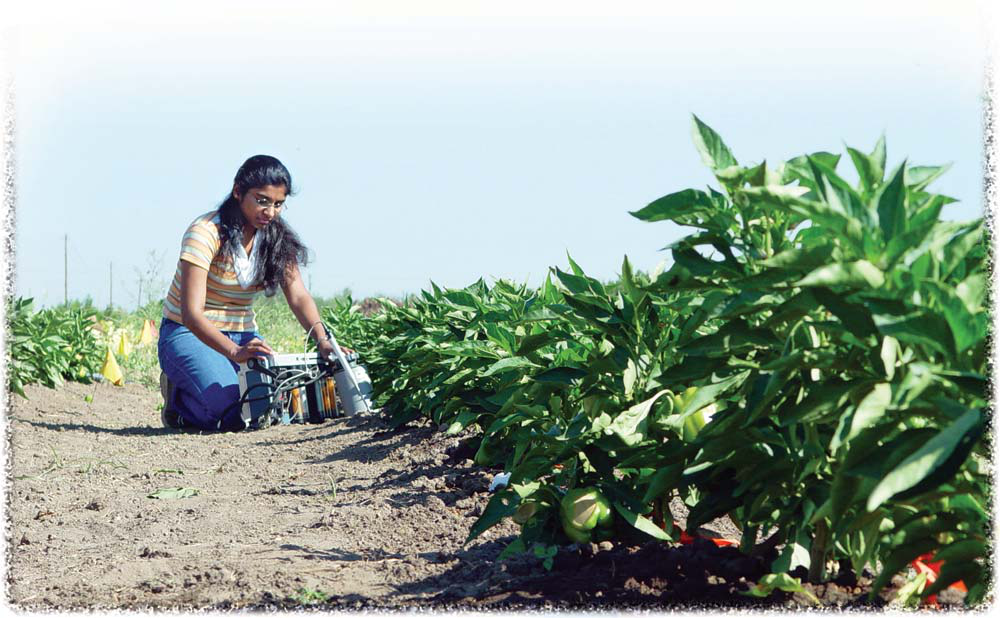
Above: Graduate student research technician Namratha Reddy tracks soil moisture conditions in an experimental plot of Bell peppers being grown organically with the AirJection® system.
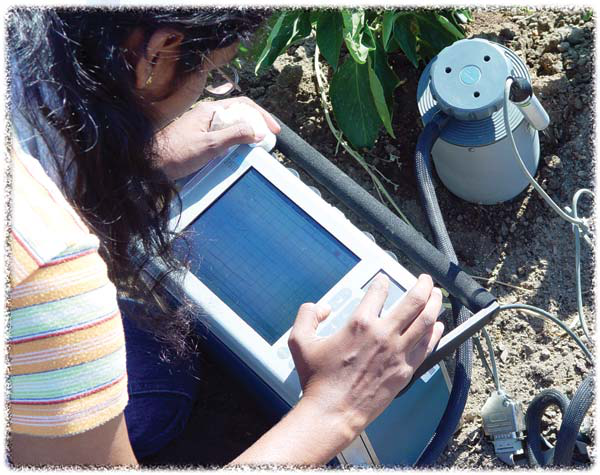
Left: Close-up of a CIRAS 2 portable photosynthesis-soil respiration system used to measure plant photosynthesis, transpiration and soil respiration rates.
Scientists with the Center for Irrigation Technology (CIT) are expanding their research in the use of air injection as a means of enhancing soil properties for crops.
Agronomist Dave Goorahoo began exploring the technique, now referred to as AirJection® Irrigation, several years ago using newly-patented technology to inject air into subsurface drip irrigation lines. The system uses high-efficiency venturi injectors to mix microscopic air bubbles with the water inside the drip line. The air permeates the soil along with the water during irrigation and helps to aerate the soil.
“Recent and ongoing research has shown that AirJection® Irrigation can increase root zone aeration and add value to grower investments in subsurface drip irrigation systems,” Goorahoo said. “So far we have tested the technology on conventionally grown bell peppers, fresh market tomatoes, cantaloupes, honeydews, broccoli and sweet corn.”
In the summer of 2004, a study on a 20-acre cantaloupe plot revealed a 13-percent increase in the number of melons harvested and an 18-percent increase in their weight, in plots treated with AirJection® Irrigation, Goorahoo noted.
The work conducted to date has been aimed at evaluating AirJection® Irrigation using conventional farming methods. In a new phase of research, Goorahoo is testing the same method to assess the impact of nitrogen on the yield and quality of Bell peppers grown organically.
The study is being conducted on Fresno State’s university farm. The experiment features a split plot design comprised of eight beds – each five feet wide and 50 feet long – representing four replications of air injected treatments and no-air (control) treatments. Nitrogen is being applied at rates of 30, 60, 90 and 120 lbs/acre as commercially available organic fertilizer (12-0-0) derived from feather meal.
Handling the technical aspects of the project is student Namratha Reddy, a master’s degree candidate in the Department of Plant Science. As part of her work, Namratha Reddy has overseen the fertilizer and irrigation applications. She also attends the field regularly to measure plant photosynthesis, transpiration rates and soil respiration.
Initial measurements through August revealed that both AirJection® Irrigation and N rate had a significant effect on plant transpiration rate, Reddy reported.
Soil samples taken before and after the cropping season will be used to assess the impact of AirJection® Irrigation on soil fertility. Yield data, tissue analysis, and plant biomass data also will be determined.
Results of yield analyses and other aspects of the project will be presented at upcoming seminars and in special publications.
For more information, Goorahoo may be contacted via email at dgooraho@csufresno.edu.
Upcoming events
Oct. 16 – Victor Valley Water District Pump Efficiency Workshop in Victor Valley, California. Call 760-843-3113 for details.
Oct. 22-23 – Water and Energy Conference addressing pump testing and efficiency, flow meters, variable frequency drives, in Irwindale, California. Call 626-812-7370.
Oct. 31 – Agricultural Pumping Efficiency Program Municipal Pump Efficiency workshop in Chico, California. For details, call 530-896-4250.
Viticulture and Enology Research Center
10 years
Research program fuels winemaking excellence, brings harvest of medals

Fresno State winemaker and enology professor Ken Fugelsang and provost Jeri Echeverria join with enology students to display the latest round of award-winning wines produced at the university winery.
Breakthrough research in winemaking processes at California State University, Fresno in recent years has propelled the university’s winery into the forefront of world-class winemaking. Evidence of that is the 32 awards won by nine Fresno State wines in just the last year, reported winemaker Ken Fugelsang during a recent event celebrating the winery’s 10-year anniversary.
It was 1997 when the Fresno State Winery became the first and only university winery in the United States to obtain a commercial bond allowing it to bottle, label and market its own wines, Fugelsang recalled. Almost immediately the winery began entering its vintages in wine competitions. At first the medals were few, especially since the facility produced only one or two wines per vintage year.
“Today we are producing 18 to 20 different wines per vintage year, giving our students as large a look at the hands-on winemaking process as we possibly can,” Fugelsang said. Many of the awarding-winning wines have been produced by students at various stages in their degree programs.
Supporting the medal winning has been a thriving viticulture and enology research program, Fugelsang noted.
“Dr. [Roy] Thornton and I have demonstrated the parameters necessary for successful high density fermentations, and we have elaborated flavor and odor-active compounds produced by the spoilage yeast, Brettanomyces,” Fugelsang said. Other faculty, such as chemistry professor Barry Gump, have joined in research to develop analytical methods for nitrogen level measurement and guidelines to achieve complete fermentation, he added.
Much of what is ‘routine’ for winemakers today arose as the result of grape/wine research studies, Fugelsang said. That’s the importance of research in any viticulture and enology program.
“The wine industry relies on continuing research to maintain a competitive edge in the global wine trade. If continued research and development lags, we will suffer losses in the marketplace to more competitively priced, excellent quality wines from other wine-producing countries,” he said.
Fresno State enters its wines in state, national and international competitions. Wines are available for purchase in the Farm Market, located on the corner of Chestnut and Barstow avenues on the Fresno State campus. Proceeds benefit agriculture programs at Fresno State.
For a complete list of all the award-winning wines produced by the Fresno State Winery and the competitions in which they have earned medals, visit www.FresnoStateWinery.com.
Upcoming events
Nov. 15 – Le Vin Nouveau wine tasting at the Fresno State Winery to celebrate the release of Nouveau vintages. Ticket sales limited. Must be 21. Call 559-278-2089.
Nov. 28-29 – Central California Winegrowers (CCW) Central Valley Winegrape Symposium in Fresno. Call 559-278-2089.
Dec. 7 – Central California Winegrowers workshop at Fresno State. For details, call 559-278-2089.
For other upcoming events related to viticulture and enology, visit Fresno State’s Department of Viticulture and Enloogy website at http://cast.csufresno.edu/ve.
Fugelsang book nets international award
Fresno State winemaster and professor Ken Fugelsang has received an award from the International Organisation of Vine and Wine (O.I.V.) in France for his enology book, “Wine Microbiology – Practical Applications and Procedures.”
The book, coauthored with Dr. Charles Edwards of Washington State University and published by Springer-Life Sciences in 2007, is a comprehensive examination of the microbiology of grape wine, juice and concentrate. It addresses real-world problems such as characterization of enumeration of yeast, bacteria and molds common to juice and wine environments, and their impact on wine quality and stability.
The first edition of “Wine Microbiology” is a recommended textbook for all enology students.
California Irrigation Management Information System
Using CIMIS data can mitigate the effects of drought
The last snow survey of winter 2007 by the California Department of Water Resources (DWR) showed that the Sierra snow pack was at 29 percent of normal. This is the lowest level it has been in nearly two decades. Although this by itself may not result in significant water shortages, past records show that dry water years have the potential to appear consecutively. If a water shortage of the same proportion or more is to reappear in 2008, the effect on Californians will be tremendous.
In anticipation, DWR, the California Urban Water Conservation Council, and the U.S. Bureau of Reclamation are sponsoring a series of workshops on drought in September and October of 2007. These workshops are designed to assist water suppliers in reviewing and updating their Water Shortage Contingency Plans for the possibility of another dry year in 2008. Information on the dates and locations of these workshops can be obtained from http://www.owue.water.ca.gov/docs/DroughtWorkshops.pdf.
Visit the CIMIS home page at http://www.cimis.water.ca.gov.
Drought is not new to California. What makes the current cycle more significant, however, is the fact that the demand for water has grown more than the supply since the last drought. That is why DWR, in collaboration with local, state, and federal agencies, is making the necessary preparation to mitigate a potential problem.
One of the proven ways for mitigating drought is, of course, through water conservation – a reduction in unnecessary and wasteful uses of water. In many cases, however, it is not easy to determine the amount of water that is beneficially used. Irrigating agricultural crops and/or landscape plantings is one such a case. It is difficult, if not impossible, for an irrigator to decide when to irrigate and how much water to apply. That is where CIMIS’s reference evapotranspiration (ETo) data becomes a significant tool.
The ETo data, along with crop coefficients, is used to determine water demands for the different crops irrigators grow and landscape plants they maintain. Knowing exactly how much water a plant needs and scheduling irrigation systems accordingly will save water by reducing unnecessary losses to runoff and deep percolation.
Although CIMIS has been around for nearly a quarter of a century and its user bases have been growing steadily, much more needs to be done to educate the public about CIMIS data and its uses. Only then can we achieve significant water savings that can mitigate the recurring drought.
For more CIMIS information...
CIMIS information is published quarterly in the CATI Update newsletter. Articles are provided by the California Department of Water Resources, CIMIS program staff.
For more information about CIMIS or its programs, contact any of the following representatives at these offices:
Northern District
Mark D. Rivera
(530) 529-7301
mrivera@water.ca.gov
San Joaquin District
Steve Ewert
(559) 230-3334
sewert@water.ca.gov
Central District
Kim Rosmaier
(916) 651-0737
krosmaie@water.ca.gov
Southern District
Sergio Fierro
(818) 543-4652
sergiof@water.ca.gov
Weekly ETo Comparisons for Fresno
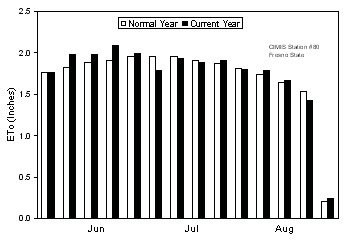
CIMIS Station #80 at Fresno State 06/01/07 – 08/31/07
Note: The last column in August is a 1-day total, and all other columns are 7-day totals.
Chart shows ETo variation from normal over last three months.
Broccoli study focuses on organic treatments

A three-season study on organic broccoli production in coastal and inland California has provided data that researchers believe will aid growers in increasing yields.
“Organic vegetable production has special needs, such as applying organic nutrients at precise times, or there will be a result of poor yields.”
“Organic vegetable production has special needs, such as applying organic nutrients at precise times, or there will be a result of poor yields,” noted U.S. Department of Agriculture plant and soil scientist Gary Banuelos in outlining reasons behind the research. Currently, he said, “there is a lack of scientific data in timely development of organic and inorganic nutrient reservoirs.”
To help fill in the information gaps in the area of distribution, movement, and uptake of organic sources of nutrients, Banuelos examined the effects of different forms of nitrogen side-dress and irrigation rates on organic broccoli production in two California regions.
Study results in both areas confirmed that nitrogen and water management can be optimized to achieve high water use efficiency and high marketable yield, Banuelos notes in a published final report. However, the application of organic fertilizer in a solid form is likely to require a greater amount of irrigation water than application in the liquid form, he added.
Of the two study plots, one was an established organic plot and the other was newly converted. Research data revealed that “addition of a nitrogen side-dress to a preplant application of compost is essential to a newly converted organic farm and should dramatically improve yields over three years of application,” Banuelos stated.
The efficacy of side-dress and water management practices are dependent upon the fertility background of each field site, the form of side-dress nitrogen used, soil type, and farm location, researchers noted.
Regular on-farm soil nitrate tests are desirable to ensure optimal levels of soil nitrate and to minimize nitrogen loss, Banuelos reported.
The research was conducted in cooperation with Fresno State’s Center for Irrigation Technology, with support from the California State University Agricultural Research Initiative (ARI).
The complete final report for this project contains additional technical information, along with data tables. For access, visit the ARI website at http://ari.calstate.edu. The project is titled, “Fate and availability of nutrients from compost to organic broccoli grown in Central and North Coastal California under different irrigation regimes.” (ARI Project #03-2-001).
Publication information
In the event of incorrect address information or extra copies to your workplace, please return this address label by mail or fax with your requested changes. CATI fax number is (559) 278-4849.
Update is published quarterly by the California Agricultural Technology Institute
College of Agricultural Sciences and Technology
California State University, Fresno
Fall 2007
CATI Publication #071001
Voice number: (559) 278-2361
Fax number: (559) 278-4849
Director of Operations: Joe Bezerra
Publications Editor: Steve Olson
Student Assistant: Megan Jacobsen
Non Profit Organization
U.S. Postage PAID
Fresno, CA
Permit No. 262
Address Service Requested
California State University, Fresno
2910 E. Barstow Ave. M/S OF115
Fresno, California 93740-8009
CALIFORNIA AGRICULTURAL TECHNOLOGY INSTITUTE
This HTML version was generated with AI assistance and may contain errors or omissions. The original approved PDF remains the official document of record. An alternative accessible format is available upon request from the document creator in accordance with Title II of the ADA.