Update - Winter 2006-07
CALIFORNIA AGRICULTURAL TECHNOLOGY INSTITUTE
WINTER 06-07
California State University, Fresno
In this issue...
- Ag dean shares vision ........ 2
- Water conference set ......... 4
- ARI research showcased .... 7
- Ozone conference coming ... 8
Fusion of new technologies enhances wine grape harvest
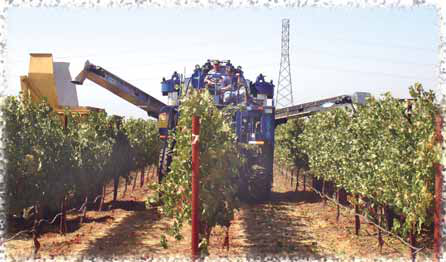
A research partnership between Fresno State viticulture scientists and the grape industry has enabled development of a sophisticated wine grape harvesting system combining satellite, computer and infrared technologies.
The system is being hailed as a breakthrough in some industry circles. Work has advanced for the past three years under the direction of Robert Wample, director of Fresno State’s Viticulture and Enology Research Center (VERC), with support from area wineries and grape growers.
The process was successfully tested in September when university and industry researchers harvested grapes from the vineyard of a cooperating grower in Lodi, California.
The marriage of technologies for wine grape harvesting features the use of near-infrared spectroscopy (NIRS) equipment in conjunction with GPS (global positioning systems) to prepare a “quality map” of a vineyard prior to harvest, Wample said in explaining the system. The NIRS device, from the Maryland-based Brimrose Corp. of America, used its near-infrared sensor capability to measure anthocyanin, sugar content (Brix), and pH content of the grapes prior to picking.
With that data as a guide, a computerized GIS (geographic information system) was used to direct the harvest.
“The quality map is used to control the mechanical harvester as it moves through the vineyard,” Wample said. See Grape, Page 5
Food safety tops topic list for conference
Agricultural industry leaders will gather to address safety issues at the 2007 Annual AgSafe Conference, to be held Jan. 31-Feb. 2 at the Embassy Suites Hotel and Conference Center on Monterey Bay.
The conference will expand its focus on food safety this year in light of several incidents that have drawn negative media attention to otherwise respected food processing companies, reported Kimberly Naffziger, program development specialist for the Center for Agricultural Business (CAB) and one of the conference organizers.
“Food safety is becoming one of the most important issues we’re facing in agriculture,” Naffziger said. “The discovery of a contaminant such as E. Coli in a single batch of a food product can bring See Safety, Page 3
Ag dean aims to enhance student success
New CAST leader seeks to strengthen ties between university, ag industry
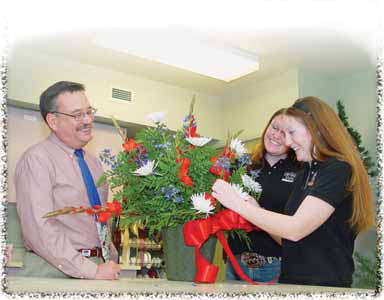
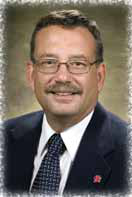
The new dean of Fresno State’s College of Agricultural Sciences and Technology (CAST) sees a rich pool of leadership potential when he observes students within the college. When he eyes the region’s agricultural industry, he sees a need for well-trained, innovative, and capable job candidates. His job is to build a bridge between the two.
Those are among the thoughts Dean Charles Boyer shared during a recent interview marking his first six months “in office,” directing the university’s agricultural college comprising more than 1,100 students.
When he arrived in Fresno last July from Oregon State University, Boyer had compiled more than 24 years of experience in the education business with three different institutions and research organizations. Through that experience, he said, he has determined that the best way to build a college and its programs is to discern the natural strengths and then build on them.
“The industry is telling us that they need help with practical problems. That’s where we have the opportunity to partner with them.”
The CAST at Fresno State is strong in both undergraduate teaching and graduate level research and training, Boyer said. He wants to build on that.
“Our work here starts with the core mission, which is the undergraduate experience,” he said. “From there we are branching out to graduate studies and applied research, which focuses on problem solving. This teaches students to go out into the industry and solve problems. It will help them to be leaders,” he said.
Boyer has observed specific program strengths in several areas during visits with faculty, staff and community members during his first six months in Fresno.
“Simply, it’s the people. I’m very impressed with the faculty and staff and their dedication to our programs,” he said. As for the surrounding agricultural industry, he’s never seen anything like it.
“This area is leading in the production of so many different crops and commodities,” Boyer remarked. “And while it’s such a vast industry, I see that it’s also still a close-knit community – not in an exclusive way – but people know each other and they support each other, both in research and in scholarship. Even in my first few weeks here, members of the industry called and said they want to support us. That makes me very excited,” he said.
Boyer noted that applied research, such as that provided by the California State University Agricultural Research Initiative (ARI) based at Fresno State and administered by the California Agricultural Technology Institute (CATI), provides excellent opportunities for both faculty and students to enhance their skills.
“Research and education work together. First, it enriches the faculty. If they are doing research, their teaching program will be that much stronger. For the students, it is another way to provide an intellectually stimulating environment – outside the classroom.”
Boyer will continue to support applied research as a means to connect Fresno State, and its students, with a very supportive agricultural industry, he said. And he sees several areas that need special attention.
“First, we can’t get away from water as an issue. Also, we have to continue to improve cultural practices. We must continue to find ways to reduce our dependence on labor. And we must seek to develop more value-added products,” Boyer said. “The industry is telling us that they need help with practical problems. That’s where we have the opportunity to partner with them.”
While the ARI program has proven See Dean, Page 8
Safety: Keynote speaker to share on importance of good programs
from Page 1
irreparable harm to a company’s good name. When we see things on the national news, everyone is affected.”
To help businesses obtain the latest information on regulations aimed at preventing such mishaps, the conference has booked acting regional FDA director Mark Roh to lead two sessions. One is titled, “Food Safety – Are GAP’s Enough?” In it Roh will discuss “good agricultural practices” and how they can prevent contamination of fresh produce. In the second session, titled “Food Safety: Where Do We Go from Here?” Roh will seek industry suggestions on how to make voluntary food safety measures work.
Over its full three days, the conference will offer more than 80 workshops, seminars and training sessions on a range of safety topics, Naffziger said. In addition to food safety, speakers will address heat stress, gas and electric safety, hazardous materials transportation, agricultural ergonomics and aging work force trends.
To help business owners keep up on legal issues, the conference will offer sessions on safety laws and regulations, workers’ compensation, hazard identification and control, developing an injury and illness prevention program, and substance abuse.

Courses one through five of the California Agricultural Safety Certificate Program will be offered – in Spanish as well as English.
Between workshops there will be networking opportunities and vendor displays of safety equipment, services and supplies.
Conference keynote speaker will be Randy Snow, president of NOXQs (no excuse) Inc. Despite losing the use of his legs as the result of a farming accident during his high school years, Snow went on to become a nationally recognized sales associate, a Paralympic gold medalist, and a Fortune 500 speaker. Snow will speak Jan. 31 on “Safety: A Wake Up Call!”
Joining AgSafe in presenting the conference are CAB, the California Agricultural Technology Institute, the National Institute for Occupational Safety and Health, the UC Center for Occupational and Environmental Health, and the UC Farm Safety Program.
Registration information, along with detailed workshop descriptions, is listed on the AgSafe website located at http://agsafe.org and on the CAB website at http://cati.csufresno.edu/cab. Or call AgSafe at (559) 278-4404.
CAB aids effort to develop policy for federal farm bill
A coalition of university study groups led by the California Institute for the Study of Specialty Crops (CISSC) and the Center for Agricultural Business (CAB) at Fresno State recently concluded a yearlong effort to gather information for use in compiling the 2007 Federal Farm Bill.
The project objective was to explore policy options that will help to maintain or improve specialty crop competitiveness and responsiveness to changing market and social conditions.
The CISSC, based at Cal Poly San Luis Obispo, is supported by special grant funds provided by the California Department of Food and Agriculture’s “Buy California” Initiative.
The study groups conducted research in a variety of areas related to agriculture and specialty crops. The work included analysis of production and trade information, surveys and public hearings. Focus areas included risk management, conservation programs, trade issues relative to specialty crops, food assistance and nutrition programs and their impact on specialty crop industries, rural development and small farm programs, and research programs.
Drawing from the information collected, the CISSC will produce policy briefs and research reports with a final comprehensive report that aims to provide a foundation for discussion and debate regarding the specialty crop industry’s stake in the 2007 Farm Bill.
For more information, visit the CISSC website at http://www.cissc.calpoly.edu.
Upcoming Events
- Jan. 31-Feb. 2 – 2007 Annual AgSafe Conference at the Embassy Suites Hotel and Conference Center in Seaside, California. For details, call 559-278-4404.
- Feb. 28 – Farm Labor Contractor Education Institute at the Piccadilly Inn Airport in Fresno. Presented in English and Spanish. For details, call 559-278-4677.
- March 22 – Farm Labor Contractor Education Institute at the Stockton Grand Hotel (formerly the Radisson) in Stockton, California. For details, call 559-278-4677.
- April 11 – Farm Labor Contractor Education Institute at the Oxnard Courtyard by Marriott in Oxnard. For details, call 559-278-4677.
Center for Irrigation Technology
Conference to address water technology
April event will be first hosted by international water technology center
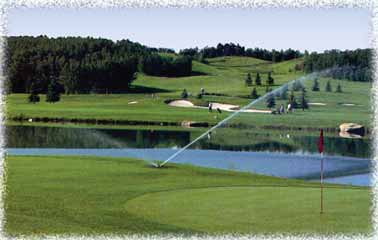
The International Center for Water Technology (ICWT) will hold its first conference April 2-4. Fresno State and the Environmental Protection Agency are event partners.
The ICWT is a public-private partnership supporting development and application of advanced technologies that enhance water use for urban, environmental and agricultural purposes. Through applied technology, the ICWT’s goal is to provide efficient first use and effective reuse of water supplies worldwide.
The center’s inaugural International Water Technology Conference will focus on how water technology innovations and science can help ensure our future water supplies, reported Center for Irrigation Technology (CIT) Director David Zoldoske, who also serves as ICWT director. Speakers, poster presentations and exhibits will highlight the first two days; optional technical tours will be available on the third day.
According to Zoldoske, studies of per capita water use in the United States, coupled with projected national population increases, indicate that the daily demand for potable water in this country could increase by more than 25 billion gallons by 2050. The only reasonable way to meet this challenge is to improve water efficiency through the application of new, innovative technology based on good, sound science.
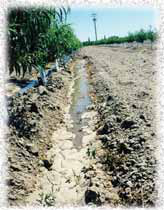
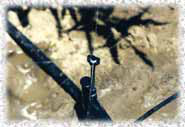
“Water is a shared and limited resource. Improving efficiency in one area can and does reduce demand in another,” Zoldoske noted.
In addition, the public has recognized how important water is to our natural ecosystems.
“The environment has emerged as an equal player in dividing up the world’s water pie,” he said. “In the past, whatever water was left over after diversion to agriculture and municipal supplies remained to support local fish and wildlife. The rules have changed, and water innovation and science can play an important role in solving the dilemma the entire world faces to maximize water supplies.”
Registration for the water technology conference will incorporate presentations and exhibits of the Ozone V conference to be held on the Fresno State campus at the same time, Zoldoske noted (see article on Page 8 for more information).
Opportunities are still available for speakers, poster presenters, exhibitors and sponsors. For more information or to register for the conference, visit the ICWT website at http://www.icwt.net or call (559) 278-2066.
CIT earns partnership award from IA
The Center for Irrigation Technology (CIT) has been named Irrigation Association 2006 Partner of the Year for its support of irrigation education, certification and product testing.
The award was presented to Director David Zoldoske during the 27th Annual International Irrigation Show held in San Antonio, Texas in November.
“There’s nothing we do that they don’t partner with,” said Brian Vinchesi, chair of the IA Awards Committee.
In a recent partnership program with the IA, CIT irrigation engineers developed testing protocols and conducted product tests for the Smart Water Application Technologies™ (SWAT™) program. CIT also provides support to the IA certification program and representation to the International Organization for Standardization, and has aided in bringing irrigation seminars to the World Ag Expo in Tulare, California.
Upcoming event
March 1 – Agricultural Pumping Efficiency Program seminar from 9 a.m. to noon at the Elks Lodge in Salinas, California. Call 800-845-6038 for details.
Viticulture and Enology Research Center
Grape: Picking controlled by GIS system on harvester
from Page 1
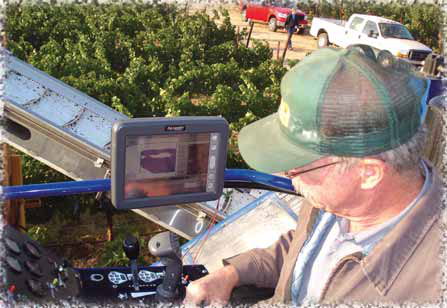
through the vineyard,” Wample said. Computer software linking the quality map and the harvester actually controls the machine’s operation, determining the distribution of the harvested fruit as the harvester travels through the vineyard. Thus, the highest quality grapes are segregated from the lower quality grapes. The same control system could be used to leave the less mature grapes to be harvested later as they reach peak quality levels, he noted.
The system helps all wine grape growers, but especially large growers and high-end wineries, Wample said.
“Given the impending labor issues facing agriculture, this could change the need for large quantities of hand labor that are typically used to do differential quality harvesting,” he said. In addition, “it will be especially useful to those working with wineries attempting to meet the continuing higher expectations of the consumer.”
“This has the potential of increasing the quality and value of the product and therefore the profit margin for wine grape growers.”
Industry representatives on the project team include Oren Kaye, a former Fresno State master’s degree student now working as a winemaker at Constellation Wines in Madera; Jim Orvis, an enology researcher with Constellation; Greg Berg of Oxbo International Corp. in Kingsburg; and Stanton Lange, a vineyard manager in Lodi.
Also contributing to the project was Dr. Antonio Odair Santos, research scientist from the Instituto Agronomico in Brazil. While assigned at VERC in 2005, Santos developed preliminary procedures to calibrate the equipment, systems and techniques.
Wample said the technology has potential for use in other crops. He has received inquiries about its possible use in strawberries.
Funding for the initial phases of the project came from several sources, including the American Vineyard Foundation, Constellation Wines, and the Viticulture Consortium West. Additional support came from Fresno State’s Office of Research and Sponsored Programs, which awarded Wample its 2006 Claude Laval Jr. Award for Innovative Technology to support the NIRS/GPS project.
Wample expects to continue work on a larger scale this year with support from the California State University Agricultural Research Initiative (ARI).
For more information visit the Department of Viticulture and Enology’s website at http://cast.csufresno.edu/ve.
Upcoming events
- Jan. 23-25 – Unified Wine & Grape Symposium in Sacramento. For details, visit http://www.asev.org.
- Feb. 7 – Viticulture and Enology Career Fair at Fresno State. For more info, call 559-278-2089.
- Feb. 22-23 – 10th Annual Central Coast Viticulture and Enology Issues Conference in San Luis Obispo, California. For details, visit http://cast.csufresno.edu/ve.
- March 2-4 – 6th Annual Fresno State Winemaster’s Weekend at the Tenaya Lodge in Yosemite. Saturday evening dinner includes Fresno State wine and agricultural products. Book reservations at the Tenaya Lodge, http://www.tenayalodge.com, or call 559-278-2089.
- April 19 – Vino Italiano Wine Tasting at the Fresno State Winery. Educational event open to the public. Must be 21 or older to attend. For details, call 559-278-2089.
A Study on ET adjustment factor set to begin

The Water Conservation in Landscape Act (Assembly Bill 325) became law on January 1, 1991. The Department of Water Resources (DWR) appointed an advisory task force that drafted a model water efficient landscape ordinance, which was adopted in 1992. It applies to new public and private, commercial, industrial, multi-family residential development, and to developer-installed, landscaped single-family homes.
The existing landscape ordinance established a water budget based on the size of the landscape, reference evapotranspiration (ETo), and an ET adjustment factor (ETAF). Water budgets are used for determining how much water to apply and when to irrigate landscapes.
ETAF adjusts ETo based on plant factor and irrigation efficiency. A statewide plant factor of 0.5, representing a mix of approximately 1/3 high-, 1/3 medium-, and 1/3 low-water-using plants is used. Irrigation efficiency used for the calculation of ETAF in the existing ordinance is 0.625. The ETAF is obtained by dividing the average plant factor of 0.5 by the average irrigation efficiency of 0.625, which is 0.8.
Since the landscape ordinance was adopted in 1992, California’s population has grown from 30 million to 36.5 million people, thereby increasing the demand for water. As a result, water conservation has become more important today than at any other time.
Cognizant of this fact, AB 2717 directed the California Urban Water Conservation Council (CUWCC) to convene a stakeholder task force – comprised of public and private agencies – to evaluate and recommend proposals for improving water use efficiency in new and existing urban irrigated landscapes in California. The task force adopted a comprehensive set of 43 recommendations, including updating the 1992 landscape ordinance. The final report was submitted to the Governor and the Legislature in December 2005.
The Water Conservation in Landscaping Act of 2006 (AB 1881) enacted many of the recommendations of the task force’s report. AB 1881 authorized DWR to update the model ordinance in accordance with the specified requirements. One such requirement was for DWR to lead a study that evaluates the possibility of reducing the ETAF.
If anyone is interested in receiving more information on either model ordinance update or the ETAF study, please contact Kent Frame via email or phone, at kframe@water.ca.gov, or 916-651-7030.
Visit the CIMIS home page at http://www.cimis.water.ca.gov
For more CIMIS information...
CIMIS information is published quarterly in the CATI Update newsletter. Articles are provided by the California Department of Water Resources, CIMIS program staff.
For more information about CIMIS or its programs, contact any of the following representatives at these offices:
- Northern District
Mark D. Rivera
(530) 529-7301
mrivera@water.ca.gov - San Joaquin District
Steve Ewert
(559) 230-3334
sewert@water.ca.gov - Central District
Marc L. Anderson
(916) 227-7603
marcla@water.ca.gov - Southern District
Sergio Fierro
(818) 543-4652
sergiof@water.ca.gov
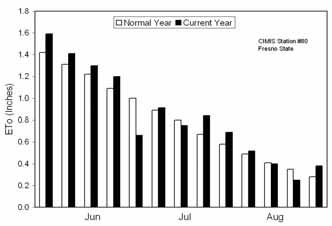
Fresno: 09/01/06 – 11/30/06
CIMIS Station #80
Fresno State
Note: All columns are 7-day totals.
Chart shows ETo variation from normal over last three months.
Scientists outline research at showcase event
Cal Poly Pomona provides venue for ARI researchers to share insights, achievements
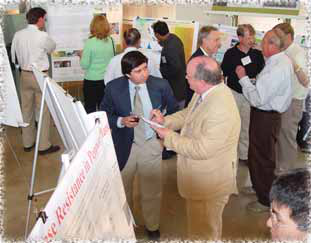
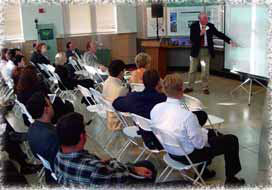
Research scientists from four California State University campuses gathered at Cal Poly Pomona recently for a special opportunity to share advancements in their work.
The event was the Sixth Annual Cal Poly Pomona Agricultural Research Initiative Showcase 2006, held in October at the university’s AGRIscapes facility. The showcase featured poster displays by more than 30 faculty and staff conducting research funded by the CSU’s Agricultural Research Initiative (ARI) program. The program provides $4 million annually to support agricultural and natural resources-related research in California.
By program policy, every dollar assigned for research is matched at least one to one by agricultural and related industries or agencies, effectively doubling the state’s investment to improve the profitability and sustainability of California agriculture.
ARI’s four member campuses include Fresno State, Cal Poly San Luis Obispo, Cal Poly Pomona and Chico State.
Several projects featured at the showcase have received widespread public attention, including air emissions studies by Fresno State plant science professor Charles Krauter. In a series of projects backed by ARI, the NASA-Ames Research Center and the California Air Resources Board, Krauter has developed new methods for monitoring ammonia emissions from dairy operations in the central and southern San Joaquin Valley.
By obtaining more accurate measurements of ammonia, as well as other compounds such as reactive organic gases (ROGs), Krauter is helping the industry to determine what specific phases of a typical dairy operation tend to produce the greatest amounts of emissions. By targeting those phases with better control strategies, dairy operators should be able to effectively reduce emissions to within new state air quality standards, Krauter said during his showcase report.
Continued monitoring over the next three years will focus on specific phases of dairy operations – such as free-stall flushing and manure handling.
Another study highlighted at the showcase examined grass-fed beef as a potential niche market alternative to conventional corn-fed beef in California. Chico State animal science professor Cynthia A. Daley reported on her study that suggests consumers are interested in the health benefits of grass-fed beef and may be willing to pay more for it.
Left: Fresno State plant science professor and researcher Charles Krauter outlines progress on his air emissions studies for showcase attendees. Above: Fresno State biology professor Alejandro Calderon (left center) explains his study on biological control of nematodes.
ARI research is designed to address pressing issues facing California’s agricultural industry and the environment. Work is focused in eight specific areas: agricultural business, biodiversity, biotechnology, food science, natural resources, production and cultural practices, public policy, and water and irrigation technology.
Projects are directed by qualified faculty and research scientists associated with ARI’s four member campuses.
For more information on ARI research or guidance on applying for funding, visit the ARI website at http://ari.calstate.edu.
ARI/CATI on the Web!
The California State University Agricultural Research Initiative (ARI) oversees applied agricultural, agribusiness and natural resources research on behalf of California agriculture. For information on our research and project results, visit our website at http://ari.calstate.edu.
The California Agricultural Technology Institute (CATI) administers ARI funding and oversees additional applied agricultural research. For more information about CATI and its research centers, visit us at http://cati.csufresno.edu, or at our centers:
- Center for Agricultural Business (CAB) – cati.csufresno.edu/cab
- Center for Food Science and Nutrition Research (CFSNR) – cati.csufresno.edu/cfsnr
- Center for Irrigation Technology (CIT) – cati.csufresno.edu/cit
- Viticulture and Enology Research Center (VERC) – cati.csufresno.edu/verc
- Agricultural Technology Information Network (ATI-Net) – cati.csufresno.edu/atinet
Scientists will gather to discuss ozone use
The fifth major international conference on ozone use in the food processing industry has been scheduled for April 2 and 3 at California State University, Fresno.
The event is titled Ozone Applications in Food and Agriculture. It is being presented by Fresno State’s Center for Food Science and Nutrition Research (CFSNR), with sponsorship from the San Joaquin Valley Subsection of the Institute of Food Technologists and assistance from the International Ozone Association-Pan American Group (IOA-PAG).
Organizers anticipate attendance of 300 or more, including researchers, end users, and primary manufacturers of ozone systems. Program presentations will focus on the antimicrobial efficacy of ozone in food processing and agricultural applications, with the goal of increasing quality and safety.
Speakers will discuss the application of gaseous and aqueous ozone to reduce microbial loads in air, water and soil, on food products, and on related equipment. Specific topics will include food handling, food processing, food packaging, food storage, and wastewater treatment.

Synergistic combinations of ozone and other agents will be described. Case studies, current research, and infield testing will be discussed. Product developments and system design practices will be outlined.
Subject to change, presentations will address ozone use on post-harvest products including grains, corn, fresh-cut vegetables, fruits, controlled atmospheres, as well as aquaculture and soil/water treatment.
Attendees will be those who are looking for solutions to food safety and quality issues; those who want to obtain and share information about current uses, successes, problems, and technology developments relating to these applications of ozone; and those who may be considering equipment acquisitions.
Ozone V registration is $260 before Feb. 1. Exhibitor space is available. For further information, visit the website at http://www.cati.csufresno.edu/ozone, or call (559) 278-5974.
Dean: Research facilities needed
from Page 2
itself vital to California, Boyer said there is one aspect he hopes will expand.
“If we see increased support for ARI, we need facilities to do the work industry is expecting us to do. First we need to get the grants. Then we need to get facilities. Then we need to find ways to ensure our faculty have time and support to do research.”
In the big picture, Boyer sees himself as a broker of sorts – linking the students to the community – and preparing a high-quality product for delivery.
“I need to be listening and identifying opportunities that will link them,” he said.
For more information on CAST programs, including opportunities for study and research, visit the college website at http://cast.csufresno.edu.
In the event of incorrect address information or extra copies to your workplace, please return this address label by mail or fax with your requested changes. CATI fax number is (559) 278-4849.
Update is published quarterly by the California Agricultural Technology Institute
College of Agricultural Sciences and Technology
California State University, Fresno
Winter 2006-07
CATI Publication #070101
Voice number: (559) 278-2361
Fax number: (559) 278-4849
Director of Operations: Joe Bezerra
Publications Editor: Steve Olson
Assistant Publications Editor: John Norton
Address Service Requested
Fresno, California 93740-8009
2910 E. Barstow Ave. M/S OF115
California State University, Fresno
Permit No. 262
Fresno, CA
PAID
U.S. Postage
Non Profit Organization
This HTML version was generated with AI assistance and may contain errors or omissions. The original approved PDF remains the official document of record. An alternative accessible format is available upon request from the document creator in accordance with Title II of the ADA.