Update: Summer 2006

SUMMER 2006
In this issue...
- Managing forest growth ..... 2
- Preventing heat stress ....... 3
- Enhancing wine aging ........ 5
- Improving iceberg lettuce ... 8
California State University, Fresno
Giant lysimeter tracks crop water use
Three year study enables soil scientists to determine optimum water use for broccoli, bell peppers, lettuce
A massive, steel-plated 14-ton weighing lysimeter buried in a field in the western San Joaquin Valley has given soil and crop scientists new data that will help valley growers to increase irrigation efficiency for their vegetable crops.
The four-year effort to develop best irrigation practices for selected vegetables began in 2001 with the installation of the lysimeter in a four-acre plot at the UC West Side Research and Extension Center near Five Points, 20 miles southwest of Fresno. Project director was David Bryla, a USDA research horticulturist who teamed with Fresno State’s Center for Irrigation Technology (CIT) to conduct the study.
“Currently, many growers tend to over-irrigate vegetable crops because these crops are relatively sensitive to water stress, and good information on the water requirements of many of these crops is lacking,” Bryla explained in outlining reasons for the research.
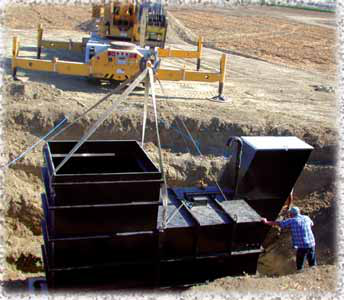
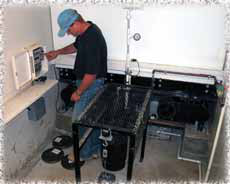
The lysimeter and mini-laboratory are housed in a steel-framed container about 10 feet high, 20 feet long and six feet wide. The lysimeter section includes a soil compartment on a scale. The lab section is a small room containing data recorders and other instruments. Scientists can descend into the room through a doorway at the top.
The complete unit was installed with its top flush with the soil surface. Once filled, the lysimeter’s soil container becomes, in essence, part of the field; it is planted and irrigated just like the soil surrounding it. The purpose of the lysimeter is to measure water use (evapotranspiration, or ET) by the plants by recording the weight of the soil before and after irrigations.
Left: 14-ton steel-framed weighing lysimeter and control room is installed in experimental field near Five Points, California.
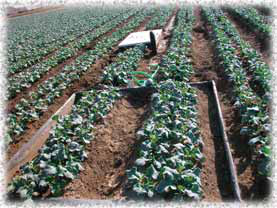
Above: Completed lysimeter installation shows top flush with field and closed lab doorway in background.
Over three growing seasons, crops of broccoli, bell pepper and head lettuce were planted, grown and harvested from the field. For each crop, sections of the field received different irrigation treatments of 50, 75, 100 and 125 percent of the maximum crop evapotranspiration requirement as measured by the weighing lysimeter.
See Water, Page 4
Forest focus
Natural resourses research team monitors conifer seedling growth
The great conifer forests of California’s Sierra Nevada mountains are among California’s most prized natural resources. And while the forest ecosystem has existed for ages, it still remains susceptible to degradation from natural or human causes, scientists have noted. In addition to fire and drought problems, infestations by pests such as the western pine beetle have shown that large forest areas in central California are susceptible to serious damage.
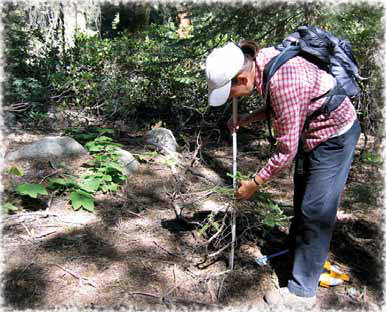
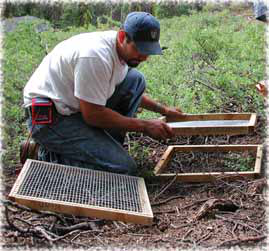
Top: Student research technician Martha Rodriguez measures seedling height in treatment area. Left: Student Jose Vasquez prepares seedling trap for placement.
In an effort to help management agencies such as the U.S. Forest Service reduce the damage from these occurrences, scientists are monitoring the growth of trees, shrubs and other forest organisms, providing agencies with detailed data on tree growth, mortality and other trends. Among them is Fresno State biology professor Ruth Ann Kern, who found in a recent experiment that research can bring unexpected as well as anticipated results.
In a planned three-year study of tree regeneration, Kern began investigating the effects of localized temperature, relative humidity and soil moisture (microclimate) on seedling establishment and survival. While the experiment did yield some important results, it turned out instead to also provide valuable data on “seed rain” traits exhibited by mature trees.
Results of the study have been published in the journal Forest Science, 51(3) 2005, Kern reported. Information also is contained in a report published by the California State University Agricultural Research Initiative (ARI), which provided funding for the study.
As a premise for the project, Kern, along with other scientists and forest management colleagues, has observed that thinning and burning treatments practiced over the years have reduced overstory canopy cover and tree density in some areas. These treatments subsequently affect light, soil moisture, and nutrient levels in the understory. In an effort to better understand these effects, Kern set out to track seedling growth as influenced by two dominant natural mountain shrubs – ceanothus (Ceanothus cordulatus) and greenleaf manzanita (Arctostaphylos patula).
“Surprisingly, even with the high mortality, some interesting trends emerged from this data...”
Approximately 900 white fir and sugar pine seedlings were planted under three treatment protocols, which included thick shrubbery growth, thinner growth and no growth. In a surprise to researchers, Kern reported, nearly all the seedlings died during the first summer after transplanting. The cause was largely attributed to severe drought conditions that year.
To have such a large proportion of the experiment fail was a serious blow to the project. In spite of the setback, Kern did not abandon her work; instead, she redirected her efforts to track moisture levels in the soil of the different environments and expanded other facets to determine numbers of seeds falling from different tree species in the various treatment areas.
“Surprisingly, even with the high mortality, some interesting trends emerged from this data, and the results, along with the microenvironmental monitoring data, helped to build a picture of conifer regeneration in a Sierra Nevada mixed conifer forest and the role shrubs play in seedling germination and establishment,” Kern said.
One finding was that despite reductions (thinning done by the Forest Service) of the basal area of white fir and incense cedar, the amount of seed dispersed by these species increased, still exceeding the amount of pine seed. Although the management goal was to reduce white fir and incense cedar in favor of the more economically favorable sugar pine and Jeffrey pine, the prolific seed production by white fir and incense cedar swamped that of the pines and led to far more white fir and incense cedar seedlings than pine seedlings in the forest understory, Kern found.
“It is possible that trees growing in thinned stands with greater resources might produce more seed. However, it is also possible that since thinning removed the smallest tree sizes in each prescription, the resulting basal area in thins is dominated by productive individuals,” she said.
These observations are “intriguing,” she noted, and warrant further study, especially considering the value of pine for the ecosystem and for lumber production.
Results from the study will contribute directly to management decisions made by forest managers and silviculturists as they develop cutting and burning prescriptions and determine what species they replant afterwards, Kern stated.
To access ARI report information regarding this project, visit the ARI website at http://ari.calstate.edu and search for Kern’s work under “Research Focus Areas: Natural Resources.”
Center for Agricultural Business
Details emerge on new heat stress rules
State regulations outline requirements for providing water, shade and training for outdoor workers
Newly detailed regulations meant to help protect farm workers and other outdoor employees from heat stress have been formulated by the California Occupational Safety and Health Administration’s (CalOSHA) Standards Board.
Information regarding the regulations is available from a number of sources, including the Center for Agricultural Business (CAB) and the University of California Cooperative Extension (UCCE), which are working together to update employers on the issue, reported Kimberly Naffziger, CAB program development specialist.
“As we are aware, it’s hot here in the valley, and there were some tragic farm worker deaths last year,” Naffziger noted in explaining CalOSHA’s increased emphasis on heat stress prevention and the organization’s plans to more closely monitor outdoor work sites during the summer months. “What we are doing is helping employers to understand how the new laws and regulations come into play and how to comply with them.” she said.
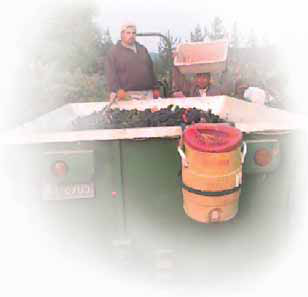
One way is by inviting experts to meet with employers to discuss the issues, Naffziger said. That has been done at two recent safety breakfast meetings hosted by CAB at Fresno State and in Calistoga. Featured speaker was Howard Rosenberg, UCCE specialist in agricultural labor management and policy, who discussed developing strategies both employers and workers can use to help prevent heat-related illness and injuries.
According to the standard recently adopted by CalOSHA, heat illness is “a serious medical condition resulting from the body’s inability to cope with a particular heat load, and includes heat cramps, heat exhaustion, heat syncope (fainting) and heat stroke.” The onset of heat illness can be influenced by a number of factors, including air temperature, relative humidity and workload, Rosenberg noted.
The new OSHA regulation outlines more specific requirements for employers in three areas: provision of water, access to shade, and training, Rosenberg said.
Regulations ready for final approval by CalOSHA Board
Proposed State Standard, Title 8, Chapter 4
(c) Provision of Water. Employees shall have access to potable drinking water… Where the supply of water is not plumbed or otherwise continuously supplied, water shall be provided in sufficient quantity at the beginning of the work shift to provide one quart per employee per hour for drinking for the entire shift. Employers may begin the shift with smaller quantities of water if they have effective procedures for replenishment during the shift as needed to allow employees to drink one quart or more per hour. The frequent drinking of water, as described in (e), shall be encouraged.
(d) Access to Shade. Employees suffering from heat illness or believing a preventative recovery period is needed, shall be provided access to an area with shade that is either open to the air or provided with ventilation or cooling for a period of no less than five minutes. Such access to shade shall be permitted at all times. Except for employers in the agriculture industry, cooling measures other than shade (e.g., use of misting machines) may be provided in lieu of shade if the employer can demonstrate that these measures are at least as effective as shade in allowing employees to cool.
From “Standards Presentation to California Occupational Safety and Health Standards Board.”
Upcoming events
- July 13 – Farm Labor Contractor Education Institute at the Embassy Suites Hotel in Seaside, California. Presented in English and Spanish. For details, call 559-278-4677.
- Aug. 1 – Ag Safety Breakfast Briefing at 7:30 a.m. in Calistoga, California. For details, call 559-278-4405.
- Aug. 24 – Farm Labor Contractor Education Institute at the Double Tree Hotel in Bakersfield, California. Presented in English and Spanish. For details, call 559-278-4677.
- Sept. 20 – Safety Breakfast Briefing at 7:30 a.m. at Fresno State. For more information, call 559-278-4405.
- Oct. 25 – Farm Labor Contractor Education Institute at the Piccadilly Inn Airport in Fresno. Presented in English and Spanish. For details, call 559-278-4677.
- Nov. 2 – 25th Annual Agribusiness Management Conference in Fresno. Call 559-278-4405 for details.
Center for Irrigation Technology
Water: Subsurface drip proves best of irrigation treatments
from Page 1
Three application methods also were used for each irrigation treatment. They included conventional furrow irrigation, and surface and subsurface drip systems.
Data analysis of the irrigation treatments showed that amounts less than 100 percent ET stressed the crops in almost all cases, confirming growers’ concerns about under-irrigation. However, over-irrigation, at the 125-percent level, provided no additional benefit in plant growth or yield, the researchers found.
Other results gained from the study are the crop coefficients that scientists have been able to develop for broccoli, bell pepper and head lettuce, Bryla said. The coefficients were formulated by comparing the vegetable crop water use with that of fescue grass planted in an adjacent field. A crop coefficient is a factor of standardized grass ET as measured by the California Irrigation Management Information System (CIMIS). The use of CIMIS crop coefficients requires specialized water delivery and monitoring equipment, but the investment can pay off in the long run, Bryla said.
“Improving irrigation management may reduce seasonal water requirements, allowing farmers to maintain yields even in the event of reduced water allocations or to use the saved water for production of other crops,” he said. “Improved water use efficiency will also result in reduced deep percolation losses and reduced drainage water.”
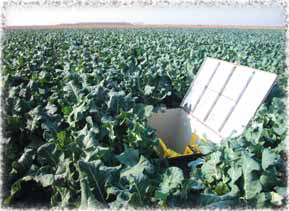
Right: Top door opens for entry into lysimeter control laboratory. Below: Inside laboratory.
Other study results showed advantages with the subsurface drip irrigation treatment, the researchers noted.
“Subsurface drip produced the highest yields among irrigation methods and significantly increased yield quality,” Bryla said. “Higher yield quality included larger crown sizes in broccoli, a higher percentage of marketable fruit in bell pepper, and firmer heads and fewer culls in head lettuce.”
Funding support for this project was provided by the California State University Agricultural Research Initiative (ARI), with additional support from the USDA, the U.S. Bureau of Reclamation, the California Department of Water Resources and University of California.
For details on irrigation practices or crop coefficients, view the complete final report on the ARI website at http://ari.calstate.edu. Search by keyword or find the project titled “Developing New Crop Coefficients and Water Management Strategies for High Cash Value Crops on the West Side of the San Joaquin Valley,” ARI # 01-2-006.
Legislators aim to develop water plan for valley
A bipartisan group of San Joaquin Valley congressmen is beginning work this summer on a plan that will address long-term water use issues facing valley residents.
The San Joaquin Valley Regional Water Plan is being developed by Congressmen George Radanovich, Devin Nunes, Dennis Cardoza, and Jim Costa. It will address water use issues in the eight county region of Stanislaus, San Joaquin, Merced, Madera, Fresno, Kings, Kern and Tulare counties.
“By coming together as an eight-county region, we can have a united focus to attract resources from local, state and federal sources,” said David Zoldoske, director of Fresno State’s Center for Irrigation Technology (CIT) and one of the project facilitators.
A first step will be to catalog existing water resources and to outline projected regional needs. To accomplish this, support staff from CIT and the California Water Institute have prepared an online survey which will be accessible during July and August 2006.
The survey will seek information on water supply, water quality, environmental restoration/enhancement, and flood control. Anyone who resides in the region and represents urban, agricultural or environmental water users is encouraged to participate.
The goal is to release a draft plan by the end of 2006. Input from both the public and private sectors is welcomed and encouraged. For more information on water issues, visit www.californiawater.org or call (559) 298-6072 ext. 201.
Viticulture and Enology Research Center
From oak to steel: wine aging advances
New method of monitoring acetaldehyde helps to enhance process similar to oak barrel aging
The use of wood containers for aging red table wines has been the standard for quality among winemakers around the world for centuries. Wood seals in the wine but still “breathes” enough to allow minute amounts of oxygen to gradually oxidize the wine, giving it a “soft” flavor and pleasing aromas.
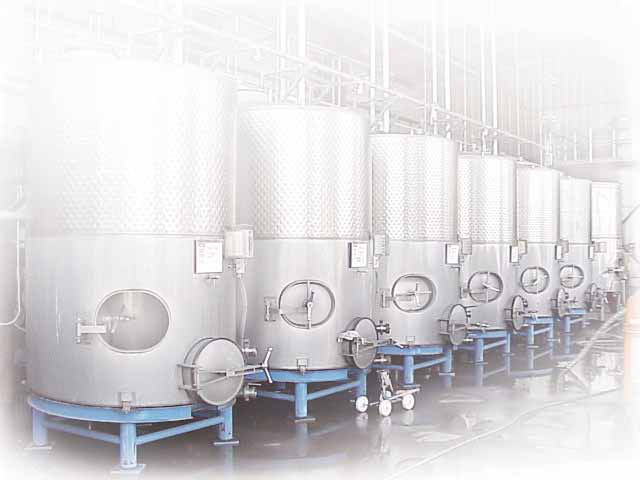
Oak barrels have been the global standard for quality in wine aging for centuries.
And while oak may never be surpassed for the quality wines it produces, advances in technology and monitoring methods are making stainless steel more attractive to the industry, reports Fresno State associate enology professor Ken Fugelsang, who also serves as winemaster for the Fresno State Winery and research scientist for the Viticulture and Enology Research Center (VERC).
One key advance in the use of stainless steel tanks for aging is a process called micro-oxygenation, Fugelsang notes in a recently published research report.
“Micro-oxygenation is a process whereby young red wines are intermittently exposed to oxygen, supplied in the form of compressed gas via a micron-size diffuser positioned close to the bottom of a stainless steel tank,” Fugelsang explained. “The process is the same as that which would occur during barrel aging, except that the time frame is significantly shortened.”
Despite advances in this technology, industry wine experts continue to question whether the artificial introduction of oxygen may stimulate growth of spoilage organisms which could mar the aging process or the wine itself, Fugelsang said. To help ease these concerns, he has been leading Fresno State efforts to improve methods for monitoring the micro-oxygenation process.
One phase of this work included developing the analytical methodology to monitor changes in the wine undergoing treatment. One such method is to use solid phase micro-extraction (SPME) to measure a primary analyte, acetaldehyde, formed during the reaction.
“Detection of increases in acetaldehyde can be used by the winemaker as an analytical tool to monitor the progress of the micro-oxygenation process,” Fugelsang said. The methodology developed in our lab “proved more than adequate to detect and monitor acetaldehyde in wine well below the sensory threshold level of 40-100 milligrams per liter.” In addition, the method is fast, with an average time per analysis of 30 minutes, he noted.
Additional monitoring methods may also be explored using other derivatization reagents such as cysteamine, which is less expensive, Fugelsang said. In the meantime, these more recent advances will give winemakers a wider choice of analytical tools to support their wine production decisions.
Details of the study are included in a complete final report available through the California Agricultural Technology Institute (CATI) or on the California State University Agricultural Research Initiative (ARI) website, located at http://ari.calstate.edu. The project title is “Micro-oxygenation of Red Table Wines – Phase II: Post-fermentation Development of Microbial Populations,” (ARI Project # 03-2-008). Go to “Projects: Funded Projects by Focus Area: Production.”
Upcoming events
- Aug. 8 – Fresno State Grape Day – field day and open house for grape growers and winemakers, from 7:30 a.m. to noon at Fresno State. Includes presentations and tours at the viticulture and enology facilities. For details, call 559-278-2089.
- Aug. 24 – Welcome-back Barbecue hosted by the Fresno State Viticulture and Enology Department. Call 559-278-2089 for info.
California Irrigation Management Information System
Reference Evapotranspiration Data (ETo) from CIMIS
Evapotranspiration (ET) is evaporation from plant and soil surfaces plus transpiration from plant leaves. It is an indicator of the water requirements of different plants. We need to know how much water a plant needs so that we can apply the right amount at the right time.
Unfortunately, determining the water needs of different plants is not an easy task as it involves complex biological, environmental, and weather related factors. Researchers have attempted to simplify these complex processes using what is known as reference evapotranspiration (ETo).
ETo is ET from standardized grass surfaces upon which the weather stations that collect the weather parameters are sited. Crop factors, also known as crop coefficients, are then used to convert ETo to actual ET for different crops.
The California Department of Water Resources (DWR) has been providing ETo data to California’s irrigators for a long time. In the early days, most of the ETo estimates provided by DWR were derived from evaporation pans. As the methodology for estimating ETo advanced over the years, DWR, in cooperation with researchers from UC Davis, developed a network of weather stations (CIMIS) that collect weather data used to estimate ETo.
Visit the CIMIS home page at http://www.cimis.water.ca.gov.
The ETo data from the CIMIS web site is calculated using mathematical models and weather parameters measured at the weather stations. Hourly, daily, monthly, and long-term average ETo data are available. The long-term average ETo was used to generate the ETo zones map for California that has been very helpful for planning purposes.
It should be noted, however, that only a few CIMIS stations had the long-term data (at least five years) that was required to generate the map at the time. Therefore, in some cases data from other sources were used.
Some DWR publications, such as the California Water Plan Update, still report ETo estimated from evaporation pans. Because of variations in estimation and measurement methods, it is possible to see some differences in ETo values reported for the same area.
CIMIS understands the confusion this creates for data users and has taken the initiative to make comparisons of ETo values measured and/or estimated using various methods. Comparisons will be made using data from the UC West Side Research and Extension Center near Five Points. Results of the analysis will be published in the future issues of CATI’s “Update” newsletter.
For more CIMIS information...
CIMIS information is published quarterly in the CATI Update newsletter. Articles are provided by the California Department of Water Resources, CIMIS program staff.
For more information about CIMIS or its programs, contact any of the following representatives at these offices:
- Northern District
Mark D. Rivera
(530) 529-7301
mrivera@water.ca.gov - San Joaquin District
Steve Ewert
(559) 230-3334
sewert@water.ca.gov - Central District
Marc L. Anderson
(916) 227-7603
marcla@water.ca.gov - Southern District
Sergio Fierro
(818) 543-4652
sergiof@water.ca.gov
Weekly ETo Comparisons for Fresno
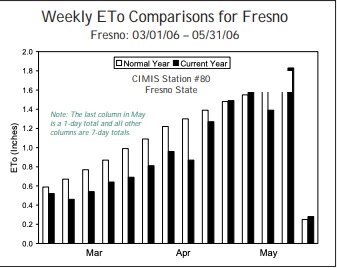
Fresno: 03/01/06 – 05/31/06
Note: The last column in May is a 1-day total and all other columns are 7-day totals.
Chart shows ETo variation from normal over last three months.
Forest: Study results to be used to track species reproduction
from Page 2
Reductions (thinning done by the Forest Service) of the basal area of white fir and incense cedar, the amount of seed dispersed by these species increased, still exceeding the amount of pine seed. Although the management goal was to reduce white fir and incense cedar in favor of the more economically favorable sugar pine and Jeffrey pine, the prolific seed production by white fir and incense cedar swamped that of the pines and led to far more white fir and incense cedar seedlings than pine seedlings in the forest understory, Kern found.
“It is possible that trees growing in thinned stands with greater resources might produce more seed. However, it is also possible that since thinning removed the smallest tree sizes in each prescription, the resulting basal area in thins is dominated by productive individuals,” she said.
These observations are “intriguing,” she noted, and warrant further study, especially considering the value of pine for the ecosystem and for lumber production.
Results from the study will contribute directly to management decisions made by forest managers and silviculturists as they develop cutting and burning prescriptions and determine what species they replant afterwards, Kern stated.
To access ARI report information regarding this project, visit the ARI website at http://ari.calstate.edu and search for Kern’s work under “Research Focus Areas: Natural Resources.”
Rules: Farm Bureau to offer training pamphlet to employers
from Page 3
For example, it stipulates that employers must provide enough drinking water at the beginning of a work shift, or through an effective replenishment plan, to give each employee one quart of water for each hour of the shift. In addition, employees must be granted at least five minutes of recovery time in a shaded area if they feel they need it to ward off heat illness.
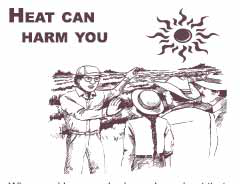
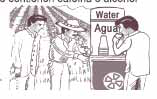
Two panel images from a pamphlet designed to inform field and other outdoor workers about heat stress. Wording is in both Spanish and English.
The new standard also requires training for both workers and supervisors on causes of heat illness, steps that can be taken to prevent it, and responses to its occurence in the workplace. To help in that area, Rosenberg teamed with the California Farm Bureau and the USDA to produce a pamphlet presenting key principles of heat stress physiology.
“Employers told us that last year’s version was a very useful tool, and we think the new one is better. Revisions in its content and format make it more readable,” Rosenberg said. The pocket-sized pamphlet, in both English and Spanish, gives information on the causes of heat stress and suggestions on how to avoid it, including drinking small amounts of water often and taking breaks in shaded areas.
More than 200,000 of the pamphlets have been printed and are available from the state Farm Bureau office by calling Danielle Rau at 1-800-696-3276.
In addition to his speaking presentations, Rosenberg has made extensive information on heat stress and the new CalOSHA regulation available on the UC’s Agricultural Personnel Management Program website located at http://apmp.berkeley.edu.
According to Naffziger, CAB will continue to address heat stress and other farm labor safety issues through programs such as the Farm Labor Contractor Education Institute. For more information, contact CAB at 559-278-4405.
ARI/CATI on the Web!
The California State University Agricultural Research Initiative (ARI) oversees applied agricultural, agribusiness and natural resources research on behalf of California agriculture. For information on our research and project results, visit our website at http://ari.calstate.edu.
The California Agricultural Technology Institute (CATI) administers ARI funding and oversees additional applied agricultural research. For more information about CATI and its research centers, visit us at http://cati.csufresno.edu, or at our centers:
- Center for Agricultural Business (CAB) – cati.csufresno.edu/cab
- Center for Food Science and Nutrition Research (CFSNR) – cati.csufresno.edu/cfsnr
- Center for Irrigation Technology (CIT) – cati.csufresno.edu/cit
- Viticulture and Enology Research Center (VERC) – cati.csufresno.edu/verc
- Agricultural Technology Information Network (ATI-Net) – cati.csufresno.edu/atinet
Aiming to enhance nutritional value of lettuce
Research effort focuses on increasing Vitamin A content, lengthening shelf life of iceberg lettuce
Faculty and student researchers at California State Polytechnic University, Pomona are searching for ways to help consumers get more nutrients from the lettuce they eat.
While lettuce is a consistent leader among California vegetable crops in annual farm sales, it is low in vitamins and minerals, leaving consumers with some roughage but little else to bolster their diet, notes professor and research scientist David Still of Cal Poly Pomona’s Department of Horticulture, Plant and Soil Science.
To help improve the situation, Still is leading efforts to increase the Vitamin A and antioxidant content of iceberg lettuce. The work has involved traditional plant breeding and newer techniques of molecular-aided breeding. The overall goal is to develop a lettuce that not only boasts better nutritional content, but also has improved seed germination and longer post-harvest shelf life.
Because of the complexity of the project, Still has organized student research teams and divided the work into component parts, counting on advancement in each area to eventually result in a single improved product.
Phase one included development of a cross between iceberg and butter lettuce, to determine if the new cultivar would have a longer supermarket shelf life, Still reported. Plants derived from this new cultivar are being tested for their growth characteristics, and mature plants are being evaluated for physical qualities such as firmness and crispness.
In phase two of the project, students are using molecular aided breeding techniques to select and enhance the genetic expression of Vitamin A in iceberg lettuce. The work has involved locating specific enzymes involved in the expression of beta-carotene, from which Vitamin A is derived.
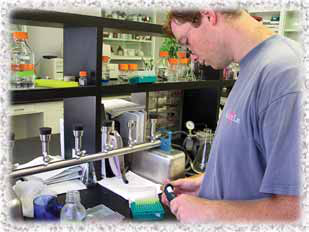
Cal Poly student research technician Zac Fisher prepares to evaluate lettuce samples for nutrient content.
Phase three has involved establishment of production and evaluation facilities for seed from the new cultivars. Seed from 28 varieties and advanced genetic breeding lines is being produced and studied at facilities at Cal Poly Pomona and in Yuma, Arizona, Still said.
Major funding for this research was provided by the California State University Agricultural Research Initiative (ARI) and the National Institute of Health. Initial results from the different project phases are available in a report on the ARI website located at http://ari.calstate.edu. Use the search function to find specific project information. Details also are available on the Cal Poly ARI website located at http://www.agresearchpomona.org.
In the event of incorrect address information or extra copies to your workplace, please return this address label by mail or fax with your requested changes. CATI fax number is (559) 278-4849.
Update is published quarterly by the California Agricultural Technology Institute
College of Agricultural Sciences and Technology
California State University, Fresno
Summer 2006
CATI Publication #060701
Voice number: (559) 278-2361
Fax number: (559) 278-4849
Director of Operations: Joe Bezerra
Publications Editor: Steve Olson
Assistant Publications Editor: John Norton
Address Service Requested
California State University, Fresno
2910 E. Barstow Ave. M/S OF115
Fresno, California 93740-8009
Non Profit Organization
U.S. Postage PAID
Fresno, CA
Permit No. 262
This HTML version was generated with AI assistance and may contain errors or omissions. The original approved PDF remains the official document of record. An alternative accessible format is available upon request from the document creator in accordance with Title II of the ADA.