Update: Fall 2006
California Agricultural Technology Institute
FALL 2006
California State University, Fresno
In this issue...
- Bird habitats examined ...... 2
- Natural yeasts nurtured ..... 5
- Housing study reported ...... 7
- Equine exercise monitored.. 8
Eye in the sky measures crop water use
Researchers employ satellite sensors and software programs to estimate crop evapotranspiration
A team of plant and soil scientists from the Center for Irrigation Technology (CIT) is conducting research to determine if satellites orbiting the earth can accurately measure crop evapotranspiration and soil salinity in the Central Valley and other parts of California.
The project is meant to help state water officials make regional determinations of how much water agricultural crops are using and how soil salinity affects crop growth, explained CIT research scientist Florence Cassel Sharma, who is directing the research. With increasing human population growth throughout the state, competition for water resources will become only more intense, she noted, in explaining reasons for the study.
“The growing demand for water in California has put pressure on agriculture to transfer some of its supplies to the urban and environmental sectors and to increase its existing water use efficiency,” she said. “It is forecast that agriculture will get less water.”
In anticipation of that trend, some growers are experimenting with strategies such as regulated deficit irrigation (RDI), where water applications are reduced from traditional levels at specific times during the growing season. This approach has been shown in some cases to reduce plant water use without affecting grower profits.
The key to measuring regional water savings from such efforts is more complex, however.
Image below is a map — generated by the SEBAL program — covering portions of five central California counties. The image shows accumulated evapotranspiration of the area for the period from April to October 2002 based on Landsat satellite image data.
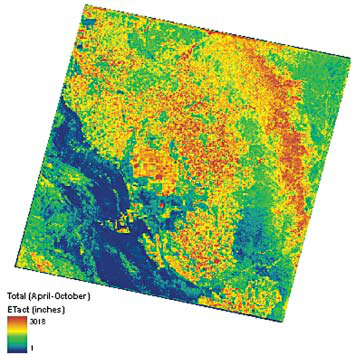
“Everyone knows how much water they are using in their own field, but we don’t know the amount statewide. It takes so much work to try and compile all that data, and there is still likely to be errors,” Cassel said. “Our project is
See Water, Page 4
Conference to address key ag issues
A new venue and a change in format will serve as backdrops for discussion of the most important issues facing California agriculture at the 25th Annual Agribusiness Management Conference, set for Thursday, Nov. 2, in Fresno.
Hosted by Fresno State’s Center for Agricultural Business (CAB), this year’s event will be held at the Fresno Convention Center and will feature a new partnership with the Greater Fresno Area Chamber of Commerce.
The program will combine the Agribusiness Management Conference with the 2006 Agriculturalist of the Year and Ag Business Award Luncheon. Recipients of the two awards are Patrick “Pat” Ricchiuti, president of the Clovis-based P-R Farms, and National Raisin Co., based in Fowler, California.
See Conference, Page 3
Wildlife study centered in Tulare Basin
Research of post-harvest field flooding shows that accumulated seeds, insects provide feed for birds
Wildlife biologists at California State University, Fresno are teaming with two environmental protection programs to help enhance water bird habitats in the Tulare Lake Basin of California.
A recently-completed research project featured a study of feed available to water birds as a result of farm irrigation practices. The work was overseen by Fresno State associate biology professor Steven Blumenshine.
“The Tulare Lake Basin in California’s southern San Joaquin Valley is among the most altered landscapes in North America,” Blumenshine notes in a report recently completed for the California State University Agricultural Research Initiative (ARI), which funded the research.
“The area once comprised the largest freshwater wetland complex west of the Mississippi River. Today it is nearly totally dominated by agriculture, has one of the highest densities of endangered species in the United States, and holds only tiny remnant wetlands.
“Despite its habitat modification, the Tulare Basin is one of the most important shorebird areas in North America and also provides crucial habitats for wintering waterfowl and other water birds,” Blumenshine said.
“... the Tulare Basin is one of the most important shorebird areas in North America and also provides crucial habitats for wintering waterfowl and other water birds.”
Working with both state and federal wildlife specialists, Blumenshine directed a study of area flood irrigation practices on the abundance of seeds and invertebrate insects, which serve as primary food for birds.
“After harvest each year, some fields are flooded to remove accumulated salts, control crop disease, and provide soil moisture. We measured availability of waste agricultural seeds and aquatic insects, both important water bird foods, and how these items varied by crop type and water depth in fields.”
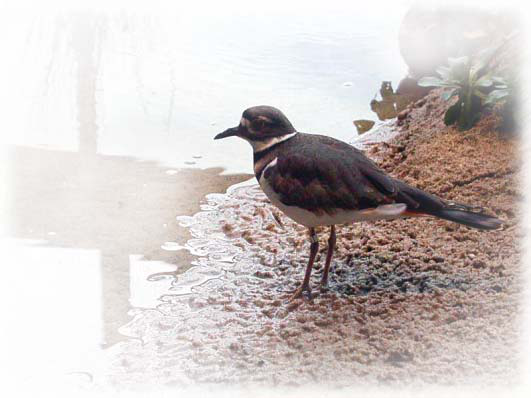
Monitoring tomato, alfalfa and wheat fields that had been flooded, the researchers measured insect and seed abundance to determine whether and how much they were affected by crop type and the depth of the water. Results indicated that insect levels were significantly higher in post-harvest flooded tomato fields compared to wheat or alfalfa fields. In addition, water bird food production was significantly increased with depth of flooding, research showed.
“Findings from this project will help to guide the Landowner Incentive Program and the Central Valley Habitat Joint Venture, both of which are broadly-supported cooperative efforts that focus on sustaining and enhancing agricultural lands for shorebirds and waterfowl,” Blumenshine said.
Additional benefits besides the actual findings have resulted from the research, report authors noted. The methods, experimental design and data analysis techniques developed will be applied to a similar study in the Grassland Wetlands of Merced County. That study has gained more than $1 million in funding support, mostly through CALFED and the California State Water Resources Control Board.
For more information on this project or related ARI research, visit the ARI website at http://ari.calstate.edu. Use the search function to find specific project information.
Center for Agricultural Business upcoming events
- Oct. 18 – Ag Safety Breakfast Briefing at 7:30 a.m. in Salinas, California. For details, call 559-278-4405.
- Oct. 25 – Farm Labor Contractor Education Institute from 8 a.m. to 5 p.m. at the Piccadilly Inn Airport in Fresno. Presented in English and Spanish. For details, call 559-278-4677.
- Nov. 2 – 25th Annual Agribusiness Management Conference in Fresno. Call 559-278-4405 for more info.
- Nov. 15 – Ag Safety Breakfast Briefing at 7:30 a.m. in Napa, California. For details, call 559-278-4405.
- Nov. 16 – Farm Labor Contractor Education Institute in Santa Rosa. Call 559-278-4677.
- Dec. 5 – Farm Labor Contractor Education Institute in Palms Springs. Call 559-278-4677.
- Jan. 31-Feb. 2, 2007 – Annual AgSafe Conference in Seaside, California. For details, call 559-278-4405.
Center for Agricultural Business
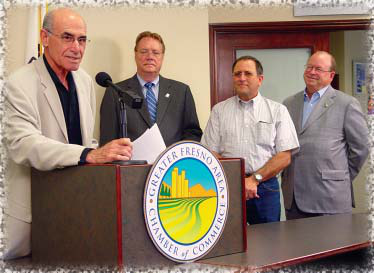
Ernest Bedrosian (left) of National Raisin Co. thanks sponsors during a press conference announcing his family’s company as ag business of the year. Patrick “Pat” Ricchiuti (second from right) also was honored – as agriculturalist of the year. Second from left is Al Smith, Fresno Area Chamber of Commerce CEO. Far right is chamber board chair Steve Geil.
Conference: Keynote speaker to outline ag’s new opportunities
from Page 1
The Agribusiness Management Conference brings agricultural leaders together to address pressing industry issues, reported Kimberly Naffziger, program development specialist for CAB.
“Labor and immigration are perhaps the most significant issues facing agriculture today, and we will have a panel providing insights in these areas,” Naffziger said. “The cost of energy and its impact on agriculture also will be discussed, and the global economic outlook for agriculture will be presented.”
Providing the conference keynote address will be Lowell Catlett, Ph.D., Regent’s Professor at New Mexico State University and recipient of numerous teaching and service awards at both the state and national levels. Recognized as an expert in commodities futures markets, Catlett has served as a consultant to many Fortune 500 companies.
He is convinced that “agriculture will change more in the next decade than in the last century” and believes that new opportunities abound for agribusiness in the areas of medicine, ecology, biosecurity, entertainment, and lifestyles. He will share specific insights in a presentation entitled, “Tomorrow’s Agriculture: Six Trends You Can’t Afford to Miss.”
Heading the Immigration Issues panel will be Bert Mason, professor and interim chair of Fresno State’s Department of Agricultural Economics. Joining Mason on the panel will be Monte B. Lake, partner in the law firm of McGuiness, Norris & Williams. Lake, who has been involved in immigration policy negotiations for more than 30 years, will provide inside information on the current debate.
Addressing energy issues will be Michael Boccadoro, executive director of the Agricultural Energy Consumers Association. Boccadoro will discuss “Coping with Rising Energy Costs: On and Off the Farm.”
Providing the morning’s opening economic outlook will be Steven A. Wood, president and chief economist for Insight Economics. Following the Immigration Issues discussion, CAB Director Mechel S. Paggi will present the California Commodity Outlook.
For those who attend the conference, written commodity reports also will be included in the proceedings. Reports will focus on almonds, beef cattle, citrus, cotton, dairy, feed grains and protein meals, raisins, table grapes, tree fruit, tomatoes, and wine grapes.
Advance registration fee for this year’s event is $100 (including the luncheon). For details, call 559-278-4405 or visit the CAB website at http://cati.csufresno.edu/cab.
Labor department honors Naffziger’s ‘exceptional’ work
The U.S. Department of Labor recently honored Kimberly Naffziger with its Exceptional Achievement Award for her work in the area of farm labor.
Naffziger serves as program development specialist for the Center for Agricultural Business (CAB) and has worked for more than 15 years on behalf of both employers and workers to enhance business operations and improve working conditions.
A key strategy in that effort was to spearhead development of the Farm Labor Contractor Education Institute (FLCEI), a program that enables contractors to increase their knowledge in areas such as Cal/OSHA and safety requirements, worker transportation and workers’ compensation issues, unemployment insurance, state disability insurance, wage and hour rules, pesticide safety rules, and housing requirements.

Since the FLCEI was launched in 2002, the program has provided state-required continuing education for approximately 600 contractors per year, noted CAB Director Mechel Paggi in outlining Naffziger’s accomplishments.
At a recent FLCEI class this summer, Naffziger was presented with a plaque signed by Labor Secretary Elaine A. Chao, citing “exemplary work in educating California’s farm labor contractors by partnering with employer groups and colleges.”
Center for Irrigation Technology
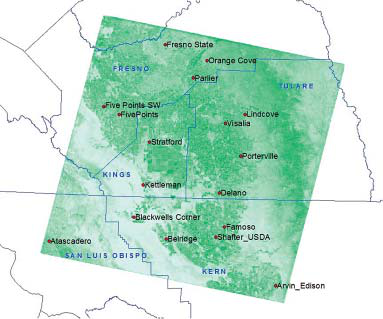
Single satellite image at right covers portions of five central California counties (the same area as that of the image on Page 1). In this graphic, locations of all area CIMIS weather stations are noted.
Water: Software algorithm will be used to determine soil salinity
from Page 1
to try to find a faster method to measure totals, using satellite images that can give us data for an entire region.”
Current satellite technology using thermal infrared sensors can detect energy emitted by and reflected from land surface features such as plants, soil and water bodies. The readings can then be employed to measure the temperature of those features, Cassel said. Several commercially available software programs have been developed to use this information to measure actual crop evapotranspiration (ET), and from that to infer crop water use. Cassel plans to analyze the ability of a program called SEBAL (Surface Energy Balance Algorithm for Land) to measure not only evapotranspiration, but soil salinity.
“The SEBAL algorithm includes a salinity module that determines soil water potential in the root zone and therefore can be used to infer soil salinity,” Cassel said.
The project will cover three years. During the first phase, Cassel will obtain Landsat satellite images and use them to compute ET over most of western Fresno County, where soils are predominantly saline. Then, using computer software, she will overlay the developed ET maps with digital field boundary and land use coverage maps. Finally, she will calculate the ET of specific agricultural crops (such as cotton, tomatoes and alfalfa) by matching the crops with the mapped field boundaries.
A similar phased approach will be used to calculate soil salinity, in this case using actual ground measurements from various field locations to help calibrate the satellite readings.
The potential benefits of this study are considerable, Cassel said.
“With the possibility of acquiring large and frequent satellite images, California could directly benefit from the use of the SEBAL model to quickly and cost-effectively estimate ET and soil salinity in many districts and counties of the state,” she said. In addition, correlations between evapotranspiration and soil salinity could also be determined.
Support for this project has come from the U.S. Bureau of Reclamation and the California State University Agricultural Research Initiative (ARI).
Work will continue through next year, Cassel said.
PG&E joins CIT to extend pump testing program
The Agricultural Pumping Efficiency Program (APEP) coordinated by the Center for Irrigation Technology (CIT) has been extended through a partnership between CIT and Pacific Gas & Electric (PG&E).
The APEP is an educational and incentive rebate program designed to improve overall pumping plant efficiency and to encourage energy conservation.
PG&E is funding the program through 2008 using the Public Purpose Programs Fund under the auspices of the California Public Utilities Commission. Eligibility now extends to all owners or users of a nonresidential, PG&E electric or natural gas utility account that is primarily used for pumping water for production agriculture, landscape or turf irrigation, or for municipal purposes, including potable and tertiary-treated (reclaimed) water.
Eligibility excludes pumps used for industrial processes, raw sewage, or secondary-treated sewage, and for those who are paying the Public Purpose Programs Charge. Customers should call APEP first with questions concerning their eligibility.
The renewed program effort will provide for 2,050 subsidized pump efficiency tests per year, cash incentives for 295 pump retrofit projects per year, and for 14 educational seminars per year.
The program has a limited budget and may be terminated or modified without notice. Applications for pump retrofit/repair incentive rebates or pump efficiency
See Testing, Page 7
Viticulture and Enology Research Center
Indigenous yeasts eyed for winemaking
New testing methods may provide means to monitor organisms during spontaneous fermentations
Years of academic and scientific training at the university level have helped California winemakers to develop highly successful production techniques. Fermentation methods featuring complex chemical analysis and careful process controls have enabled them to produce some of the finest wines in the world, experts agree.
Does than mean California wines have reached a flavor plateau, albeit a good one? Not necessarily, says enology specialist Roy Thornton, a microbiologist for Fresno State’s Viticulture and Enology Research Center (VERC). According to Thornton, research has shown that sometimes a less “predictable” approach can also bring some very satisfactory results for winemakers.
“Modern winemaking fermentations tend to follow a common recipe,” Thornton said in explaining his studies of a more spontaneous approach to fermentation. The “common” method is to use sulfur dioxide to eliminate bacteria and sensitive wild yeasts, and then to add rehydrated dried yeast preparations to inoculate the treated grape juice and initiate fermentation.
“A consequence of these production practices is that many wines have similar tastes and aromas and lack individual character,” Thornton said. “Although the winemaker’s art of blending different fermentations of the same wine grape juice can give some individuality, it’s still an uphill battle.”
In an effort to find new flavors, many winemakers are now trying spontaneous, or “sauvage” fermentation, which relies on indigenous yeast populations, such as those found on the grape skins, to guide the process.
“It is believed that the interaction of the different yeasts produces wines of more complex character and, because the process is random, individuality,” Thornton said. However, this process also can result in the appearance of spoilage yeasts and bacteria that bring undesirable finish characteristics.
To help avoid this, Thornton and VERC research fellow Susan Rodriguez are studying spontaneous fermentations featuring the use of a secondary fermentation agent called malolactic acid bacteria (MLB). Using this approach, they will use two techniques that may be able to monitor microbial populations and detect unwanted compounds.
One, known as flow cytometry (FCM), can identify and determine the viability of different wine microorganisms using antibodies and fluorescent dye labeling.
The other technology is Fourier Transform Infra Red (FTIR) spectroscopy, which permits the rapid chemical analysis of grape juice and wine fermentations in real time.
“We anticipate being able to monitor and adjust the primary alcoholic and secondary malolactic fermentations using these technologies,” Thornton said. “This will allow the winemaker to manipulate the fermentation to produce more varied and complex wines.”
If these two monitoring techniques prove reliable, winemakers may have the best of both worlds: more variety in the yeasts they use, and the capability to effectively guide fermentations — producing more distinctive wines for California and the world’s consumers.

In addition to funding from the California State University Agricultural Research Initiative (ARI), support for this study has come from the American Vineyard Foundation and the California Competitive Grant Program for Research in Viticulture and Enology.
Thornton anticipates study results to be released at the conclusion of the project next year.
Upcoming events
- Nov. 1 – Grape & Raisin Expo in Fresno. For details, call 559-278-2089.
- Nov. 9 – Central Coast Grape Expo in Paso Robles. For details, call 559-278-2089.
- Nov. 16 – Le Vin Nouveau wine tasting at the Fresno State Winery, from 5:30-8:30 p.m., to celebrate the release of Nouveau vintages. Includes light hors d’oeuvres. Discounts on admission and wine purchases available. Ticket sales limited. Must be 21. Call 559-278-2089 for details.
- Nov. TBA – Filtration Day at Fresno State Winery. For details, call 559-278-2089.
- Jan. 23-25, 2007 – Unified Wine & Grape Symposium in Sacramento. For details, visit http://www.asev.org.
California Irrigation Management Information System
OCTOBER 2006
Efforts under way to mitigate spatial ETo data gaps
The significance of obtaining accurate estimates of reference evapotranspiration (ETo) data has been stressed in the preceding issues of CATI Update.
CIMIS has been instrumental in providing localized ETo and other weather data for more than 20 years. Despite all the efforts by CIMIS, however, there remained a problem of spatial data gaps resulting from the fact that the stations are sparsely scattered across the state.
The focus in the past has been on installing new stations. With technological advancements in acquiring and processing large volumes of weather data, however, the efforts have become multidimensional. CIMIS is currently working on multiple projects designed to mitigate the spatial data gaps.
The GOES Project
This project involves producing statewide daily maps of ETo by coupling remotely sensed satellite data from Geostationary Operational Environmental Satellites (GOES) with point measurements at the CIMIS stations.
CIMIS and the University of California, Davis (UCD) have created a promising product which they are currently beta testing. UCD has recently obtained funding from Proposition 50 grants to refine the model and improve data delivery methods to end users. We anticipate the product to be released to the public within a year.
Visit the CIMIS home page at http://www.cimis.water.ca.gov.
Non-ideal Site Study
Another effort that CIMIS has been promoting for quite some time is what is known as a non-ideal site station. This involves installing weather stations at sites that do not satisfy the standards required by CIMIS and converting the collected data into an equivalent reference condition. This would be achieved by setting up paired reference and non-ideal stations in a given study area and correlating the data.
CIMIS, in cooperation with the California Urban Water Conservation Council (CUWCC), has started installation of the non-ideal site stations. In addition to providing the data for local consumption, these stations will provide data vital for the accuracy of the ETo maps from the GOES project.
New Stations
Four new stations have been added to the CIMIS network this year, bringing the number of active stations to 131. The new stations are Indio 2 (#200), UC Andrade (#201), Nipomo (#202), and Alpaugh (#203). Several other potential station locations are also being evaluated.
For more CIMIS information...
CIMIS information is published quarterly in the CATI Update newsletter. Articles are provided by the California Department of Water Resources, CIMIS program staff.
For more information about CIMIS or its programs, contact any of the following representatives at these offices:
- Northern District
Mark D. Rivera
(530) 529-7301
mrivera@water.ca.gov - San Joaquin District
Steve Ewert
(559) 230-3334
sewert@water.ca.gov - Central District
Marc L. Anderson
(916) 227-7603
marcla@water.ca.gov - Southern District
Sergio Fierro
(818) 543-4652
sergiof@water.ca.gov
Weekly ETo Comparisons for Fresno
CIMIS Station #80 at Fresno State: 06/01/06 – 08/31/06
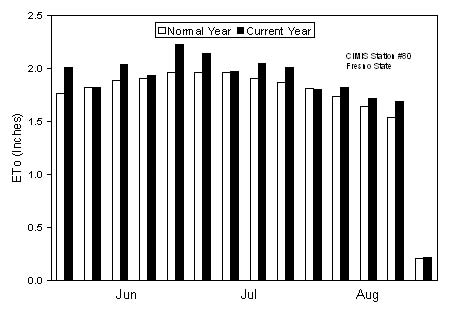
Note: The last column in August is a 1-day total and all other columns are 7-day totals.
Chart shows ETo variation from normal over last three months.
Housing study offers options to help preserve agricultural land
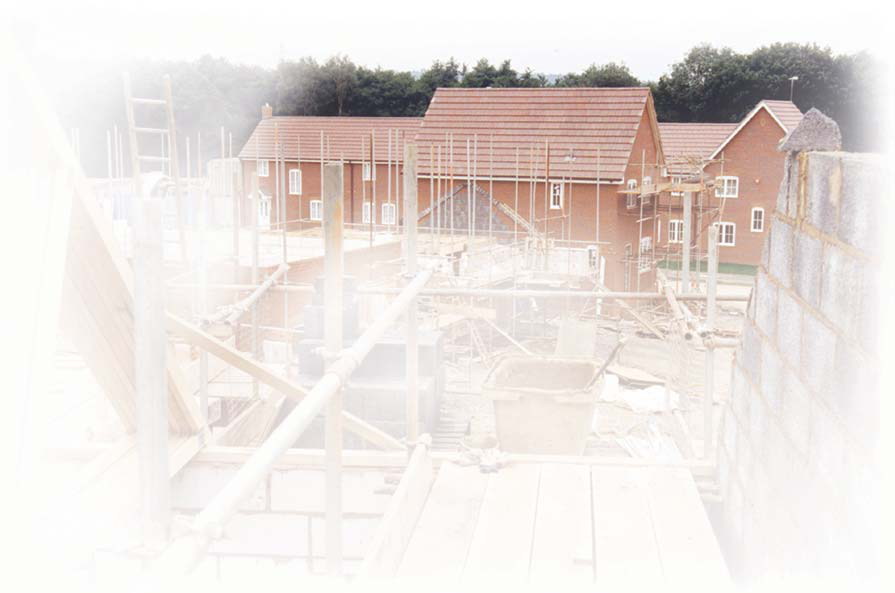
Researchers from California State University, Chico have completed work on a policy paper that could ultimately benefit both the housing market and agriculture in California’s Central Valley.
The work included a survey of California county planners and environmental health officers. The purpose was to learn why enhanced on-site wastewater treatment systems have not been adopted for use in all 58 California counties, reported project director Mitchell Johns, a soil and irrigation professor in Chico State’s College of Agriculture.
The Central Valley is home to 5.5 million residents, and its population is expected to double by 2040, Johns said in explaining reasons for the study. While the fertile soil of the valley is ideally suited for irrigated agriculture, it also is well-suited for houses and septic tanks, prompting expansive home building on agricultural lands.
“The need to satisfy a growing housing demand poses a major threat to valley farmland,” Johns states. “The adoption of on-site enhanced wastewater treatment systems, however, enables communities to both increase residential density and place housing in marginal soils away from productive valley farmland.”
The survey found the most serious obstacles to local on-site wastewater treatment systems include a lack of perception of need by city or county planning officials, a lack of understanding of the innovation, and a lack of technical evaluation capability, among other things. Researchers also found that the offer of more information concerning an innovation — especially about its successful implementation elsewhere — prompted more interest by planners in adopting the technology.
Johns said that the survey and follow-up communication, along with the report, have opened lines of communication with planning officials statewide regarding this issue.
“With the assistance of regional and state agencies, planners are encouraged to become familiar with enhanced wastewater treatment systems,” Johns said. “The adoption of these systems can lead to an expansion in the range of planning options available and provide county governments with additional tools for preserving ag lands threatened by a ballooning state population.”
Researchers expect that broad dissemination of the report should provide impetus for changing land-use policy in favor of preserving prime agricultural land in California, Johns said.
This study was funded in part by the California State University Agricultural Research Initiative (ARI), administered by Fresno State’s California Agricultural Technology Institute (CATI).
To view and/or obtain a copy of the complete final report and related documents, visit the ARI website at http://ari.calstate.edu and search for the project titled “Agricultural Lands Preservation Utilizing a Performance-based Onsite Sewage Treatment Ordinance,” (ARI # 01-5-020).
Testing: Program office offers additional info
from Page 4
tests are accepted on a first-come, first-served basis until available funds are allocated or the end of the program, whichever comes first.
The APEP Program office can be contacted by calling toll free, 1-800-845-6038 or by visiting the APEP website at http://www.pumpefficiency.org.
ARI/CATI on the Web!
The California State University Agricultural Research Initiative (ARI) oversees applied agricultural, agribusiness and natural resources research on behalf of California agriculture. For information on our research and project results, visit our website at http://ari.calstate.edu.
The California Agricultural Technology Institute (CATI) administers ARI funding and oversees additional applied agricultural research. For more information about CATI and its research centers, visit us at http://cati.csufresno.edu, or at our centers:
- Center for Agricultural Business (CAB) – cati.csufresno.edu/cab
- Center for Food Science and Nutrition Research (CFSNR) – cati.csufresno.edu/cfsnr
- Center for Irrigation Technology (CIT) – cati.csufresno.edu/cit
- Viticulture and Enology Research Center (VERC) – cati.csufresno.edu/verc
- Agricultural Technology Information Network (ATI-Net) – cati.csufresno.edu/atinet
Pomona professor pursues equine research
Studies aim to improve training techniques and reduce athletic injuries
America’s equine industry produces goods and services estimated at $25.3 billion annually, with a total impact on the U.S. Gross Domestic Product listed at $112 billion, industry reports show.
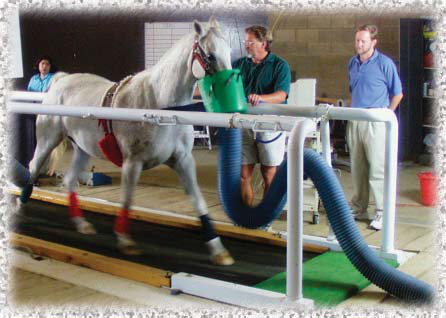
Specially designed equine treadmill enables Cal Poly Pomona professor Steven Wickler (left) to measure the metabolic effects of walking and trotting.
In spite of the role the horse plays in the nation’s economy, studies in equine physiology, training, and conditioning are severely lacking, according to an equine specialist based at California State Polytechnic University, Pomona.
The number of thoroughbred horses still racing at four years of age is a dismal 17 percent of the number initially entered into the pool, reports animal and veterinary sciences professor Steven Wickler. This is largely attributable to the lack of efficiency of current horse training programs, and poor or nonexistent training regimes.
“While proper training and conditioning in human sports medicine is a fine-tuned science, in the horse world most training methods are passed on from trainer to trainer,” Wickler said in a recently completed report on horse physiology and exercise.
Through a series of studies funded by the California State University Agricultural Research Initiative (ARI), Wickler is evaluating different ways to improve equine athletic performance while simultaneously reducing occurrences of injury and death during sporting events. To this extent, he has led research projects aimed at increasing knowledge of basic horse physiology, improving recovery rates after exercise, developing injury prevention strategies, and improving athletic performance through diet and more effective training.
Much of Wickler’s work, some of which has been published in the Journal of Experimental Biology, has provided useful information for scientists and horse owners on how to train horses more effectively.
For more information, visit the ARI website at http://ari.calstate.edu. Use the search function to locate Wickler’s projects. Information also is available on the Cal Poly Pomona College of Agriculture website at http://www.csupomona.edu/~agri.
In the event of incorrect address information or extra copies to your workplace, please return this address label by mail or fax with your requested changes. CATI fax number is (559) 278-4849.
Update publication information
Update is published quarterly by the California Agricultural Technology Institute
College of Agricultural Sciences and Technology
California State University, Fresno
Fall 2006
CATI Publication #061001
Voice number: (559) 278-2361
Fax number: (559) 278-4849
Director of Operations: Joe Bezerra
Publications Editor: Steve Olson
Assistant Publications Editor: John Norton
Non Profit Organization
U.S. Postage PAID
Fresno, CA
Permit No. 262
Address Service Requested
California State University, Fresno
2910 E. Barstow Ave. M/S OF115
Fresno, California 93740-8009
This HTML version was generated with AI assistance and may contain errors or omissions. The original approved PDF remains the official document of record. An alternative accessible format is available upon request from the document creator in accordance with Title II of the ADA.