Update — Summer 2005

In this issue...
Product containers tested .. 2
Safety video released ......... 2
Soil sensors examined ........ 4
Grower group established ... 5
Export study focuses on air cargo
Report outlines growth potential for California airborne agricultural exports

The Center for Agricultural Business (CAB) at California State University, Fresno has released an extensive report examining the expanding role of the commercial airline industry as a vehicle for exporting California agricultural products.
The report was compiled by a research team led by Bert Mason, professor in Fresno State’s Department of Agricultural Economics. Lead author is Jock O’Connell, principal consultant with The ClarkStreetGroup based in Sacramento. O’Connell is a consultant on world trade and economic trends and a member of the California Economic Strategy Panel’s Technical Advisory Group.
The study presents an in-depth evaluation of the role of air cargo services in transporting agricultural exports.
“Although air cargo accounts for a seemingly modest share of the state’s farm export trade, California’s airborne agricultural exports in 2004 were valued at $659 million, an increase of nearly 60 percent since 2000,” O’Connell notes in the report. The export values, along with a wide range of economic and demographic data regarding airborne trade, were collected from agencies such as the University of California, Davis Agricultural Issues Center; the U.S. Department of Agriculture; the U.S. Census Bureau; and the Western Institute for Strategic Economic Research.
Reasons for the increase in airborne farm product exports include a growing demand in Pacific Rim countries for high-value perishable crops such as cherries, strawberries, asparagus and fresh organically-raised produce, the authors note.
See Cargo, Page 3
Golf courses consider recycled water use
Staff members from the Center for Irrigation Technology (CIT) traveled by special invitation to San Jose this spring to spend an entire week making the rounds at two area golf courses.
By agreement, not a single golf ball was hit; rather, the three-person CIT research team spent their days traveling up and down fairways with specialized monitoring equipment to measure soil moisture and salinity levels beneath the green fairways.
The operation was part of a team effort of CIT, the golf courses and the Santa Clara Valley Water District to increase water use efficiency in course irrigations, reported CIT research scientist Florence Cassel-Sharmasarker, who directed the soil survey.
“They want to use municipal re-
See Water, Page 7
Shipping containers
New packaging technology may provide boost to vegetable growers, shippers
Researchers at California State University, San Luis Obispo have determined that a new type of shipping container has the potential to reduce microbial loads and extend the shipping and shelf life of fruits and vegetables.
The SLX container system, produced by SLX International, based in San Luis Obispo, California, is made of food-grade plastic with a hermetic seal able to contain a modified inner atmosphere. The container is re-usable and considered a “green technology,” as opposed to paperboard containers that are single use and disposable.
It makes use of modified atmosphere packaging (MAP) technology, which is quickly advancing from an adolescent to adult stage.
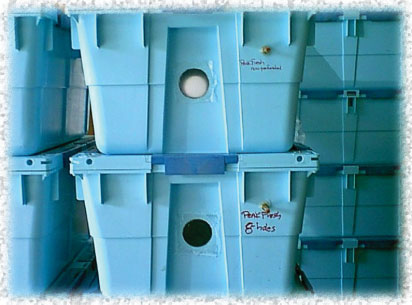
Above: Modified SLX containers showing sealed MAP film patches at forward and rear locations.
A team of investigators from Cal Poly, led by professors J. Wyatt Brown and Brian Hampson, recently concluded a study using the SLX container for the optimization of shelf-life and shipping quality of California-grown broccoli florets. Research parameters included, but were not limited to, respiration rate of the commodity, color, taste, odor, and microbial load, as well as extension of quality factors over time and distance shipped.
As part of the research, containers were injected with different combinations of oxygen, carbon dioxide and nitrogen gases. Containers were then packed with 40 pounds of broccoli florets and sealed with experimental films designed to help maintain the modified atmosphere inside the container.
Containers were held in storage for 14, 21 28 and 42 days at different cold storage temperatures. Containers were then opened and florets measured for color and firmness.
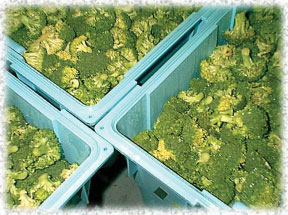
Above: Broccoli floret appearance after 28 days of storage in the SLX-MAP II.
Observations made in regard to overall microbial load indicated that use of the SLX container appeared to significantly reduce the microbial load on the florets, thus potentially reducing health risks to consumers as well as extending shipping life of the product.
Researchers believe the MAP system will lend itself to a number of products. Further study is planned using different fruits and vegetables. If corroborated, this research should increase SLX International’s ability to sell its product and may ultimately allow for sale of fresh farm commodities all around the globe, especially to previously inaccessible markets in Asia and Europe.
To view and/or obtain a copy of the complete final report for this project, titled “Bulk Modified Atmosphere Packaging of Fresh Produce Commodities,” visit the ARI website at ari.calstate.edu. Go to “Funded Projects” and click on the Research Focus Area: “Food Science.”
CAB offers driver safety training video
A new training video featuring safe driving messages for farm workers is to be released this summer by the Center for Agricultural Business (CAB).
The video is one phase of a CAB program aimed at reducing farm worker injuries and fatalities in motor vehicle crashes. The program has included several stages of research, planning and materials development, all aimed at helping workers get to work more safely.
“During the pilot project the agricultural industry indicated the need for a safety training video to help educate farm workers about safe driving practices,” stated Kimberly Naffziger, project director. “The video will be a great addition to the materials that have already been developed. It is designed to provide important information on safe driving behaviors and will help educate farm workers on understanding traffic rules and signs.”
The program features safe driving messages using the media, employers and outreach activities in Fresno, Tulare, Madera, Kings and Kern counties.
The video is available in English and Spanish. For more information on the project or materials, contact CAB at 559-278-4405.
Center for Agriculture Business
Cargo: Airport expansions face challenges
from Page 1
fresh organically-raised produce, the authors note.
Airborne farm exports are shipped aboard all-cargo air-freighters as well as in the cargo holds of passenger aircraft. Amounts range from a few boxes to several pallets. Cool aircraft temperatures and relatively short flight times enable the perishable items to endure transport.
While the trend for increased airborne shipments is likely to continue, California airport demographics will be the single most influential factor affecting exports, the authors suggest.
Currently, Los Angeles International (LAX) and San Francisco International (SFO) airports handle more than 90 percent of all California farm commodity exports, “yet both airports face severe constraints on their ability to handle significantly greater levels of additional cargo,” the authors state. Issues such as traffic congestion, noise and air pollution near the airports present serious challenges to increased flights.
The most likely air transport growth scenario will be expanded passenger and cargo service through other airports such as Oakland International and Sacramento International in the north, and Ontario International in the south.
Other issues that may affect airborne trade include California grower concerns over pest and disease infestation, the authors note.
“Though such flights would be highly beneficial to international travelers and businesses in places such as the San Joaquin Valley, growers have a legitimate concern—that either by accident or maliciousness, overseas flights could carry ‘passengers’ that might prove devastating to growers, ranchers and dairy operators.”
The authors conclude that while foreign demand for high-value California airborne farm exports will likely continue to increase, needed infrastructure improvements may prove “elusive” because of demographic, environmental and political constraints that could hinder airport expansions. Supporters of airborne trade must bring legislators, city and county leaders, and other policymakers up to date on the issues in order to build the teamwork required for successful improvements.
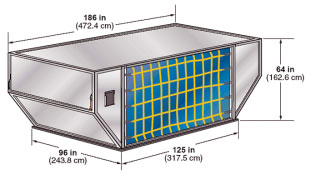
Common designation: Half pallet
IATA ULD code: PLA half pallet with net.
Also known as: PLB, FLA, P9A, P9B, P9P, P9R, and P9S
Rate class: Type 6
Description: Half pallet is contoured for lower and main deck.
Suitable for: 747 and 777 lower deck; 707G, 727F, and 737F main deck with contoured
load
Maximum gross weight: 6,999 lb (3,175 kg)
Tare weight: 200 lb (91 kg)
AS 1825 volume: 250 ft3 (7.1 m3)
O’Connell anticipates the report to be utilized by agencies such as the U.S. Department of Agriculture and the California Department of Food and Agriculture to help in guiding policy decisions. The authors also plan to meet with grower organizations such as the California Farm Bureau Federation to discuss implications of the study.
Single print copies of the report, titled “The Role of Air Cargo in California’s Agricultural Export Trade,” may be ordered using the Publications Order form on Page 7. It can also be accessed in pdf format on CAB’s website at cati.csufresno.edu/cab.
Funding for this project was made available by the Governor’s “Buy California Initiative,” the California Department of Food and Agriculture, and the U.S. Department of Agriculture, through the California State University Agricultural Research Initiative (ARI) Program.
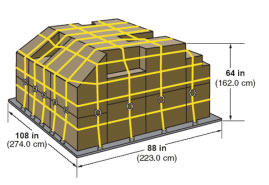
Common designation: LD-39
IATA ULD code: AMU contoured container on P6P base
Rate class: Type 2BG
Description: Full-width lower deck container angled at both ends. Door is canvas with
built-in net door straps.
Suitable for: 747
Door opening: 120 x 60 in (305 x 152 cm)
Maximum gross weight: 11,100 lb (5,035 kg)
Tare weight: 639 lb (290 kg)
AS1825 volume: 560 ft3 (15.9m3)
Upcoming events
July 12 – Farm Labor Contractor Education Institute class at the Embassy Suites Hotel in Seaside, California. For details, call 559-278-4405.
July 27 –Safety Breakfast Meeting in Calistoga, California. Call 559-278-4405.
Aug. 3 – Agricultural Safety Program Supervisor Safety Training (presented in Spanish) in Calistoga, California. Call 559-278-4405 for details.
Aug. 23 – Farm Labor Contractor Education Institute at the Double Tree Hotel in Bakersfield. For details, call 559-278-4405.
Oct. 25 – Farm Labor Contractor Education Institute at the Piccadilly Inn Airport in
Testing soil moisture sensors
New protocol offers objective means to compare products by different makers
A new testing protocol for measuring the accuracy of soil moisture sensors is now available to the irrigation industry.
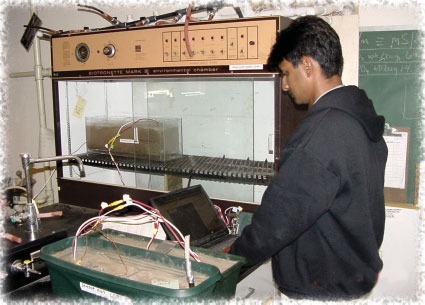
Above: Research analyst Diganta Adhikari downloads moisture data from sensors embedded in a soil sample.
The protocol was developed by research technicians with the Center for Irrigation Technology (CIT) in cooperation with the Irrigation Association (IA), a national trade association that serves the irrigation industry.
“There are many different types of soil sensors commercially available—they come in all shapes and sizes,” noted CIT research scientist Dave Goorahoo in explaining the project. In common marketing fashion, companies typically use their own testing standards to affirm their product’s quality. But with many companies employing different standards, it’s difficult to accurately compare the qualities of different sensors against one another based on individual company claims.
“Since part of the IA’s mission is to improve water use efficiency, they decided that there should be a standardized way of testing sensors, and it should be done by an independent agency,” Goorahoo said.
IA officials contacted CIT and worked out details for developing the protocol. The first action was to organize a development team, led by CIT engineer Ed Norum with assistance from Goorahoo and research database analyst Diganta Adhikari. The team began with a review of existing testing methods; following that were consultations with leading manufacturers and other researchers on how to set up the protocol.
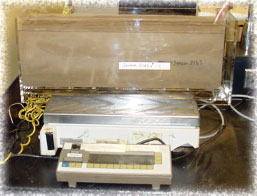 Left: Initial soil moisture content is determinted by weighing sample.
Part of the process involved developing draft protocols and posting them on the IA website where they would be reviewed and critiqued by irrigation specialists from all over the world, Goorahoo said. Following months of postings, critiques, revisions and re-postings, the draft protocol was agreed upon by all concerned.
Factors that were considered in developing the protocol included selection of different soil types. Temperature and salinity levels also were determined for use with each soil type. The resulting combination of soils, temperatures and salinity levels means that one complete sensor test regimen will include more than a dozen actual treatments, Goorahoo noted.
With the protocol now officially established, CIT is ready to contract with sensor manufacturers to test their products. Testing arrangements will be made on an individual contract basis, and results will be confidential.
“There is no pass or fail with these tests,” Goorahoo said. “We will simply provide the data to the client. It is up to the company to decide how they want to use it.”
Sensor testing will be especially valuable to the irrigation industry in light of advancements in the use of electronic sprinkler controllers for both
See Sensors, Page 7
“There should be a standardized way of testing sensors, and it should be done by an independent agency.”
Upcoming events
July 21 – Agricultural Pumping Efficiency Program (APEP) almond pump efficiency class from 9 to 11 a.m. at the Chowchilla Women’s Facility in Chowchilla, California. Call 559-278-2066 for details.
Sept. 8 – APEP Backflow Prevention seminar from 8:30 a.m. to noon at College of the Redwoods in Eureka, California. Call 559-278-2066 for details.
Oct. 26-27 – APEP 201 Pump Efficiency Seminar at Durham Pump in Chico, California. 530-891-4821 for details.
Seasoned voice speaks for CCW
New organization supports research, education, outreach activies for Central Valley Winegrowers
Members of Central California’s wine grape growing industry have teamed with viticulture and enology researchers from California State University, Fresno to help improve wine grape production methods in the region.
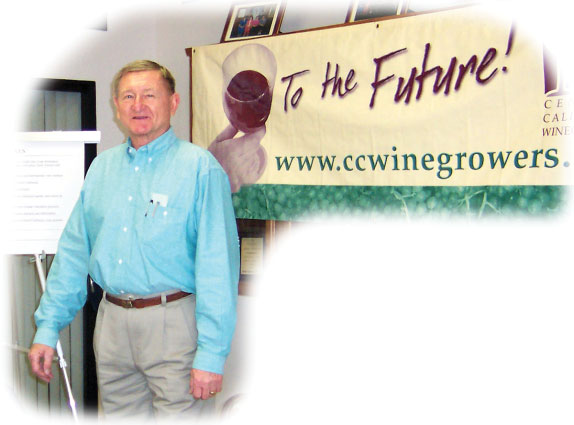
Long-term Central Valley grape grower Ron Metzler now serves as executive director of Central California Winegrowers.
The centerpiece of the new effort was the formation three years ago of the Central California Winegrowers (CCW), a first-of-its-kind organization dedicated to improving the quality of grapes grown for wine in the San Joaquin Valley.
Approximately 50 percent of California’s wine grape crush comes each year from the San Joaquin Valley, which extends roughly from Stockton in the north to the Bakersfield area in the south, noted Ron Metzler, a long-time valley grape grower and now executive director of CCW.
“There has never been an organization of wine grape growers to represent our district, which is a warm climate area,” Metzler said. “Our mission is to oversee research and provide information to growers in our area to help them improve their economic returns.”
One important production issue for the San Joaquin Valley is canopy management, Metzler explained. The warm, sunny climate can bring lush vine growth with full irrigation. However, an overgrown canopy can reduce grape sugar levels and lower the quality of wine produced.
Rather than attempting to plant or grow new vineyards to use in research in this area, CCW has teamed with several area growers who have set aside portions of their own vineyards for experimental irrigation treatments to reduce canopy growth. The process requires careful study, since it can bring unwanted results.
“Sunlight on the grapes from a more open canopy is good, but too much sunlight can burn the grapes,” Metzler noted.
Student research technicians from Fresno State’s Viticulture and Enology Research Center (VERC) are monitoring the vineyard irrigation treatments. They visit experimental plots weekly to record plant water stress, berry development, cluster weight and other attributes. Following harvest, quality of fruit and wines produced will be analyzed.
The second phase of CCW’s mission is to disseminate information to represented growers, Metzler said. So far the organization has sponsored a series of tailgate meetings at participant vineyards, hosted annual meetings and a symposium, and held workshops with several area wineries. In addition, a newsletter is sent periodically to more than 700 area growers.
As a non-profit organization, CCW works from donations and so far has a donor list of more than 150 individuals and businesses. Metzler said.
“We started during an economic downturn, and we know it was tough for growers to be behind on payments and then try to make a donation to CCW. But now things are looking a little better and we are hoping to expand our donor base,” he said.
Additional information on this summer’s irrigation trials will be released through tailgate meetings and workshops, Metzler said. For details on upcoming events, or for more information on CCW, call 559-618-1856 or visit the website at www.ccwinegrowers.org.
Funds supporting establishment of the CCW were made available by the Governor’s “Buy California Initiative,” the California Department of Food and Agriculture, and the U.S. Department of Agriculture through the California State University Agricultural Research Initiative (ARI) Program.
Upcoming events
Nov. 17 – Le Vin Nouveau wine tasting to celebrate the release of Nouveau vintages, from 5:30 to 8:30 p.m. at the Fresno State Winery. Presented with support from Fresno State’s Department of Viticulture and Enology and the Enology Society. Must be 21 or older to attend. Ticket sales limited. Call 559-278-2089.
California Irrigation Management Information System

New stations added to CIMIS network
We are glad to inform CIMIS data users that three new stations have been added to the network since February. This brings the total number of currently active CIMIS stations to 128.
The new stations are Auburn (#195) and Esparto (#196) in Central District and Palmdale (#197) in Southern District. Several other potential station locations are also being evaluated for possible addition to the network.
There is no doubt that adding new stations will reduce the existing spatial data gaps. For information on installing a station in your area, contact your CIMIS representative. Contact information can be found at http://wwwcimis.water.ca.gov/cimis/welcomeStaff.jsp.
DWR awards $28 million in ag, urban water use grants
The California Department of Water Resources (DWR) has awarded $28 million in Proposition 50 grants to 75 agricultural and urban water use efficiency projects.
DWR issued a Proposal Solicitation Package in November 2004 and received 174 applications by the deadline. The proposals were evaluated in the areas of science and economics before further examination, scoring, and ranking by technical review panels. Draft funding recommendations were then posted on DWR’s Web site for public review.
Following a public workshop on June 1, 2005, the California Bay-Delta Authority endorsed the Department’s recommendations, and DWR Director Lester A. Snow gave final funding approvals on June 10.
Local agencies, water districts, academic and research institutions, non-profit organizations and others will use the funds for implementation, pilot and demonstration projects, research and development, feasibility studies, technical assistance and education.
Proposition 50 funding is from the Water Security, Clean Drinking Water, Coastal and Beach Protection Act of 2002. The act provides grants for agricultural, urban water conservation and recycling through Water Code Chapter 7, Section 79550(g).
The project list, along with related information, is posted at http://www.owue.water.ca.gov/finance/.
Questions or comments regarding the grants can be addressed to:
Baryohay Davidoff
DWR Office of Water Use Efficiency and Transfers
901 P Street, 3rd Floor
Sacramento, CA 95814
baryohay@water.ca.gov
For more CIMIS information...
CIMIS information is published quarterly in the CATI Update newsletter. Articles are provided by the California Department of Water Resources, CIMIS program staff.
For more information about CIMIS or its programs, contact any of the following representatives at these offices:
Northern District
Jamie Dubay
(530) 529-7367
dubay@water.ca.gov
San Joaquin District
Steve Ewert
(559) 230-3334
sewert@water.ca.gov
Central District
Mark L. Anderson
(916) 227-7603
marcla@water.ca.gov
Southern District
Sergio Fierro
(818) 543-4652
sergiof@water.ca.gov
If you are unable to reach a CIMIS representative near you, call the CIMIS Helpline at 1-800-922-4647.
Weekly ETo Comparisons for Fresno
Fresno: 03/01/05 – 05/31/05
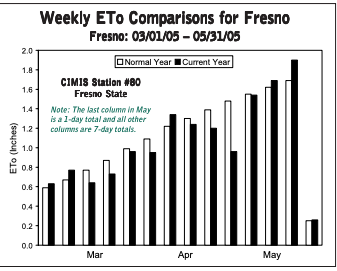
CIMIS Station #80
Fresno State
Note: The last column in May is a 1-day total and all other columns are 7-day totals.
Chart shows ETo variation from normal over last three months.
Sensors: Contact CIT for testing
from Page 4
urban and agricultural irrigation systems, said Adhikari.
“It is essential to know the soil water status for efficient irrigation scheduling in order to optimize water use by crops,” he said.
New irrigation technology employing soil moisture sensors or weather stations to directly communicate with controllers has been dubbed Smart Water Application Technology (SWAT).
SWAT has the potential to significantly increase water use efficiency, with water applications based on the needs of the plant rather than on arbitrary timer settings, Goorahoo noted.
Manufacturers interested in soil sensor testing may call CIT at 559-278-2066 or visit the website at cati.csufresno.edu/cit.
ARI/CATI on the Web!
The California State University Agricultural Research Initiative (ARI) oversees applied agricultural, agribusiness and natural resources research on behalf of California agriculture. For information on our research and project results, visit our website at ari.calstate.edu.
The California Agricultural Technology Institute (CATI) administers ARI funding and oversees additional applied agricultural research. For more information about CATI and its research centers, visit us at cati.csufresno.edu, or at our centers:
- Center for Agricultural Business (CAB) – cati.csufresno.edu/cab
- Center for Food Science and Nutrition Research (CFSNR) – cati.csufresno.edu/cfsnr
- Center for Irrigation Technology (CIT) – cati.csufresno.edu/cit
- Viticulture and Enology Research Center (VERC) – cati.csufresno.edu/verc
- Agricultural Technology Information Network (ATI-Net) – cati.csufresno.edu/atinet
Water: Soil salinity profiles will aid in irrigation planning
from Page 1
cycled water for their turf irrigation,” Cassel explained. Municipal recycled water includes residential and commercial runoff that has been treated in municipal facilities.
The move by a facility such as a golf course to use recycled water in irrigation requires careful planning, Cassel noted.
“Whenever you use recycled water, you first need to determine the chemical properties of the soil you will be irrigating. This will determine how much recycled water you apply, since it often has higher salinity levels.”
As part of their survey, the CIT team set up a grid over each golf course, establishing transect lines 100 feet apart. Using an all-terrain vehicle, they pulled an EM-38 ground conductivity meter along each line, taking soil conductivity readings every 36 feet.
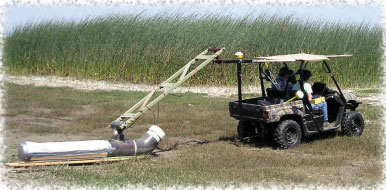
A customized all-terrain vehicle is used to pull an EM-38 ground conductivity meter over golf course turf.
Following that process, the team collected soil samples from a number of sites across each course. Based on exact salinity measurements taken from the soil samples, the researchers were able to calibrate the EC recordings and determine general soil salinity levels across each entire course.
The information will be delivered to the golf course managers in reports containing the soil data obtained, soil profile maps and other observations.
“The salinity profiles will be used to develop best management practices for irrigation of the golf courses with appropriately treated recycled water,” Cassel said. Continued monitoring of soil salinity levels by irrigation system managers will be an important part of the program, she said.
CIT research scientists conduct a wide range of soil salinity surveys as well as other types of soil and irrigation system and equipment testing. For more information, call CIT at 559-278-2066 or visit the website at cati.csufresno.edu/cit.
Publications Available
(These publications may be viewed in their entirety on CATI’s World Wide Web pages, located at cati.csufresno.edu. Single print copies are also available by mail at no charge.)
- The Role of Air Cargo in California’s Agricultural Export Trade, by Jock O’Connell, Bert Mason and John Hagen. CATI Pub. #050502.
Ordering Information:
Check the publication(s) desired and mail or fax form to:
CATI
California State University, Fresno
2910 E. Barstow Ave. M/S OF115
Fresno, CA 93740-8009
Fax: (559) 278-4849
Name
Company
Mailing Address
City State Zip
Update:
Summer 2005
Survey finds gardens effective school tool
A study conducted at California State Polytechnic University, Pomona has concluded that approximately 25 percent of the public schools in California have a school garden. The number represents a significant increase over estimates from a 1998 analysis that indicated at least 13 percent of schools had gardens.
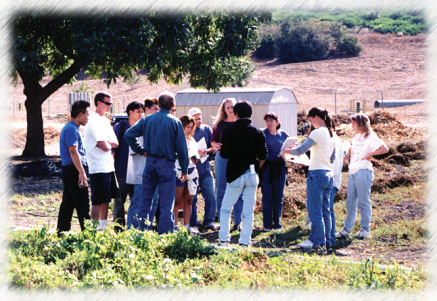
Most school principals responding to a Cal Poly Pomona survey believe that working in school gardens enhances students’ academic performance as well as social skills.
Cal Poly Pomona plant and soil science professor Peggy S. Perry oversaw the most recent research effort, which determined the current status of gardens in California schools through self-administered Internet and mailed surveys.
Of nearly 10,000 surveys sent to school principals, 43 percent were returned. Of those respondents, 57 percent reported having a school garden, with most indicating that the gardens helped enhance academic instruction. Principals strongly agreed that nutrition lessons could be used successfully in teaching about gardens.
Some of the most frequently taught subjects using the school garden were science, environmental studies, nutrition, language arts, and math. Most principals believe gardens are effective at enhancing science, social skills, academic performance, and physical activity.
The survey also assessed the barriers to using gardens in instruction. These includes lack of time or curriculum linked to academic standards, and lack of teacher interest, knowledge, experience or training in gardening. The greatest barriers to a successful garden included lack of funding, time constraints and lack of supplies.
Preliminary evidence from this and other studies indicates that improvement in school attendance, social interaction, and nutrition result from outdoor educational experiences that gardens can provide, Perry noted. These results may encourage schools without gardens to consider implementing them as an educational tool, she said.
This study was funded in part by the California State University Agricultural Research Initiative (ARI), administered by the California Agricultural Technology Institute (CATI) at California State University, Fresno.
To view and/or obtain a complete copy of the final report for this project, titled “Gardens and Farm-to-School Programs in California Public Schools,” visit the ARI website at ari.calstate.edu. Go to “Projects Funded by Focus Area” and click on “Public Policy.”
In the event of incorrect address information or extra copies to your workplace, please return this address label by mail or fax with your requested changes. CATI fax number is (559) 278-4849.
Update publication information
Update is published quarterly by the California Agricultural Technology Institute
College of Agricultural Sciences and Technology
California State University, Fresno
Summer 2005
CATI Publication #050701
Voice number: (559) 278-2361
Fax number: (559) 278-4849
Director of Operations: Joe Bezerra
Publications Editor: Steve Olson
Editorial Assistant: John Norton
California Agricultural Technology Institute
California State University, Fresno
2910 E. Barstow Ave. M/S OF115
Fresno, California 93740-8009
Non Profit Organization
U.S. Postage PAID
Permit No. 262
Fresno, CA
This HTML version was generated with AI assistance and may contain errors or omissions. The original approved PDF remains the official document of record. An alternative accessible format is available upon request from the document creator in accordance with Title II of the ADA.