Update Spring 2005
CALIFORNIA AGRICULTURAL TECHNOLOGY INSTITUTE
SPRING 2005
In this issue...
Tomato skins processed ..... 2
Trade report released ........ 3
Saline soils examined ......... 4
Vine root aeration tested .... 5
California State University, Fresno
‘Buffering’ evaluated as new lagoon management strategy
Air emissions measurements aimed at evaluating dairy lagoon management practices in central California have indicated that treatment of dairy effluent by a process called “lagoon buffering” successfully reduces atmospheric ammonia emissions from the lagoons.
The findings come as part of a larger three-year study by researchers with Fresno State’s Center for Irrigation Technology (CIT) in partnership with the dairy industry.
The results provide good news for dairy operators who are exploring additional ways to reduce odors and gases typically emitted from dairy operations, noted project director and CIT research scientist Dave Goorahoo. Depending upon the nutrient and organic content of the dairy effluent, as well as the physical, chemical and biological environment of the lagoon, several gases such as ammonia, hydrogen sulfide and methane can be released into the atmosphere, Goorahoo noted.
“We are looking at management practices that will reduce ammonia emissions,” he said. “We think we can definitely cut them back using the buffering method, as ammonia emissions are largely dependent on pH and temperature of the lagoon water.”
Because of its potential to form tiny particulates as it reacts with oxides of nitrogen and sulfur in the air, atmospheric ammonia is under intense scrutiny by state and federal environmental regulators concerned about harmful health effects.
One goal of lagoon buffering is to reduce ammonia emissions by reducing the pH of the effluent and lagoon water.
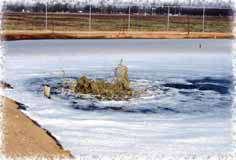
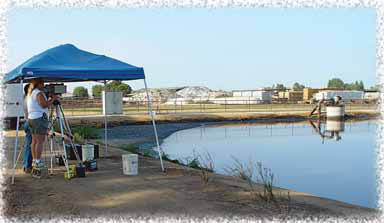
Above: Typical dairy lagoon aeration process. Left: Fresno State researchers use tunable diode lasers to measure ammonia and other gas emissions above lagoon.
CALI conference for ag lenders coming in June
Planning is under way for the California Agricultural Lending Institute (CALI) to be held June 20-24 at the Piccadilly Inn University in Fresno, California.
A joint project by Fresno State’s Center for Agricultural Business (CAB) and the Ag Lenders Society of California, CALI provides in-depth, competency-based training for lending professionals, accountants, attorneys, farm managers and rural appraisers.
Now in its fourth year, CALI offers classes for participants in a two-year course of study. The classes are offered concurrently in a condensed, yet comprehensive, one-week format allowing students the opportunity to focus completely on their classes. First-year sessions range from analysis of financial information, cash flow considerations and tax return analysis to essentials of field inspection, crop budgeting, business writing skills, and tools for customer retention.
Second-year classes address advanced topics on cash flow, essentials of field inspection, dairy budgeting, advanced business writing skills, managing credit risks, problem loan management, and farm family succession planning.
Classes are conducted in a facilitative style employing a case study format as a means of enhancing the principles taught during the week, culminating in the analysis and presentation of a loan request based on facts found in the case study and utilizing the skills acquired in the classroom.
The goal of the institute is to provide quality instruction that prepares participants to be informed and effective leaders in agricultural lending, to promote the success of their financial institutions, and to promote the growth of agriculture in California and the nation.
Successful program participants will be awarded a “Certificate of Completion” from California State University, Fresno, and a “Certificate of Accredited Education” from the Ag Lenders Society of California and will have an opportunity to pursue designation as an Accredited Agricultural Lending Professional (AALP).
CALI’s faculty includes senior agricultural lenders, university faculty specializing in agricultural finance, CPAs and other experts in their respective fields.
For registration information, call 559-278-4405 or visit the CAB website at cati.csufresno.edu/cab.
Tomato processing advances
New treatment formula provides for peels to be used in sauces and pastes
Food science researchers at California Polytechnic State University, San Luis Obispo have teamed with California’s tomato processing industry to develop a new process for utilization of on-line tomato process waste.
The partnership included FMC Corporation in Madera, California; Harter-Morningstar Tomato Processing Co. in Yuba, California; Pacific Coast Producers in Lodi, California; and Liberty Packing in Los Banos, California.
The research team has been searching for ways to utilize tomato skins normally disposed of after tomatoes are peeled using a conventional lye bath, reported Cal Poly professor and project director Joseph Montecalvo.
In the new process, developed in full compliance with federal Food and Drug Administration requirements, tomato peel generated from the alkali bath (15-17 percent sodium hydroxide) was acidified to pH 3.9–4.0 with the addition of either citric acid or hydrochloric acid.
The mixture was further processed into a puree product and added as a topping sauce for whole peeled tomatoes.

By-product from tomato processing is being further processed and incorporated into retail products such as barbecue sauce, pizza sauce and salsa products.
Incorporation of the acidified tomato by-product in commercial Del Monte salsa, pizza sauce and barbecue sauces showed very high consumer acceptability as a result of consumer location testing, Montecalvo reported. All acidified by-product-containing retail products were judged superior to their non-by-product-containing control.
Based on these positive results, the by-product also is being concentrated into tomato paste and incorporated into additional commercial retail products such as barbecue sauce, pizza sauce and salsa products.
Results of this project have significantly contributed to the reduction of process waste streams previously costing the processing industry hundreds of thousands of dollars per year in municipal waste disposal and in truck transport costs associated with solid waste disposal, Montecalvo reported.
Details of research, including lists of other technical articles and presentations, are available in a final report titled “Characterization and Food Product Applications of Acidified Tomato By-products,” located on Cal Poly’s ARI website at ari.calpoly.edu. For additional project or related information, Montecalvo may be contacted at montecalvo@charter.net
Additional ARI research information is located on the ARI website at ari.calstate.edu.
CALI: Case studies help illustrate financial principles
from Page 1
ations and tax return analysis to essentials of field inspection, crop budgeting, business writing skills, and tools for customer retention.
Second-year classes address advanced topics on cash flow, essentials of field inspection, dairy budgeting, advanced business writing skills, managing credit risks, problem loan management, and farm family succession planning.
Classes are conducted in a facilitative style employing a case study format as a means of enhancing the principles taught during the week, culminating in the analysis and presentation of a loan request based on facts found in the case study and utilizing the skills acquired in the classroom.
The goal of the institute is to provide quality instruction that prepares participants to be informed and effective leaders in agricultural lending, to promote the success of their financial institutions, and to promote the growth of agriculture in California and the nation.
Successful program participants will be awarded a “Certificate of Completion” from California State University, Fresno, and a “Certificate of Accredited Education” from the Ag Lenders Society of California and will have an opportunity to pursue designation as an Accredited Agricultural Lending Professional (AALP).
CALI’s faculty includes senior agricultural lenders, university faculty specializing in agricultural finance, CPAs and other experts in their respective fields.
For registration information, call 559-278-4405 or visit the CAB website at cati.csufresno.edu/cab.
Center for Agricultural Business
CAFTA report outlines market opportunities
A new agreement among the United States and seven Central American countries may allow for “modest” market gains by California agricultural commodity producers, according to a report recently released by the Center for Agricultural Business (CAB).
The report is titled “The Central American Free Trade Agreement: What’s at Stake for California Agriculture?” It was compiled by CAB Director Mechel Paggi, CAB senior research economist Fumiko Yamazaki, and professor emeritus Tim Josling of Stanford University’s Food Research Institute, under a contract with the California Institute for the Study of Specialty Crops based at California Polytechnic State University, San Luis Obispo.
The report outlines opportunities and challenges likely to face California agribusinesses as a result of the introduction of CAFTA, Paggi reported.
“In particular, the study focuses on the potential increased export market opportunities and increased import competition for California specialty crops,” he said.
CAFTA was negotiated by a Bush administration team under the Trade Promotion Authority granted to the president in 2002. The agreement converts non-reciprocal trade pacts between the United States and several Latin American countries into a permanent multinational agreement.
“The CAFTA is intended to help foster economic growth and improved living standards in the Central American region by reducing and eliminating barriers to trade and investment,” Paggi said. Along with the United States, the countries involved are Costa Rica, El Salvador, Guatemala, Honduras, Nicaragua, Dominican Republic and Panama.
“CAFTA will create improved market opportunities for U.S. agricultural products and related goods and services,” Paggi states in the report. Tariff rates ranging from 35 to 60 percent on incoming U.S. agricultural products will be reduced in most cases to levels ranging from 11 to 13 percent.
Even with the dramatic rate reductions, California commodity producers should not expect immediate market inroads for two reasons, Paggi noted. First, because of their relatively small populations and economies, most of the CAFTA trade partners currently lack buying power for more goods. Secondly,


Labor commissioner to speak at ag labor summit on May 3
California State Labor Commissioner Donna Dell leads the list of speakers for this year’s Agricultural Labor and Employment Summit scheduled for May 3 at Harris Ranch in Coalinga, California.
Cosponsored by the Center for Agricultural Business (CAB), the summit brings agricultural professionals together to address key labor and employment issues.
Dell and three other speakers will offer labor and employment law updates and also will address topics such as workers’ compensation and transitional work programs.
The event is open to the public. For registration information call CAB at 559-278-4405.
Website offers financial risk seminar
Tools and strategies to assist California commodity producers in risk assessment, management and enterprise planning are now available through an on-line Internet seminar hosted by the California Risk Management Organization (located at www.calriskmgmt.org).
The seminar includes modules addressing typical risks farm producers face, such as family, financial, production, market, legal and regulatory risks. Included in the modules are emerging as well as time-honored tools that can be used for implementing risk management strategies.
The seminar targets tree fruit and nut producers, with emphasis on small and beginning farms. The website was developed as part of the Targeted Commodities Program managed by the Center for Agricultural Business (CAB) and the University of California Agricultural Issues Center.
For more information contact CAB at 559-278-4405.
Center for Irrigation Technology
Saline soils examined
Student’s thesis study results provide new data on water retention properties
A former school teacher has converted her interest in plants, soil and water into a scientific study that provides new information on the hydraulic properties of soils irrigated with saline-sodic drainage water on California’s Westside San Joaquin Valley (SJV).
The findings could assist Westside growers who are considering using “Integrated On-Farm Drainage Management (IFDM)” to reclaim cropland lost due to poor drainage and increased levels of salt and boron. Saline-sodic drainage water, which also contains selenium and other trace elements, tends to degrade soil structure and requires that IFDM systems be carefully designed and properly managed.
Following several years of junior high school teaching, new Fresno State agricultural research technician Kim Senatore decided to change directions and pursue her real career passion–the study of plants and ecology. She recently earned her master’s degree in plant science at Fresno State, based upon her thesis research entitled “Determination of Hydraulic Parameters for Soils Irrigated with Recycled Saline-Sodic Drainage Water.” Her work was part of a larger study of irrigation and drainage management strategies being conducted by Fresno State plant science professor Sharon Benes and CIT soil scientist Dave Goorahoo.
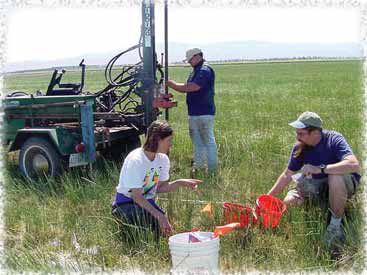
Fresno State plant science professor Sharon Benes and student research assistants collect soil samples using a mechanized core sampling rig.
“Salinity is a general term for the sum total of soluble salts in soils, while sodium is a specific component of salt which actually damages soil structure,” Senatore said.
Sodium has chemical properties that break down and disperse small soil particles such as clays, which leads to the clogging of soil pores and impaired water percolation.
“This type of clogging results in poor drainage and water-saturated soils, which can lead to root rot and poor plant growth,” she noted.
Since many Westside growers now irrigate with water that has higher than desirable salt and sodium (SAR) levels, Senatore, with guidance from her thesis committee, decided to evaluate the effects of these waters on Westside soils. Over a year and a half, she collected and analyzed more than 450 soil samples that had been irrigated with water of different salt and sodium levels.
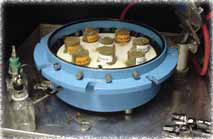
Soil samples were placed in a vacuum chamber to draw moisture out.
Senatore developed water retention curves for the soils being irrigated by drainage waters with different sodium levels. She anticipates that the data will be used by crop water consultants to develop appropriate irrigation strategies based on crop, soil type, and water properties, particularly in IFDM systems that utilize saline-sodic waters to irrigate salt tolerant crops and forages.
“This information would also be useful for hydrologic modeling of salt movement and effects on groundwater,” she said.
Professionals in the agricultural industry have been impressed with Senatore’s work. At the recent annual meeting of the American Society of Agronomy, she presented findings in a poster in competition with students from several universities. Her poster won first place and a cash award of $300.
Senatore recently was appointed a full-time research lab technician for the Center for Irrigation Technology (CIT). She will continue working on projects focusing on salt and drainage issues.
For details on Senatore’s and Benes’ work, visit the California State University Agricultural Research Initiative (ARI) website at ari.calstate.edu. Click on “Funded Projects,” then find Benes’ work under “Production and Cultural Practices, or contact Senatore directly at ksenatore@cusfresno.edu.
Upcoming events
April 27 – APEP golf course presentation and seminar for golf course superintendents, from 10 a.m. to noon. For location info, visit www.pumpefficiency.org
April 29 – APEP 101 seminar, including description and eligibility, from 10 a.m. to noon at Pistachio Pump in Sanger, California. 559-875-4528 for details.
Viticulture and Enology Research Center
Root aeration tried on table grapes
Researchers inject air into subsurface drip lines to determine if added oxygen will boost vine growth
A university-industry research partnership led by scientists from Fresno State’s Viticulture and Enology Research Center (VERC) recently completed field trials for a new method of vineyard irrigation.
The trials consisted of air injection into a subsurface drip irrigation system in an attempt to increase oxygen levels, and, thus, aerobic activity, in the soil. Cooperating with VERC researchers on the project are a Delano area grape grower and a Bakersfield-based irrigation equipment manufacturer.
“The process offers a method of increasing vineyard productivity using relatively inexpensive technology,” reported Roy Thornton, a VERC research scientist and one of the project leaders.
“Several studies have suggested the possible benefits of modifying root zone environments by injecting air,” Thornton noted in explaining the work. “Conventional subsurface drip irrigation and flood irrigation both can produce an anaerobic root zone environment,” he said. With the injection of air, “the microbial population will change from predominantly anaerobic types to aerobic types or organisms, resulting in increased soil nitrogen.” Researchers believe the practice may improve crop production and fruit quality.
As part of the project, a two-acre portion of vineyard owned by VBZ Vineyards near Delano was set aside for treatments. One acre was irrigated by subsurface drip with aeration. High-efficiency, venturi-type injectors dispensed the air, which forms very small bubbles once injected into the drip lines. The other acre served as a control treatment, receiving above ground drip irrigation without aeration.
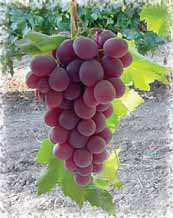
Vine root aeration study was conducted on Ruby Red Globe table grape vines.
Soil samples were taken from random locations of each treatment during the growing season, Thornton said. The samples are being analyzed to determine the types of microorganisms present and whether they vary among the different treatments.
In addition to soil sampling, researchers collected leaf samples to determine nitrogen status of the vines and berry samples to determine weight, percent soluble solids, titratable acidity and pH.
Thornton expects analyses of the different aspects of the work to continue through the summer, with results available in the fall. Fresno State associate biology professor Alice Wright and a team of students are conducting the soil analyses. Microbial diversity of each soil sample will be determined by extracting and analyzing DNA components of the microorganisms.
The air injectors for the research were provided by Mazzei Injector Corp. of Bakersfield.
Funding for this project was made available by the Governor’s “Buy California Initiative,” the California Department of Food and Agriculture and the U.S. Department of Agriculture through the California State University Agricultural Research Initiative program. For additional information, contact Thornton at rthornto@csufresno.edu.
Upcoming events
April 16 – Annual FFA Field Day Vine Judging at the Fresno State Vineyards. Call 559-278-2011 for details.
April 21 –3rd Annual Vino Italiano wine tasting at the Fresno State Winery. Details online at www.FresnoStateWinery.com.
May 19 – Viticulture and Enology Graduates’ Dinner in Clovis, California. Grape and wine industry, alumni, faculty, staff and students invited. RSVP at 559-278-2089.
June 5 – A Celebration of Wine – annual wine tasting and fundraiser – at the Dennes Coombs’ Riverbend Ranch in Madera, California. Call 559-244-5741 or visit www.acelebrationofwine.com.
June 22-24 – ASEV Annual Meeting in Seattle, Washington. For more info, visit www.asev.org or email society@asev.org.
California Irrigation Management Information System
Irrigation scheduling using reference evapotranspiration
Reference evapotranspiration is the sum total of evaporation and transpiration from a standardized grass (ETo) and/or alfalfa (ETr) surface. The standardization is necessitated by the fact that different plants need different amounts of water. The California Irrigation Management Information System (CIMIS) uses cool season grass as a standardized surface. Hence ETo refers to CIMIS’s reference evapotranspiration in this article.
With ETo values from the CIMIS database, irrigators can schedule their irrigation using what is known as the water budget method. The water budget method is nothing more than an accounting of the soil moisture. Precipitation and irrigation will be added, and runoff, deep percolation, and evapotranspiration will be subtracted from the soil moisture. The first thing a scheduler needs to do is convert ETo to actual evapotranspiration (ETc) from a specific crop/plant. This is accomplished using crop coefficients (Kc), a ratio of evapotranspiration from the standardized surfaces to that of the specific crop/plant. This ratio has been developed through research and can be obtained from various sources. When the balance reaches a predetermined soil moisture level, it is time to irrigate.
Some argue that using soil moisture sensors is superior to using the ETo approach. There is no denying that soil moisture is the ultimate indicator if there is a need for irrigation, since plant roots get their water directly from the soil. The sensors, however, have limitations, including, among other things, the spatial variability of soil physical, chemical, and biological properties; cracks around the sensors because of the expansion and contraction of soils as a result of the wetting and drying processes; and the effect of salinity on the accuracy of the sensors.
Some of these limitations can be overcome by using the ETo approach. This does not, however, mean that the ETo approach has no problems. The ETo approach is expensive, complex, time consuming, and deals with atmospheric demand alone.
The intent of this article is not to state which method is better for irrigation scheduling. It is rather intended to show how difficult it is to choose one method over another. Local conditions and availability of data dictate the choice one has to make. The best scenario, however, would probably be to fine-tune the ETo based approach using the soil moisture sensors.
Visit the CIMIS home page at http://www.cimis.water.ca.gov
For more CIMIS information...
CIMIS information is published quarterly in the CATI Update newsletter. Articles are provided by the California Department of Water Resources, CIMIS program staff.
For more information about CIMIS or its programs, contact any of the following representatives at these offices:
Northern District
Jamie Dubay
(530) 529-7367
dubay@water.ca.gov
San Joaquin District
Steve Ewert
(559) 230-3334
sewert@water.ca.gov
Central District
Mark L. Anderson
(916) 227-7603
marcla@water.ca.gov
Southern District
Sergio Fierro
(818) 543-4652
sergiof@water.ca.gov
If you are unable to reach a CIMIS representative near you, call the CIMIS Helpline at 1-800-922-4647.
Weekly ETo Comparisons for Fresno
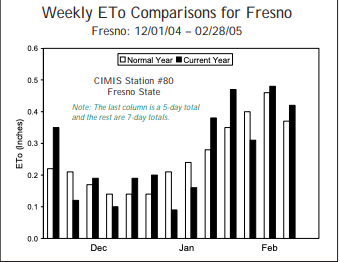
Fresno: 12/01/04 – 02/28/05
CIMIS Station #80
Fresno State
Note: The last column is a 5-day total and the rest are 7-day totals.
Chart shows ETo variation from normal over last three months.
Lagoon: Further study will assess irrigation impacts
from Page 1
A pH of greater than 8.0 favors ammonia emissions, Goorahoo noted.
The three-pronged approach of lagoon buffering combines natural processes–aeration and recirculation–with the addition of sulfuric acid to reduce effluent pH levels from above 7.5 to slightly below 7, making the lagoon water slightly more acidic than alkaline.
Air monitoring equipment measured lower ammonia emissions over lagoons when the water pH levels were below 7, Goorahoo said.
The lagoon buffering process was developed by Verdegaal Brothers Inc., a fertilizer and sulfuric acid business firm based in Hanford, California. Still under evaluation, the process requires careful management, since addition of too much acid can take pH levels to undesirably low levels, researchers have found.
“If the pH goes too low, we can have serious odor problems as a result of greater hydrogen sulfide emissions,” Goorahoo said. “We have to be careful that in fixing one problem we’re not creating another.”
Other aspects of the process will require additional study. For example, since dairy operators typically use lagoon water to irrigate alfalfa, silage corn and other crops, researchers are planning to examine the impact of slightly-acidic lagoon water on plants and soil.
Results of lagoon-buffering research are being presented in publications and at seminars hosted by CIT, the California Agricultural Technology Institute and the dairy industry. For details on this and related research, contact Goorahoo at dgooraho@csufresno.edu or visit the ARI website at ari.calstate.edu.
Students win EPA fellowships for continuing ARI research
Three students from Fresno State’s Biology Department have won federal graduate fellowships for research proposals submitted to the U.S. Environmental Protection Agency (EPA). Two of the three proposals stem from original research funded by California State University’s Agricultural Research Initiative (ARI).
The fellowships were awarded by the EPA under the Greater Research Opportunities (GRO) program, open to master’s and doctoral students in environmental studies. Only 22 students were awarded fellowships nationwide. The two-year program includes a stipend of $20,000 per year and full payment of tuition and fees.
The students’ mentors are assistant biology professors Alice Wright, Ruth Ann Kern and Mamta Rawat.



Graduate student Michelle Davison will continue research with Dr. Wright. Davison’s project, launched by Wright with ARI funding in 1999, extends studies of proteins that regulate enzyme production needed for pesticide degradation. An understanding of the molecular processes involved in the degradation of pesticides and other chemicals will aid in the development of bioremediation strategies for pollutants.
Ryan Lopez is studying the patterns of soil moisture in the mixed conifer forest of Sequoia National Park. He is working with Dr. Kern, who obtained ARI funding in 1999 to study factors affecting seedling survival in Sierra Nevada forests. Ryan will test hypotheses concerning patterns of soil moisture in forest gaps and understory.
Project results will improve the understanding of forest dynamics and will be useful to forest managers attempting to preserve this resource.
Denise Lopez, along with research advisor Dr. Rawat, is studying the degradation of toxic dyes and pesticides by a soil-dwelling bacterium called Mycobacterium smegmatis. She is using genetic tools to identify genes involved in the degradation of these pollutants. Identification of the genes will aid in understanding how mycobacteria are able to biodegrade these toxic compounds.
ARI/CATI on the Web!
The California State University Agricultural Research Initiative (ARI) oversees applied agricultural, agribusiness and natural resources research on behalf of California agriculture. For information on our research and project results, visit our website at ari.calstate.edu.
The California Agricultural Technology Institute (CATI) administers ARI funding and oversees additional applied agricultural research. For more information about CATI and its research centers, visit us at cati.csufresno.edu, or at our centers:
- Center for Agricultural Business (CAB) – cati.csufresno.edu/cab
- Center for Food Science and Nutrition Research (CFSNR) – cati.csufresno.edu/cfsnr
- Center for Irrigation Technology (CIT) – cati.csufresno.edu/cit
- Viticulture and Enology Research Center (VERC) – cati.csufresno.edu/verc
- Agricultural Technology Information Network (ATI-Net) – cati.csufresno.edu/atinet
CAFTA: Market strategies will key exporters’ success
from Page 3
some of the tariff cuts are incremental over 10 to 20 years.
“The main impact of CAFTA on U.S. agricultural producers, and on California specialty crop exporters, is the degree of preference relative to the major competitors,” Paggi suggested. “The United States will be regaining parity in market access with Mexico and with producers within the Central American Common Market and gaining an advantage over some South American and European suppliers.”
The key to success in this, as in any new market, hinges on export strategies implemented by producers, Paggi noted. The authors believe that information provided in the new report can help in the development of those strategies.
Report chapters address topics such as market opportunities, competition in domestic markets, trade remedies, safeguards, and dispute settlements.
The report may be accessed through the Internet on the CAB website at cati.csufresno.edu/cab. Single print copies also are available free of charge and may be requested by email to cab@cati.csufresno.edu.
Ozone products analyzed
Researchers, consultants and equipment providers specializing in ozone use in agriculture and food processing gathered in Fresno in March for Ozone IV, an international conference that featured updates of the latest in ozone research.
Ozone, or O3, a form of oxygen, is being evaluated as an antimicrobial agent in a variety of agricultural and food processing applications. The conference enabled more than 100 participants from around the world to present case studies, research results, and recent ozone-related technology developments in areas such as food safety and quality, process water treatment and re-use, controlled environments, and clean-in-place procedures.
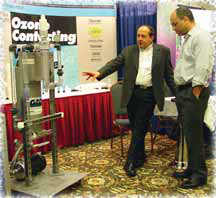
Angelo Mazzei (left), president of Mazzei Injector Corp. of Bakersfield, explains a compact ozone contacting system for use in water treatment with Aaron Rosenblat, chairman of CDG Research Corp. of Bethlehem, Pennsylvania.
Researchers discussed ozone applications on fresh cut vegetables, fruit, stored grains, and in wine making, cold storage, and aquaculture.
Direct use of ozone on food was approved by the U.S. Food and Drug Administration in 2002, providing strong impetus for research and development of additional applications and new equipment, noted Erin Dormedy, assistant professor of food science and nutrition at Fresno State and one of the conference organizers.
The event was sponsored in part by Fresno State’s Center for Food Science and Nutrition, G&L AgriTec of Three Rivers, California, and the International Ozone Association.
Ozone V has been tentatively scheduled for early 2007.
In the event of incorrect address information or extra copies to your workplace, please return this address label by mail or fax with your requested changes. CATI fax number is (559) 278-4849.
Update is published quarterly by the California Agricultural Technology Institute
College of Agricultural Sciences and Technology
California State University, Fresno
Spring 2005
CATI Publication #050401
Voice number: (559) 278-2361
Fax number: (559) 278-4849
Director of Operations: Joe Bezerra
Publications Editor: Steve Olson
Editorial Assistant: John Norton
Address Service Requested
California State University, Fresno
2910 E. Barstow Ave. M/S OF115
Fresno, California 93740-8009
Non Profit Organzation
U.S. Postage PAID
Fresno, CA
Permit No. 262
This HTML version was generated with AI assistance and may contain errors or omissions. The original approved PDF remains the official document of record. An alternative accessible format is available upon request from the document creator in accordance with Title II of the ADA.