Update Winter 04-05
CALIFORNIA AGRICULTURAL TECHNOLOGY INSTITUTE
WINTER 04-05
California State University, Fresno
In this issue...
- Nuclear technology tried ...... 2
- IA spotlights CIT leaders ...... 4
- Winning wines analyzed ....... 5
- Rodent control monitored ..... 7
Canola crop may fulfill dual West Side roles
Plant extracts selenium from soil; may serve as source of oil for biofuel.
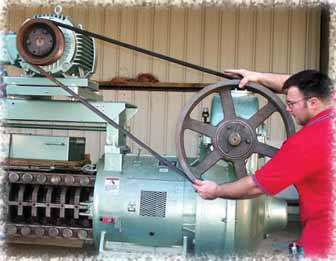
Continuing efforts by researchers to help resolve soil selenium (Se) problems in California agriculture have led to the development of a process that first uses plants to extract excess soluble selenium from the soil, then produces a product—biofuel—that can be used for powering tractors and trucks.
U.S. Department of Agriculture scientist Gary Banuelos is leading the project with support from a Fresno State engineering specialist and partners in the agricultural industry.
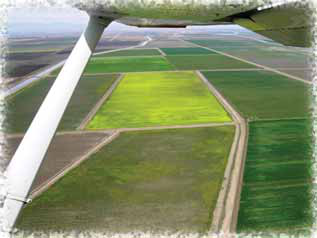
Banuelos is testing the production potential of canola as a source for both livestock feed and oil that could be blended with diesel fuel to power engines. The project involves several field trial plots on the San Joaquin Valley’s West Side and features the use of drainage water with high levels of selenium for irrigation.
Some West Side soils contain high levels of selenium, salt and other trace elements that have accumulated over decades of irrigated farming, Banuelos said in explaining the project. An impervious clay layer not far under the soil surface requires many growers to install drainage lines to remove soluble salts from the soil. Due to the high concentrations of Se in the drainage water and the lack of safe drainage water disposal options, thousands of acres of farmland have become environmentally unfit for production.
Research has demonstrated that salt-tolerant crops such as saltgrass, cordgrass, and halophytes can successfully be used as recipients for disposing of Se-laden effluent. Such plants can be harvested and at least considered as animal forage.
Other plants like canola offer an alternative.
See Canola, Page 8
Center for Agricultural Business
Annual AgSafe conference scheduled
The 11th Annual AgSafe Conference has been scheduled for Feb. 2 and 3 at the Embassy Suites Hotel and Conference Center on Monterey Bay in Seaside, California.
Presented by AgSafe and Fresno State’s Center for Agricultural Business (CAB), the conference has become a central annual event allowing California growers, packers, processors and others in related businesses to collectively address the most important safety issues facing the state’s agricultural industry.
More than 40 workshops, seminars and training sessions will be offered as part of the 2005 conference, reported AgSafe Director Kimberly Naffziger. New sessions this year include “Food Safety and Security,” “Row Crop Safety,” “Confined Space Hazards in Dairies,” and “X-mod – Understanding the Bottom Line.” Back by popular demand are sessions one through four of the California Agricultural Safety Certificate Program offered by CAB. Other key issues to be addressed include workers’ compensation, job safety analysis, and injury and illness prevention programs.
Positive feedback from last year’s “Early Bird” experiment prompted organizers to again offer an additional day of sessions prior to this year’s event, Naffziger said. The early bird workshops, set for Feb. 1, will include sessions one and two of the safety certificate program, pesticide training, and a special agricultural tour.
The conference opening address will be presented Wednesday by Sean McNally, vice president of human resources and legal counsel for Grimmway Farms in Bakersfield. A specialist in workers’ compensation and discrimination defense for employers, McNally will analyze recent changes in the workers’ compensation system and how they are likely to affect businesses.
Thursday’s keynote will come from Duane A. Selby, regional vice president of DuPont Safety Resources. Selby recently led the development and implementation of a highly successful safety improvement program for the Los Angeles Metropolitan Transportation Authority. He will speak on “Building Safety Culture and Leadership.”
More than a dozen specialists in various agricultural safety issues will provide information and training over the three-day event, which typically draws more than 300 participants from throughout California. To better serve Spanish-speaking clients, many of the classes will be presented in Spanish, Naffziger said.
Another feature new to this year’s conference will be a tour of several successful agricultural operations in the Salinas Valley. The tour will be held the afternoon of Feb. 1 and will conclude with a wine tasting at Scheid Vineyard.
Between workshops there will be networking opportunities, as well as vendor displays of safety equipment, services and supplies.
Joining CAB and AgSafe in presenting the conference are the National Institute for Occupational Safety and Health, the UC Center for Occupational and Environmental Health, and the UC Farm Safety Program.
Cost to attend is $195 for AgSafe members and $275 for nonmembers for registrations postmarked by Jan. 25. For single-day rates and other discount information, call (559) 278-4404.
Workshop descriptions are listed on the AgSafe website at agsafe.org and on the CAB website at cati.csufresno.edu/cab.
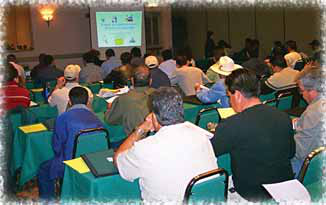

The 2005 AgSafe Conference will feature classes and seminars addressing key agricultural safety issues.
Statewide ag symposium set for March 23, 24
A major agricultural symposium cosponsored by the Center for Agricultural Business will explore challenges and opportunities facing California agriculture on March 23 and 24 at the Arden West Hilton in Sacramento.
Special sessions will address air and water quality, biotechnology, food quality and safety, environmental regulation, marketing new and specialty crops, international trade and policy, rural and urban interface issues, pest management, farm labor, and water policy.
Featured speakers include California Secretary of Food and Agriculture A.G. Kawamura, farm and industry leaders, government officials and university faculty.
Seating is limited to 300. Registration fee is $125 by Feb. 25.
For more information visit www.CalAgSymposium.org or call 530-752-1748 or 530-752-2320.
Upcoming events
- Feb.2-3 – 11th Annual AgSafe Conference at the Embassy Suites Hotel & Conference Center on Monterey Bay in Seaside, California. For details, call 559-278-4404.
- Feb. 22 – Farm Labor Contractor Education Institute (FLCEI) at the Embassy Suites in Seaside. Classes in English and Spanish. For details, call 559-278-4405.
- March 8 – FLCEI at the Double Tree Hotel in Bakersfield. Call 559-278-4405.
- April 6 – FLCEI at the Courtyard by Marriott in Oxnard. Call 559-278-4405.
- April 27 – FLCEI at the California Farm Bureau in Sacramento. Call 559-278-4405.
- May 25 – FLCEI at the California Piccadilly Inn Airport in Fresno. Call 559-278-4405.
Nuclear transfer technology tried
One of three calves born survives to produce calf without complication
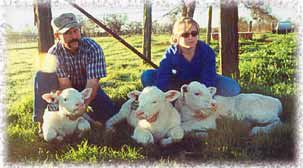
Researchers at California State University, Chico have overseen the birth of the first set of cloned calves in California through the process of Nuclear Transfer (NT), a.k.a. cloning, in beef cattle.
NT is still in its infancy with regard to the commercial beef industry, reported animal biotechnology professor and project director Cynthia Daley. Pregnancy rates of NT embryos continue to be 40 percent below that expected with modern methods of embryo transfer. Before NT technology can be used more widely to enhance genetic quality of herds, it will have to become more refined and produce a more consistent product, she said.
Data collected from the recently completed project suggest that with NT, perinatal calf losses are considerable if intervention is not provided in a timely manner. Surgery or therapeutic doses of antibiotics are necessary to prevent septicemia, which can occur from enlarged umbilici. However, after 30 days, the calves performed as expected. Of the three calves born, one survived to adulthood and produced an 82-pound bull calf without complication, indicating that NT calves are reproductively sound.

Project work also helped to improve perinatal calf care of NT derived calves, Daley said. Most labs producing NT calves are now placing them on therapeutic doses of antibiotics to ensure against septicemia. With these and other changes, post-calving survival rates are now 90 percent or better.
“Clearly, the potential for NT technology is huge for the cattle industry, although it will take many more years of study before technology improves to the point where it compares with in-vivo embryo production,” Daley said.
The project was funded by the California State University Agricultural Research Initiative in cooperation with Chico State University, with private industry support from Cyagra Inc.
To view and/or obtain a complete copy of the final report for this project, titled “Applications of IVF Technology within the Beef Industry,” (ARI Project #01-5-005), visit the ARI website at ari.calstate.edu. Go to “Funded Projects” and click on the Research Focus Area: Production and Cultural Practices.
Ozone IV event continues focus on food processing
The fourth major international conference on the use of ozone in the food processing industry has been scheduled for March 2-4 in Fresno California.
The event is titled, “Applications of Ozone as an Antimicrobial Agent in the Food and Agriculture Industries.” It is being presented by G & L AgriTec in conjunction with the International Ozone Association-Pan American Group (IOA-PAG), with primary sponsorship and support from Fresno State’s Center for Food Science and Nutrition Research (CFSNR). It will be held at the Radisson Hotel and Conference Center downtown.
Organizers anticipate attendance of 200 or more, including researchers, end users, and primary manufacturers of ozone systems.
The program will address the antimicrobial efficacy of ozone with the goal of increasing food safety and quality. Speakers will discuss application of gaseous and aqueous ozone to reduce microbial loads in air, water and soil, on food products, and on related equipment.
Nicknamed “Ozone IV,” the conference continues a series – the last of which was held in Fresno in 2002.
For details, visit the conference website at http://cati.csufresno.edu/ozone or contact the conference coordinator at 559-561-0112 or at ozone4coord@earthlink.net.
Center for Irrigation Technology
CIT draws Irrigation Association spotlight
Zoldoske assumes post as president; Norum honored for work
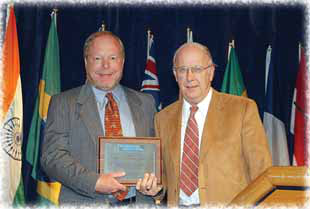
Two leaders of Fresno State’s Center for Irrigation Technology (CIT) took center stage at a recent meeting of the Irrigation Association (IA) – one to receive a commission and the other a commendation.
CIT director David Zoldoske was sworn in as IA president, a post he will hold for one year, and CIT consulting irrigation engineer Ed Norum was honored as the IA’s Person of the Year, an award given for contributions to the irrigation industry.
Zoldoske is the first academic professional to serve as IA president. All predecessors have been from industry ranks. Coming from CIT, a university-based research institute, Zoldoske said he will bring educational priorities to the forefront of the IA’s priority list.
“We want to emphasize the importance of water management and irrigation in our schools, from kindergarten through 12th grades and in the colleges,” Zoldoske said. “One of my priorities will be developing curriculum in these areas to be made available to teachers.”
With a $2.5 million annual budget and a full-time staff of 14, the IA, based in Falls Church, Virginia, has significant resources to apply to special project areas, Zoldoske noted.
In addition, the new president said, he wants to continue expanding the IA’s traditional focus from water conservation to broader issues of water quality, management, and energy use. With water supply issues becoming more serious in California, irrigation industry leaders must adopt a more “environmental outlook,” examining ways to maintain water quality and to conserve energy during the water distribution and irrigation processes, Zoldoske said.
Norum was a central figure in establishing CIT at Fresno State in the early 1980s and served as its director from 1982-85. Following a term of service with the U.S. Agency for International Development, he returned to CIT in 1996 as a consulting engineer, developing research and testing technologies for irrigation systems.
Most recently he has led developmental testing for Smart Water Application Technology, the Irrigation Association’s program to gain acceptance for water-saving irrigation technology such as weather-based controllers and moisture sensors.
Both Norum and Zoldoske are known internationally for their work in advancing the irrigation industry. They also have been active leaders in establishing the International Center for Water Technology, an institute – based at Fresno State – that will lead in water technology research, product development, education and training.
For more information on the IA, visit the website at www.irrigation.org.
Pumping efficiency program extended
The Agricultural Pumping Efficiency Program (APEP), coordinated by the Center for Irrigation Technology (CIT), has been refunded through December 31, 2005.
The program offers education and incentives to improve overall pumping plant efficiency and to encourage energy conservation.
All owners or users of an electric or natural gas utility account that is used for production agriculture or large turf irrigation (non-residential accounts of 5 horsepower or more for turf irrigation) and who are paying the Public Goods Charge (normally customers of PG&E, SCE, SCG, or SDG&E – SDG&E customers should call the program first to check on their eligibility) are eligible.
For details visit the APEP website at www.pumpefficiency.org.
Regional Offices are located in Northern California – call 866-333-8938 (toll-free); the San Joaquin Valley (Main Office) – call 800-845-6038; and the Central Coast – call 866-473-0847.
Upcoming events
- Jan. 14 – Agricultural Pumping Efficiency Program (APEP) Pump Efficiency 101 seminar from 10 a.m. to noon in Shafter, California. Call 661-589-6901 for details.
- Jan. 20 – APEP pump and irrigation efficiency seminar from 10 a.m. to noon in San Joaquin, California. Call 559-693-4315.
- Jan. 27 – APEP 201 seminar on eligibility, pump curves, cost analysis from 8:30 a.m. to noon at CIT in Fresno. Call 800-845-6038.
- Feb. 8 – APEP seminar on well and pump efficiency from 7:30 a.m. to 11:30 a.m. at the Southern California AgTAC in Tulare, California. Call 800-845-6038 for details.
Winning ways
VERC researchers seek ways to share successful strategies with industry
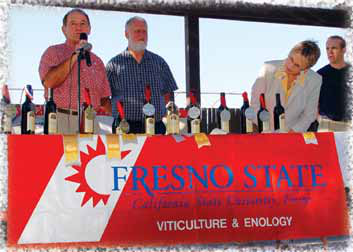
Enology scientists at Fresno State’s Viticulture and Enology Research Center (VERC) are seeking ways to share some of the university winery’s successful fermentation methods with the California wine industry.
The effort comes as increased global wine production has prompted California winemakers to explore new ways of improving their own wines while reducing production costs.
One potential method of raising wine quality is harvesting grapes based on flavor and aroma development rather than traditional sugar and acid levels, reported VERC scientist Roy Thornton. The more subjective method has been highly successful for Fresno State wine production in recent years, as wines produced using these practices have won silver and gold medals in prestigious national and international wine competitions.
Using subjective practices at industry levels can be risky, however. Harvesting fruit beyond traditional maturity definitions brings sugar levels higher than the standard 24o Brix. These higher levels can cause a winemaker serious problems such as sluggish or stuck fermentations.
“These incidents result in economic loss to the producer who must spend time and materials to rectify the situation,” Thornton said. “Furthermore, sluggish and stuck fermentations can significantly affect production schedules and frequently bring an accompanying diminution in quality.”

The Fresno State commercial winery regularly harvests fruit at high (25-28oB) maturity levels, and over the last 100 production cycles has observed only a single stuck fermentation, noted enology professor and winemaser Ken Fugelsang.
One facet of production that may provide the better results involves cooler fermentation temperatures.
“The approach developed for red wine fermentation is atypical in that we ferment at 70-75o F rather than the industry norm of 80-90+o F and incrementally supplement the ferment with nitrogen in the form of diammonium phosphate,” Thornton said.
In a new series of production trials, the VERC team, consisting of Thornton, Fugelsang, researcher Susan Rodriguez and chemistry professor Barry Gump, is attempting to generate solid scientific data to support the experiential observations that have been made at Fresno State over the years.
The work features high sugar, or “high-density,” fermentations in two red varieties (Shiraz and Cabernet Sauvignon) and one white variety (Chardonnay) by characterizing both nutrient changes and metabolite formation, and by characterizing changes in the microbial population, during the course of production. A unique combination of methodologies – Fourier Transform Infra Red (FTIR) Spectroscopy and Flow Cytometry – are being used to characterize the fermentations and will provide real-time analysis of the microbial and chemical events occurring in the fermentations.
Results of two years of trials are expected to be released later this year. Funding for the work was made available by the Governor’s “Buy California Initiative,” the California Department of Food and Agriculture and the U.S. Department of Agriculture through the California State University Agricultural Research Initiative program.
Upcoming events
- Jan. 18 – 1st Viticulture and Enology Career Fair from 10 a.m. to 1 p.m. at VERC. For details call 559-278-2089.
- Feb. 5 – Annual FFA Vine Pruning Contest at Fresno State vineyards. Call 559-278-2011.
- Feb. 24-25 – 8th Annual Central Coast Viticulture and Enology Issues Conference on Syrah, in San Luis Obispo, California. For details email cynthiaw@csufresno.edu.
- March 4-6 – Fresno State Winemaster’s Weekend at the Tenaya Lodge in Yosemite. For details call 559- 278-2089.
- April 16 – Annual FFA Field Day Vine Judging at the Fresno State Vineyards. Call 559-278-2011 for details.
- April 18-19 – Wine Microbiology Conference at the Tenaya Lodge in Yosemite. Contact cynthiaw@csufresno.edu for details.
Net radiation estimation method performing well
As reported in the October 2004 issue of Update, the Office of Water Use Efficiency (OWUE) staff compared reference evapotranspiration (ETo) and net radiation (Rn) estimated using CIMIS’s Modified Penman (CIMIS MP) and the standardized Penman-Monteith (PM) equations. The result showed that differences in ETo estimated by the two equations are not significant, whereas differences in Rn are significant.
Rn is the net radiant energy that is available at the surface to evaporate water, heat the air and heat the soil. It is either measured using net radiometers or estimated using theoretical and empirical formulas. Since net radiometers are expensive and difficult to maintain, Rn formulas are usually used to estimate Rn.
ETo is evaporation plus transpiration from standardized grass surfaces. Crop factors are used to convert ETo to actual crop evapotranspiration (ETc). ETc is in turn used for irrigation scheduling purposes. Although ETo can be measured using instruments such as Lysimeters, theoretical and empirical equations are widely used because measurements are expensive.
For efficient irrigation, it is essential that ETo is estimated as accurately as possible. The accuracy with which ETo is estimated depends mainly on the accuracy with which the parameters used to calculate ETo are measured or estimated. Rn is by far the most important parameter in the calculation of ETo using the Penman type combination equations. Therefore, it is equally important that Rn is estimated with utmost accuracy.
CIMIS purchased and installed net radiometers near the Davis CIMIS station to compare Rn estimated by the two methods against measured values. A preliminary analysis using hourly data from July 17, 2004 through October 24, 2004 indicated that both equations estimated Rn within possible measurement errors. However, the CIMIS MP method provided a better estimate of measured Rn than the PM.
On average, Rn estimated by the PM was eight percent higher than the measured, whereas Rn estimated by the CIMIS MP was four percent less than the measured Rn. This will certainly raise the confidence of CIMIS data users and providers in the quality of the data. The experiment will continue for one year to incorporate the effects of seasonal variability.
Visit the CIMIS home page at http://www.cimis.water.ca.gov
For more CIMIS information...
CIMIS information is published quarterly in the CATI Update newsletter. Articles are provided by the California Department of Water Resources, CIMIS program staff.
For more information about CIMIS or its programs, contact any of the following representatives at these offices:
- Northern District
Jamie Dubay
(530) 529-7367
dubay@water.ca.gov - San Joaquin District
Steve Ewert
(559) 230-3334
sewert@water.ca.gov - Central District
Mark L. Anderson
(916) 227-7603
marcla@water.ca.gov - Southern District
Sergio Fierro
(818) 543-4652
sergiof@water.ca.gov
If you are unable to reach a CIMIS representative near you, call the CIMIS Helpline at 1-800-922-4647.
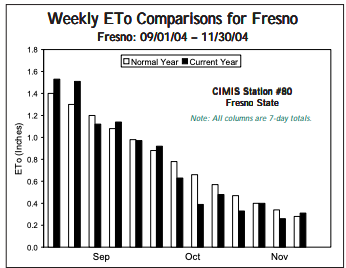
Weekly ETo Comparisons for Fresno
Fresno: 09/01/04 – 11/30/04
Normal Year Current Year
CIMIS Station #80 Fresno State
Note: All columns are 7-day totals.
ETo (Inches)
Sep Oct Nov
Chart shows ETo variation from normal over last three months.
Research team targets recovery rates of horses following exercise
The ability of a horse to recover quickly from an exercise session is a key element for successful athletic competition in a number of equine sports. Understanding the basis for recovery is essential for both planning conditioning programs and, more importantly, identifying the limitations to recovery so they can be recognized to prevent injury to the animal.
A research team headed by California State Polytechnic University, Pomona professor Steven Wickler is addressing these issues in a research project evaluating post-exercise recovery strategies for horses. One aspect of the study featured injection of a non-radioactive isotope and collection of respiratory gases for analysis. Data collection is under way and will continue throughout the winter quarter of 2004-05.
The study team hopes to continue with a grant from the National Institute of Health, in collaboration with researchers from the University of Colorado, Boulder. The work would expand to cover animals of varying body mass.
Wickler’s study was supported in part by the California State University Agricultural Research Initiative (ARI), administered by the California Agricultural Technology Institute (CATI).
For more information on Wickler’s project, entitled “Post Exercise Recovery Strategies,” visit the ARI website at ari.calstate.edu. Go to “Funded Projects” and click on the Research Focus Area: Production and Cultural Practices.
Study results support continued use of rodent control chemical
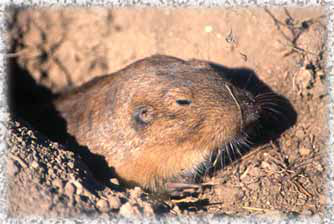
Aluminum phosphide has been proven to be one of the most effective chemicals for controlling rodents such as gophers and ground squirrels.
A scientific study of a chemical used to control rodent populations has indicated that the material is suitable for re-registration without additional restrictions.
Aluminum phosphide, a popular primary pest management tool for pocket gophers and ground squirrels, is undergoing re-registration with new use regulations being recommended.
A recent study evaluated the risk of aluminum phosphide and gathered support data for continued registration of current label uses. The study, conducted by California State Polytechnic University, Pomona professor Rex Baker, evaluated data logged by 33 applicators in both urban and agricultural settings. All applications were made according to the label and at the highest rates allowed.
The resulting data concluded that aluminum phosphide is safe when applied according to the label. No applicators were found to be exposed to levels of phosphide above or even close to the currently established time weighted average of 0.3 ppm.
Baker’s study was supported in part by the California State University Agricultural Research Initiative (ARI), administered by the California Agricultural Technology Institute.
To view and/or obtain a complete copy of the final report for this project, titled “Aluminum Phosphide Industrial Hygiene,” visit the ARI website at ari.calstate.edu. Go to “Funded Projects” and click on the Research Focus Area: Production and Cultural Practices.
ARI/CATI on the Web!
The California State University Agricultural Research Initiative (ARI) oversees applied agricultural, agribusiness and natural resources research on behalf of California agriculture. For information on our research and project results, visit our website at ari.calstate.edu.
The California Agricultural Technology Institute (CATI) administers ARI funding and oversees additional applied agricultural research. For more information about CATI and its research centers, visit us at cati.csufresno.edu, or at our centers:
- Center for Agricultural Business (CAB) – cati.csufresno.edu/cab
- Center for Food Science and Nutrition Research (CFSNR) – cati.csufresno.edu/cfsnr
- Center for Irrigation Technology (CIT) – cati.csufresno.edu/cit
- Viticulture and Enology Research Center (VERC) – cati.csufresno.edu/verc
- Agricultural Technology Information Network (ATI-Net) – cati.csufresno.edu/atinet
Canola: Crop may provide use for drainage water
from Page 1
Alternative, Banuelos believes.
“This plant species can successfully extract more Se than other salt-tolerant crops after irrigation with Se-laden effluent,” he said.
However, in order for canola to be used to manage the volume and Se content of effluent produced in the West Side, it is imperative that viable economic uses for the harvested plant product be available.
Canola is grown worldwide for cooking oil, Banuelos noted. The plants produce seeds that have a raw oil content of between 35 and 40 percent.
“For the purpose of biofuel, canola as one of the highest-yielding oil crops lends itself well,” he said. Prior research has demonstrated that canola oil is a suitable diesel fuel extender at inclusion rates of up to 25 percent.
After pressing the canola seeds for oil, the remaining seed by-products are commercially valuable high-protein and Se-enriched meal for animal feed.
Banuelos’ first project objective has been to grow a commercial-sized crop of canola using regular and high-selenium irrigation water to achieve quality production levels in West Side soils. The second-phase objective is to develop viable products from the plant material, which includes biofuel, after pressing and extruding oil from the seeds.
Following a year of production on one 90-acre plot and several other smaller field plots, USDA researchers, in conjunction with Red Rock Ranch and Panoche Drainage District, have collected more than 300 tons of canola seed for pressing. A dry extruder and oil press are being installed on the ranch of West Side grower John Diener, who is hosting the project on his Red Rock Ranch near Five Points.
Teaming with Banuelos in the biofuel production is Fresno State professor Walter Loscutoff from the Department of Mechanical and Industrial Engineering. He will evaluate performance and efficiency of the biofuel-powered engines.
The project is funded primarily by the California State University Agricultural Research Initiative ARI, with support from the USDA and the California Department of Water Resources.
Additional canola plantings are planned for this spring. Extracted oil from both canola and sunflower seeds will be mixed with diesel for use in diesel-powered engines at the Red Rock Ranch. The seed by-products will be collected, analyzed for selenium content, and blended with forage for dairy cows.
Dissemination of results will begin later this year. For more information on the project, contact Banuelos at gbanuelos@fresno.ars.usda.gov.
In the event of incorrect address information or extra copies to your workplace, please return this address label by mail or fax with your requested changes. CATI fax number is (559) 278-4849.
Update is published quarterly by the California Agricultural Technology Institute
College of Agricultural Sciences and Technology
California State University, Fresno
Winter 04-05
CATI Publication #050101
Voice number: (559) 278-2361
Fax number: (559) 278-4849
Director of Operations: Joe Bezerra
Publications Editor: Steve Olson
Editorial Assistant: John Norton
Address Service Requested
California State University, Fresno
2910 E. Barstow Ave. M/S OF115
Fresno, California 93740-8009
Non Profit Organization
U.S. Postage PAID
Fresno, CA
Permit No. 262
This HTML version was generated with AI assistance and may contain errors or omissions. The original approved PDF remains the official document of record. An alternative accessible format is available upon request from the document creator in accordance with Title II of the ADA.