Update — Spring 2004
In this issue...
- Market survey planned ........ 3
- Promor A passes tests ......... 4
- Eutypa fungus studied ......... 5
- Educators educated ............ 7
New irrigation strategies address West Side salt, selenium problems
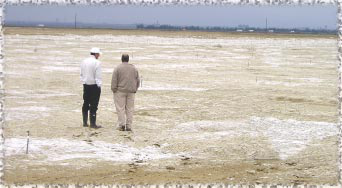
IFDM grower Michael Andrews (left) of AndrewsAg Inc. offers a workshop participant a view of land and sprinklers used for water evaporation. Salt drying is the final step in the IFDM sequence.
More than 10 years of research and testing by growers, irrigation engineers, plant scientists and university education specialists have culminated this spring in the release of a new set of water management strategies for use by growers on California’s Westside San Joaquin Valley.
The strategies are outlined in a new landowner’s manual that was distributed to 140 growers during a recent series of workshops cohosted by Fresno State’s Center for Irrigation Technology (CIT), reported Tim Jacobsen, CIT education specialist and one of the workshop organizers.
The purpose of the new strategies is to aid growers in addressing the chronic buildup of salt, selenium, and other elements in Westside soils. A dense clay layer beneath the topsoil prevents leaching of these natural elements and has resulted in the buildup of high concentrations in some areas. As a result, thousands of acres of once rich farmland have been taken out of production.
In many areas growers have tried to address the salt problem by installing perforated tile drains beneath the soil surface to collect water that leaches down through the topsoil. The water is collected in sumps and pumped out for reapplication. However, as salt concentrations have increased, both soil and drainage water have become unusable.
A key to resolving this problem is for growers to alter their approach to irrigation system management, Jacobsen said. The new approach being presented is called integrated on-farm drainage management (IFDM) and features the sequential reuse of water in a more tactical way.
“This system views the subsurface drainage water containing salts and selenium as resources, rather than considering them as wastes and environmental problems,” Jacobsen said. “It minimizes salt and selenium risks to water quality and the environment, and it allows you to deal with your subsurface water on-site.”
The IFDM system involves application of irrigation water first on high-value, salt-sensitive crops. Drainage water from that acreage is then applied, in sequence, to salt-tolerant crops, forages, and halophyte plants, with drainage water volume reduced in each stage. The final volume of drainage water is delivered to a solar evaporator. Once the salts and other elements are dehydrated and allowed to crystallize, they can be disposed of or marketed.
The nine-chapter manual outlining the IFDM system was produced by specialists from a dozen state and federal agencies and universities, including the California Department of Water Resources, the U.S. Department of Agriculture, California State University, Fresno, and the University of California.
At several workshops offered to Westside growers in February and March, presenters led a chapter-by-chapter overview of the system. Topics included salt management; system monitoring, record keeping and reporting; geology and soils; drainage water characteristics; plant selection; effects on wildlife; economics; and laws and regulations.
Jacobsen noted that adopting IFDM strategies requires dedication to a new type of technology.
“There’s a mindset required to make it work. There are operational and regulatory issues to be addressed,” he said. But the payoffs are significant, including in some cases the ability to continue farming on land that otherwise would have to be retired.
A new series of workshops targeting irrigation engineers, technicians and regulatory personnel is planned for later this year, Jacobsen said. The workshops will address technical aspects of installing and maintaining an IFDM system. Though targeted to specialized audiences, they will be open to all who are interested.
Details and dates of the workshops will be announced through CIT mailings and on the website, located at cati.csufresno.edu/cit. For other information contact Jacobsen at 559-278-5752 or at tjacobse@csufresno.edu.
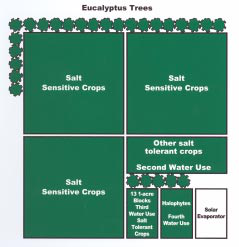
Schematic diagram outlines the sequential reuse of irrigation water under the IFDM system. Steps conclude with drainage water delivered to a solar evaporator.
Key research on the IFDM system has been led by Fresno State plant science professor Sharon Benes. With funding support from the California State University Agricultural Research Initiative (ARI), Benes has overseen a variety of growth trials on different types of salt-tolerant plants and halophytes. Several varieties tested have been recommended for use by growers as part of their IFDM crop rotation.
For more information on Benes’ IFDM research, visit the ARI website at ari.calstate.edu. Click on Funded Projects and the Research Focus Area: Water and Irrigation Technology.
Workshop to focus on risk management
California farmers will have the opportunity to learn their own risk tolerance styles and apply them to practical risk management farm solutions at a workshop being offered April 27 in Fresno.
Titled “Tailoring Risk Management to Fit Your Farm,” the morning workshop will be held at the Center for Agricultural Business (CAB) at California State University, Fresno.
Program presentation was made possible by a grant from the USDA Risk Management Agency to the University of California Agricultural Issues Center. Partners include CAB and the UC Cooperative Extension.
During the workshop, participants will develop size-appropriate solutions to the five major agriculture risks: family/personal, financial, production, marketing, and legal/regulatory. The event is intended for all farmers, ranchers or nursery operators; however, it will have information particularly useful for those with gross receipts of less than $250,000 per year and who have been operating for fewer than 10 years.
“The participants will learn scale-appropriate solutions to their risk problems. We will share new and emerging risk management programs to help in all farming operations,” said David Visher of FACTS, an agricultural training firm coordinating the workshop.
Registration, including a binder of materials for each participant, is $20.
The same workshop also will be held on several other dates from April 20 to May 14 at 10 other California locations ranging from Humboldt County in northern California to San Diego County in the south.
For details on the Fresno workshop, call 559-456-7560. For more information on the other workshops, visit the UC Agricultural and Natural Resources website at http://news.ucanr.org.
Center for Agricultural Business
Economics study targets juice concentrate market
Results should provide clearer picture of opportunities
Grape growers who have been struggling with low prices for their product and who are exploring market alternatives will have access to some new information later this year regarding opportunities in the juice concentrate market.
A research team of economics specialists from the Center for Agricultural Business (CAB) and the University of California will delve into current concentrate market conditions as part of a study for the recently formed Central California Winegrowers (CCW) association. Funding for this project has been made available by the Governor’s “Buy California Initiative,” the California Department of Food and Agriculture and the U.S. Department of Agriculture through the California State University Agricultural Research Initiative Program through a subgrant awarded to the CCW.
In the last three years prices for Thompson seedless grapes have hovered around $100 per ton or less – not enough to support grape grower production costs, noted CAB director Mickey Paggi in explaining the basis for the research. Since grapes for concentrate account for 15 to 25 percent of California’s total grape crush, and 30 to 45 percent of the grapes crushed are from the Fresno-south region, the low prices pose a significant threat to a large part of the industry.
“The sustainability of a grape-for-concentrate production sector in California will require some combination of factors to contribute to increased revenues,” Paggi stated. Those factors are higher prices, lower production costs, and increased yields.
In order to give growers more substantive information about market opportunities, Paggi’s research team will develop a detailed profile of the juice concentrate industry. This will include information on domestic and international competition from alternative sweeteners such as apple and pear juice concentrates, and new product developments.
In another part of the project, economics specialists will build a detailed economic enterprise budget analysis for a representative grape-for-concentrate production system. The goal of the analysis will be to provide grape growers with the information necessary to evaluate the long-term sustainability of their current and/or proposed operations, Paggi said.
Developing the industry profile will require extensive interviews with growers, processors, brokers and shippers. Building the enterprise budget will require study of statistical data related to industry structure, conduct and performance in recent years.
“The primary benefit to the industry will be a sound basis of reliable information to use as a basis for investment and marketing decisions,” Paggi said.
Assisting Paggi in project administration will be members of the University of California, Davis Agricultural Issues Center. Other leading team members include Fumiko Yamazaki, Ph.D., a senior research associate for CAB, and an economics specialist from the UC Cooperative Extension.
Project activities are to begin in May, with final reports slated for presentation at the end of the year. Those with questions pertaining to the project or with interest in participating may contact CAB at 559-278-4405.
Website to highlight risk management
A special program to assist California commodity producers in risk management will offer education and training via the World Wide Web.
The new website is being developed as part of the “Targeted Commodities Program” conducted by the Center for Agricultural Business (CAB) and the University of California Agricultural Issues Center.
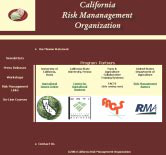
The website is titled the “California Risk Management Organization.” It is dedicated to providing tree fruit and nut producers with tools and concepts to aid them in risk assessment, management and enterprise planning. The site will offer educational modules addressing specific topics in risk management.
When program courses are offered, growers will be able to register for the class and work through the program modules at their own pace from their home computers via the Internet. The site also contains links to other risk management topics and organizations, as well as a calendar of events and news releases on important related issues.
The website, still under construction, is located at www.calriskmgmt.org. For details contact CAB at 559-278-4405 or Dr. Jim Casey, chairman of Fresno State’s Department of Agricultural Economics, at 559-278-3004.
Upcoming events
- April 21 – Fresno Safety Breakfast meeting “Issues in Workers’ Compensation Fraud” from 8 to 9:30 a.m. in the CATI Conference room. Call 559-278-4405 for details.
- April 27 – Calistoga Safety Breakfast meeting from 9 to 11 a.m. at the Napa County Fairgrounds, Cropp Building. Call 559-278-4405 for details.
- May 26 – Farm Labor Contractor Education Institute – English and Spanish classes, at the Piccadilly Inn University from 8 a.m. to 5 p.m. Call 559-278-4405 for details.
- June 21-25 – California Agricultural Lending Institute at the Piccadilly Inn University. Call 559-278-4405 for details.
Center for Irrigation Technology
Elephant grass makes impressive showing in dairy lactation trials
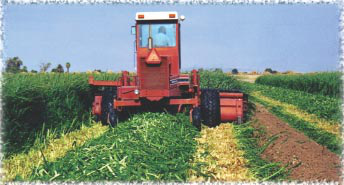
Custom unit harvests Promor A (elephant grass) from an Imperial Valley, California field for use in lactation trials comparing nutrition content of Promor A with alfalfa and Sudangrass.
Experiments on a forage grass called Promor A continue to bring positive results to plant and animal scientists who are exploring its potential as a supplement or alternative to alfalfa and other commonly used livestock feeds.
A recent study led by a team of Fresno State and University of California researchers has shown that Promor A actually enhanced milk production in dairy cows when added as a supplemental ingredient in their feed diet.
Promor A, also called elephant grass, Napier grass, and by its botanical name, Pennisetum, is a perennial tropical forage grass that is little known in temperate climates but is used worldwide as a forage grass in tropical zones, noted Morton Rothberg, chief consultant for the project on behalf of Fresno State’s Center for Irrigation Technology (CIT).
Previous tests conducted by CIT at Fresno State’s university farm have shown Promor A to be a hardy forage grass that can grow in soils high in salt and selenium. It has thrived under irrigation by wastewater from dairy lagoons and other high-nitrogen-containing wastewater sources such as food processing plants.
A key to pursuing production studies of Promor A in California was to determine its palatability and quality as a feed supplement for cattle and other livestock, Rothberg said. During the last three years he has teamed with UC animal science researcher Richard Zinn to conduct palatability, nutrition and lactation trials on the use of Promor A as a dairy feed supplement at the UC Research Extension Station in El Centro, California.
The first trial included 112 crossbred yearling heifers in a 56-day test comparing Promor A hay with high-quality alfalfa and Sudangrass hay. Consumption and weight gain analysis showed Promor A to be a surprising competitor to alfalfa.
“The net energy value of elephant grass is similar to that of Sundangrass. However, the palatability or accepta-bililty of Promor A is superior to that of alfalfa and Sudangrass in growing-finishing diets for feedlot cattle,” researchers concluded.
Two more trials, this time with lactating dairy cattle, were carried out last year. The first trial evaluated the effects of forage substitutions on digestive function, and the second trial evaluated treatment effects on lactational performance.
“Results indicated that partial replacement of alfalfa hay for either Sudangrass or Promor A did not limit dry matter intake and lactational performance,” Rothberg said.
Current Promor A production studies at Fresno State are comparing the relationship between irrigation treatments, forage yields and nutritional content, Rothberg added. The studies involve the use of an above-ground drip irrigation system with varying treatments.
Support for this study was provided by the California State University Agricultural Research Initiative (ARI). Analysis of the production study results is to be completed later this year. For details on this project, visit the ARI website at ari.calstate.edu. Click on Funded Projects and the Research Focus Area: Production and Cultural Practices.
Upcoming events
- April 21 – Agricultural Pumping Efficiency Program (APEP) 101 and 201 seminars from 11 a.m. to 2:30 p.m. in Reedley, California. Call Bill Green at (559) 278-2066 for details.
- May 13 – APEP 101 seminar in Nelson, California. Call (559) 278-2066 for details.
Students’ work impresses judges at conference
Fresno State graduate students have made impressive contributions to agriculture through recent presentations of their research in agronomy, air quality and other areas.
At a recent annual meeting of the California Chapter of the Agronomy Society of America held in Visalia, teams of Fresno State faculty, staff and graduate students from the Plant Science Department presented eight posters outlining different projects. Two of the eight posters won first and second places in a judging competition that included 16 posters by students from several California State University and University of California campuses.
Taking top honors was Genett Carstensen, a CIT research technician pursuing graduate studies in plant science. Her poster outlined the latest research by a Fresno State team using laser technology to measure methane and other gas emissions around San Joaquin Valley dairies. The work will aid state air quality regulatory agencies in developing more accurate methods for measuring emissions. Project director is Dave Goorahoo, CIT soil scientist.
Earning second place was Kim Senatore, who also is pursuing her master’s in plant science. Kim’s poster outlined a study of the effects of saline drainage water on soil profiles. The objective of the research is to aid in developing an irrigation model that growers can use to effectively manage crops on California’s Westside San Joaquin Valley. Project director is professor Sharon Benes of the Plant Science Department.
Both winning students are involved in research projects overseen by the Center for Irrigation Technology (CIT).
For project details contact CIT at 559-278-2066 or cati.csufresno.edu/cit.
Viticulture and Enology Research Center
Eutypa fungus eyed up-close in molecular study
Fresno State research team attempts to develop molecular markers to aid in early detection of disease
Researchers from California State University, Fresno and the state’s wine industry are slowly advancing in their efforts to control Eutypa dieback, one of the most serious diseases known to infect grapevines.
A recent study led by biology professor Jim Prince focused on the development of molecular markers for detecting the Eutypa fungus in woody tissues of the grapevine. Results have provided new information that will aid in the most important aspect of disease control – early detection.
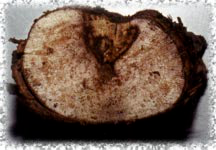
Above: Closeup photo shows the eutypa fungus necrotic zone in a crossection of grapevine wood.

Right: An example of PCR-based detection of the Eutypa pathogen.
The Eutypa fungus typically enters a grapevine through pruning wounds, proliferating and traveling through the vine’s vascular system, reported Prince in outlining his research. Over time the fungal growth constricts the flow of water and nutrients though the vascular tissue. It also produces a phytotoxin that may damage new growth.
Eventual dieback of the infected wood occurs, leading to death of the vine. And since there is no known cure for the disease, growers who discover symptoms must either face significant production losses or pull and replace their vines. Either way the financial impact can be catastrophic.
Unfortunately for growers, little is known about the epidemiology of Eutypa dieback. Existing methods of diagnosis, such as visual inspection and plating of the fungus, can be slow and sometimes unreliable. In a team effort with E & J Gallo Inc., Prince led a study to determine whether the fungus could be detected in plant wood at the molecular level.
Using DNA markers patented and provided by Gallo, Prince’s research team sought to establish sensitivity and specificity thresholds of the DNA markers for Eutypa detection in various sample matrices through a reaction called PCR (polymerase chain reaction). The markers worked well on Eutypa DNA and on fungal mycelium but were not initially reliable on infected woody grapevine tissue. Evidently, some type of inhibitors of PCR are present in grapevine wood, Prince said. In order to use the DNA markers successfully, it was necessary to characterize this inhibition.
An experiment was designed to test levels of PCR inhibition in Cabernet Sauvignon, Zinfandel, Merlot, Chenin Blanc and Pinot Noir grapevine wood at four different times of the year: bud break, veraison, post-harvest and dormancy. Samples were seeded with Eutypa DNA and subjected to the PCR test with Gallo’s markers, with and without PVP and BSA, two compounds that in previous work showed some success at overcoming inhibition.
Prince’s recommendations for use of Gallo’s Eutypa detection PCR primers can be summed up as follows: “Harvest your wood during post-harvest season, and use BSA in your PCR reactions. This combination should provide the greatest chance of detecting the pathogen if it is present in your sample.”
Eutypa control is a high priority for the American Vineyard Foundation, which helped to fund the research along with California State University’s Agricultural Research Initiative (ARI). Although Prince’s study has been completed, Eutypa research will likely continue at various levels, he said.
For more detailed information on this project, including test procedures, visit the ARI website at ari.calstate.edu. Click on Funded Projects and the Research Focus Area: Biotechnology.
Upcoming events
- April 22 – 2nd Annual Vino Italiano event at the Fresno State Winery, featuring Italian varietals produced by Fresno State students. For details, call 559-278-2089.
- June 6 – A Celebration of Wine at the Dennes Coombs’ Riverbend Ranch in Madera, California. For details, call 559-278-2089.
- June 30-July 1 – ASEV Annual Meeting at the San Diego Manchester Grand Hyatt in San Diego. Fresno State will host a display booth and an alumni and friends reunion June 30. For details, call 559-278-2089.
- Aug. 10 – Grape Day 2004 at the Fresno State viticulture and enology facilities. Presentations will focus on current research projects and industry issues. For details, call 559-278-2089.
CIMIS announces release of upgraded web site

CIMIS announced in the Spring 2003 issue of Update that it was in the process of upgrading its web site. The upgraded and much improved web site was released to the public on February 17, 2004.
The new frameless web site replaces the old frame-based site in compliance with ADA and uses the advanced Struts development framework. The current technical architecture and system design will allow CIMIS to easily evolve and expand to meet future needs.
The upgraded web site has a completely different look and feel. Information from the old site has been updated, revised, and reorganized in a manner that makes navigation easier and more understandable.
In addition to updating, revising, and reorganizing information from the old site, the current site also contains new materials considered to be beneficial to CIMIS data users. The updated and newly developed materials were reorganized under five distinct tabs: WELCOME, INFO CENTER, DATA, RESOUCE CENTER, and MY CIMIS. The names used for these tabs are self explanatory, and additional information regarding the contents of each tab can be obtained by clicking on the tab.
The new site has several new features that greatly improved the data retrieval process. One such feature is the addition of the MY CIMIS tab. MY CIMIS provides a single-click reporting mechanism. Therefore, it is an invaluable feature for those who retrieve data more frequently.
First time visitors to the MY CIMIS tab need to create their profile by establishing Station Lists for which quick reports are to be produced. MY CIMIS then keeps track of their profile for next visits, requiring only a single click to generate a report. Users can add or remove a station to the list as needed.
CIMIS data users can also customize their report and specify their parameters and sensor types in MY CIMIS. Once set in MY CIMIS, the preferences become default for the user.
The transition from the old to the new web site was flawless. The new web site can be accessed using the same URL address (http://www.cimis.water.ca.gov) as the old site.
As always, questions regarding the web site or CIMIS in general can be forwarded to the CIMIS staff listed below. Comments and suggestions are also welcome.
Visit the CIMIS home page at http://www.cimis.water.ca.gov.
For more CIMIS information...
CIMIS information is published quarterly in the CATI Update newsletter. Articles are provided by the California Department of Water Resources, CIMIS program staff.
For more information about CIMIS or its programs, contact any of the following representatives at these offices:
- Northern District
Jamie Dubay
(530) 529-7367
dubay@water.ca.gov - San Joaquin District
Steve Ewert
(559) 230-3334
sewert@water.ca.gov - Central District
Mark L. Anderson
(916) 227-7603
marcla@water.ca.gov - Southern District
Sergio Fierro
(818) 543-4652
sergiof@water.ca.gov
If you are unable to reach a CIMIS representative near you, call the CIMIS Helpline at 1-800-922-4647.
Weekly ETo Comparisons for Fresno
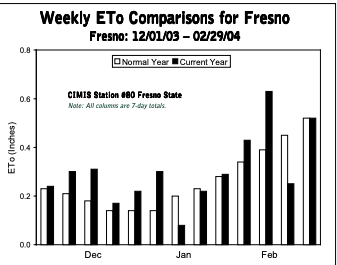
Fresno: 12/01/03 – 02/29/04
Normal Year Current Year
CIMIS Station #80 Fresno State
Note: All columns are 7-day totals.
ETo (Inches)
Dec Jan Feb
Chart shows ETo variation from normal over last three months.
Grass: Production studies continuing at Fresno State
from Page 4
“The net energy value of elephant grass is similar to that of Sundangrass. However, the palatability or accepta-bililty of Promor A is superior to that of alfalfa and Sudangrass in growing-finishing diets for feedlot cattle,” researchers concluded.
Two more trials, this time with lactating dairy cattle, were carried out last year. The first trial evaluated the effects of forage substitutions on digestive function, and the second trial evaluated treatment effects on lactational performance.
“Results indicated that partial replacement of alfalfa hay for either Sudangrass or Promor A did not limit dry matter intake and lactational performance,” Rothberg said.
Current Promor A production studies at Fresno State are comparing the relationship between irrigation treatments, forage yields and nutritional content, Rothberg added. The studies involve the use of an above-ground drip irrigation system with varying treatments.
Support for this study was provided by the California State University Agricultural Research Initiative (ARI). Analysis of the production study results is to be completed later this year. For details on this project, visit the ARI website at ari.calstate.edu. Click on Funded Projects and the Research Focus Area: Production and Cultural Practices.
Educators educated on biotechnology issues facing California agriculture

Conference participants discuss biotechnology issues in agriculture at special symposium hosted by researchers at California State University, Pomona.
The use of biotechnology is fueling a worldwide debate that will likely have a profound impact on California agriculture. Therefore it is important for educators to have sound science-based knowledge that can be incorporated into a classroom setting.
To address this issue, California State Polytechnic University, Pomona professor Mark Meskin, in cooperation with members of University of California, Davis and California Polytechnic State University, San Luis Obispo, has completed a project aimed at giving educators the knowledge and expertise they need to promote the discussion of biotechnology issues in the classroom.
The research team sponsored two workshops entitled “Biotechnology: What Every Educator Should Know,” held at Cal Poly Pomona, and “A Full Plate of Biotechnology: A Workshop for Community College Educators,” held at UC Davis. Participants included university and community college professors as well as deans, community college chairs, and directors of community college biotechnology programs.
Educational materials on food biotechnology and genetically modified crops were distributed to each participant.
Meskin believes future educational efforts will grow from these workshops.
The study was funded by the California State University Agricultural Research Initiative (ARI).
A final project report is available on the ARI website at ari.calstate.edu. The project is titled “Educating the Educators: Scientific-based Safety Assessment and Applications of Biotechnology and Genetically Engineered Foods in California Agriculture.” It is listed under Funded Projects and the Research Focus Area: Public Policy.
Concentrate: Report slated for presentation later this year
from Page 3
with the information necessary to evaluate the long-term sustainability of their current and/or proposed operations, Paggi said.
Developing the industry profile will require extensive interviews with growers, processors, brokers and shippers. Building the enterprise budget will require study of statistical data related to industry structure, conduct and performance in recent years.
“The primary benefit to the industry will be a sound basis of reliable information to use as a basis for investment and marketing decisions,” Paggi said.
Assisting Paggi in project administration will be members of the University of California, Davis Agricultural Issues Center. Other leading team members include Fumiko Yamazaki, Ph.D., a senior research associate for CAB, and an economics specialist from the UC Cooperative Extension.
Project activities are to begin in May, with final reports slated for presentation at the end of the year. Those with questions pertaining to the project or with interest in participating may contact CAB at 559-278-4405.
Legume study tracks nitrogen-fixing bacteria
A study of natural-growing legumes and the bacterium Rhizobium has shown that the nitrogen-fixing ability of the bacterium extends to various clover species rather than just to specific ones.
The study was conducted by Fresno State biology professor Ethelynda Harding with funding support from the California State University Agricultural Research Initiative (ARI).
Because of the economic importance of legumes as forage for grazing animals, including sheep and cattle, this plant-bacterial relationship has been intensively studied in agricultural systems, Harding noted in reporting study results.
Legumes such as clovers are rich in nitrogen because they form a symbiotic association with Rhizobium, she said. However, little is known about the Rhizobium-legume interaction under more natural conditions. In an effort to learn more about this relationship, she led a study of Rhizobium infecting native clovers in the Sierra Nevada foothills and mountain meadows.
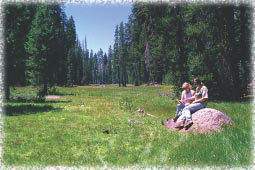
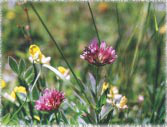
Sierra Nevada mountain meadows host various native clover species that in turn host Rhizobiom, a beneficial nitrogen-fixing bacterium.
Previous work showed that two types of Rhizobium were present in high mountain meadows, each associating with two clover species. The current study evaluated 82 Rhizobium strains for their ability to fix nitrogen on the different clover species and showed that plants grew best when inoculated with their naturally-occurring Rhizobium type.
A second part of the study using molecular methods to determine the extent of genetic exchange among Rhizobium infecting annual clovers in the Sierra Nevada foothills confirmed that genetic exchange is sufficient to cause complete mixing among the Rhizobium infecting these clovers.
The results confirm the lack of host specificity in the Rhizobium-legume symbiosis in the annual clover system, while confirming that the perennial clovers preferentially associate with Rhizobium that are effective in nitrogen fixation, Harding reported.
For a more detailed report on this project, visit the ARI website at ari.calstate.edu. Click on Funded Projects and the Research Focus Area: Natural Resources.
In the event of incorrect address information or extra copies to your workplace, please return this address label by mail or fax with your requested changes. CATI fax number is (559) 278-4849.
Update publication information
Update is published quarterly by the California Agricultural Technology Institute
College of Agricultural Sciences and Technology
California State University, Fresno
Spring 2004
CATI Publication #040401
Voice number: (559) 278-2361
Fax number: (559) 278-4849
Director of Operations: Joe Bezerra
Publications Editor: Steve Olson
Editorial Assistant: John Norton
Non Profit Organization
U.S. Postage PAID
Fresno, CA
Permit No. 262
Address Service Requested
California State University, Fresno
2910 E. Barstow Ave. M/S OF115
Fresno, California 93740-8009
This HTML version was generated with AI assistance and may contain errors or omissions. The original approved PDF remains the official document of record. An alternative accessible format is available upon request from the document creator in accordance with Title II of the ADA.