Update, Winter 03-04
CALIFORNIA AGRICULTURAL TECHNOLOGY INSTITUTE
WINTER 03-04
In this issue...
- Nematode controls sought ... 2
- Grower workshops slated .... 3
- Air injection studied ............ 4
- Biogas collected ................. 7
California State University, Fresno
Research to be showcased at farm show
Air emissions study among projects to be featured at CATI exhibit booths
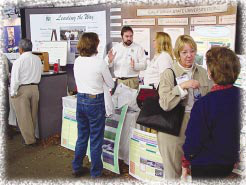
Faculty and staff researchers from the California Agricultural Technology Institute discuss their work with passersby at the World Ag Expo in Tulare, California last year. This year’s event will be held Feb. 10-12.
An assortment of displays, publications and real-live researchers will be on hand to explain and discuss applied agricultural research at the upcoming World Ag Expo to be held Feb. 10-12 in Tulare, California.
The California Agricultural Technology Institute (CATI) will again team with Fresno State’s College of Agricultural Sciences and Technology (CAST) to host a series of exhibit booths at the annual farm equipment show. The displays provide CAST with an opportunity to showcase programs to potential students visiting the farm show, and the CATI exhibits supply a venue for outlining research funded by CATI and the California State University Agricultural Research Initiative (ARI).
Under the ARI program, dozens of Fresno State faculty and staff researchers are conducting studies in the areas of both agriculture and natural resources. Projects range from the study of viticultural practices on new table grape varieties to the testing of new biological methods for controlling nematodes and other crop pests (see article on Page 2).
One project to be highlighted at the farm show involves a new approach to measuring methane and other biogases emitted from dairy lagoons. The method features the use of tunable diode laser (TDL) technology, explained project director Dave Goorahoo. The TDL system consists of an infrared laser sent by one instrument and received by another anywhere from one to 100 meters away. The method can reveal the presence of different gases in the atmosphere by the amount of light absorbed by the laser signal.
Goorahoo will set up a portable TDL
See Farm Show, Page 8
Annual AgSafe conference set for Feb. 4, 5
New classes and “early bird” sessions are among the additions to the 10th Annual AgSafe Conference to be held Feb. 4 and 5 at the Embassy Suites Hotel and Conference Center on Monterey Bay in Seaside, California.
Co-sponsored by the Center for Agricultural Business (CAB), this year’s event will feature more than 30 workshops on safety issues ranging from hazard recognition and control to workers’ compensation. More than a dozen specialists in various aspects of agricultural safety will provide information and training.
One of the new additions to the conference is a three-session series on “Raising the Bar in Human Resources and Safety Management.” These classes will offer strategies and tools on how to
See AgSafe, Page 7
Biotechnology may provide pathway to nematode control
Placement of nematode cell death genes in plant DNA seen as way to build resistance
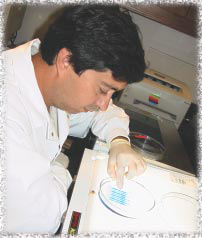
Left: Biology professor Alejandro Calderon-Urrea monitors the expression of cell death genes in a bacterium serving as a temporary host for the cell death genes.
Below: Schematic diagram illustrates use of transgenic plants and programmed cell death genes.
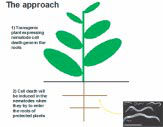
The approach
- Transgenic plant expressing nematode cell death gene in the roots.
- Cell death will be induced in the nematodes when they try to enter the roots of protected plants.
In the face of an expected federal ban on the pesticide methyl bromide in the near future, California agriculturalists and researchers are searching intently for new methods of controlling nematodes – small worms that can damage an assortment of important crops by feeding on their roots.
While methyl bromide is effective at controlling nematodes, it has been found to damage the earth’s ozone layer and is to be completely phased out of use by 2005, noted Fresno State biology professor Alejandro Calderon-Urrea in outlining new research he is conducting on behalf of the farming industry.
In an effort to develop new control strategies that are both effective and environmentally friendly, Calderon-Urrea is turning to biotechnology: he is exploring the use of nematode cell suicide genes as mechanisms to control nematode infestation.
Among the DNA of all plants and animals are genes that, under certain circumstances, can cause cells to undertake a cell death pathway, Calderon-Urrea explained. Programmed cell death (PCD) is a genetically regulated process of cell suicide in response to development and environmental signals.
“We all have genes that can kill us, but they are suppressed,” Calderon-Urrea said. “Our approach here is to isolate genes that induce cell death in related plant pathogenic nematodes. Once these genes have been identified and isolated from pathogenic nematodes they can be used to produce transgenic plants that can express them in order to induce cell death in nematodes that enter the plant tissue.”
Calderon-Urrea’s research team has achieved several goals after more than a year of work, he reported. First, they have isolated cell suicide genes in a species of nematode they can culture easily in the laboratory. That species is Caenorhabditis elegans, one that typically does not attack plant roots. Secondly, they have attached those genes to tobacco plant DNA and confirmed that the gene would not damage the plant.
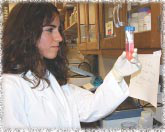
Student research assistant Genevra Ornelas prepares DNA samples extracted from plants.
Now the most difficult work phase will be undertaken: introducing pathogenic nematodes into the roots of tobacco and tomato plants and determining the response of plants and nematodes. The hope is that as the nematodes consume plant cells, the introduced suicide genes will induce uncontrollable cell death in the nematodes.
“Based on our previous results, our research hypothesis is that high levels of [this] gene expression in plants will substantially limit the development of pathogenic nematodes,” Calderon-Urrea said.
Because of the significance of the work, he is making arrangements with university legal advisors to have the process patented should it prove to be successful.
Project work is expected to continue for two to three more years before any significant conclusions can be made. Support for this study was provided by the California State University Agricultural Research Initiative (ARI), with matching funding coming from the National Institute of Health.
For additional information on work completed so far, visit the ARI website at ari.calstate.edu. Click on Funded Projects and the Research Focus Area: Biotechnology.
Center for Agricultural Business
CAB to partner in developing risk management workshops for growers
The Center for Agricultural Business (CAB) will team with the University of California and other agencies this year to develop risk management workshops for targeted California commodity producers.
Through one of two grants provided by the U.S. Department of Agriculture, CAB will join with UC’s Agricultural Issues Center (AIC) to oversee the “Targeted Commodities Program.” This program will provide education and training for commodity producers that are historically underserved by government support agencies.
CAB will play a key role in one phase of the training, which will include a web-based course for tree fruit and nut producers in California. The course will be accessible via the World Wide Web, so that participants can “attend” through their personal Internet connections, noted CAB director Mickey Paggi.
Another targeted group is small and beginning farmers and ranchers. Program teams will offer them a series of workshops and print materials this spring on risk management.
Information on the dates and times of workshops will be posted on the CAB website at cati.csufresno.edu/cab.
A second grant from the USDA Cooperative State Research, Education and Extension Service will enable CAB to conduct a risk management education seminar for producers and agricultural lenders. The focus of this first program will be on cotton. Participants will develop an enterprise market plan that allows for structuring the elements of the plan to their individual risk preferences and options.
If the program is successful, it is hoped that additional funding will be forthcoming to expand efforts to include other commodities.
Those interested in participating in the seminar may contact Paggi via email at mpaggi@csufresno.edu.
Lending institute organizers plan summer sessions
Planning is under way for the third annual California Agricultural Lending Institute (CALI) to be held in Fresno this summer.
Sponsored by Fresno State’s Center for Agricultural Business (CAB) and the San Joaquin Valley Ag Lenders Society, the institute provides in-depth training for lending professionals granting and maintaining agricultural loan portfolios.
This year’s sessions will be held June 21-25, with classes offered for participants in both the first and second-year program phases.
First-year classes focus on the loan process and the agencies and institutions that provide cooperative services to lending institutions. Second year sessions focus on maintaining and servicing loans, with a special emphasis on problem loans.
Successful program participants will be awarded a “Certificate of Completion” from California State University, Fresno and a “Certificate of Accreditation” from the San Joaquin Valley Ag Lenders Society.
See Institute, Page 7
Agribusiness outlooks available on line
Some of the latest agribusiness outlooks for California, the United States and the world are now posted online on the Center for Agricultural Business (CAB) website.
The outlooks are from presentations made by economics experts at the recent Agribusiness Management Conference in Fresno, and they are available for viewing or downloading. To access the presentations, visit the website at cati.csufresno.edu/cab.
Powerpoint presentations include the following:
- Today’s Agricultural Environment by Brenda Jahns Southwick, managing counsel of the California Farm Bureau
- Outlook for California Agriculture by Mechel S. Paggi, director, CAB
- Industry Outlook and Issues – United States and Global Economics by Joseph D. Hurd, Hurd Consulting
- Food Safety and Security Issues by Trevor Suslow, University of California, Davis
- Globalization and the Supermarket Revolution in Emerging Markets: Opportunities for U.S. Exporters by Thomas A. Reardon, Michigan State University
Upcoming events
- Feb. 4-5 – 10th Annual AgSafe Conference at the Embassy Suites Hotel & Conference Center in Seaside, California. For details see article on Page 1, or call 559-278-4404.
- Feb. 19 – Farm Labor Contractor Education Institute (presented in English and Spanish) at the Embassy Suites Hotel & Conference Center in Seaside. Call 559-278-4405.
- March 16 – Farm Labor Contractor Education Institute at the Radisson Hotel in Oxnard.
- April 1 – Farm Labor Contractor Education Institute at the Harris Ranch in Coalinga.
- April 7 – Farm Labor Contractor Education Institute at the California Farm Bureau Federation in Sacramento.

Center for Irrigation Technology


Commercial field trials favor air injection system
By Dave Goorahoo
Project Director, Air Injection Study
Center for Irrigation Technology
Harvest data analysis shows greater yields for melons, tomatoes, peppers
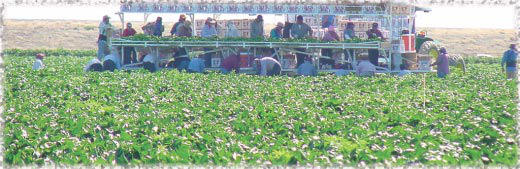
Modification of root zone environments by injecting air continues to intrigue investigators. Aerating irrigation water increases the potential for air to enter the plant root zone and positively affect crop growth. For example, since oxygen is essential for root respiration, a soil that is well aerated will favor increased root respiration as well as increased aerobic microbial activity. Conversely, in waterlogged soils typical of poor drainage, anaerobic conditions prevail, and the roots can no longer respire normally.
The Mazzei Corporation of Bakersfield, California has developed high efficiency venturi injectors capable of aerating water with fine air bubbles. In 2000, a pilot study was conducted by the Center for Irrigation Technology (CIT) in which air was injected into the root zone of bell peppers via a subsurface drip irrigation (SDI) system. Yield analysis showed a 33 percent increase in pepper count and a 39 percent increase in pepper weight for the aerated plots versus the plots receiving only water.
The major goal of the current research is to evaluate the technical and economic feasibility of injecting ambient air into a subsurface drip tape irrigation system as a best management practice for crop production. Our current focus is on three crops: bell peppers, fresh-market tomatoes and melons.
In the summer of 2003 we conducted comparative tests between air injection and water-only treated honeydew melons on 13-acre plots with a drip tape run length of more than 400 meters. There was a 14 percent increase in the number and a 16 percent increase in the weight of melons harvested due to air injection.
In another experiment with peppers grown on 40 acres with drip tape runs of more than 400 meters, we observed a trend of decreasing yield moving away from the source of the air and water injection; there was still a positive effect of the air injection towards the tail end of the irrigation tape.
In the third experiment we compared the effects of air injection on a tomato crop grown on 20-acre plots with drip tape run lengths of 300 meters. We observed that for the air-treated plants there were greater yields from the plants located at the “head” of the drip line versus the plants down at the “tail.”
The tomato and pepper experiment data sets are still being processed.
Based on initial positive results, the primary benefit of this research to the vegetable and fruit industry would be increased productivity. Negative aspects will identify areas for further research.
Support for this study was provided by the California State University Agricultural Research Initiative (ARI), with additional funding from the California Department of Food and Agriculture’s “Buy California Initiative” Specialty Crop Program.
Additional trials are planned for this summer. More detailed reports will be available in February on the ARI website at ari.calstate.edu and through the CIT website at cati.csufresno.edu/cit. For the ARI website, click on Funded Projects and the Research Focus Area: Production and Cultural Practices.
Upcoming events
- Jan. 27 – Agricultural Pumping Efficiency Program (APEP) Educational Seminars 101, 201, and 301 at the Center for Irrigation Technology in Fresno. Basic to advanced discussions of pump efficiency, irrigation scheduling, well construction and other topics. Call Patti Senter at 800-845-6038 for details.
- Feb. 10-12 – APEP seminars and demonstrations at the Southern California Edison AgTAC in Tulare, California in conjunction with the World Ag Expo. Call Bill Green at 559-278-2327 for details.
- March 30 – APEP Educational Seminar 101 in Sanger. Call 559-278-2327 for details.
Viticulture and Enology Research Center
Industry partnership boosts VERC production, research programs
Specialists from one of the world’s leading makers of filtration, separation and purification equipment are partnering with Fresno State’s Viticulture and Enology Research Center (VERC) to bring the latest filtration techniques to the California wine industry.
For a second year, experts from Pall Corp. spent several days at Fresno State in December giving presentations and live demonstrations of crossflow microfiltration (CFM) systems. More than 30 individuals – a mix of Fresno State enology students and representatives of California’s wine industry – gathered to hear the Pall specialists discuss the latest advances in crossflow technology. Other media discussed included depth filtration, sheet filtration, sterile filtration and filter handling.
Pall Corp., headquartered in East Hills, New York, has donated state-of-the-art filtration equipment to the Fresno State Winery for use in production and research.
CFM is a type of filtration process that has the ability to filter very turbid wines and juices (with high levels of solids) to a clarity level of water, noted Ken Fugelsang, winemaster and associate professor of enology at Fresno State.
“Pall’s technologies play a vital role in many industries, including the food and beverage industry,” Fugelsang said. Winemakers, for example, are able to clarify wine and juice by removing particulates such as yeast, bacteria, and other grape solids.
“While filtration is a standard practice for wineries, CFM is a new technology to the U.S. winemaker,” he said. Several VERC enology researchers are currently conducting fermentation and filtration studies using Pall technologies.
In addition to being a great opportunity for students, the workshops offer a chance for winemakers and winery personnel to learn from some of the world’s experts in this field, noted VERC Director Robert Wample.
“We are pleased to partner with industry leaders such as Pall to bring these types of educational workshops to our campus,” Wample said.
Fresno State is the first winery in the United States to have a license to produce and sell wine commercially. Students in the enology program participate in the winemaking process and receive hands-on training in the winery.
For more information on viticulture and enology research, visit the VERC website at cati.csufresno.edu/verc or call VERC at (559) 278-2089.
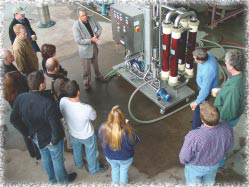
Pall Corp. wine system sales manager Allen Posella demonstrates a crossflow filtration unit to students and wine industry members during a workshop held at VERC.
Coastal conference to address grape, wine issues
The 7th Annual Central Coast Viticulture and Enology Issues Conference has been set for Feb. 26 and 27 at the Embassy Suites in San Luis Obispo California.
The two-day event is designed for grape and wine producers and will focus on issues current to the industry. It will include vineyard and winery tours and an optional networking dinner on Feb. 26.
The conference is presented by Fresno State’s Viticulture and Enology Research Center (VERC), Department of Viticulture and Enology, and the California Agricultural Technology Institute, with support from industry sponsors.
For registration or other information call VERC at 559-278-2089 or visit the VERC website at cati.csufresno.edu/verc.
For industry sponsorship opportunities, contact Cynthia Wood at cynthiaw@csufresno.edu.
Upcoming events
- Jan. 28-29 – Unified Wine & Grape Symposium at the Sacramento Convention Center. For details, call 916-932-2244.
- Feb. 7 – FFA Vine Pruning Contest, hosted by the Viticulture Club at Fresno State. Call 559-278-2011 for details.
- Feb. 26-27 – 7th Annual Central Coast Viticulture and Enology Issues Conference at the Embassy Suites in San Luis Obispo, California. For details, call 559-278-2089.
- March 5-7 – Fresno State Winemaster’s Dinner at the Tenaya Lodge in Yosemite, California. For details, call 559-278-2089.
- June 6 – A Celebration of Wine at the Dennes Coombs’ Riverbend Ranch in Madera, California. For more information, call 559-278-2089.
California Irrigation Management Information System
Have you benefited from using the CIMIS data?
A successful program such as CIMIS needs to look back into its past and reevaluate its achievements. Several studies have already been conducted by UC Davis and UC Berkeley scientists to quantify the benefits of using CIMIS data. Results have all shown increased water savings, yield, crop quality, and money savings, among others.
CIMIS now wants to hear directly from users. If you have benefited from using CIMIS data, we would like to hear your success stories. You can simply write an article(s) and send it (them) to us.
For information on formats of such articles, where to send, and how to send them, please contact Kent Frame at (916) 651-7030 [kframe@water.ca.gov] or Bekele Temesgen at (916) 651-9679 [temesgen@water.ca.gov].
Outreach activities planned by CIMIS and UCD Extension
The Department of Water Resources has contracted with the University of California, Davis (UCD) to conduct outreach activities throughout California.
The University Extension and specialists at the Department of Land, Air, and Water Resources (LAWR) at UCD will coordinate with local University of California Cooperative Extension (UCCE) farm and landscape advisors to conduct several educational workshops for growers, landscape managers and other interested water managers. The workshops are designed to promote water use efficiency through the use of CIMIS data.
Dr. Richard L. Snyder of LAWR will coordinate the project with turf and landscape advisors, and Dr. Blaine Hanson will coordinate with farm advisors working on agricultural crops. In addition to providing the funding for the outreach activities, DWR’s CIMIS staff will also participate in the workshops. Although the focus of these workshops is on the use of CIMIS data to improve water management, organizers can include any topic related to efficient use of California’s water resources. UCCE farm advisors who wish to organize these workshops can contact either the UCCE or the CIMIS staff for more information.
The workshops will be offered to the public free of charge. If you are interested in attending, please contact your local farm advisor for information regarding the possible date, time, and place, and to sign up.
Visit the CIMIS home page at http://www.cimis.water.ca.gov
For more CIMIS information...
CIMIS information is published quarterly in the CATI Update newsletter. Articles are provided by the California Department of Water Resources, CIMIS program staff.
For more information about CIMIS or its programs, contact any of the following representatives at these offices:
- Northern District
Jamie Dubay
(530) 529-7367
dubay@water.ca.gov - San Joaquin District
Steve Ewert
(559) 230-3334
sewert@water.ca.gov - Central District
Mark L. Anderson
(916) 227-7603
marcla@water.ca.gov - Southern District
Sergio Fierro
(818) 543-4652
sergiof@water.ca.gov
If you are unable to reach a CIMIS representative near you, call the CIMIS Helpline at 1-800-922-4647.
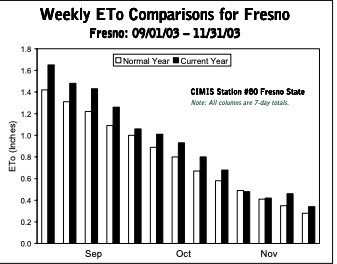
Weekly ETo Comparisons for Fresno
Fresno: 09/01/03 – 11/31/03
CIMIS Station #80 Fresno State
Note: All columns are 7-day totals.
Chart shows ETo variation from normal over last three months.
Agsafe: Assorted classes will be offered in Spanish
from Page 1
approach safety at an advanced level.
“Class presenters will discuss the need for human resources departments to articulate a safety training program with a ‘return-on-investment’ approach,” stated Kimberly Naffziger, director of AgSafe and conference coordinator. Another session will feature discussion led by five specialists in human resources and safety training issues.
The conference opening address will be presented Wednesday morning by Greg Hale, chief safety officer and vice president of safety accessibility and advanced technology for Walt Disney Parks and Resorts. Invited to provide Thursday’s keynote is California Insurance Commissioner John Garamendi.
The other new addition to this year’s event is three “early bird” classes to be held on Tuesday, Feb. 3. They include two offerings from the Safety Certificate Program launched by AgSafe four years ago.
Other conference classes will address pesticide laws and regulations, managing health care costs, and drugs, sexual harassment and violence in the workplace. An assortment of classes will be presented in Spanish, Naffziger said.
The conference is designed to benefit participants representing all areas of agriculture and agribusiness. Cost to attend is $195 for AgSafe members and $275 for non-members for registrations postmarked by Jan. 23, 2004. For single-day rates and other details, call (559) 278-4404.
Additional conference information, including detailed descriptions of workshops, is available on the AgSafe website at agsafe.org. Information is also on the CAB website at cati.csufresno.edu/cab.
Dairy biogas collection system converts methane into electricity
A recent study at California Polytechnic State University, San Luis Obispo may hold the key to reducing air pollution and unwelcome odors caused by dairy lagoons.
Cal Poly professor and waste management specialist Douglas Williams directed the project, which featured the construction and preliminary testing of a lagoon methane recovery system designed to collect biogases.
To accomplish this, a new lagoon was constructed to hold a liquid volume of 14,000 cubic meters and then covered with a flexible, buoyant polypropylene material which floated on the surface and collected the biogases. The methane was used to fuel a 30-kilowatt micro-turbine electric generator.
Based on the measured biogas production and the rated efficiency of the micro-turbine, the completed methane recovery system will produce 170,000 kilowatt-hours of electricity, estimated to be worth nearly $16,000. By contrast, the average annual power consumption of the solids separator at Cal Poly’s existing 19,000-cubic-meter lagoon is 234,000 kilowatt-hours, for a total annual cost of $21,000.
In addition to providing electricity, the recovery system has several environmental benefits: 1) odor is controlled by capture of the gases from the lagoon; 2) methane, a significant greenhouse gas, is kept out of the atmosphere; and 3) water pollution is reduced by reducing organic matter in the lagoon.
Base funding and administrative support for the project was provided by the California State University Agricultural Research Initiative (ARI), administered by the California Agricultural Technology Institute at California State University, Fresno.
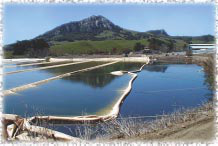
Dairy lagoon methane collection system at Cal Poly San Luis Obispo includes a 1.0ml-thick, reinforced polypropylene floating lagoon cover including Styrofoam floats, weights and tie-down.
Additional details are posted on the ARI website, located at ari.calstate.edu. Information is located under Funded Projects, Research Focus Area: Agricultural Business.
Institute: Faculty includes lending experts
from Page 3
of Accreditation” from the San Joaquin Valley Ag Lenders Society.
CALI’s goal is to provide quality instruction that equips participants to be effective leaders in agricultural lending, to promote the success of their financial institutions, and to enhance the growth of agriculture in California. In addition to agricultural lending professionals, the institute also is designed for accountants, attorneys, farm managers and rural appraisers.
CALI features a distinguished faculty with expertise in all areas of the lending process. Instructors include university faculty in agricultural finance and experienced professionals in ag lending.
For registration information, call CAB at 559-278-4405 or visit the CAB website at cati.csufresno.edu/cab.
Water center draws additional federal support
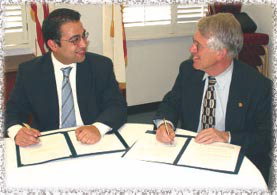
Joseph H. Bogosian, deputy assistant secretary for Transportation and Machinery in the U.S. Department of Commerce (left), joins with University President John Welty in signing an agreement to support work of the International Center for Water Technology (ICWT) currently in development on the Fresno State campus.
Bogosian pledged his agency to work jointly with the ICWT to develop an export opportunities program for U.S. water and fluid science technology firms.
The ICWT is a collaborative venture between the university, industry and public agencies. Center for Irrigation Technology Director David Zoldoske is serving as interim director. Groundbreaking is slated for this spring at Chestnut and Barstow avenues on the Fresno State campus. For more information, contact Zoldoske at (559) 278-2066.
Farm Show: Talks, demos scheduled for several venues
from Page 1
system at CATI’s farm show booth to illustrate equipment operation, and he and research team members will be on hand to discuss the project.
Representatives from CATI research centers will also be at other locations at the farm show to discuss key agribusiness and irrigation issues.
On Wednesday, Feb. 11, Mickey Paggi, director of the Center for Agricultural Business, will be at the Heritage Center to discuss key developments in international agricultural production and trade. In his 3 p.m. address, Paggi will discuss the increasing levels of foreign agricultural imports into the United States, reasons behind the trend, and the implications for California agriculture.
Education specialists from the Center for Irrigation Technology will direct workshops at the Edison AgTAC facility located adjacent to the farm show grounds. Seminars will address topics such as pump curves, cost analysis and pump efficiency.
Included in the CIT displays will be the pump mobile education center used for the Agricultural Pumping Efficiency Program. Information will be offered on subsidized pump tests and retrofit/repair incentive rebates.
For details on days and times of these and other presentations, visit the farm show website at worldagexpo.org or stop by the CATI booths during the show.
The booths housing CATI, ARI and CAST materials will be in the north section of Pavillion C, in booths 3312 to 3316. For more information about CATI, call 559-278-2361 or visit the CATI website at cati.csufresno.edu.
In the event of incorrect address information or extra copies to your workplace, please return this address label by mail or fax with your requested changes. CATI fax number is (559) 278-4849.
Update publication information
Update is published quarterly by the California Agricultural Technology Institute
College of Agricultural Sciences and Technology
California State University, Fresno
Winter 03-04
CATI Publication #040101
Voice number: (559) 278-2361
Fax number: (559) 278-4849
Director of Operations: Joe Bezerra
Publications Editor: Steve Olson
Editorial Assistant: John Norton
This HTML version was generated with AI assistance and may contain errors or omissions. The original approved PDF remains the official document of record. An alternative accessible format is available upon request from the document creator in accordance with Title II of the ADA.