Update Fall 2003
CALIFORNIA AGRICULTURAL TECHNOLOGY INSTITUTE
FALL 2003
In this issue...
China travel slated .............. 3
Irrigation improved ............. 4
PRD re-evaluated ............... 5
Sugar substitute studied ...... 8
California State University, Fresno
TDL technology explored
Tunable diode lasers tested for accuracy in measuring wider array of air emissions
Fresno State scientists studying air emissions around dairies are using laser beam technology in hopes of gaining even more accurate measurements of gases emitted from dairy stalls, corrals and lagoons.
The laser work is gaining increased significance in California because of greater government scrutiny of the dairy industry as a source of ammonia, methane, hydrogen sulfide and other gases that contribute to air pollution. More accurate measurements of these gases may reveal that dairy operations are less a source of unwanted emissions than previously believed.
Earlier this year, Fresno State plant science professor Charles Krauter reported preliminary readings of reactive organic gas (ROG) levels obtained using special canisters to collect air samples. These gases are related to ozone formation. In addition to the ROG measurements, ammonia emissions were monitored with the aid of chemically treated filter traps mounted on a 10-meter mast. The filter traps “catch” the gas molecules as they pass through over a measured period of time.
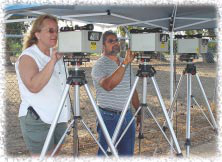
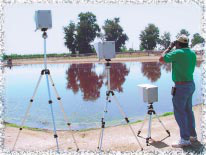
The other method now being tested by Krauter and fellow researcher Dave Goorahoo features tunable diode laser (TDL) technology. The TDL system consists of an infrared laser, invisible to the human eye, sent by one instrument and received by another anywhere from one to 100 meters away. The method can reveal the presence of different gases in the atmosphere by the amount of light absorbed by the laser signal as it passes through the air.
Top photo: Research assistant Genett Carstensen (left) and soil scientist Dave Goorahoo program tunable diode lasers for calibration and data logging at the Fresno State dairy. At right, Goorahoo checks reflectors from the other side of dairy lagoon.
See Lasers, Page 2
Conference to eye environmental issues
Agriculture and the environment will be among the discussion topics at this year’s Agribusiness Management Conference set for Tuesday, Oct. 28, in Fresno, California.
Fresno State’s Center for Agricultural Business (CAB) is once again hosting the event in partnership with Bank of America Corp. It is to be held at the Radisson Hotel & Conference Center downtown.
Leading off the day’s speakers will be Joseph Hurd, owner of Hurd Consulting and a recognized specialist in economic forecasting, product pricing and business modeling. With a Ph.D. in economics from UC Berkeley, Hurd has chaired the economic advisory group for the California State Chamber of Commerce and has been a frequent participant at the Anderson School of Business forecast seminars. Hurd will offer an outlook on the U.S. and global economies for the coming year.
Following Hurd will be CAB Director Mickey Paggi presenting his outlook for the California agricultural economy. With a background in world trade policy gained through positions with the USDA and the United Nations, Paggi has spent his last two years as CAB director focusing on California agricultural issues and concerns.
In a break from the past, this year’s conference will feature a single morning panel with three speakers. Brenda Jahns Southwick, associate counsel for the California Farm Bureau Federation, will discuss “Today’s Agricultural Environment.” Donna Garren, vice president of scientific and technical affairs for the United Fresh Fruit and Vegetable Association, will address food safety and security. Thomas A. Reardon, professor of agricultural economics at Michigan State University, will discuss “Globalization and the Supermarket Revolution in Emerging Markets.”
Culminating this year’s conference will be a luncheon address by Patrick Moore, a founding member and former director of Greenpeace International.
In recent years Moore has turned to consensus building and promoting sustainable practices among various industries. In 1991 he founded GreensSpirit, a consultancy focusing on environmental policy and communications in natural resources, biodiversity, energy and climate change. He recently helped to develop “Principles of Sustainable Forestry” for use by the timber industry.
Though no oral commodity presentations will be given this year, industry specialists have provided written outlook reports which will be included in the conference proceedings, Paggi said.
Early conference registration fee is $85. For additional information, call 559-278-4405 or visit CAB’s website at cati.csufresno.edu/cab.
See Outlook, Page 2
Lasers: Trials to continue through next year
from Page 1
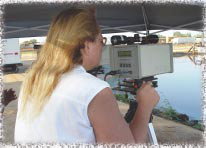
“The tunable diode laser (TDL) system is commercially available from several companies and is being used by other industries for monitoring air emissions,” Goorahoo said. “However, to the best of our knowledge, this is the first case in California where it has been used to monitor the atmosphere in an agricultural setting.”
Portable and fixed TDL systems will be placed at several dairies during the next few months to measure emissions from specific locations at each dairy. The system will focus on ammonia, methane and hydrogen sulfide.
“Our findings so far indicate that data collected with the TDL depict the periods of relatively higher emissions which generally go undetected with the other sampling and monitoring techniques,” Goorahoo said.
The information gained from this research will aid dairy owners in managing the dairy effluent stream, as recycled lagoon water is flushed through the alleys, stored in the lagoons and eventually pumped out to cropped fields.
“In the short term, and on the local scale, the dairy operator will be able to better manage the system.”
“In the short term, and on the local scale, the dairy operator will be able to better manage the system,” Goorahoo said. For example, if there is a high degree of methane emission from a lagoon, it may be feasible to install a methane recovery system.
At the state level, the data collected will help in compiling an inventory of methane, hydrogen sulfide and ammonia emissions, he added.
Project work will continue through this year and next, with results to be reported through various media channels to state officials, dairy groups, researchers and educators.
Administrative support was provided by the Center for Irrigation Technology at California State University, Fresno. Funding was from the California State University Agricultural Research Initiative (ARI). Additional support was provided by UniSearch Associates, Boreal Laser LTD, the NASA Ames Research Center, the California Air Resources Board, the California Department of Food and Agriculture, and University of California.
Outlook: ’Supermarket revolution’ to be discussed
from Page 1
Business forecast seminars. Hurd will offer an outlook on the U.S. and global economies for the coming year.
Following Hurd will be CAB Director Mickey Paggi presenting his outlook for the California agricultural economy. With a background in world trade policy gained through positions with the USDA and the United Nations, Paggi has spent his last two years as CAB director focusing on California agricultural issues and concerns.
In a break from the past, this year’s conference will feature a single morning panel with three speakers. Brenda Jahns Southwick, associate counsel for the California Farm Bureau Federation, will discuss “Today’s Agricultural Environment.” Donna Garren, vice president of scientific and technical affairs for the United Fresh Fruit and Vegetable Association, will address food safety and security. Thomas A. Reardon, professor of agricultural economics at Michigan State University, will discuss “Globalization and the Supermarket Revolution in Emerging Markets.”
Culminating this year’s conference will be a luncheon address by Patrick Moore, a founding member and former director of Greenpeace International.
In recent years Moore has turned to consensus building and promoting sustainable practices among various industries. In 1991 he founded GreensSpirit, a consultancy focusing on environmental policy and communications in natural resources, biodiversity, energy and climate change. He recently helped to develop “Principles of Sustainable Forestry” for use by the timber industry.
Though no oral commodity presentations will be given this year, industry specialists have provided written outlook reports which will be included in the conference proceedings, Paggi said.
Early conference registration fee is $85. For additional information, call 559-278-4405 or visit CAB’s website at cati.csufresno.edu/cab.
Center for Agricultural Business

CDFA chief helps launch vehicle safety program
California Secretary of Agriculture Bill Lyons (second from right) was among the state officials attending a recent press conference formally launching the new “Farm Worker Motor Vehicle Safety Education Project.” Sponsored by the Center for Agricultural Business (CAB), the program aims to reduce the number of motor vehicle crashes, fatalities and injuries suffered by farm workers and other rural residents. The campaign targets Spanish-speaking farm worker populations in Fresno and Tulare counties.
Pictured with Lyons are (from left) Andrew Alvarado, professor in Fresno State’s Department of Social Work Education and co-director of the project; Soledad Gammage, farm community liaison; and Kimberly Naffiziger, CAB program development specialist and project co-director.
Paggi to travel to China with trade group
Director Mickey Paggi of Fresno State’s Center for Agricultural Business (CAB) is slated to travel to China in November as part of a U.S. delegation exploring agricultural production and marketing developments affecting California agriculture.
The two-week trip, hosted by the Chinese government, will allow U.S. ag representatives and economists to discuss production and trade issues with Chinese growers and business leaders.
The visit is part of an exchange program designed to enhance trade between China and the United States.
Information exchange with China can sometimes result in tricky negotiation sessions, Paggi noted. While China has potential as a major importer of California farm products, it is also a competitor in some areas.
During the upcoming visit, the U.S. delegation anticipates visiting the Shandong province to observe production of onions, garlic, walnuts, peanuts, peaches and apricots, and the Shanxi province to see apple and walnut production. The U.S. delegation includes Paggi, one representative from the USDA, two from other U.S. universities, and one individual from a private consulting firm.
Paggi’s participation in trade-related work with China is funded in part by the California Agricultural Technology Institute (CATI). More detailed information about China’s walnut production can be found in an article Paggi wrote for the July/August 2003 issue of Pacific Nut Producer.
Additional information about California and China agricultural issues is available on CAB’s website, located at cati.csufresno.edu/cab.
Conference to focus on cotton marketing and management
A special conference titled “Marketing and Risk Management Alternatives for the California Cotton Industry” will be held Dec. 16 in Visalia, California.
The daylong conference will focus on marketing alternatives, including futures and options, forward contacting, and domestic and international farm policy issues.
Speakers include Carl Anderson, Ph.D., cotton marketing expert from Texas A&M University; Tom Walker, vice president for marketing for the New York Board of Trade; and Mechel S. Paggi, Ph.D., director of Fresno State’s Center for Agricultural Business (CAB).
The conference will be held from 8 a.m. to 5 p.m. at the Holiday Inn. It is sponsored by CAB, the University of California Cooperative Extension, the State Support Committee of Cotton Inc., the California Cotton Growers and Ginners Association, and the Western Cotton Shippers Association.
Contact CAB at 559-278-4405 for further information.
Upcoming events
- Oct. 28 – 22nd Annual Agribusiness Management Conference in Fresno. 559-278-4405.
- Nov. 19 – Farm Labor Contractor Education Institute (presented in English and Spanish) in Santa Rosa. 559-278-4405.
- Nov. 20 – Farm Labor Contractor Education Institute (in English and Spanish) in Modesto. 559-278-4405.
- Dec. 3 – Farm Labor Contractor Education Institute (in English and Spanish) in El Centro. 559-278-4405.
- Feb. 4-5, 2004 – Annual AgSafe Conference in Seaside, California. For details, call 559-278-4405.
Center for Irrigation Technology
Golf courses report irrigation improvements
Golf course owners have access to a new irrigation report discussing methods for saving thousands of dollars per year in water and energy costs.
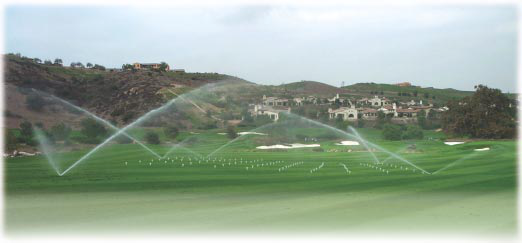
The report is titled “Improving Golf Course Irrigation Uniformity: A California Case Study.” It has been released by Center for Irrigation Technology (CIT) Director David Zoldoske and details the reductions in water use obtained by golf course superintendents who refitted turf sprinklers with improved nozzles.
Five golf courses participated in the study, comprising 108 golf holes and 606 acres of irrigated turf, Zoldoske reported. Data collection began one year prior to the nozzle change and concluded after one year of operation following the change.
The study was conducted to evaluate the experience of golf course superintendents who re-nozzled existing sprinkler systems to improve irrigation uniformity, Zoldoske said.
“As California faces the reality of 15 million new residents in the next 25 years, the pressure to extend existing water supplies will be unprecedented,” he stated. “We hope the information provided in the report will encourage other golf course superintendents to look closely at the uniformity of their irrigation systems and determine if improvements are warranted.”
“We hope the information provided in the report will encourage other golf course superintendents to look closely at the uniformity of their irrigation systems...”
By conducting an irrigation uniformity audit and changing sprinkler nozzles to improve uniformity, golf course superintendents recorded an average annual gross savings of 6.5 percent of applied water use. Adjusting for useful rainfall that replaced some irrigations, the average estimated water savings was 5.7 percent. That equals a total of 82.9 acre feet, or more than 27 million gallons of water.
Since all water used for irrigation in a golf course is pumped, every gallon of water delivered to the field also has some energy cost associated with it, Zoldoske noted.
“The more water and pressure use, the more energy we consume. Conversely, reducing the amount of water applied and/or reducing the operating pressure will minimize the total cost of energy, thus reducing overall operations costs,” he said.
Additionally, golf course superintendents will likely put a dollar value on any perceived improvement in turf quality, reduction in hand-watering, and/or playability of the course. This would favorably impact or shorten the payback period, he added.
Water savings for each golf course varied as a result of factors unique to each course, Zoldoske noted.
See Golf, Page 7
Pump efficiency program still operating
California agricultural producers may have their final opportunity during the next three months to take part in portions of the Agricultural Pumping Efficiency Program (APEP). The program offers education and incentive rebates intended to improve pumping plant efficiency and encourage energy conservation.
The program has four parts, consisting of 1) Education, 2) Technical Assistance, 3) Pump Efficiency Testing, and 4) Pump Repair.
Category 3 has reached its reserve-funding limit and applications are not currently being approved, although applications are still being accepted, as previously approved projects have been known to withdraw.
See Pump, Page 7
Viticulture and Enology Research Center
Research prompts re-evaluation of PRD potential
Further tests reveal new approach may not offer significant improvements
Continued studies in California on a new approach to vineyard irrigation have shown that partial rootzone drying was not as effective as previously suggested.
Partial rootzone drying (PRD) features irrigation of half a grapevine’s rootzone at a time, explained Sanliang Gu, research scientist for Fresno State’s Viticulture and Enology Research Center (VERC) and director of recent PRD trials at the university’s vineyards.
Earlier PRD trials had established that chemical signals produced in a vine’s drying roots reduce stomatal conductance and overall vegetative growth, Gu reported. By using PRD to reduce plant transpiration, scientists hoped to enhance water use efficiency while maintaining fruit quality and crop yield.
Previous published studies have reported positive effects of PRD. However, they have not compared PRD against conventional irrigation treatments at the same irrigation rate, Gu said. In three seasons of trials at Fresno State, Gu’s team of researchers evaluated not only PRD but also conventional systems, featuring treatments of both PRD and conventional irrigation at 0.4 and 0.8 crop evapotranspiration (ETc).
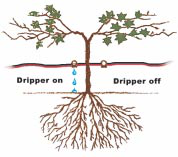
The PRD system in Gu’s study featured two above-ground drip irrigation lines along each vine row. Emitters in each line were placed on alternate sides of each grapevine, so that when one line was operating, one side of the vine’s rootzone would receive water. When the other line was run, the other side of the vine would be irrigated.
While the trials showed that PRD at deficit treatments did not affect yield, neither did the deficit treatments using conventional drip irrigation.
“Vines responded to the reduction of irrigation rate the same way under both PRD and conventional irrigation,” Gu said. “It appears that the irrigation amount, not PRD, is the determining factor for inducing water stress and reducing transpiration and vegetative growth.”
Similar findings also were presented at the International Symposium on Irrigation of Horticultural Crops held at University of California, Davis in early September, Gu reported. Following presentations by scientists from several countries, symposium researchers concluded that PRD does not offer any benefit over conventional irrigation at the same irrigation rate under vineyard conditions. Based on those findings, Gu said he would not recommend use of PRD for commercial wine grape production.
“There is a significant increase in material costs associated with PRD irrigation system establishment with drip irrigation because two drip lines are needed instead of one as in conventional drip irrigation,” he stated. “Maintenance and management costs are also likely to be higher.”
Details of Gu’s PRD study will be published as a paper titled “Effect of Irrigation Amount on Water Relations, Vegetative Growth, Yield, and Fruit Composition of Sauvignon Blanc Grapevines under Partial Rootzone Drying and Conventional Irrigation in the San Joaquin Valley of California.” It will appear in the Journal of Horticultural Science and Biotechnology.
Additional project details are available on the California State University Agricultural Research Initiative (ARI) website located at ari.calstate.edu. Gu’s project is listed under the Research Focus Area: Production and Cultural Practices.
Funding was provided by ARI, the American Vineyard Foundation, and the California Competitive Grant Program for Research in Viticulture and Enology. Materials and irrigation system setup was provided by Netafim Irrigation Inc.
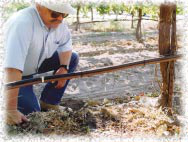
CIT field research specialist Greg Jorgensen examines a PRD irrigation system featuring two drip irrigation lines for each vine row.
Upcoming events
- Nov. 8 – Viticulture Club Annual Fall Harvest BBQ at California State University, Fresno’s Smittcamp Alumni House – for industry, alumni and friends. For more info, call 559-278-7151.
- Nov. 19 – American Vineyard Magazine North Coast Grape Expo in Cloverdale. For details, call 559-298-6675.
- Nov. 20 – Le Vin Nouveau at the Winery, California State University, Fresno. Event celebrates the release of nouveau vintages. For details, call 559-278-2089.
- Jan. 28-29, 2004 – Unified Wine & Grape Symposium at the Sacramento Convention Center. For details, call 916-932-2244.
The many uses of CIMIS weather data
OCTOBER 2003
California Irrigation Management Information System
Since the beginning of the CIMIS weather station network in 1982, the primary purpose of CIMIS was to make available to the public, free of charge, information useful in estimating crop water use for irrigation scheduling.
Although irrigation scheduling continues to be the main use of CIMIS evapotranspiration and weather data, the uses of CIMIS weather data have been constantly expanding. At present, there are approximately 7,000 registered CIMIS users from diverse backgrounds accessing the CIMIS computer directly. It has been estimated that on average, requests for CIMIS information on the WWW total about 70,000 per year.
There are also many secondary suppliers of CIMIS weather data, such as other web sites, radio, newspapers, consultants, and local water agencies.
Although CIMIS continues to improve data collection and dissemination to keep current with emerging irrigation management practices and technologies, there is emerging a much broader use and application of CIMIS data. The availability of hourly, daily and monthly weather data from CIMIS has greatly improved the flexibility of data applications for a myriad of business functions.
Some of the broader applications we are seeing are a greater CIMIS presence in the planning and managing of resources. These resources include not only water use, but water quality, planning water balances, watershed maintenance, air resources monitoring and predicting, and forestry management.
Modeling is becoming ever more important with CIMIS data being automatically downloaded into degree day, insect monitoring, and plant and weather models. These uses are being applied at the local, regional, and state agency’s level.
CIMIS Registered Users Categories
| Category | Percentage |
|---|---|
| Consultants | 14% |
| Growers | 22% |
| Others | 22% |
| University | 16% |
| Landscape | 10% |
| Water Agencies | 5% |
| Public Agencies | 11% |
Weekly ETo Comparisons for Fresno
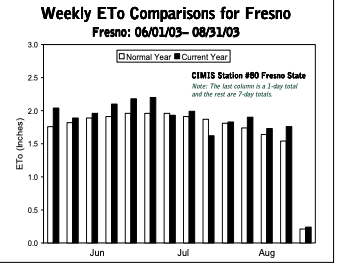
Fresno: 06/01/03–08/31/03
Normal Year Current Year
CIMIS Station #80 Fresno State
Note: The last column is a 1-day total and the rest are 7-day totals.
ETo (Inches)
Chart shows ETo variation from normal over last three months.
For more CIMIS information...
CIMIS information is published quarterly in the CATI Update newsletter. Articles are provided by the California Department of Water Resources, CIMIS program staff.
For more information about CIMIS or its programs, contact any of the following representatives at these offices:
| District | Representative | Telephone | |
|---|---|---|---|
| Northern District | Jamie Dubay | (530) 529-7367 | dubay@water.ca.gov |
| San Joaquin District | Steve Ewert | (559) 230-3334 | sewert@water.ca.gov |
| Central District | Mark L. Anderson | (916) 227-7603 | marcla@water.ca.gov |
| Southern District | Sergio Fierro | (818) 543-4652 | sergiof@water.ca.gov |
If you are unable to reach a CIMIS representative near you, call the CIMIS Helpline at 1-800-922-4647.
Golf: Variety of factors will affect water, energy use
from Page 4
“The ultimate determination of whether re-nozzling is a viable option will be based on local economics, and must include all relevant conditions,” he said.
Included in the CIT report are brief discussions of densograms and scheduling coefficients, and how they can be used to help improve irrigation uniformity. The importance of irrigation uniformity in relation to fertilizer use also is addressed.
To obtain a print copy of the report, complete and return the Publications Available form on this page. Copies also may be viewed on the CIT website located at cati.csufresno.edu/cit. The study was funded by the California Department of Water Resources.
For more information about sprinkler testing and irrigation uniformity, call CIT at 559-278-2066.
Pump: Seminars will continue through fall
from Page 4
Category 1 for education still has funding. In fact, a number of free seminars on agricultural pumping efficiency are slated in the San Joaquin Valley and in northern California during October, November and December.
Categories 2 and 4 also still have limited funds remaining for proposals and projects. Applications may be submitted up to Dec. 31, 2003. For details on pump testing, rebates and seminars, visit the APEP program website at http://www.pumpefficiency.org or call 1-800-845-6038.
The APEP is funded by California utility rate-payers through the California Public Utilities Commission.
Fungal study reveals new details on causes of cavity spot on carrots
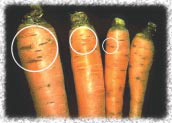
Cavity spot is one of the most damaging diseases of carrots in California’s San Joaquin Valley, blemishing many carrots and rendering them unsuitable for the fresh market. The economic impact can be substantial.
In an effort to learn more about the disease and how it might be controlled, California State University, Fresno plant science professor Jim Farrar recently oversaw a study of the fungus species known to cause cavity spot.
Worldwide, cavity spot in carrot is known to be caused by at least three species of Pythium, including P. violae, P. ultimum, and P. sulcatum. These species were isolated from cavity spot lesions and tested for pathogenicity on mature carrots.
In Farrar’s study, 20 pathogenic carrot isolates were characterized for growth rate, cardinal temperatures, sporangia formation, mefenoxam resistance and other properties. Of these isolate species, two irregulare and two sulcatum were resistant to the fungicide mefenoxam.
The study identified a major shift in the population of Pythium spp. causing cavity spot of carrot in California. In addition, it demonstrated that a small percentage of Pythium isolates are resistant to the fungicide mefanoxam, which is the only fungicide currently labeled for control of cavity spot.
Researchers stated that the project provided carrot growers with a more accurate synopsis of causes of cavity spot and made progress toward developing new cavity spot control strategies.
The study was funded by the California State University Agricultural Research Initiative (ARI) and the California Fresh Carrot Advisory Board, with support from University of California, Davis and the UC Cooperative Extension.
A final report containing details of this project is available on the ARI website at ari.calstate.edu. The project title is “Etiology of Cavity Spot of Carrot in California” and is listed under the Research Focus Area: Production and Cultural Practices.
Publications Available
(These publications may be viewed in their entirety on CATI’s World Wide Web pages, located at cati.csufresno.edu. Single print copies are also available by mail at no charge.)
- Improving Golf Course Irrigation Uniformity: A California Case Study, by David F. Zoldoske. CATI Pub. #030901.
Ordering Information:
Check the publication(s) desired and mail or fax form to:
CATI
California State University, Fresno
2910 E. Barstow Ave. M/S OF115
Fresno, CA 93740-8009
Fax: (559) 278-4849
Name
Company
Mailing Address
City State Zip
Stevia examined as sweetening compound
Researchers at California State University, Chico have explored the possibility of extracting a powerful sweetening compound called Rebaudioside A from a plant native to Paraguay, South America.
The botanical name of the plant is Stevia rebaudiana. The research team, led by adjunct professor Lau Ackerman, examined the growth characteristics of the plant to determine whether multiple harvests could be made in a single season. Researchers also monitored Rebaudioside A levels in plants throughout the growing season and the effects of different fertilizers on plant growth habits.
Study results suggested that Stevia is well suited for growing in California’s Sacramento Valley, as the plant possesses sufficient winter hardiness and can withstand the region’s hot summer temperatures. Additionally, above-ground drip irrigation achieved strong growth results.
Researchers also determined that thin layer chromatography (TLC) is a valid way to screen plants for Rebaudioside A levels. It is faster and cheaper than the high-pressure liquid chromatography (HPLC) method, though not as accurate. HPLC could be used for more in-depth study of plants if necessary, Ackerman noted.
Multiple harvests in a single season are a viable and positive option, results showed. Multiple harvests would increase grower income, and plant health is increased as plants thrive with cutting and subsequent re-growth.
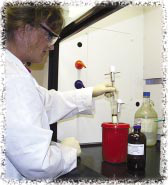
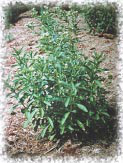
Below: Lab technician refines a sample of Stevia for testing. At right: The Stevia plant.
Further research concluded that using TLC to monitor Rebaudioside A levels during the growing season would enable growers to harvest at optimal times to maximize the Rebaudioside A production.
Researchers determined that more testing with fertilizers is needed, since plant growth showed no significant differences between treatments.
Funding for the project was provided by the California State University Agricultural Research Initiative (ARI). More information, including a complete final project report, may be viewed on the ARI website at ari.calstate.edu. Look for the project title, “Stevia as an Alternative Crop for Sacramento Valley Growers,” under Funded Projects and the Research Focus Area: Production and Cultural Practices.
Publication information
In the event of incorrect address information or extra copies to your workplace, please return this address label by mail or fax with your requested changes. CATI fax number is (559) 278-4849.
Update is published quarterly by the California Agricultural Technology Institute
College of Agricultural Sciences and Technology
California State University, Fresno
Fall 2003
CATI Publication #031001
Voice number: (559) 278-2361
Fax number: (559) 278-4849
Director of Operations: Joe Bezerra
Publications Editor: Steve Olson
Editorial Assistant: John Norton
Address Service Requested
Fresno, California 93740-8009
2910 E. Barstow Ave. M/S OF115
California State University, Fresno
Non Profit Organization
U.S. Postage PAID
Fresno, CA
Permit No. 262
CALIFORNIA AGRICULTURAL TECHNOLOGY INSTITUTE
This HTML version was generated with AI assistance and may contain errors or omissions. The original approved PDF remains the official document of record. An alternative accessible format is available upon request from the document creator in accordance with Title II of the ADA.