Update: Winter 2002-03
CALIFORNIA AGRICULTURAL TECHNOLOGY INSTITUTE
WINTER 02-03
In this issue...
- Equine feeds assayed .......... 2
- Economics on line ............... 3
- Pump testing program ......... 4
- Grapevine cold hardiness ..... 5
California State University, Fresno

University teams with Bion in dairy partnership
Nutrient management system will convert effluent into nutrient-rich fertilizer
The California Agricultural Technology Institute (CATI) at California State University, Fresno and Bion Environmental Technologies, Inc. have agreed to collaborate on a project to design, construct, operate, maintain and evaluate the performance of a Bion Nutrient Management System (NMS®) at the university’s dairy.
Based in New York, Bion is a full service waste management company serving the livestock industry since 1989. Among the company’s service products is its patented NMS® technology to convert animal waste into nutrient rich fertilizer. All steps in the process are monitored and controlled by state-of-the-art information systems which precisely track the fate of all nutrient elements and air emissions.
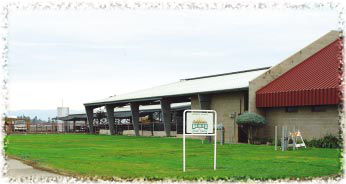
The new partnership and research program, announced by CATI Director Joe A. Bezerra, will be conducted to provide independent evaluation and verification of the performance of the Bion NMS® for dairy effluent.
The timing of the partnership is significant for California’s dairy industry in light of the U.S. Environmental Protection Agency’s recent announcement of new regulations meant to help reduce water pollution from large livestock operations. The EPA has defined “large” for the dairy industry as an operation with more than 700 dairy cows.
In addition to dairy, the new EPA regulations affect all other “concentrated animal feeding operations” (CAFOs), including beef cattle, swine, sheep, chickens, laying hens, and turkeys.
According to EPA Administrator Christie Whitman, the agency will require all large CAFOs to obtain permits that ensure they have taken
See Bion, Page 7
Safety conference set in seaside location
Discussions of agricultural safety issues will fill the meeting rooms and hallways of the Embassy Suites Hotel and Conference Center in Seaside on February 5 and 6, as the Ninth Annual AgSafe Conference is held once again along Monterey Bay, California.
The event will feature more than 30 workshops on safety issues ranging from hazard recognition to dealing with medical providers.
“With workers’ compensation rates going up, safety managers are going to have to address these issues more proactively in order to keep their costs in line,” reported Kimberly Naffziger, director of AgSafe and conference coordinator.
Several workshops will address financial issues directly related to safety, such as workers’ compensation, loss control and claims management, and occupational medical clinics, Naffziger noted.
See Safety, Page 2
Equine feeds assayed
Glycemic index will provide guide for anticipating athletic performance
A specialist in equine diet and exercise at California State University, Fresno has recently completed a study focusing on the relationship of feed and athletic performance in horses.
Professor Anne Rodiek of the Department of Animal Sciences and Agricultural Education used the results of her research study on feed and blood glucose levels to create a glycemic index for 16 horse feeds based on the blood glucose response elicited by each feed.
Shown below are feeds tested, including barley, beet pulp, oats, wheat, carrots, and corn.
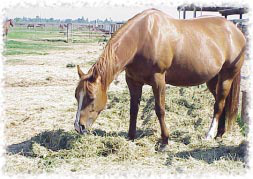
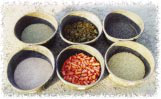
Basic feeds including corn, oats, barley and combinations of these and others were compared in trials using six horses. Horses were fed a different diet each day, with blood samples taken several times over a five-hour period following each feeding. Blood glucose response curves were graphed for each feed based on changes in blood glucose concentrations over the five-hour period.
The areas under the glucose response curves for each feed were compared, on a percentage basis, to the area under the glucose response curve for oats, which was assigned a relative value and a glycemic index of 100. The other feeds and feed combinations were assigned glycemic index values based on the relative size of their glucose response curves compared with that of oats.
Results revealed that corn produced the greatest glucose response, with a glycemic index of 117, followed by oats and molasses with an index of 105. On the lower end of the spectrum, bermudagrass hay measured an index of 23, rice bran 22, followed by beet pulp with a glycemic index of one.
A formal index of glucose responses should prove valuable to horse owners, trainers and breeders, Rodiek said, because the manipulation of a horse’s diet may enhance its athletic performance by providing the optimum metabolic fuels for a particular event.
Teaming with Rodiek in the study was Carolyn Stull of the Veterinary Medicine Extension of the University of California, Davis. Graduate student Renee D’Ambrosi of Fresno State’s Department of Animal Sciences and Agricultural Education directed project field work. The study was funded by the California State University Agricultural Research Initiative (ARI).
A complete listing of the feed glucose values and other details of the study are contained in a research report titled “Glycemic Index of Practical Horse Feeds” (ARI Pub. #00-2-034-1B), available in print format from the California Agricultural Technology Institute (CATI).
The report also may be viewed or downloaded from the ARI website at ari.calstate.edu (Research Focus Area: Production Management Systems).
Safety: Speakers to discuss business benefits of safety program
from Page 1
Other conference classes will cover safety laws and regulations, emergency response, crisis management training, strategies to promote safe workplace behavior, ammonia safety, how to be an effective leader, and other topics.
The conference is designed to benefit participants representing all areas of agriculture and agribusiness, including safety professionals, production managers, supervisors, chemical handlers, machine operators and company owners. It typically draws more than 200 participants from throughout California.
International public speaker, trainer and consultant Valentine DiCerto will provide the opening keynote address entitled “Taking Knowledge to Power.”
In addition to the workshops there will be networking opportunities, as well as vendor displays of safety equipment, services and supplies, Naffziger said.
The conference is sponsored by AgSafe; the Center for Agricultural Business (CAB) and California Agricultural Technology Institute at California State University, Fresno; the National Institute for Occupational Safety and Health; the UC Center for Occupational and Environmental Health; and the UC Farm Safety Program.
Cost to attend is $190 for AgSafe members and $265 for non-members, for registrations postmarked by January 24, 2003. For additional information, including detailed descriptions of the workshops, visit the AgSafe website at agsafe.org, the CAB website at cati.csufresno.edu/cab, or call (559) 278-4404.
Center for Agricultural Business
Economic outlooks from CAB conference now available on web
Economic and production outlooks for a variety of California agricultural commodities are now available for viewing on-line at the Center for Agricultural Business (CAB) website.
The information is from the proceedings of the 21st Annual Agribusiness Management Conference, hosted by CAB on Oct. 31, 2002 in Fresno. More than 400 agricultural and business leaders from throughout California gathered at the Radisson Hotel to hear projections by specialists and discuss issues facing California agriculture.
Featured among the downloadable files on the website are keynote presentations by Steven Wood, chief economist for Financial Oxygen Inc.; Daniel Sumner, director of the UC Agricultural Issues Center; and Terry Barr, chief economist for the National Council of Farmer Cooperatives. The presentations include outlooks for the California, U.S. and global economies for 2003 and beyond.
Additional presentations by commodity marketing leaders offer outlooks on wine grapes, table grapes, stone fruit, nut crops, tomatoes, and cotton.
The files are in MS PowerPoint format and can be viewed on most Internet browsers or downloaded as a PowerPoint file.
In addition to the conference proceedings, the CAB website also offers the latest information obtained through research and study on a variety of agribusiness issues ranging from trade opportunities in China to alternative raisin production systems.
Visit the CAB website at cati.csufresno.edu/cab.
Grants will enable CAB to address specialty crop, vehicle safety issues
The Center for Agricultural Business (CAB) was notified recently by the California Department of Food and Agriculture (CDFA) that it has been awarded two special grants through the state’s Buy California Initiative.
The initiative includes $7 million in federal funds for projects that support the state’s specialty crop industry. Of the more than 700 applications submitted last fall, the two CAB proposals were among 51 selected for funding.
One proposal was awarded $150,000 to investigate “Trade Law Protection for Import-sensitive Crops.” The grant will enable CAB Director Mechel Paggi to direct an effort identifying current and potential California specialty crops whose marketability may be lessened by increasing foreign imports.

Current international trade laws allow California agricultural producers to take action if increased imports of foreign commodities threaten to cause serious economic injury to a domestic industry, Paggi noted. However, he stated, “for California specialty crop producers, these options many times prove inadequate due to problems associated with commodity coverage and/or the mechanics of the process that result in protection after injury to the domestic industry has already occurred.”
The goal of the project is to identify various options under current international trade law and suggest new, more effective alternatives to protect import-sensitive crops.
Industry support from the Grower Shipper Association, the California Grape and Tree Fruit League, the California Asparagus Commission, the Paso Robles Vintners and Growers Association and others indicates broad agreement that this emerging issue merits prompt and focused analysis.
A second grant of $280,000 will support the “Farm Worker Motor Vehicle Safety Education Project.” Directed by CAB program development specialist Kimberly Naffziger, the project will feature an aggressive public education campaign on motor vehicle safety targeting the monolingual Spanish-speaking farm worker population in Fresno and Tulare counties.
In order to help reduce the number of motor vehicle crashes, fatalities and serious injuries suffered by farm workers and other rural residents, project specialists will identify major motor vehicle safety issues and then implement an educational campaign to be presented in Spanish.
The campaign is planned for this spring and summer. The project also has received support from the Nisei Farmers League, the California Grape and Tree Fruit League, AgSafe, and Farm Labor Contractors for Safety and Compliance.
Upcoming events
- Jan. 21 – Agricultural Safety Breakfast Meeting in Calistoga, California. For more information, call (559) 278-4405.
- Jan. 22 – Agricultural Safety Breakfast Meeting in Ukiah, California. For details, call (559) 278-4405.
- Feb. 5-6 – Ninth Annual AgSafe Conference, Embassy Suites Hotel and Conference Center in Seaside, California. Call (559) 278-4404.
- March 11- Farm Labor Contractor Continuing Education Course in Modesto, California. For additional dates or more information, call (559) 278-4405.
- March 18 – Farm Labor Contractor Continuing Education Course in Oxnard, California.
Center for Irrigation Technology
Pump testing program offers incentives for saving energy
To further enhance efficiency in water and energy use by California agricultural producers, the Center for Irrigation Technology (CIT) is sponsoring a program offering financial rebates for water pump testing, retrofit and repair.
It is called the Agricultural Pumping Efficiency Program and has been funded at $6.4 million by the California Public Utilities Commission (PUC). It extends from October 1, 2002 through December 31, 2003, reported CIT director David Zoldoske.
“Records show that 80 percent of production agriculture electricity is used to pump water. That’s why we’re focused on pumps in this program,” Zoldoske reported. “If we can provide just a five or 10 percent increase in efficiency, that translates into a significant reduction in energy use.”
Water conservation also is a goal, Zoldoske said, noting that increased pumping efficiency will allow growers to be more efficient in their irrigating.
The pumping efficiency program features financial rebates for pump testing, as well as rebates of up to 65 percent toward the cost of retrofitting or repairing agricultural irrigation pumps.
The funding was granted by the PUC from monies raised through the “public goods charge,” a portion of each ratepayer’s tax bill dedicated to energy conservation.
An additional key phase of this particular program will be education, Zoldoske said. With pump and water flow technology constantly evolving and improving, growers and farm managers need continued training on how to make the best use of the latest equipment. CIT staff engineers will oversee construction of a permanent CIT demonstration site as well as the outfitting of two mobile trailers that will take education events to growers around the state.
The pumping efficiency program follows an earlier state-funded program called the Agricultural Peak Load Reduction Program, which offers financial support for a variety of efforts that reduce power use during peak load periods. The pumping efficiency program, on the other hand, is specifically for irrigation pumps.
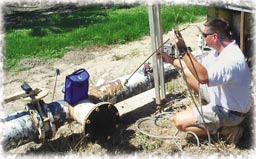
Bill Powers, of Power Hydrodynamics of Modesto, is one of 25 dealers statewide who have contracted to do pump testing for the pumping efficiency program.
While both programs will continue through the end of 2003, Zoldoske urged prospective applicants to act quickly because funds are limited. Applications are accepted on a first-come, first-served basis until available funds are allocated or until December 31, 2003, whichever comes first, he said.
For more information about the pumping efficiency program, call 800-845-6038 or visit the program website at www.pumpefficiency.org. For details on the peak load program, call 1-866-297-3029 toll free or visit the website at cati.csufresno.edu/cit/load_reduction.
Upcoming events
- Jan. 21 – Agricultural Peak Load Reduction Program – Informational Seminar for Dairy Operators, at the AgTAC in Tulare, California. Call 800-772-4822 to register.
- Feb. 19 – Ground Water Training for PCAs in Clovis, California. For more information, call (916) 324-4086.
- Feb. 26 – Agricultural Peak Load Reduction Program – Saving Energy in Food Production and Processing, at the Center for Irrigation Technology. Call (559) 278-5389 for details.
Fundraising begins for water center
Congressional representatives from major political parties recently joined with leaders of central California’s agricultural industry to formally announce establishment of the International Center for Water Technology (ICWT) at California State University, Fresno.
Plans for the ICWT have been public for more than a year. The appearance by representatives Cal Dooley and George Radanovich at an October press conference at the Center for Irrigation Technology (CIT) lent strong support to efforts to secure $2 million in federal funds to help with construction of the planned $60-million center, reported CIT Director David Zoldoske. Leading the press conference and outlining Fresno State’s support for the center was J. Michael Ortiz, provost and vice president for academic affairs.
Claude Laval, president of Claude Laval Corporation and co-chair of the San Joaquin Valley Water Technology Cluster, also attended to relay private industry’s support for the project. The water technology cluster, the Fresno Area Workforce Investment Council,
See Center, Page 7
Viticulture and Enology Research Center
Grapevine cold hardiness...
Predictive model will provide growers with new tool to aid in protecting vines
Cold-weather research on grapevines in the central coast region of California has provided viticulture plant scientists with clues on how to protect vines against tissue-killing freezes during fall, winter and spring months.
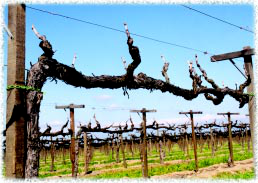
Research scientist Robert Wample, professor and director of the Viticulture and Enology Research Center (VERC) at California State University, Fresno, is directing the Grapevine Cold Hardiness project with the goal of helping growers prevent severe damage to grape crops as a result of cold temperatures.
“Observations show [cold weather] damage to structural tissues, such as trunks, cordons and canes, as well as buds,” Wample said after assessing damage recently reported by growers in the Paso Robles area. “In at least a few cases, the vines have been killed down to the graft union with the rootstock. Such damage requires either grafting new scions onto the surviving rootstocks or replanting the vineyard. In either case, this is a very expensive process.”
Certain measures can be taken to help insulate grapevines from extremely low temperatures, Wample noted. They include flood or drip irrigation, which can raise the soil and air temperature several degrees; sprinkler irrigation, which coats the vines with ice and helps to prevent the wood temperatures from dropping below freezing; and wind machines, which help prevent cold air pockets from forming by slowly moving the air through the vineyard.
All these methods add significantly to production costs, however, and until now, growers have been without accurate information to aid them in their decisions as to when to apply such measures, Wample said.
Specific objectives of the cold hardiness project are to determine the temperatures at which tissue damage occurs in several varieties. To accomplish this, researchers first established locations for data collection in selected mature vineyards in the Paso Robles area and on the Fresno State University Farm.
With weather station data providing early morning low temperature readings, technicians took cane and bud samples weekly from December 2001 through February 2002. The samples were insulated to maintain their temperatures and transported to VERC laboratories for analysis.
In the lab, specially designed equipment was used to help in determining the extent of tissue damage at varying temperatures. Initial results showed that damage occurred on the samples at temperature ranges from -14 to -22 degrees centigrade (8 to -6 degrees Fahrenheit) .
Much effort during the first year of the project was devoted to the design and calibration of sampling equipment and to the development of computer software for information analysis, Wample said. The data collected represent the beginning of the data set that will eventually allow some prediction of grapevine bud cold hardiness.
A predictive model “will allow growers in many diverse regions to more accurately estimate vine cold hardiness and therefore make better decisions regarding the use of costly protective measures,” Wample said.
Funding for this project was provided
See Cold, Page 8
Upcoming events
- Jan. 28-30 – Unified Grape and Wine Symposium in Sacramento, California. Includes industry trade show and wine tasting on January 29 featuring Fresno State wines (http://www.asev.org/Events/EventsFrame).
- March 5-6 – Sixth Annual Central Coast Viticulture and Enology Issues Conference at the Rancho Santa Barbara Marriott in Buellton, California. Theme: Quality – from the vineyard to the table. Presented by the Viticulture and Enology Research Center, in cooperation with Allan Hancock College of Santa Maria. For industry sponsorship opportunities, contact Cynthia Wood at cynthiaw@csufresno.edu or call 559-278-7135.
Interested in a new CIMIS weather station?
In the October 2002 issue of “Update,” we presented brief guidelines for selecting a CIMIS weather station in a given area. The installation of a new CIMIS station was also presented as one of the options for mitigating the existing data limitations. In the current issue, we expand on this option by presenting the responsibilities of the different parties involved.
A CIMIS weather station costs approximately $5,000. At present, DWR does not provide any funding for purchase of the station equipment. However, other local, state, and federal agencies might provide the necessary funding.
For information on alternative funding sources, you may contact a CIMIS representative from the list provided below.
Any interested person/group, referred to as a cooperator hereafter, is responsible for securing the funding and purchasing the equipment.
In addition to the equipment, the cooperator is also required to provide a station site that fulfills the weather station siting criteria required by CIMIS.
Detailed information on the CIMIS station siting criteria can be obtained from the CIMIS web site. The landowner can be the cooperator or someone else who has agreed to provide the land.
Requirements/Responsibilities for acquiring a CIMIS weather station
The cooperator and/or the landowner will:
- Supply the weather station equipment.
- Build a fence around the station for security, if needed.
- Supply telephone service to the station.
- Carry out monthly maintenance visits, year-round.
- Maintain the pasture/turf inside and outside the fenced enclosure in a healthy growing condition year-round.
- Install or modify the irrigation system to prevent irrigation water from hitting the weather station.
- Allow state personnel access to the site during normal work hours.
The responsibilities of DWR include:
- Approving the siting of the prospective station.
- Assigning an appropriate name and number to the prospective station and administering the agreement between the parties involved.
- Installing and activating the weather station.
- Training cooperator/landowner personnel responsible for monthly maintenance.
- Assisting cooperator in the troubleshooting of weather station problems.
- Providing quality assurance measures, including the calibration and regular servicing of the station sensors.
- Capturing the weather data for processing, troubleshooting, and posting into the CIMIS database.
- Processing the data through the quality control program and calculating and posting estimated ETo values.
Visit the CIMIS home page at the following address: http://www.cimis.water.ca.gov
For more CIMIS information...
CIMIS information is published quarterly in the CATI Update newsletter. Articles are provided by the California Department of Water Resources, CIMIS program staff.
For more information about CIMIS or its programs, contact any of the following representatives at these offices:
- Northern District
Jamie Dubay
(530) 529-7367
dubay@water.ca.gov - San Joaquin District
Steve Ewert
(559) 230-3334
sewert@water.ca.gov - Central District
Mark L. Anderson
(916) 227-7603
marcla@water.ca.gov - Southern District
Sergio Fierro
(818) 543-4652
sergiof@water.ca.gov
If you are unable to reach a CIMIS representative near you, call the CIMIS Helpline at 1-800-922-4647.
Weekly ETo Comparisons for Fresno
Fresno: 09/01/02–11/30/02
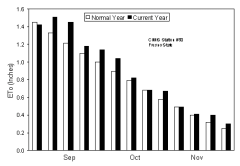
CIMIS Station #80
Fresno State
Chart shows ETo variation from normal over last three months.
Bion: Fresno State dairy will serve as demonstration site
from Page 1
steps to reduce water pollution. One of the permit requirements is that the livestock operation develop and follow a plan for handling manure and effluent.
Initial goals of the CATI partnership with Bion include completion of a detailed mass balance assessment of the Bion effluent treatment process, Bezerra reported. The assessment will include documentation of the fate of nitrogen and phosphorus in the treatment process and quantification of gaseous air emissions from the system.
Process monitoring and control parameters will be correlated with operational results to model and predict Bion treatment system nutrient removal and air emission performance.
“On a long-term basis, the Bion NMS® treatment facility will serve as a day-to-day effluent management system for the university’s dairy and provide a demonstration site for testing various effluent handling and treatment technologies,” Bezerra said.
As with many federal programs, states will be given significant flexibility to tailor nutrient management plans for CAFOs, Bezerra noted. This enables states to develop permits that take into account the size, location and environmental risks that may be posed by an operation. It also allows states to authorize alternative performance standards that will help to promote the use of innovative technologies.
Construction of the Bion NMS® system at Fresno State is to begin this month and be completed in April.
Closer spacing of new cotton varieties yields mixed results
California cotton producers continue to explore new methods for reducing production costs and increasing yields.
One of those methods – reducing the space between rows – has been studied over the years with mixed results, reports California State University, Fresno plant science professor Jim Farrar, who recently oversaw a narrow-row study using two new varieties.
High-density planting increases initial production costs and can also result in lower quality fiber from the cotton bolls, Farrar noted. However, the method also offers several advantages. For example, higher density planting allows the plant canopy to shade the soil sooner, resulting in less weed growth. In addition, the plants tend to mature faster, providing a shorter growing season.
In a recent study conducted in Fresno and Kings counties, two varieties were grown using 15-inch row spacings in comparison with conventional 30-inch.
The new varieties were Delta Pine 6100 Roundup Ready and Delta Pine 5415 Roundup Ready. Focus of the study was on fiber quality and yield.
Results showed that while bolls per acre increased, size of the bolls tended to decrease, leaving overall yield similar to that of control plots using conventional spacings. Fiber quality, as measured by length, strength, and micronaire, was not significantly different between the control and experimental plots, and the high-density plantings did not mature significantly earlier than the control.
The study was funded by the California State University Agricultural Research Initiative (ARI) and involved collaborative support from researchers with the UC Cooperative Extension in Hanford and Shafter, California.
Further work is planned as new varieties continue to be developed. A final report containing details of this project is available on the ARI website at ari.calstate.edu. Project title is “Alternative Row Spacing to Reduce California Cotton Production Costs” (ARI Pub. #00-2-047-1B). It is listed under the research focus area of “Production and Cultural Practices.”
Center: Partnerships still sought
from Page 4
and the California Water Institute also have joined in supporting development of the ICWT.
Key functions of the center will be to provide testing and certification services, community education, cooperative marketing services, and technology demonstration related to water technology and conservation.
The physical plant is to consist of a building complex with an exposition center, conference rooms, testing and training facilities, and offices.
Financial support is to be obtained through public sources, including state and federal allocations, as well as from private industry, Zoldoske said.
Zoldoske has been appointed interim director. The interim board of directors is anticipated to consist of both university and industry representatives. Persons interested in supporting the project are encouraged to call the ICWT phone line at 559-278-2691.
Cold: Area growers teamed to support initial research
from Page 5
by the California State University Agricultural Research Initiative (ARI), which is administered by the California Agricultural Technology Institute (CATI), and by the American Vineyard Foundation (AVF) and the California Competitive Grants Program.
Paso Robles area growers organized to support the effort during the course of the research. They collectively provided $16,800 to help support initial work, Wample noted.
Further research is being planned, with anticipated support from the AVF. In the meantime, Wample plans to continue educational outreach to growers on the problem of low temperature injury.
Details of this study are available in a final report located on the ARI website at ari.calstate.edu. The project is titled “Grapevine Cold Hardiness in California’s Central Coast Region” (ARI Proj. #01-2-032) and is listed under the “Production and Cultural Practices” research focus area.
Students tackle real-world problems at Cal Poly design clinic for agriculture
Students at California Polytechnic State University, San Luis Obispo are helping to solve real-world problems in the farming industry through a new program called the Mechanical Systems Design Clinic for Agriculture.
The clinic was established last year with funding support from the California State University Agricultural Research Initiative (ARI), administered by Fresno State’s California Agricultural Technology Institute (CATI). Development work was directed by Cal Poly professor Mark Zohns of the BioResource and Agricultural Engineering Department.
Undergraduate students working for the clinic have completed a number of projects addressing the specialty needs of several California agribusinesses.
In one project students addressed a common problem at dairies, where the cows nose much of the grain and silage out of their reach in the feed bunk during feeding. To help push the feed back into place, students developed a computer controlled, electrically powered prime mover fitted with a small “dozer” blade.
The machine is outfitted with a programmable logic controller and optical sensors which guide it along an optical track to scrape the silage/grain closer to the feeding mangers.
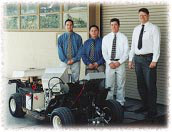
Sudents at Cal Poly San Luis Obispo display a computer-controlled, electrically powered prime mover fitted with a small “dozer” blade for pushing feed back into the feed bunk.
A final report outlining additional student projects is available on the ARI website at ari.calstate.edu. The report title is “Mechanical Systems Design Clinic for Agriculture” (ARI Project #00-3-064). It is listed under the “Agricultural Business” research focus area.
For more information, call the clinic at (805) 756-2378.
In the event of incorrect address information or extra copies to your workplace, please return this address label by mail or fax with your requested changes. CATI fax number is (559) 278-4849.
Update
Update is published quarterly by the California Agricultural Technology Institute
College of Agricultural Sciences and Technology
California State University, Fresno
Winter 2002-03
CATI Publication #030101
Voice number: (559) 278-2361
Fax number: (559) 278-4849
Director of Operations: Joe Bezerra
Publications Editor: Steve Olson
Editorial Assistant: John Norton
In the event of incorrect address information or extra copies to your workplace, please return this address label by mail or fax with your requested changes. CATI fax number is (559) 278-4849.
Address Service Requested
California State University, Fresno
2910 E. Barstow Ave. M/S OF115
Fresno, California 93740-8009
Fresno, California
Non Profit Organization
U.S. Postage PAID
Permit No. 262
CALIFORNIA AGRICULTURAL TECHNOLOGY INSTITUTE
This HTML version was generated with AI assistance and may contain errors or omissions. The original approved PDF remains the official document of record. An alternative accessible format is available upon request from the document creator in accordance with Title II of the ADA.