Update — Fall 2002
CALIFORNIA AGRICULTURAL TECHNOLOGY INSTITUTE
FALL 2002
California State University, Fresno
In this issue...
Animal habits tracked .......... 2
Contractor classes offered ... 3
Survey results reported ....... 4
Table grapes tested ............. 5
Research leader brings experts together to produce textbook
A first-of-its-kind raisin textbook authored by a Fresno State viticulture specialist has been printed by a Fresno area publishing firm.
The book is titled “A Treatise on Raisin Production, Processing, and Marketing.” The editors are Vincent E. Petrucci, former viticulture professor and director emeritus of Fresno State’s Viticulture and Enology Research Center (VERC), and Carter D. Clary, former director of the university’s Dried Foods Technology Laboratory.
The text was published by Malcolm Media Press of Clovis, California, which publishes, in association with Malcolm Media Corp., several regional farm magazines including American Vineyard and Central Valley Farmer.
Below is the cover of the new textbook edited by Vincent Petrucci (right) and Carter Clary, both former research leaders at Fresno State.
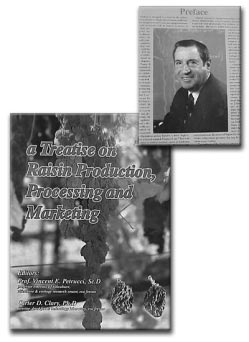
Petrucci served as VERC director from 1977 to 1996 and also taught the raisin production class during most of his 45-year tenure at Fresno State. One perpetual problem he had as a professor was finding a good text on raisin production, Petrucci recalled, so when retirement allowed him a few more free hours, he decided to produce one himself, for future professors and students. He felt this was especially important because Fresno State is the only institute of higher learning in the world that operates a commercial raisin processing facility, he noted.
“A lot has been written on grape growing in general and on wine production, but there never has been a textbook on raisin production, processing and marketing,” Petrucci said, describing his first thoughts for the text back in 1997. And the book is not only for students, he said: “There are chapters that should satisfy growers. There are chapters that should satisfy processors and there are those for marketers.”
Petrucci began his work by contacting professionals – many of whom were former university colleagues – in the various aspects of raisin production and inviting them to contribute to the book.
“I chose each individual on the basis of their expertise, because I knew I couldn’t cover all aspects myself. The result is that I have information from professionals in every area, including production, processing and marketing.”
At nearly 300 pages, the text is designed for university-level coursework and as a reference for high school students. It will also be valuable for general use by anyone interested in raisin production, Petrucci said.
The text provides an overview of world dried-grape production and the history of the California grape industry. It discusses 13 grape varieties that can be made into raisins, along with methods of developing improved raisin cultivars. It covers production systems in California and Australia and has a special section on economics. It also addresses dehydration, storage, processing, major insects and diseases, and the promotion and marketing of raisins. Chapter 14 concludes the text with a discussion of commercial and domestic uses of raisins, even offering 29 recipes for raisin lovers.
Petrucci expressed his gratitude to the chapter authors for their contributions. He also noted that 25 percent of all book sale revenues will be returned to Fresno State’s viticulture and enology program to support the education of students in those areas.
Cost of the text is $75, plus tax and shipping. Copies may be ordered by contacting P&P Enterprises in Clovis at (559) 297-7376. Petrucci said the text also will be available at the Fresno State Kennel Bookstore. He hopes to have it available through other outlets in the near future.
Issues conference to feature outlooks on ag trends
An agricultural trade policy specialist will explore the complex relationship of politics and agriculture in a keynote luncheon address at the 21st Annual Agricultural Business Management Conference set for Thursday, Oct. 31 in Fresno, California.
Barry Flinchbaugh, a professor and extension state leader from Kansas State University, will draw on his years of experience to discuss the politics of agricultural policy and its relevance for California agriculture. Flinchbaugh has served as counsel for agricultural leaders such as Kansas Senator Pat Roberts and fellow Kansan Dan Glickman during Glickman’s tenure as U.S. Secretary of Agriculture and his years in the U.S. House of Representatives.
Most recently, Flinchbaugh served as chair of the federal Commission on 21st Century Production Agriculture, providing Congress and the president with recommendations for future farm policy.
The morning portion of this year’s outlook conference will feature presentations by three other economics and trade specialists: Steven Wood, chief economist for FinancialOxygen Inc. of Walnut Creek, California; Daniel Sumner, director of the University of California Agricultural Issues Center; and Terry Barr, chief economist for the National Council of Farmer Cooperatives.
In addition to broad economic outlooks, the conference will provide information on specific California agricultural commodities. A morning panel of agribusiness leaders will offer market projections for California wine grapes, raisins, table grapes, tree fruit, cotton, and nut crops.
After lunch a second panel will offer outlooks for citrus, tomatoes, dairy products, and vegetables.
The annual conference is sponsored by California State University, Fresno’s Center for Agricultural Business (CAB) and California Agricultural Technology Institute, and by Bank of America Corp.
The registration fee is $85 for registrations postmarked by Oct. 25. For additional conference information, call 559-278-4405 or visit the CAB website at cati.csufresno.edu/cab.
Tracking animal behavior
Natural resources research provides habitat data that will aid in devising management strategies
Two research studies designed to help protect populations of native California mammal and bird species have been completed under the direction of Fresno State biology professor David Grubbs.
The studies were undertaken with funding from the California State University Agricultural Research Initiative (ARI), which provides support for research in the area of natural resources as well as agriculture.
One of the projects involved tracking the winter foraging habits of the fisher (Martes pennanti), a cat-sized cousin to the weasel that historically has thrived in the mountains of the western United States. Because of recently diminished populations, the fisher has received the status of a Species of Special Concern, Grubbs reported in proposing the tracking study.
In an effort to better understand the fisher’s habitat requirements, Grubbs teamed with specialists from the U.S. Forest Service to study the animal’s winter ecology.
“The information gained will be used in developing management strategies to help preserve this species,” he said.
Fresno State graduate student Amie Mazzoni directed the fieldwork, which involved trapping and placing radio collars on 14 fishers in the fall of 1999 and 2000. Over two winters the animals were tracked and their locations recorded. The data retrieved was used to determine home range areas for the animals.
The information shows that fishers primarily use large diameter trees and snags for resting. The researchers concluded that older, large trees have structural attributes suitable for fisher resting, such as cavities, large branches and mistletoe brooms, along with dense canopies that younger trees may lack.
“In an effort to proliferate fisher habitat, management practices should be implemented that would support large tree growth while maintaining dense cover and a multi-layered canopy,” was among the recommendations made in a report provided to the U.S. Forest Service, Grubbs said.
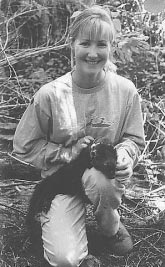
Student research technician Amie Mazzoni shows a fisher that has been trapped, tranquilized and fitted with a radio collar for tracking.
In a second study, master’s degree students Virginia Wible and Rodney Olsen tracked the foraging and nesting habits of a non-native bird species called the European Starling (Sturnus vulgaris), reported to have been introduced into North America in 1890. Following years of rapid population growth, the aggressive starling has threatened to displace several native species in central California’s oak woodlands areas.
By disrupting the already threatened status of some secondary cavity nesting birds, starlings are affecting the diversity and resilience of the entire ecological community, the grasses of which serve as an important food resource for grazing cattle, Grubbs noted.
Tracking studies showed that starlings tend to occupy nest sites earlier in the spring than other cavity-nesting birds. This and other information will serve as a basis for management strategies that could support the preservation of native birds, Grubbs said.
Details of the two research studies are available in final reports located on the ARI website at ari.calstate.edu. The fisher study is titled “Habitat Use by Fishers in the Southern Sierra Nevada” (ARI Proj. #00-2-016), listed under the “Natural Resources” focus area.
The starling study is titled “Foraging and Nesting Habitats of European Starlings: Implications for Managing Starling Impact on Native Species” (ARI Proj. #01-2-013), listed under “Biodiversity” projects.
Ozone conference to address food processing applications
Everything you’ve ever wanted to know about the use of ozone as an antimicrobial agent in food storage and processing will likely be discussed at the upcoming Ozone III conference set for Oct. 28-30 in Fresno, California.
Sponsored by Fresno State and G&L AgriTec of Three Rivers, California, the conference will feature presentations on ozone use in agriculture and food processing.
Ozone, or 03, is a form of oxygen that has proven effective in destroying microorganisms.
The conference will begin Monday morning, Oct. 28, with a review of federal regulations on ozone use in the food industry. In subsequent presentations, researchers from both universities and private industry will address the use of ozone on meat and poultry, seafood, fresh fruit and other foods. Additional presenters will discuss the use of ozone as a cleaning agent for food processing and nursery equipment, and as an antimicrobial agent for treating soil, irrigation water and wastewater.
The event will be held at the Radisson Hotel in downtown Fresno. The registration fee is $250. For more information call 559-561-0112 or visit the California Agricultural Technology Institute (CATI) website at cati.csufresno.edu and click on “Announcements and Events.”
Center for Agricultural Business
CAB to sponsor education classes for contactors
Recent changes in the California Labor Code require every person applying for or renewing a farm labor contractor (FLC) license to take at least eight hours of relevant educational classes each year, and only classes approved by the state labor commissioner may be taken to meet this requirement.
In an effort to help contractors fulfill this obligation, the Center for Agricultural Business (CAB) has teamed with several statewide agencies to develop a new educational program for farm Labor contractors. Called the “Farm labor Contractor Education Institute,” The program is a collaborative effort of CAB, the Farm Employers Labor Service, AgSafe, Western Growers Association, and the University of California Cooperative Extension.
Those organizations have developed an eight-hour course approved by state Labor Commissioner Arthur Lujan. Classes will be presented by industry experts approved to present specific topics. Participants attending the classes will receive a certificate of attendance from the Farm Labor Contractor Education Institute.
Training will cover a variety of important issues including farm labor contractor requirements, Cal/OSHA and safety requirements, transportation of workers, workers’ compensation, unemployment insurance and state disability insurance, wage and hour rules, pesticide safety rules, housing requirements, and the Agricultural Labor Relations Act. Classes will be offered in English and Spanish.
“The agricultural industry has expressed a need for this training to be conducted,” stated Kimberly Naffziger, program development specialist for CAB. “Industry leaders from around the state have expressed tremendous support for the program, and we are excited to be offering it.” Classes have been scheduled on the dates shown in the chart above. Classes also will be held at the annual AgSafe Conference scheduled for Feb. 5 and 6, 2003 in Monterey, California.
The registration fee for Farm Labor Contractor Education Institute classes is $185 per person, or $135 per person for members of a sponsoring organization. For registration and other information, contact CAB at (559) 278-4405.
Farm Labor Contractor Continuing Education Course Dates
| Date | Location and language |
|---|---|
| Oct. 16 | Salinas (presented in English) |
| Oct. 17 | Sacramento (English) |
| Nov. 5 | Fresno (English) |
| Nov. 6 | Fresno (Spanish) |
| Nov. 20 | Calistoga (Spanish) |
| Dec. 4 | El Centro (English) |
| Dec. 5 | El Centro (Spanish) |
Upcoming events
Oct. 16 – Farm Labor Contractor Continuing Education Course in Salinas, California. For additional dates, see article on this page or call (559) 278-4405.
Oct. 31 – 21st Annual Agribusiness Management Conference, Radisson Hotel and Conference Center in Fresno, California. For more info, call (559) 278-4405.
Nov. 19 – Agricultural Safety Breakfast Meeting in Calistoga, California. For more info, call (559) 278-4404.
Nov. 19 – Supervising for Success with a Positive Leadership Style, presented in Spanish, in Calistoga. For more info, call (559) 278-4405.
Center for Irrigation Technology
Survey draws grower feedback on water issues
Farmers in California’s San Joaquin Valley could all be wearing “eternal optimist” buttons, based on the results of a recent survey conducted by the Center for Irrigation Technology (CIT).
Despite water shortages, low commodity prices and other issues forcing the state’s farming industry into one of its deepest slumps ever, most growers don’t consider retirement as an option; rather, they want to improve in what they do. They want to become more efficient water users, they are interested in new technology, and they value education as a tool to improve their industry, noted CIT Director David Zoldoske in summarizing the results of the survey.
The ever-growing threat of water shortage in California was one of the issues that prompted Zoldoske to have the survey compiled and mailed to more than 2,500 San Joaquin Valley growers last fall.
With irrigation education a key part of CIT’s mission, he regards the survey as an important method for determining growers’ greatest concerns regarding water use.
“We wanted to understand the barriers growers face in adopting new water management technologies,” Zoldoske said. “What are the issues that prevent them from being better water users?”
It’s not that growers are poor water users now, he noted. But with the terms “shortage” and “drought” becoming more common than unusual these days, greater efficiency will be required for survival.
“We wanted to understand the barriers growers face in adopting new water management technologies.”
When the survey asked, “What contingency plans do you have in the event of a prolonged drought?” growers chose “develop a deficit irrigation plan” and “improve system efficiency” most over six other choices. The third and fourth most popular options were “drill new wells” and “obtain water from other sources,” indicating that farmers want to solve their problems in other ways than “take land out of production” or “quit farming/go out of business.”
Of the more than 2,500 growers contacted through a joint effort with a local ag publishing firm, 445 returned the completed questionnaire. The 17 percent response rate – excellent for a random, unsolicited mail survey – indicates a high interest among growers in water issues, Zoldoske said.
Most questions on the survey invited growers to select and rank several responses in order of importance.
For example, when growers were asked what factors impact their ability to irrigate effectively, the most frequently chosen factor was “difficult soil conditions,” which tallied 104 responses. Other factors listed were “insufficient water quality” (80 responses), “improperly graded fields (75 responses), and “fixed delivery schedules” (72 responses).
Nearly 50 percent of the growers who were surveyed indicated they have some problems with irrigation uniformity due to system design, maintenance, or poor water infiltration. When asked about improvements they would make to their system, the highest-ranking response was “install drip/micro,” with 171 responses.
Growers believe education and training is important, and listed their “irrigation dealer” as the number one choice for information on systems and water management. One in four listed CIT as an important source of training and information. Other sources listed were “irrigation consultants” and UC extension services.
Workshop to address system monitoring
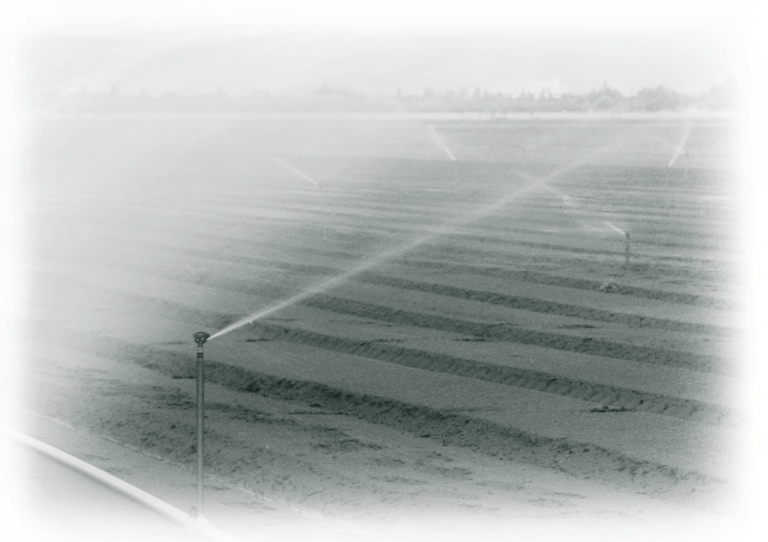
An agricultural irrigation workshop on system monitoring and control will be held from 8 to 9:30 a.m. Nov. 14 at the AgTAC facility in Tulare, California.
The workshop is for operators and managers of modern irrigation systems. Presenters Tim Jacobsen, from the Center for Irrigation Technology (CIT), and Brian Hockett and Andy Hensel, from Irrometer, will discuss climatological-based control, CIMIS soil moisture-based control, time-based controllers, and application efficiency studies.
A continental breakfast will be served. Sponsors include CIT and the California Department of Water Resources. For details call (559) 278-5752. Pre-register by calling 1-800-772-4822.
Viticulture and Enology Research Center
Table grape trials...
Newly released white and black varieties undergo viticulture trials
Two new table grape varieties are undergoing final evaluation in the vineyards and laboratories of California State University, Fresno.
The varieties are called “Princess” and “Summer Royal” and may soon be found in supermarkets in California and throughout the nation.
The evaluations are part of a long-term table grape development program operated jointly by Fresno State and the U.S. Department of Agriculture. Directing the Fresno State work is professor Sayed A. Badr of the Department of Viticulture and Enology. Overseeing breeding and development of the new varieties is USDA geneticist David W. Ramming, based at the USDA-ARS San Joaquin Valley Agricultural Science Research Center in Parlier, California.
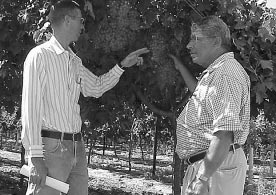
USDA geneticist David Ramming (left) and Fresno State viticulture professor Sayed Badr discuss one of the new table grape varieties being evaluated in Fresno State vineyard trials.
The purpose of the program is to develop, evaluate and introduce improved varieties that will help to expand the U.S. and world markets for California table grapes, Badr said.
“USDA releases are going to meet a need in the marketplace. That means they will be attractive to consumers,” Badr explained. For U.S. consumers, that means the grape should be seedless; have a large, uniform berry size; an attractive color; and have a good flavor.
Equally important for a new variety are the production, storage and shipping characteristics, Badr noted.
“We need a variety that is grower-friendly,” he said, “one that produces good size and quality fruit with minimal production costs, and one that is resilient to diseases. We also need a grape that will maintain its firmness and flavor during storage and transportation.”
Developing such traits in a single variety requires years of trials and evaluation, Badr said.
The new “Princess” variety is a “white” seedless grape; it ripens in mid-season and has a larger berry size than the popular Thompson seedless, Badr reported. Though “Princess” was released by the USDA to the public in 1999, evaluations have continued to help determine optimal viticultural practices.
Key practices that have been evaluated for “Princess” include pruning method and response to girdling and gibberellic acid application. Trials have shown that vines produced consistently higher yields on cane-pruned rather than spur-pruned vines, with comparable fruit quality. Gibberellic acid applied at one part per million (ppm) during bloom adequately thinned the clusters without negative impact on yield or fruit quality, Badr reported. Girdling treatments still have not given consistent results.
“Summer Royal” is a new black mid-season variety. It is similar to the popular “Ribier” but is seedless, which is a distinct advantage for sales to American consumers, Badr noted.
Viticulture trials showed that “Summer Royal” also produced higher yields on cane-pruned rather than spur-pruned vines. Girdling and gibberellic acid treatments increased berry size, weight and overall yield without significantly influencing other fruit parameters. Continuing trials are planned to help confirm these findings.
“The purpose of the program is to develop, evaluate and introduce improved varieties that will help to expand the U.S. and world markets for California table grapes.”
The USDA-Fresno State program has evaluated more than 60 selections over 15 years, with many discarded because of less desirable characteristics. Some, such as “Crimson,” have gained a strong foothold in the marketplace.
Recent developmental research has gained additional support from the California State University Agricultural Research Initiative (ARI).
California Irrigation Management Information System
Selecting a weather station for your area
The California Irrigation Management Information System (CIMIS) manages over 120 automated weather stations scattered throughout the state of California. If a hypothetical assumption is made that these stations are uniformly distributed, it means that a single station represents approximately 1,300 square miles of California’s land area. This is a very large area to be represented by a single station. Several studies have indicated that weather parameters can vary significantly even within the same field. Therefore, it is not an exaggeration to state that ET and other weather data are limited.
CIMIS recognizes these limitations and is exploring different options to mitigate the problems. Two of the many options that CIMIS is currently exploring are as follows:
- Coupling remotely sensed data from satellites with ground data from CIMIS weather stations and mapping the results using Geographic Information Systems (GIS). The maps would then be interactively available on the CIMIS web site (listed above).
- Installing new stations in areas of data limitations. This includes installing new stations either at standard reference or “non-ideal” sites. The “non-ideal” weather station site study was announced in the spring issue of “Update.”
Visit the CIMIS home page at the following address: http://www.cimis.water.ca.gov
These are some of the plans for reducing data gaps. In the meantime, you may want to know how to select a CIMIS weather station from the existing 120. Unfortunately, there are no easy ways to do this. We only present the following brief pointers on how you can obtain the best possible data for your locality:
- Using the reference evapotranspiration (ETo) zone map. This map is available on the CIMIS web site or can be ordered by contacting CIMIS. The ETo zone map helps users to identify areas of similar microclimates and select stations within those areas.
- Selecting a station that is the closest to the area of interest. Once the similarity of microclimates is established based upon the ETo zone map or familiarity with local climates, the proximity of the station to the area of interest has to be considered.
- Interpolating between points of data measurements. If you are not satisfied by the proximity of the stations and/or the similarity of microclimates, you may consider interpolation methods that can produce better estimates using the available data.
For more CIMIS information...
CIMIS information is published quarterly in the CATI Update newsletter. Articles are provided by the California Department of Water Resources, CIMIS program staff.
For more information about CIMIS or its programs, contact any of the following representatives at these offices:
| District | Representative | Telephone | |
|---|---|---|---|
| Northern District | Jamie Dubay | (530) 529-7367 | dubay@water.ca.gov |
| San Joaquin District | Steve Ewert | (559) 230-3334 | sewert@water.ca.gov |
| Central District | Mark L. Anderson | (916) 227-7603 | marcla@water.ca.gov |
| Southern District | Sergio Fierro | (818) 543-4652 | sergiof@water.ca.gov |
If you are unable to reach a CIMIS representative near you, call the CIMIS Helpline at 1-800-922-4647.
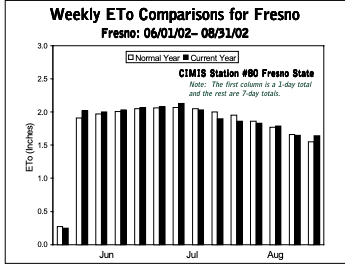
Weekly ETo Comparisons for Fresno
Fresno: 06/01/02–08/31/02
CIMIS Station #80 Fresno State
Note: The first column is a 1-day total and the rest are 7-day totals.
Chart shows ETo variation from normal over last three months.
Calcium may control Erwinia affects on potatoes
Some potato growers in the southern San Joaquin Valley of California are applying increased rates of calcium to their crops as a result of information gained through a recent study focused on controlling the effects of Erwinia bacteria.
Erwinia is present in several south valley counties and has caused problems for potato growers in those areas, reported Fresno State plant science professor Jim Farrar, director of the study.
Different subspecies of Erwinia are known to cause Erwinia early dying, soft rot, aerial stem rot, black leg, and lenticel rot in potatoes.
Because Erwinia early dying is considered one of the more serious diseases in the area, Farrar’s research focused specifically on determining how water and moisture might affect the spread of the disease.
The study featured irrigation of experimental plots at 75 percent, 100 percent, 150 percent and 200 percent of normal rates, based on reference plant evapotranspiration data. Calcium fertilizer applications also were incorporated as part of the treatments.
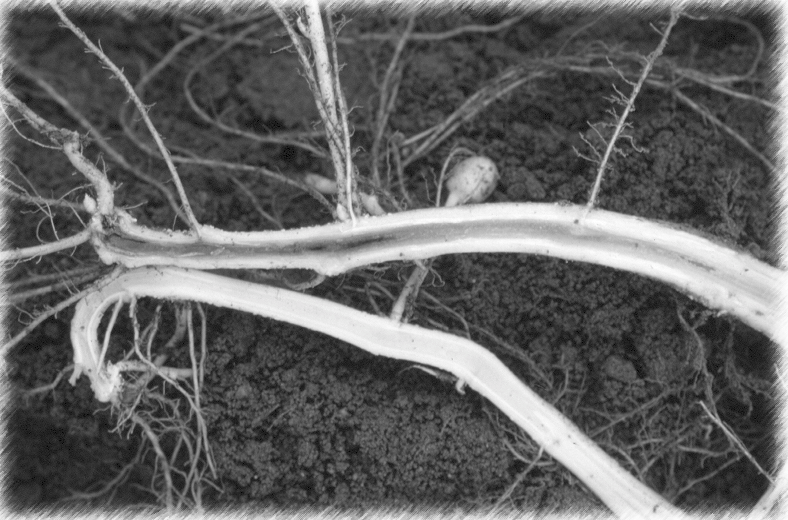
Comparison of healthy (bottom) and diseased (top) potato stems. Top stem is affected by Erwinia.
Results showed that disease severity ratings and crop yields were not significantly affected by the different irrigation treatments, though there was a trend toward increased disease at higher irrigation rates, Farrar noted.
Perhaps more significantly, the increased calcium fertilizations were shown to reduce post-harvest soft rot disease, Farrar reported. Based on that preliminary data, several growers are applying increased calcium rates either as gypsum pre-plant or calcium chloride through sprinklers, he said.
A final report containing details of this project is available on the ARI website at ari.calstate.edu. The project title is “Epidemiology and Control of Erwinia Early Dying of Potato in California” (ARI Proj. #01-2-031). It is listed under the research focus area of “Production and Cultural Practices.”
Text: Designed for college courses, also as reference for growers
From Page 1
Former university colleagues – in the various aspects of raisin production and inviting them to contribute to the book.
“I chose each individual on the basis of their expertise, because I couldn’t cover all aspects myself. The result is that I have information from professionals in every area, including production, processing and marketing.”
At nearly 300 pages, the text is designed for university-level coursework and as a reference for high school students. It will also be valuable for general use by anyone interested in raisin production, Petrucci said.
The text provides an overview of world dried-grape production and the history of the California grape industry. It discusses 13 grape varieties that can be made into raisins, along with methods of developing improved raisin cultivars. It covers production systems in California and Australia and has a special section on economics. It also addresses dehydration, storage, processing, major insects and diseases, and the promotion and marketing of raisins. Chapter 14 concludes the text with a discussion of commercial and domestic uses of raisins, even offering 29 recipes for raisin lovers.
Petrucci expressed his gratitude to the chapter authors for their contributions. He also noted that 25 percent of all book sale revenues will be returned to Fresno State’s viticulture and enology program to support the education of students in those areas.
Cost of the text is $75, plus tax and shipping. Copies may be ordered by contacting P&P Enterprises in Clovis at (559) 297-7376. Petrucci said the text also will be available at the Fresno State Kennel Bookstore. He hopes to have it available through other outlets in the near future.
Survey: research supported
From Page 4
Clearly, growers are looking to government agencies and educational institutions for help in improving their irrigation practices, Zoldoske noted. When growers were asked how such entities could assist them in becoming more efficient, 269 listed low-interest loans as the best form of help. Other high-ranking methods cited were research (159 responses), technical assistance (134 responses), grant-funded demonstration projects (110 responses), and expansion of the EQIP program (100 responses).
The data from this survey will be an important resource for CIT, for the irrigation industry, and also for educational institutes and governmental agencies, Zoldoske said.
“Farmers are very aware of water issues, and they are interested in improving water use efficiency on their farms,” he said. “This data will help CIT and others to design programs to meet those needs.”
Complete results of the survey will be made available on the CIT website. Zoldoske also plans to share and discuss the data with representatives of the California Department of Water Resources and the U.S. Bureau of Reclamation, whose staff members also helped to develop the questionnaire.
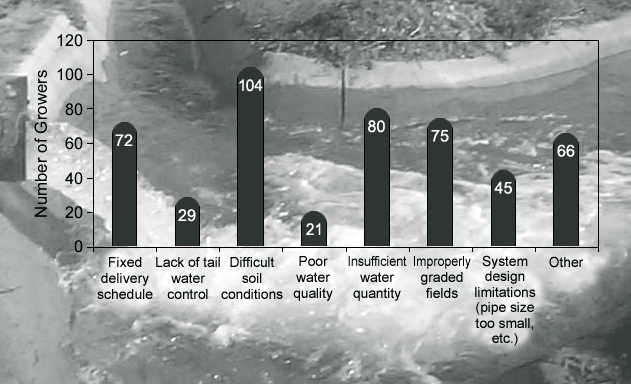
Graph at left compares responses of 445 growers to the following question: “Do you have any special factors that impact your ability to irrigate effectively and profitably?”
CATI on the Web!
For timely information about CATI, its research projects or centers, or to view text of research publications, visit us at cati.csufresno.edu.
Center for Agricultural Business (CAB) – cati.csufresno.edu/cab
Center for Food Science and Nutrition Research (CFSNR) – cati.csufresno.edu/cfsnr
Center for Irrigation Technology (CIT) – cati.csufresno.edu/cit
Viticulture and Enology Research Center (VERC) – cati.csufresno.edu/verc
Agricultural Technology Information Network (ATI-Net) – cati.csufresno.edu/atinet
Update publication information
In the event of incorrect address information or extra copies to your workplace, please return this address label by mail or fax with your requested changes. CATI fax number is (559) 278-4849.
Update is published quarterly by the California Agricultural Technology Institute
College of Agricultural Sciences and Technology
California State University, Fresno
Fall 2002
CATI Publication #021001
Voice number: (559) 278-2361
Fax number: (559) 278-4849
Director of Operations: Joe Bezerra
Publications Editor: Steve Olson
Editorial Assistant: John Norton
Non Profit Organization
U.S. Postage PAID
Fresno, CA
Permit No. 262
Address Service Requested
California State University, Fresno
2910 E. Barstow Ave. M/S OF115
Fresno, California 93740-8009
This HTML version was generated with AI assistance and may contain errors or omissions. The original approved PDF remains the official document of record. An alternative accessible format is available upon request from the document creator in accordance with Title II of the ADA.