Update: Summer 2001
California Agricultural Technology Institute
California State University, Fresno
SUMMER 2001
In this issue...
- ARI proposals in ..........2
- Turf tested for runoff ...........4
- Eutypa incidence reduced.....5
- The CIMIS connection .........6
Getting to the roots...
Researchers use high-tech equipment to observe root growth of peach trees
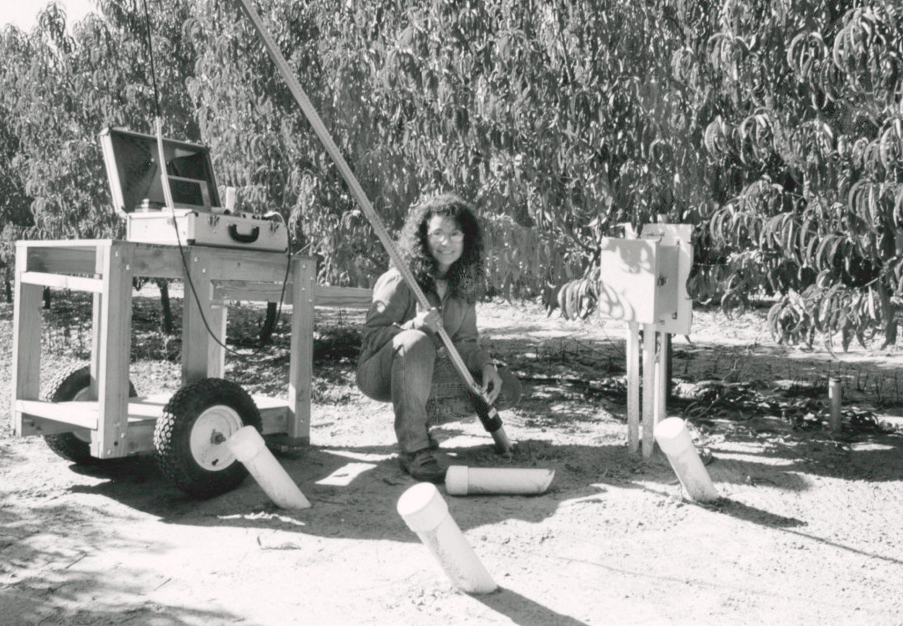
Miniature video and still cameras have enabled medical and other technical professions to make great strides in improving products and services for the public over the years. Now cameras are being tried in another area – underground, in agriculture; and scientists hope that advances brought by their use will not only improve food crops, but will reduce water and fertilizer use as well.
The specialized cameras in this case are being used to measure the rate of root growth in young peach trees under different irrigation and fertilization regimes. The project has been sponsored by the California State University Agricultural Research Initiative (ARI) and is being conducted through a team effort featuring researchers from the U.S. Department of Agriculture and California State University, Fresno.
“Large quantities of water and nutrients (such as nitrogen) are used by growers for irrigating and fertilizing perennial tree crops grown on the east side of the San Joaquin Valley,” noted lead researcher David Bryla of the USDA’s Agricultural Research Service based in Fresno. Some scientists have estimated that 20 to 50 percent of applications may be added unnecessarily due to improper water management practices, he noted.

Key aspects of this project, being conducted at a USDA research site southeast of Fresno, are to try different management practices on young peach trees to determine whether deficit applications of water and nitrogen fertilizer stimulate more active root growth, thus making the trees more efficient and productive in the long run.
Fresno State graduate student Elizabeth Dickson kneels by the underground tubes through which a video camera takes images of peach tree roots using a minirhizotron camera system. Photo at left shows sample picture captured by the camera.
State offers ag energy rebate program
In an effort to reduce energy consumption and mitigate the effects of California’s looming energy crisis, the California Energy Commission is offering technical services and up to $75 million in financial incentives to those in the agricultural industry who are willing to reduce electricity consumption during peak summer use hours.
Simply by installing new, energy-efficient equipment, retrofitting existing systems such as irrigation pumps, or adopting other electricity-saving measures, farm producers can qualify for cash incentives that will cover portions of the costs of their investments.
The incentive program is being administered jointly by California State University, Fresno and California Polytechnic State University, San Luis Obispo. The Center for Irrigation Technology (CIT) will oversee the program for Fresno State.
See Rebate, Page 2
ARI funding draws high number of CSU proposals
Scientists from California State University, Fresno and other California State University campuses have submitted more than 90 new proposals for research through the Agricultural Research Initiative (ARI) for the 2001-2002 academic year.
The ARI was established in 1999 by a California legislative mandate and provides $5 million annually to support applied research in agriculture and natural resources management and technology transfer. ARI funding is administered by the California Agricultural Technology Institute (CATI).
Project proposals for the coming year range from reducing selenium levels in San Joaquin Valley soils to controlling the spread of Sudden Oak Death, a disease affecting California oak trees.
More than 50 percent of the coming year’s ARI funding already is committed to multi-year projects funded during the past two years, leaving approximately $2.5 million available for new projects, reported Joe Bezerra, CATI director of operations and executive director of the ARI.
Grants are awarded annually through a competitive proposal process. ARI funds require at least dollar-for-dollar cash and in-kind matching support from external sources such as industry and state and federal agencies.
According to Bezerra, award announcements for this fiscal year will be made in the first part of July following approval by the ARI governing board in late June. Funding will be released once the state budget is approved by the Legislature and signed by the governor.
ARI projects are directed by scientists from CSU campuses including California State University, Fresno; California State Polytechnic University, Pomona; California State University, Chico; and California Polytechnic State University, San Luis Obispo. Researchers from the University of California, the U.S. Department of Agriculture, and other agencies and institutions also participate.
Proposals up for peer review this year from Fresno State researchers alone seek more than $3.5 million in ARI funding, Bezerra noted. External matching funds for those proposals total more than $3.4 million. This competitive process ensures that the highest-quality research will address priority issues of California’s agricultural industry and the environment, he said.
ARI research is designed to improve the economic efficiency, productivity, profitability, and sustainability of California agriculture and its allied industries, and to enhance our environment by improving management of our natural resources.
For more information about ARI research and proposal deadlines, contact CATI at (559) 278-2361.
ARI Research Priorities
- Agricultural business
- Biodiversity
- Biotechnology
- Food safety, nutrition, processing, and product development
- Natural resources
- Production cultural practices
- Public policy
- Water and irrigation technology
Rebate: Incentives aimed to cut peak load energy use
from Page 1
Technology (CIT) will oversee the program for Fresno State.
“The main objective is to get people to reduce peak load energy use. We will pay you to do that,” stated CIT director David Zoldoske in outlining the seriousness of lawmakers in establishing the program, which is also known as SB 5X.
Incentives will be available to water agencies, food and fiber producers, dairy farms, animal production facilities, food processors, greenhouses, cold storage facilities and other agricultural energy users. Funding will be awarded to those purchasing or installing high-efficiency agricultural equipment or facilities.
Eligible projects include but are not limited to the following:
- Refrigeration and other cold storage equipment, pumps and premium motors, automated control systems
- Testing of agricultural water pumps; retrofitting or replacing pumps and premium efficiency motors
- Purchase/installation of advanced metering and telemetry equipment
- Retrofitting natural gas-powered equipment to burn alternative fuels
Successful applicants for funding must demonstrate that these new additions reduce or shift electricity inflow and usage from peak times (between 12 noon and 6 p.m. Monday through Friday from the months of June through September).
For further information contact CIT toll free at (866) 297-3029 or visit the energy reduction program website at www.energy.ca.gov/ag.
“The main objective is to get people to reduce peak load energy use. We will pay you to do that.”
Center for Agricultural Business
Cotton ginners provide forum for safety advocate
Promoting safety in the workplace was the topic of a presentation to a group of managers of one of California’s largest agricultural industries.
Kimberly Naffziger, program development specialist for the Center for Agricultural Business (CAB), encouraged members of the California Cotton Ginners Association to bolster their existing injury and illness prevention programs by training and supporting company safety managers.
“Empowering your safety officer with the knowledge and training needed is essential to a successful safety program,” Naffziger stated. “A well-developed and maintained program not only protects workers, but also will boost the company’s profitability,” she said.
“If you look at both the direct and indirect costs of incidents and start adding up what one incident will cost your company, it is phenomenal,” she explained. In addition, with the rising cost of workers’ compensation, it is now more important than ever that companies take a more aggressive approach to the prevention of job-related injuries.
“We know that by reducing injuries and keeping our experience modification rate low we can have an impact on the cost of workers’ compensation and thus the bottom line.”
A safety program can be successfully applied by having a properly trained and equipped safety manager on board. That training is available through the California Agricultural Safety Certificate Program.
The training program curriculum was developed by faculty from California State University, Fresno; California Polytechnic State University, San Luis Obispo; and the University of California, Davis, in cooperation with key representatives of the agricultural industry. The purpose of the training is to equip company safety officers by providing the proper knowledge, training and resources needed to do their job.
The course is organized into five modules that provide 20 hours of training. Individual modules are presented at San Joaquin Valley and coastal locations. Modules one through four will be offered this summer in Exeter, California as well as other dates in Salinas, California. See the upcoming events calendar for specific dates and times.
Upcoming events
July 20 – Central Coast Winegrape Pre-harvest Breakfast Briefing, at the Paso Robles Golf Club in Paso Robles, California. For more info call (559) 278-4405.
July 26 – Modules one and two of the California Agricultural Safety Certificate Program: Introduction to Safety Laws and Regulations, from 8 a.m. to noon; Foundations for Occupational Health and Safety, from 1 to 5 p.m, in Exeter, California. To register, call (559) 278-4404.
August 23 – Modules three and four of the California Agricultural Safety Certificate Program: Agricultural Workplace Injury and Illness Prevention, from 8 a.m. to noon; Effective Health and Safety Training, from 1 to 5 p.m, in Exeter, California. To register, call (559) 278-4404.
Ag safety alliance formed in Napa
The importance of regional agricultural safety networks was reinforced again this spring with the formation of an alliance in the wine country of northern California.
At a May gathering in the Napa/Sonoma area, viticulture industry representatives joined safety educators from California State University, Fresno and the University of California in forming the Agricultural Safety Resource Alliance (ASRA).
The alliance will be modeled after safety coalitions already formed in the Fresno and Salinas areas under the guidance of the Center for Agricultural Business’s Agricultural Safety Program. Kimberly Naffziger, program development specialist for CAB, oversees the safety program and also is the director of AgSafe, a private, non-profit corporation that promotes safety in agriculture.
The alliance will begin by hosting local safety breakfast meetings like those now held in Fresno and Salinas. The target audience for the meetings will be safety coordinators, managers and foremen responsible for worker safety.
Goals will be to inform and provide employers with resources to help them develop and maintain effective safety programs through regional meetings. Sessions are open to representatives from all agricultural industries.
For information on dates and location of the first meetings, call (559) 278-4405.
Center for Irrigation Technology
Turf plots examined for pesticide runoff
Sloping lawns may be the source of diazinon found in surface water
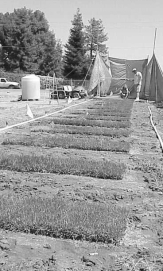
Field researcher Cindy Garretson (kneeling) of the Department of Pesticide Regulation prepares a turf plot for sprinkling during tests measuring diazinon runoff. Assisting in project operations (right) is CIT research technician Hercules Gonsalves. Bottom photo: One-liter bottles collect runoff water at end of each turf plot.
Thirty-two miniature turf plots are receiving special irrigation treatments at the Center for Irrigation Technology (CIT) this summer as part of a diazinon runoff study being conducted for the California Department of Pesticide Regulation (DPR).
Diazinon is one of the most common and widely-used insecticides in the state, applied by farmers, large-scale turf managers, and homeowners to control an assortment of insect pests ranging from spiders to mites. Diazinon can be applied to trees, shrubs and lawns, depending on the pest control need.
In spite of close diazinon monitoring by environmental protection agencies, small amounts have been detected in surface water in the Sacramento area and other areas of the state, noted Cindy Garretson, field researcher overseeing the diazinon study for DPR research scientist Frank Spurlock.
Some of the drinking water in Sacramento is drawn from the American River, and sampling is done frequently, Garretson said.
“They’re finding levels of diazinon in surface water more and more. So we’re looking to see if there is a contribution from sources other than agriculture.”
CIT technical staff are managing the research area. It features 32 two-by-five-foot plots of Kentucky blue grass. Half of the plots have been established on mounds with a five-percent slope. The other half are on a slope of two and one-half percent.
Garretson’s trials consist of making liquid and granular applications of diazinon to different plots, according to manufacturer’s specifications. Immediately following the applications, water is applied to each plot in amounts of one or two inches per hour, simulating sprinkler use or rainfall.
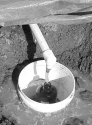
A metal container around each plot directs all water runoff to a funnel for collection. Twenty liters of runoff will be collected from each plot and sequentially analyzed for pesticide content.
“We want to see the concentrations in runoff over time,” she said.
There are few specifics known about homeowner use of diazinon, Garretson said. The DPR has assessed the landscape maintenance industry in the Sacramento area and is aware of Diazinon use, but it has been impossible to tell whether the additional parts per billion found in water sources such as the American River result from over-application or simply widespread use.
Drainage from lawns, following sprinkling or rain, could cause water flows into streets and gutters and other waterways, Garretson said.
Results of this study will hopefully begin to provide some answers, she added. Data analysis from the summer study should be completed by the DPR later this year.
CIT education events scheduled
Information and training in agricultural safety, pump testing and drip emitter basics will be offered this summer by the Center for Irrigation Technology (CIT).
Events are free of charge and will be held at Southern California Edison AGTAC in Tulare.
Events are as follows:
July 24 – Agricultural Irrigation Safety will detail the precautions all people involved in agricultural irrigation should be aware of. Topics will include basic water, electrical, and back safety.
August 2 – Pump Testing Basics is intended to give people with an interest in pumping plant efficiency an introduction into theory and procedures involved in pump testing. In addition to an overview of pump testing, the workshop will outline what is involved, skills and aptitude required, and the opportunities for further training and employment.
September 11 – Drip Emitter Basics will cover what type of emitter best suits your needs, how to evaluate emitter performance, quality, durability, and filtration requirements.
For workshop details, call CIT education specialist Tim Jacobsen at (559) 278-5752.
Viticulture and Enology Research Center
Pruning methods effective in Eutypa control
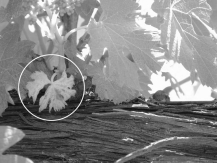
Research studies at a commercially-owned vineyard in California over the last several years have shown that pruning methods can significantly aid in the prevention of Eutypa dieback.
Eutypa dieback is a fungal disease that attacks grapevines all over the world, reported lead project researcher Sanliang Gu, who holds the Ricchiuti Chair of Viticulture Research at Fresno State’s Viticulture and Enology Research Center. The disease is not as “popular” in California as pests such as the glassy-winged sharp shooter, but it is just as deadly, Gu noted.
Once the fungus enters the vine, usually through pruning wounds, it causes dieback of spurs and arms, and eventually death of vines.
The only positive aspect of the disease is that it is slow in developing, Gu said: it can take three, four, five or more years for symptoms to become severe. Since there is no known cure, the grower has plenty of time to decide how to retrain or replace the vines.
“Hopefully, you will never see a vineyard severely infected with Eutypa,” Gu noted, “because before it reaches that stage the grower should have already pulled the vines out.”
The good news is that Eutypa appears to be preventable through use of modified pruning methods, Gu reported in the results of a study of Eutypa incidence in the Lodi area of California.
“In that area, this is a very important project, because of the problems they have had with Eutypa.”
“In that area, this is a very important project, because of the problems they have had with Eutypa,” Gu said. “We’ve seen some really encouraging results when using minimal and machine pruning methods.”
Minimal pruning eliminates dormant pruning and leaves no pruning wound to be infected by Eutypa fungus, Gu said. Mechanical pruning allows faster pruning at a very late date when susceptibility of pruning wounds to Eutypa infection is low. Comparable to late hand pruning, this method of pruning also exposes the pruning wounds to Eutypa infection for the shortest time possible.
There is one “conventional” method that has been proven to control Eutypa, Gu noted. That involves late hand pruning and painting every pruning wound with a fungicide every year. But that method is highly labor-intensive and expensive. The minimal pruning approach can save management costs, and mechanical pruning with hand follow-up is not necessarily higher in cost than conventional hand pruning.
The Eutypa study was initiated in 1992 in a commercial vineyard of Cabernet Sauvignon grapevines grafted onto Freedom rootstock. Training systems and pruning practices under evaluation include bilateral cordon and Sylvoz training with hand spur pruning, head training with hand cane pruning, mechanical pruning with and without hand follow-up, and minimal pruning.
No visual symptoms of Eutypa dieback have been observed so far on the minimally-pruned vines, Gu reported. On the other hand, symptoms of the disease were first noted on bilateral cordon and Sylvoz-trained vines with hand pruning in 1996. Since then, Eutypa has reached “strikingly high” incidence of 90 percent in those vines.
Gu acknowledged that minimal pruning is not a popular training method for vineyard managers, nor is mechanical pruning. However, as a researcher, Gu has certain goals in mind.
“First, we are trying to find a way to control Eutypa. Then we can go back and determine how well the methods serve growers,” he said.
Original funding for this project was provided by the Lodi-Woodbridge Winegrape Commission, Gu said. Additional funding has been provided by the California State University Agricultural Research Initiative (ARI) and the American Vineyard Foundation. Further funding is anticipated in order to continue the work. The study was conducted at Vino Farms Inc.
Gu is continuing to release results through various means. A detailed report will soon be available through the California Agricultural Technology Institute (CATI), which oversees ARI research.
See Eutypa, Page 7
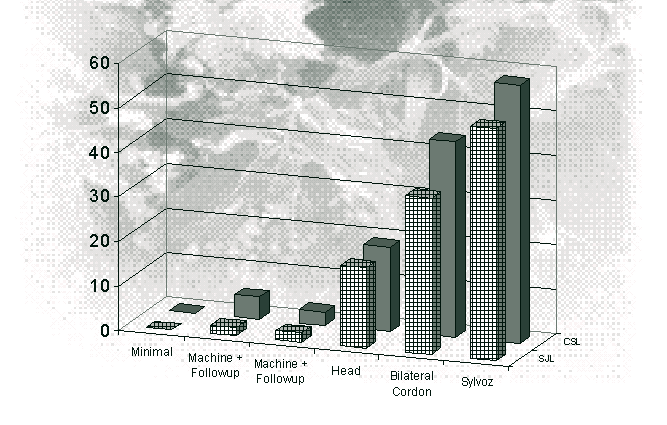
Figure above shows Eutypa incidence in vineyard with various treatment methods. The front and back rows of bars indicate soil types: SJL = San Joaquin loam, a low-water-capacity soil; CSL = Columbia silt loam, a high-water-capacity soil. Eutypa Incidence (percent of vines with leaf symptoms)
Site standards ensure accuracy of station data
As many of you know, about 65 percent of the weather stations on the CIMIS network are owned by local agencies. CIMIS continues to receive requests from local agencies seeking to buy, install, and connect weather stations to the network.
Because a weather station site can affect the accuracy of ETo data, the Department of Water Resources has prepared, with the help of the University of California, guidelines to assist local agencies find and judge prospective sites for CIMIS weather stations.
Buildings or trees close to a weather station can affect wind speed data, which in turn affects the estimated ETo. The absence of healthy green grass around a weather station affects humidity, which will adversely affect ETo. Bare soil instead of grass around the station can result in increased temperature and decreased humidity, which in turn increase the ETo value.
A CIMIS weather station should be located within the area that the station is meant to represent. The overriding factor in locating any CIMIS weather station is that the station location should be representative of the largest possible surrounding area. This ensures the most efficient use of weather stations for supplying accurate ETo information. The grass at the site should be well maintained, properly irrigated and fertilized, and mowed or grazed frequently to maintain a height between 4 to 6 inches.
For additional information on station siting, please visit the CIMIS website at wwwdpla.water.ca.gov/cimis.html, or call the local Department of Water Resources’ CIMIS representative.
Summary of regional, local, and immediate station surrounding siting criteria
Regional and Local Criteria:
- Site the station within the region it is meant to represent.
- Site the station away from topographic depression and high points.
- Maintain the same land use around the site.
Immediate Surrounding Criteria:
- Site the station away from wind obstructions.
- Place the station at a distance from areas where there are frequent land use changes.
- Site the station away from abrupt vegetation changes.
- Avoid roads within 100 yards of the site.
- Small rivers should be no closer than 100 yds. and large water bodies no closer than 1,000 yds.
Weekly ETo Comparisons for Fresno
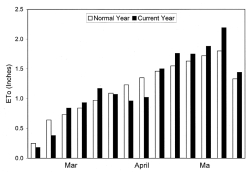
Chart shows ETo variation from normal over last three months.
Fresno: 3/01/00– 5/31/01
CIMIS Station #80
Fresno State
For more CIMIS information...
CIMIS information is published quarterly in the CATI Update newsletter. Articles are provided by the California Department of Water Resources, CIMIS program staff.
For more information about CIMIS or its programs, contact any of the following representatives at these offices:
Northern District
Jamie Dubay
(530) 529-7367
pixley@water.ca.gov
Central District
Mark Rivera
(916) 227-7603
mrivera@water.ca.gov
San Joaquin District
David Scruggs
(559) 230-3322
kframe@water.ca.gov
Southern District
Sergio Fierro
(818) 543-4652
sergiof@water.ca.gov
If you are unable to reach a CIMIS representative near you, call the CIMIS Helpline at 1-800-922-4647.
Visit the CIMIS home page at the following address:
wwwdpla.water.ca.gov/cimis.html
Bell Pepper report offers details on study of irrigation with air injection
A report on bell pepper growth and yield trials using subsurface irrigation with injected air has been completed by research scientist Dave Goorahoo of the Center for Irrigation Technology (CIT) and is now available for viewing or copying from the California Agricultural Technology Institute (CATI) website.
From the date of initial seedling planting to final harvest, the report offers documentation and analysis of the effects of aerated water on the overall yield of bell pepper plants. Initial trials showed that pepper plants irrigated with air-injected water had significantly higher yields than plants irrigated without the aerated water.
The pepper project was completed with support from the Mazzei Injector Corp., the Toro Ag Co., and CATI.
The report is entitled “A Pilot Study on the Impact of Air Injected into Water Delivered Through Subsurface Drip Irrigation Tape on the Growth and Yield of Bell Peppers.” It is available in portable document format (pdf) on the CATI website, located at cati.csufresno.edu.
Single print copies also may be requested using the order form below.
Results available in state ag teacher survey
Technology is a vital element in educating today’s youth, but how available is it to our teachers?
Michael Spiess, general manager of the Agricultural Technology Information Network (ATI-Net) and lecturer for Fresno State’s Plant Science Department, has focused research efforts to try to answer this question in the form of a survey conducted of secondary agricultural teachers all over California.
Results of the survey offer information regarding not only availability of technology for students, but also resources for teachers.
The survey report is entitled, “Computer Technology Use by California Agricultural Teachers.” It has been placed in portable document format (pdf) and may be viewed or printed from the California Agricultural Technology Institute (CATI) website, located at cati.csufresno.edu. Print copies also may be ordered using the form below.
Publications available
(These publications may be viewed in their entirety on CATI’s World Wide Web pages, located at cati.csufresno.edu. Single copies are also available by mail at no charge)
- A Pilot Study on the Impact of Air Injected into Water Delivered Through Subsurface Drip Irrigation Tape on the Growth and Yield of Bell Peppers, by Dave Goorahoo, Genett Carstensen, and Angelo Mazzei. Pub. #010201.
- Computer Technology Use by California Agricultural Teachers, by Michael Spiess. Pub. #010501.
Ordering Information:
Check the publication(s) desired and mail or fax form to:
CATI
California State University, Fresno
2910 E. Barstow Ave. M/S OF115
Fresno, CA 93740-8009
Fax: (559) 278-4849
Name
Company
Mailing Address
City State Zip
CATI on the Web!
For timely information about CATI, its research projects or centers, or to view text of research publications, visit us at cati.csufresno.edu.
Center for Agricultural Business (CAB) – cati.csufresno.edu/cab
Center for Food Science and Nutrition Research (CFSNR) – cati.csufresno.edu/cfsnr
Center for Irrigation Technology (CIT) – cati.csufresno.edu/cit
Viticulture and Enology Research Center (VERC) – cati.csufresno.edu/verc
Agricultural Technology Information Network (ATI-Net) – cati.csufresno.edu/atinet
Eutypa: Minimal pruning may not attract growers
from Page 5
For vineyard managers, nor is mechanical pruning. However, as a researcher, Gu has certain goals in mind.
“First, we are trying to find a way to control Eutypa. Then we can go back and determine how well the methods serve growers,” he said.
Original funding for this project was provided by the Lodi-Woodbridge Winegrape Commission, Gu said. Additional funding has been provided by the California State University Agricultural Research Initiative (ARI) and the American Vineyard Foundation. Further funding is anticipated in order to continue the work. The study was conducted at Vino Farms Inc.
Gu is continuing to release results through various means. A detailed report will soon be available through the California Agricultural Technology Institute (CATI), which oversees ARI research.
Roots: Three irrigation treatments to be applied
from Page 1
Applications of water and nitrogen fertilizer stimulate more active root growth, thus making the trees more efficient and productive in the long run.
“Better water management practices developed for peach will reduce water and nutrient losses on the farm, while increasing the efficiency in which water and nutrients are acquired by plants, thereby increasing yields per dollar invested,” Bryla said.
Irrigation treatments for the project comprise three methods: microsprayer, subsurface drip and conventional furrow. Each method also features treatments irrigated to 70 and 150 percent of normal, based on relative evapotranspiration data.
Nitrogen fertilizer also will be added at different levels during the first three years of tree growth, Bryla said.
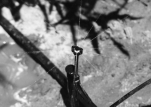
Microjet sprayer used for above-ground irrigation treatment.
To measure soil moisture content in relation to tree growth, special moisture sensing probes have been inserted in groups around selected trees at depths of 10, 25, 50 and 100 centimeters. Also installed along with the moisture probes will be soil solution samplers that will track movement and amounts of nutrients such as nitrogen and potassium.
To track root growth, researchers have installed clear plastic observation tubes one meter deep into the ground around the selected trees. Digital video cameras in the tubes will monitor root growth and send the information for analysis to an interactive software program developed by Duke University.
The study is in its third leaf and produced its first crop in May.
“Yields will be expressed per unit of water and nutrients applied,” Bryla said. “We will continue to measure yield and fruit quality for at least another three years.”
Information gleaned from the study will be used to advise peach and other stone fruit growers of the advantages and disadvantages of using various types of microirrigation systems and management practices for reducing production costs and increasing harvestable yields during early stages of tree development, Bryla said. Specific recommendations on placement of irrigation systems, irrigation scheduling, and water and nutrient applications rates also will be possible.
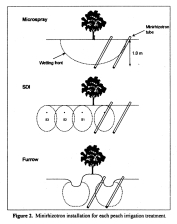
Illustration shows minirhizotron installation for three different peach tree irrigation treatments
For more information on this project, Bryla may be contacted through the ARS Water Management Research Laboratory in Fresno at (559) 453-3106 or at bryla@spininternet.com.
Publication information
Update is published quarterly by the California Agricultural Technology Institute
College of Agricultural Sciences and Technology
California State University, Fresno
Summer 2001
CATI Publication #010701
Voice number: (559) 278-2361
Fax number: (559) 278-4849
Director of Operations: Joe Bezerra
Publications Editor: Steve Olson
Editorial Assistant: Mike Rivera
California Agricultural Technology Institute
California State University, Fresno
2910 E. Barstow Ave. M/S OF115
Fresno, California 93740-8009
Non Profit Organization
U.S. Postage
PAID
Fresno, CA
Permit No. 262
Address Service Requested
In the event of incorrect address information or extra copies to your workplace, please return this address label by mail or fax with your requested changes. CATI fax number is (559) 278-4849.
This HTML version was generated with AI assistance and may contain errors or omissions. The original approved PDF remains the official document of record. An alternative accessible format is available upon request from the document creator in accordance with Title II of the ADA.