Update: Winter 2000-01
California Agricultural Technology Institute
California State University, Fresno
In this issue...
ARI projects planned — 2
AgSafe conference set — 3
Bell peppers produce — 4
Water issues addressed — 7
Satellites help steer tractor on campus farm
Global positioning system (GPS) technology eyed as focus of new research
On a foggy December morning, a tractor equipped with a global positioning system (GPS) computer draws perfectly parallel lines across a field on the Fresno State farm laboratory.
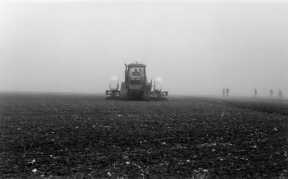
A new dimension of “power steering” was applied to a tractor doing fieldwork on the California State University, Fresno campus farm recently. Working in a dense December morning fog, the tractor traveled in perfectly parallel paths in an open field without the use of field markers or mechanical tracking devices. It pulled a six-row lister, which prepared seedbeds and furrows for planting the next cotton crop.
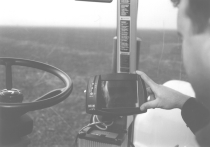
The tractor’s steering was controlled by global positioning system (GPS) technology. Each time the operator positioned the tractor in line for a pass, he was able to release the steering wheel and tend to other controls while the tractor completed each pass to within one inch of the center line from where it started.
GPS is considered by many to be the next significant technology breakthrough for mechanized agriculture. Using satellites to track the travel of a tractor or other equipment unit across the ground, GPS technology can enable growers to make precision applications of water, fertilizers, pesticides or other materials in selected areas of a field, thus decreasing materials use and increasing crop yields by significant percentages.
The Fresno State demonstration featured the use of a Beeline Navigator® guidance system fitted to a John Deere tractor. The Beeline system includes three key components: the tractor, fitted with an on-board computer and electronic override module connected to the power steering system; a stationary radio transmitter located near the field; and U.S. military satellites circling the earth.
With the dimensions of the field and the farm implement logged into the tractor’s computer system, an on-board radio transmitter communicates with at least three satellites simultaneously to fix the tractor’s position and guide its travel back and forth. The stationary transmitter nearby also communicates with the satellites and with the tractor computer, serving to correct any errors generated by “atmospheric anomalies.”
GPS technology is already being used by large farming operations on the West Side of the central San Joaquin Valley, noted Carl Pherson, director of Fresno State Agricultural Operations. “Straight, precisely located crop rows are not simply a matter of farmer pride,” Pherson said. “Ability to precisely plant, cultivate, and apply materials has economic, agronomic and environmental payoffs. Further, employers of our graduates are rapidly adopting this technology and expect them to possess knowledge and operational expertise upon graduation.”
The use of GPS technology is being explored not only for use on the university farm, but also by researchers with the California Agricultural Technology Institute (CATI). In one project under way, computer software specialists are seeking to improve the efficiency of mapping technologies, which use overhead photography and remote sensing to measure crop growth, soil moisture content, and other field or crop conditions.
CATI researchers are discussing opportunities for further experimentation with major West Side growers, reported director Joe Bezerra. Funds allocated through the California State University Agricultural Research Initiative (CSU/ARI) will soon be available for the 2001-02 funding cycle. Individuals or businesses interested in partnering with the university in research may contact CATI for more information at (559) 278-2361.
Research to be featured at farm show
Research specialists from the California Agricultural Technology Institute (CATI) will be on hand to discuss their work during the World Ag Expo to be held Feb. 13-15 at the International Agri-Center in Tulare, California. As it did last year, CATI will host an exhibit booth at the expo, in the northeast corner of Pavilion C, the education pavilion. Staffing the booth will be CATI administrative and staff personnel, as well as faculty and students involved in applied research.
Posters and other information will be available for a number of projects currently funded by the California State University Agricultural Research Initiative (CSU/ARI).
Formerly known as the “Tulare Farm Show,” the World Ag Expo has adopted its new name to represent the global attraction it has become. Visitors and exhibitors come from all over the globe to see displays of the latest in virtually all types of agricultural equipment and technology. Members of the agricultural community are invited to stop by to learn about the latest research CATI is involved in.
High interest shown for coming-year ARI research
Research scientists from throughout the California State University system are finalizing proposals this month for applied agricultural research to be funded by the Agricultural Research Initiative (ARI).
The ARI is administered by the California Agricultural Technology Institute (CATI) and provides approximately $4 million annually for applied research in natural resources management as well as agriculture. Research projects are awarded annually through a competitive proposal process, with all ARI grants requiring at least dollar-for-dollar matching support of cash, services or supplies from private industry or other collaborative sources.
The Call for Proposals for 2001-02 research was issued in December. More than 40 pre-proposals already have been reviewed. The Request for Full Proposals is to be issued Jan. 29, with the deadline for submission set at March 23.
ARI projects will be led by scientists from four CSU campuses: California State University, Fresno; California State Polytechnic University, Pomona; California State University, Chico; and California Polytechnic State University, San Luis Obispo.
Proposal submission, review and funding is overseen by the ARI Board of Governors, which includes the presidents of the ARI’s four participating CSU campuses, the vice president of Agriculture and Natural Resources for the University of California, and four private industry representatives. Project administration is overseen by Joe Bezerra, CATI director of operations and executive director of the ARI.
Researchers from the University of California, the U.S. Department of Agriculture and other institutions also are expected to participate. ARI research is designed to improve the economic efficiency, productivity, profitability, and sustainability of California agriculture and its allied industries, and to enhance our environment by improving management of our natural resources.
For more information about ARI research and proposal information, contact CATI at (559) 278-2361.
ARI Research Priorities
- Agricultural business
- Biodiversity
- Biotechnology
- Food processing, safety, nutrition, and new food product development
- Irrigation management and technology
- Natural resources
- Production management systems and cultural practices
- Public policy
Annual safety conference slated for February 7, 8
More than a dozen specialists in different aspects of agricultural safety will be on hand to share their expertise at the seventh annual AgSafe Conference scheduled for Feb. 7 and 8 in San Luis Obispo, California.
Growers, managers, supervisors, safety professionals and others in agriculture and related fields are encouraged to attend this premier educational event, said Kimberly Naffziger, program development specialist for the Center for Agricultural Business (CAB). The conference will offer more than 30 workshops, table-top displays of the latest safety equipment, services and supplies, keynote presentations and a networking reception.

First keynote presenter will be Guadalupe Sandoval, director of risk management services for Daugherty and Company-USI. Sandoval will speak Wednesday morning on “Achieving Safety Excellence in Agriculture and Elsewhere.” Thursday’s luncheon will feature a keynote address by Valentine DiCerto, an independent “productivity catalyst,” who will speak on “Net Gain: Safety’s Motive for an Easy Sell.”
Another feature presentation will be given by John Avila, deputy sheriff assigned to a major narcotics unit in central California. Avila will discuss the “Hazards of Clandestine Labs and the Agricultural Influence.”
In addition to the keynote addresses, classes will be offered on safety management, workers’ compensation, ergonomics, safety compliance for growers and farm labor contractors, regulations for transporting pesticides and chemicals, and other topics. A number of supervisor training classes will be offered in both English and Spanish, including ammonia safety and pesticide handling.
Continuing education hours have been approved from the state Department of Pesticide Regulation for many of the classes, including hours offered in laws and regulations, Naffziger said.
The conference will be held at the Embassy Suites Hotel. It is sponsored by AgSafe; CAB and the California Agricultural Technology Institute at California State University, Fresno; the Environmental Safety and Health Program at University of California, Davis; and the National Institute of Occupational Safety and Health. In addition, the San Luis Obispo County Farm Bureau is hosting the event.
Cost to attend the entire conference is $185 for AgSafe members and $250 for non-members for registrations postmarked by Jan. 26. Fees after that date increase $20. Special discounts are also available.
For more information on the conference or AgSafe membership, call (559) 278-4404, or visit the CAB website at cati.csufresno.edu/cab.
Researcher offers management portfolio
The fundamentals of futures trading have been outlined in a new portfolio of computer programs released by Fresno State agricultural economics professor James Cothern.
The portfolio is part of a CATI project to develop professional educational tools for the agricultural and agribusiness communities. The goal of Cothern’s efforts is to offer computer and Internet programming as a means of analyzing risk management in agricultural production.
One part of the portfolio consists of two sets of Microsoft Power Point slides. The first set of 26 slides introduces the individual to the fundamentals of futures trading. The second set of 22 slides provides an introduction to hedging.
Another part of the portfolio is a program, written by Cothern, called Trader. Trader may be used to track trades or it may be used by an instructor for classroom or workshop simulated trading experience. Trader tracks daily trades for more than 40 participants or accounts. It provides a report of daily trades and summarizes trades of all individuals and accounts. An integrated, context sensitive help program is also part of the program. It is written in Microsoft Excel.
The portfolio may be downloaded at http://zimmer.csufresno.edu/~jamesco/Fut_Trade.htm. Cothern’s main website also includes other agribusiness information and programs, as well as links to sites of value to the beginning or intermediate student interested in learning futures trading fundamentals.
Upcoming events
Feb. 7-8 – 7th Annual AgSafe Conference. See article above for details.
Feb. 27 – Train-the-Trainer (T-3) for Pesticide Handlers and Fieldworkers, from 8 a.m. to 5 p.m. at the California Agricultural Technology Institute in Fresno, California. For details call (559) 278-4405.
March 14 – Fresno Safety Breakfast Meeting. Topic: Implementing Early Return to Work Programs, from 7:30 to 9 a.m. at the California Agricultural Technology Institute. For details call (559) 278-4405.
March 21 – Salinas Safety Breakfast Meeting. Topic: Reducing Repetitive Stress Injuries in the Agricultural Workplace, from 7:30 to 9 a.m. at the Grower Shipper Vegetable Association in Salinas, California. For details call (559) 278-4405.
Center for Irrigation Technology
Air injection in bell pepper study brings significant yield increases
A new approach to subsurface drip irrigation (SDI) on a vegetable crop has shown striking yield improvements in small-scale production trials overseen by staff of the Center for Irrigation Technology (CIT).
The trials featured injection of air into drip lines, so that the water applied had a volume of approximately 11 percent air. Comprehensive harvest data for one growing season showed that bell pepper plants irrigated with the aerated water produced 33 percent more peppers with 39 percent greater weight than plants irrigated with non-aerated water, reported project director Ed Norum, consulting engineer for CIT.
Modifying root zones of plants has long been a subject of interest among growers and researchers, Norum noted in explaining the impetus for the study. Well-aerated soil is known to provide a better environment for root development and plant growth. Unfortunately, single-purpose air injection systems have typically proven too costly for successful commercial application. With advances in SDI technology, that could change.
“With the acceptance of subsurface drip irrigation by commercial growers, the air injection system is at least potentially available in the form of the SDI system,” Norum said. “The concept of saturating the irrigation water with air has at least the potential for the air to move with water within the root zone more generally and affect crop growth.”
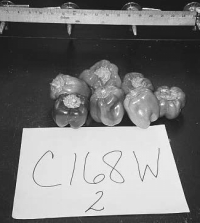
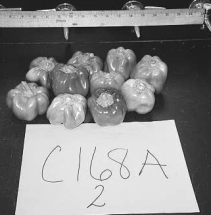
Photos at right and above show yield differences of pepper plants irrigated with regular and air-injected water. Section C168W at right was without air; section C168W above was aerated.
The experimental plot was approximately one-third acre. Soil cover over the drip line was five to six inches, and plant rows were 190 feet long. Treatments consisted of SDI with untreated water and SDI with 11 percent injected air. Treatment plots consisted of two rows per treatment, with four replications of each treatment.
For air injection into the drip lines a manifold was constructed using a Mazzei model 584 differential pressure injector. Once the stands were established, irrigations were conducted every seven days using reference ETo information.
In addition to yield data, researchers also measured dry weight and root mass of selected plants from the different treatments. Results indicated generally greater dry weight and larger root mass in those plants which had received aerated water.
Norum noted that distance of plants from the drip tape inlet at the beginning of each row could be a significant factor in the process. The data suggest that “the major effect of the injected air is within the first 150 feet of the drip tape inlet,” he said. In commercial production rows can extend as long as 680 feet. Nevertheless, the small-plot results are sufficiently encouraging to justify further trials on plots approaching commercial scale, he said.
Project funding support and the air-injection equipment was supplied by the Mazzei Injector Co. of Bakersfield, California. Drip tape and related fittings were supplied by Toro Ag of El Cajon, California.
February seminars will address irrigation issues
Four seminars addressing agricultural irrigation issues will be held next month in Tulare and Salinas.
The seminars represent an expansion of CIT educational activities resulting from an education endowment established in 1998. The endowment allowed for the hiring of education specialist Tim Jacobsen, who is developing and coordinating the seminars.
Additional seminars are being planned for March and April and beyond. Visit the CIT website at cati.csufresno.edu/cit, or call (559) 278-2066 for more information. Details on the four February workshops are presented below:
Feb. 9 – Dairy Waste Management Seminar, to focus on research at California State University, Fresno and the use of mechanical move sprinklers in dairy waste management, at the Edison AgTAC in Tulare, from 1:30 to 5 p.m.
Feb. 13 – Micro-irrigation Seminar, to address system installation, operation, and scheduling, at Edison AgTAC in Tulare, 8 a.m. to 3 p.m.
Feb. 22 – Vegetables West Expo/Central Coast Irrigation and Nutrition Management Conference, to focus on precision agriculture and the impact of new regulations on irrigation and chemical use, at the Salinas Community Center, Salinas, 7 a.m. to 3 p.m.
Feb. 26 – Determining Pumping Efficiencies and Costs, to demonstrate techniques involved in determining pumping plant efficiency and quantifying costs involved in pumping water, at Edison AgTAC in Tulare, 8:30 a.m. to noon.
Viticulture and Enology Research Center
Irrigation treatments reduce pest numbers
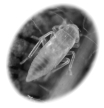
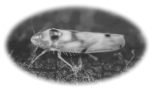
Irrigation trials on two wine vineyards in central California have shown that deficit irrigation of vines had significant reducing effects on western grape leafhopper populations.
The trials, which took place in the summer of 2000, featured deficit irrigation treatments on cabernet sauvignon grapevines in vineyards in the Firebaugh and Paso Robles areas. In each case where water applications were reduced, numbers of leafhopper nymphs were reduced.
Yields in the two plots also were reduced significantly. However, in both cases the color intensity and brix levels of the grapes increased, which offers the potential for improved wine quality, reported Michael Costello, a viticulture researcher conducting the study with support from the California Agricultural Technology Institute (CATI).
“There is no question that the objective of reducing leafhopper numbers was achieved at each site, which confirms the dependence of leafhopper nymphs on vine water status,” Costello said of the study.
He began the project as part of a team study with former Fresno State plant science professor Mark Mayse. Mayse, who headed the university’s integrated pest management (IPM) program for years, died in June 2000 following a battle with cancer.
A key aspect of IPM research is the integration of multiple disciplines into a vineyard management program, using irrigation and/or other treatments “to promote development of a healthy vine that is less susceptible to outbreaks of insect pests, and, at the same time, produce a crop with the potential for improving grape quality,” Costello said. In this approach, efforts are focused on cultural and biological controls so that chemical treatment is minimized.
Deficit irrigation practices on vineyards have been tested in the past mainly as a water-saving strategy and as a way to increase sugar content in grapes, Costello noted. More recent research has shown a correlation between vine water status and leafhopper levels. The current study focused on specific timing of deficit irrigation, with treatments applied between berry set and veraison, Costello said.
In the Firebaugh vineyard, on the west-side San Joaquin Valley, the treatment was 40 percent of standard ET for that area. In Paso Robles, located in the eastern foothills of the Coast Range mountains, the deficit irrigation treatment was 20 percent of ET.
In the Firebaugh vineyard the brix and color intensity level of berries increased only slightly, while yield was reduced by nearly two tons per acre. In the Paso Robles vineyard, however, brix increased from 20.8 to 22.8, while yield decreased from 6.6 to 5.7 tons per acre.
“There is a better chance that the one-ton-per-acre yield loss at the Paso Robles site could be offset by a higher premium for quality,” Costello said. “It is also possible that at each site, increasing the cluster load in the deficit irrigation treatment could compensate for smaller berry size.”
Collaborating on the project with Costello were Sanliang Gu, who holds the Ricchiuti Chair of Viticulture Research at Fresno State’s Viticulture and Enology Research Center, and Keith Patterson, viticulture professor at California Polytechnic State University, San Luis Obispo. Details of the project will soon be available on the CATI web site, located at cati.csufresno.edu.
Annual issues conference set for March
Grape growers and vintners from throughout California are expected to attend the fourth annual Central Coast Viticulture and Enology Issues Conference on March 8 and 9 in Santa Maria.
The conference is designed for professionals in the grape and wine industry, as well as for those seeking careers in the field. Speakers will address current grape and wine issues and will lead panel discussions and tours to local vineyards and wineries.
This year’s event will focus on grapevine water management.
“This conference is intended to provide growers with the detailed, fundamental knowledge to achieve the goals of increased efficiency with equal or better yield and quality,” said Robert Wample, director of the Viticulture and Enology Research Center (VERC).
“As the interface between vineyards and our surrounding communities becomes more intense, we need to be proactive in our management practices to be as efficient and environmentally friendly as possible,” he said.
The conference is sponsored by VERC and Allan Hancock College’s Enology and Viticulture Program. It will be held at the Santa Maria Airport Regency Hotel and Conference Center. Registration fee is $145, reduced to $130 for preregistration by Feb. 22. Student and other discounts are available. For registration details, call VERC at (559) 278-2089. For sponsorship information, call (559) 278-7135 or email cyntiaw@csufresno.edu.
Station numbers increase in 2000
Twelve new CIMIS stations were installed and five stations were removed in 2000. A list of the stations is presented in the table below.
| Station | Name | County | Installed | Removed |
|---|---|---|---|---|
| Stations Installed in 2000 | ||||
| 152 | Camarillo | Ventura | 01/21/00 | |
| 158 | Bennett Valley | Sonoma | 12/28/00 | |
| 163 | Atascadero | San Luis Obispo | 11/21/00 | |
| 164 | Valley of the Moon | Sonoma | 04/01/00 | |
| 165 | Sisquoc | Santa Barbara | 04/26/00 | |
| 166 | Lodi West | San Joaquin | 09/13/00 | |
| 169 | Porterville | Tulare | 08/20/00 | |
| 172 | Lost Hills NW | Kern | 07/26/00 | |
| 173 | Torrey Pines | San Diego | 11/29/00 | |
| 174 | Long Beach | Los Angeles | 09/22/00 | |
| 176 | La Quinta | Riverside | 11/10/00 | |
| 177 | Watsonville West | Santa Cruz | 11/30/00 | |
| Stations Removed in 2000 | ||||
| 72 | Palo Verde | Imperial | 09/08/87 | 12/20/00 |
| 81 | Shenandoah Valley | Amador | 05/11/90 | 05/17/00 |
| 97 | Port Hueneme | Ventura | 02/16/91 | 07/31/00 |
| 100 | Fremont | Alameda | 08/29/91 | 06/19/00 |
| 120 | Guadalupe | Santa Barbara | 12/24/93 | 11/28/00 |
Weekly ETo Comparisons for Fresno
Fresno: 9/01/00–11/31/00
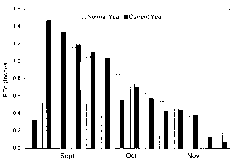
Chart shows ETo variation from normal over last three months.
CIMIS will unveil new web site in Fresno
In the last issue of Update, there was an article about a new CIMIS web site that was expected to go on line by January 2001. Unfortunately, the consulting firm that was building the new web application underwent major personnel changes and did not deliver the application on schedule. The application was delivered in December 2000, and will be beta tested in January 2001.
The new web site is now expected to go on line in February 2001. It will be unveiled during the 39th Annual California Irrigation Institute Conference, set for January 30 and 31, in Fresno.
Visit the CIMIS home page at the following address: wwwdpla.water.ca.gov/cimis.html
For more CIMIS information...
CIMIS information is published quarterly in the CATI Update newsletter. Articles are provided by the California Department of Water Resources, CIMIS program staff.
For more information about CIMIS or its programs, contact any of the following representatives at these offices:
- Northern District: Eugene Pixley, (916) 529-7392, pixley@water.ca.gov
- Central District: Mark Rivera, (916) 227-7603, mrivera@water.ca.gov
- San Joaquin District: Kent Frame, (559) 230-3334, kframe@water.ca.gov
- Southern District: Sergio Fierro, (818) 543-4652, sergiof@water.ca.gov
If you are unable to reach a CIMIS representative near you, call the CIMIS Helpline at 1-800-922-4647.
Institute formed to address water issues

State Senator Jim Costa (left center in white shirt) leads one of several strategy sessions held Oct. 26 as part of a day-long planning meeting for the new San Joaquin Valley Water Institute.
One of the driest fall seasons on record in California will likely result this year in summer and fall seasons of serious water shortages in San Joaquin Valley agricultural and urban areas.
Perhaps the only good news is that leaders of the irrigation industry and water use agencies are already geared up to address the problems through the newly-formed San Joaquin Valley Water Institute.
Center for Irrigation Technology Director David Zoldoske was a key contributor to the initial organizing session of the institute, which was held last fall at the California Agricultural Technology Institute (CATI) and included some 50 government and business leaders and top water officials from throughout the state.
Formation was authorized last year when California voters approved Proposition 13, a $2 billion bond measure that included $3 million in seed money for the institute.
State Senator Jim Costa of Fresno, along with Assemblyman Mike Machado of Stockton, co-authored the portion of Proposition 13 providing funds for the institute. It will be housed at Fresno State, with Karl Longley, dean of the College of Engineering and Computer Science, serving as director and Zoldoske as associate director.
Leaders envision the institute providing water policy advice to local, state and federal agencies and helping private companies and individual farmers to better manage water supplies. Specific responsibilities will be to promote practices that enhance and preserve water resources and quality; to carry out and support scientific research; to oversee information transfer pertaining to water resources and quality; and to promote collaboration among all San Joaquin Valley water issues.
Key issues to be addressed include the following:
- Over-pumping of groundwater — in an average year, 1.5 million more acre-feet are pumped out of the groundwater basin than is replenished.
- Urban growth that is taking water away from agriculture — California’s population is projected to jump from about 34 million to 50 million in the next 20 years, with much of that growth occurring in the San Joaquin Valley.
- Conflict over water supplies in the Sacramento-San Joaquin Delta — the transfer point for much of the state’s water supply.
- A growing pollution problem — in which salts, nitrates, pesticides and other contaminants are degrading streams and groundwater.
“The goal of the institute is to bring together ag, urban, and environmental groups to develop a shared vision of how our water resources will be utilized.”
The over-riding goal of the institute, Zoldoske said, will be to “bring together ag, urban and environmental groups to develop a shared vision of how our water resources will be utilized in the future.” This will be of immediate importance as the consequences of drought loom ever larger on California’s agricultural horizon, he said.
Show: ARI research will be discussed
Featured include a study of ammonia emissions as related to nitrogen fertilizer applications, the addition of sulfuric acid to dairy lagoon water to reduce pH, and the use of global positioning system (GPS) technology for precision farming.
Formerly known as the “Tulare Farm Show,” the World Ag Expo has adopted its new name to represent the global attraction it has become. Visitors and exhibitors come from all over the globe to see displays of the latest in virtually all types of agricultural equipment and technology. Members of the agricultural community are invited to stop by to learn about the latest research CATI is involved in.
Air: Row length may be factor in yield results
The experimental plot was approximately one-third acre. Soil cover over the drip line was five to six inches, and plant rows were 190 feet long. Treatments consisted of SDI with untreated water and SDI with 11 percent injected air. Treatment plots consisted of two rows per treatment, with four replications of each treatment.
Materials used in the project included Toro-Ag blue stripe drip tape rated 0.34 gallons per minute per 100 feet under pressure of eight pounds per square inch.
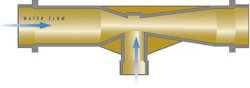
For air injection into the drip lines a manifold was constructed using a Mazzei model 584 differential pressure injector. Once the stands were established, irrigations were conducted every seven days using reference ETo information.
In addition to yield data, researchers also measured dry weight and root mass of selected plants from the different treatments. Results indicated generally greater dry weight and larger root mass in those plants which had received aerated water.
Norum noted that distance of plants from the drip tape inlet at the beginning of each row could be a significant factor in the process. The data suggest that “the major effect of the injected air is within the first 150 feet of the drip tape inlet,” he said. In commercial production rows can extend as long as 680 feet.
Nevertheless, the small-plot results are sufficiently encouraging to justify further trials on plots approaching commercial scale, he said.
Project funding support and the air-injection equipment was supplied by the Mazzei Injector Co. of Bakersfield, California. Drip tape and related fittings were supplied by Toro Ag of El Cajon, California.
Water: Work may expand to state-wide level
Work of the San Joaquin Valley Water Institute may be expanded to address state-wide water issues as well, Zoldoske noted. Some of its work also may overlap that of the existing Central Valley Water Education Center (CVWEC), which was formed in 1997 with support from the federal Bureau of Reclamation, CIT and California State University, Fresno.
Primary purpose of the CVWEC is to provide public education on water issues and to foster cooperation among water users in the central San Joaquin Valley.
For information on becoming involved in water issues, call CIT at (559) 278-2066 or contact Zoldoske via email at david_zoldoske@csufresno.edu.
California Agricultural Technology Institute
California State University, Fresno
2910 E. Barstow Ave. M/S OF115
Fresno, California 93740-8009
Update is published quarterly by the California Agricultural Technology Institute
College of Agricultural Sciences and Technology
California State University, Fresno
Winter 00-01
CATI Publication #010101
Voice number: (559) 278-2361
Fax number: (559) 278-4849
Director of Operations: Joe Bezerra
Publications Editor: Steve Olson
Address Service Requested
This HTML version was generated with AI assistance and may contain errors or omissions. The original approved PDF remains the official document of record. An alternative accessible format is available upon request from the document creator in accordance with Title II of the ADA.