Update: Spring 2000
CALIFORNIA AGRICULTURAL TECHNOLOGY INSTITUTE
SPRING 2000
In this issue...
- From the director ................ 2
- New soil scientist ................. 4
- Coastal conference set ......... 5
- CIMIS info .......................... 6
California State University, Fresno
New VERC director embraces California opportunity
A viticulture research specialist with an eye for San Joaquin Valley production issues has come to Fresno State as the new director of the Viticulture and Enology Research Center (VERC).
Robert L. Wample, Ph.D., of Washington, was appointed VERC director in February following an international search. He will formally assume his duties in May.
The new director comes to VERC after serving more than 20 years in various teaching and research positions at Washington State University in Pullman, Washington. His most recent position was professor/horticulturist/viticulturist for the university’s Irrigated Agriculture Research and Extension Center located in Prosser, Washington.
Asked what prompted him to make the move to California, the new director comfortably replied in one word: “Opportunity,” he said.
“What I see is the potential for this program to become one of the best, if not the best, for viticulture and enology research and training in the world. The potential is there.”
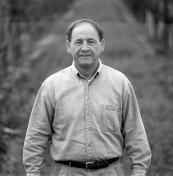
Although he has spent the last 23 years in Washington, Wample has engaged himself in viticultural research issues that are of key significance to California’s grape and wine industry. He and several colleagues from Washington State were among the first to experiment with global positioning systems (GPS) technology to monitor yields in relation to mechanical pruning and fertilizer application. In fact, Wample himself gave two presentations on mechanical pruning at the first Vincent E. Petrucci Viticulture Symposium held at Fresno State in 1996.
His priorities for applied research at VERC will include mechanization, precision farming, and irrigation management.
“Water will be an issue here,” he said. In the face of possible regional water shortages for crops, “I hope to see the grape and wine industry here be a leader in efficient irrigation practices, so that we will have answers rather than be scrambling for answers when the questions come.”
See Director, Page 5
New CATI logo signals, stronger, broader mission
Notice anything different? Yes, CATI has a new color, a new logo, and a new look that will continue to emerge in 2000.
Does that mean a major change in our mission to California agriculture? No. The California Agricultural Technology Institute enters the year 2000 with the same mission as originally established in 1984 — dedicated to improving the economic performance and sustainability of California agriculture through applied research. Applied means practical, useful and applicable today by the farm and agribusiness industries that encourage and support our work.
Yes, a number of our research efforts do have multi-year and long-term objectives; but the key is in the applicability of the results as they come in. That could mean offering the industry an innovative strategy for vineyard pest control, a more efficient row crop irrigation system, a new food processing method, or an “employee-friendly” plant management policy that reduces injuries by 50 percent.
See Mission, Page 2
From the director
Industry, state investments will yield exponential benefits
Interest in and response to the first California State University Agricultural Research Initiative (CSU/ARI) call for proposals has been phenomenal! The research community has embraced the ARI opportunity with tremendous enthusiasm. In excess of 217 CSU, UC, UC Extension, and industry researchers and cooperators from more than 126 colleges, departments, extension offices, and industry organizations collaborated to submit 183 research proposals totaling $14,221,651 in ARI funding requests.
The total value of all proposals submitted, including all documented matching support, equaled $25,683,891. Additionally, at the time this article was written, these ARI proposals have pending companion proposals submitted for additional external funding valued at $9,824,168.
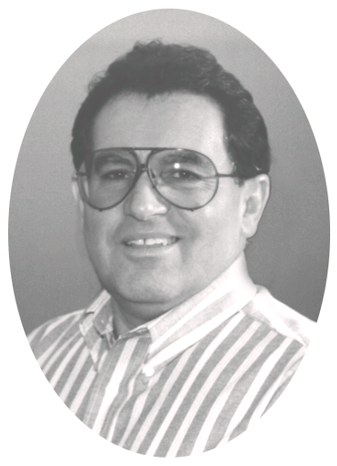
Joe Bezerra
The research community has embraced the ARI opportunity with tremendous enthusiasm
I am extremely pleased to report that as I was writing this Update article, ARI campus coordinators and I were busy writing 100 project funding award letters totaling nearly $5,000,000. All these successful projects have generated industry external matching support, and they address identified high-priority issues.
Projects vary in ARI funding support, from total dollar amounts of less than $10,000 to nearly $300,000, and some have received as much as 2.2 to 1 matching funds in additional external industry support.
Projects range in duration from one to three years and cover a broad range of topics, from agricultural public policy and agricultural literacy to biotechnology, food processing, food safety, and cultural and production practices.
The second ARI call for proposals, which will provide funding for fiscal year 2000/2001, will be announced April 3.
It has been immediately apparent, from the response to the first ARI funding cycle, that the university, industry and state investment will reap exponential benefits from this new funding allocation. ARI funding has provided new collaborative research opportunities for more CSU research staff and faculty as well as for graduate and undergraduate students. It has also provided the opportunity to simultaneously address a greater range of industry priority issues. The resulting research activities will ensure stronger collaborative relationships among researchers across all university systems and industry, provide for enhanced graduate and undergraduate academic programs, and serve as a regional economic development catalyst.
Mission: Additional funding brings growth, change
from Page 1
irrgation system, a new food processing method, or an "employee-friendly" plant menagement policy that reduces imjuries by 50 percent.
While we will continue our focus on applied research, CATI is growing, changing, and becoming even more widely recognized as a leader in applied research. This was evidenced most recently by the state Legislature through its approval of the new California State University Agricultural Research Initiative (CSU/ARI). This system-wide funding mechanism will channel up to $5 million per year in state monies through CATI to support agricultural, natural resources and other types of research at California State University, Fresno and three other strong agricultural universities in the CSU system. This funding will require minimum dollar-for-dollar matches in industry support and service. The other universities are California State Polytechnic University, Pomona; California State University, Chico; and California Polytechnic State University, San Luis Obispo.
CATI will administer the funding of this system; therefore, the new set of logos for CATI and its research centers will have a similar look to the new CSU/ARI logo. The new logos establish CATI and its centers as distinct, yet part of the same team as the CSU/ARI.
More information on the CSU/ARI will continue to be released through CATI as the program unfolds. In the meantime, examine the new research center logos as they appear on new informational pieces, on the remodeled CATI web site, and on new research publications as they become available.
As the new CATI brochure states, CATI is “Working Together” with industry, government and the educational community to maintain strong support for applied agricultural research, and CATI is now “Leading the Way” to expand this type of research to other disciplines throughout the CSU system.
Center for Agricultural Business
Second-year tests of barrier hand lotion prove inconsistent
Two seasons of trials have brought mixed results to a team of researchers testing the capability of a special polymer skin lotion to prevent dermal absorption of pesticide residues.
Following favorable results in 1998, a second season of tests in 1999 brought inconsistent numbers to Fresno State Animal Science professor Michael Thomas and UC Riverside agricultural toxicologist Robert Krieger. Their aim was to learn weather the lotion, when applied to farm workers’ hands, would block absorption of undesirable chemicals.
“It is known by previous studies that pesticides indeed are absorbed in small quantities by dermal absorption,” Thomas noted in explaining the impetus for their study. “It is also known that the most significant exposure is through the skin of the fingers and hands,” he said. In an effort to resolve the problem, the researchers tried a lotion containing an inert polymer that has been shown to provide long-lasting protection to the skin surface. When properly applied, the polymer coating dries and resists intrusion by an assortment of chemicals.
The studies focused on workers picking strawberries in fields routinely treated with the insecticide malathion. Comparisons were made among workers who did not apply lotion, who did apply the lotion, and who did not apply lotion but used gloves.

Pesticide amounts were determined by toxicological tests of the urine.
The results of the first trial were encouraging, suggesting that workers who applied the hand cream absorbed fewer chemicals, Thomas said. However, the second trial results were very inconsistent. There were slight differences in the time of application in the second study.
“With these mixed results, we’re looking for a product that would perform more reliably. Further work with the protective lotion needs to be done before recommending its use to farm workers,” Thomas said.
Funding for the study was provided through the Center for Agricultural Business. A brief report titled “Dermal Absorption of Pesticides in Farm Workers” can be ordered using the form on Page 7. It also may be seen on the CAB web site at cati.csufresno.edu/cab.
Harris Ranch to host third annual summit
Legal and legislative updates of California law will be offered at the Third Annual Agricultural Labor and Employment Summit set for May 4 at the Harris Ranch in Coalinga, California.
The half-day summit will address the new overtime (AB 60) law, farm worker transportation, sick leave, Social Security “mismatches,” and other issues.
Speakers include L. George Daniels III of the Farm Employers Labor Service; Hector Madrigal of the California Highway Patrol’s SAFE Program; Gilbert S. Molena of the U.S. Department of Labor’s Wage and Hour Division; and E. Mark Hanna and Michael C. Saqui of the law firm of Barsamian, Saqui and Moody.
The Center for Agricultural Business (CAB) is a summit sponsor. Registration fee is $40. For registration details, call (559) 278-4405.
Symposium will address new labor, employment laws
New California laws affecting labor and employment in the grape and wine industries will be the subject of discussion at a symposium set for April 28 in Paso Robles, California.
This first-time event has been organized through a joint effort of Fresno State’s Center for Agricultural Business (CAB) and the Paso Robles Vintners and Growers Association.
A number of new state laws approved this year, including AB 60, the overtime obligation law, are directly impacting the way agricultural business is conducted, and many business leaders are seeking help in interpreting various aspects of the laws, stated Kimberly Naffziger, program development specialist for CAB.
In responding to this need, CAB and the vintners association have called on the Barsamian, Saqui & Moody law firm of Fresno, California. During the day-long symposium, law firm specialists will lead seminars titled “Legislative Update: Hot Topics in Labor and Employment Law,” “Drugs, Sex and Violence in the Workplace,” and “Dealing with the Injured Worker.”
A luncheon address entitled “The Character Ethics of Business” will be provided by Valentine A. DiCerto of DiCerto Enterprises. In addition, a panel of industry and state government representatives will address “Farm Worker Transportation Issues.”
The symposium is recommended for anyone involved in management and labor issues in the agribusiness arena, Naffziger said, including business owners, growers, managers, supervisors, farm labor contractors, custom harvesters, and labor relations and human resource professionals.
The event will be held at the Special Events Center of the California Mid-State Fairgrounds. General registration fee is $75, discounted to $55 for members of the Vintners and Growers Association. Additional discounts to $70 and $50, respectively, are available for registrations postmarked on or before April 21, 2000.
For registration information, call (559) 278-4405 or visit the CAB web site at cati.csufresno.edu/cab.
Center for Irrigation Technology
Soil scientist will bolster CIT research efforts
Dave Goorahoo will focus on movement of water and solutes through soil
A new soil scientist working for the Center for Irrigation Technology (CIT ) has found a full workload addressing some of the most serious soil and water problems facing the central San Joaquin Valley.
Dave Goorahoo began work in January as a full-time, post-doctoral researcher for CIT, consulting on research projects dealing with movement of water and solutes through the soil. Goorahoo earned his master’s degree and Ph.D. in soil fertility and soil physics, respectively, from the University of Guelph in Ontario, Canada. He is originally from Trinidad and Tobago of the West Indies.
In recent years dairy operations have increased in both size and number in several central San Joaquin Valley counties, especially in Tulare County. Public health officials are concerned about the high levels of nutrients, especially nitrogen, in lagoon water, and the potential for groundwater and air pollution by nitrates and ammonia if this dairy waste water is not handled properly. Hence, a key area of Goorahoo’s initial work will be helping to develop best management practices (BMP) for dairy lagoon water.
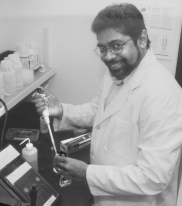
Another area of research is the San Joaquin Valley’s West Side, where Goorahoo will join Fresno State plant scientist Sharon Benes in tracking the growth rates of salt-tolerant plants. Several halophyte species are being studied to determine if they could be useful in drawing out unwanted salts and selenium from the soil.
In a third project, Goorahoo will consult in a Fresno State-led study of ammonia emissions from the soil following fertilizer applications.
While much of Goorahoo’s work will be tracking and analysis of chemicals and chemical movement in the soil, his primary objectives are to develop BMPs and predictive models that will help the agricultural industry avoid the kind of practices that result in unwanted chemical accumulation in the soil.
“I strongly believe that the philosophy of a prevention strategy rather than one of detection and remedial action is the most sensible approach in dealing with the issue of environmental pollution and degradation,” he said.
Goorahoo will use computer software combined with database information to develop predictive models of solute transport in the soil.
Sand media filter handles lagoon water in irrigation tests
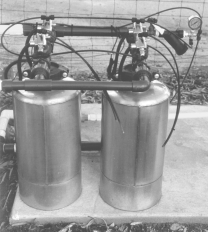
Subsurface application of dairy lagoon water to an alfalfa plot was successfully accomplished during the past year after researchers switched from a static screen filter to a sand media filter with regular backflushing.
The experiment is continuing this year under the direction of Center for Irrigation Technology (CIT) research engineer Ed Norum. According to a progress report prepared by Norum and scheduled for presentation later this year, the initial trial results are promising; however, more data needs to be gathered to determine durability of the irrigation system, crop yield, and nutrient levels.
The concept of using subsurface drip irrigation technology to apply dairy lagoon waste water to a crop became a physical reality last year when a private company decided to team with CIT to try the process. The use of lagoon water for flood irrigation of alfalfa and other crops is common in California, but with the growing size and number of dairy operations in the southern and central San Joaquin Valley, the potential for problems also is increasing.
“The safe handling of lagoon water is of major importance in California.”
Public health officials are concerned about unwanted runoff from fields, unwelcome odors, and percolation of nitrates into groundwater supplies. “The safe handling of lagoon water is of major importance in California,” Norum noted initially as a rationale for the project.
Subsurface application of lagoon water creates special filtration problems, since the water contains high levels of particulates, Norum said. Researchers first installed a 200-mesh static screen filter in the system for irrigating the half-acre plot on the Fresno State campus. In spite of regular backflushing, the filter became too clustered with fibers to be effective.
Viticulture and Enology Research Center
Director: Program potential unmatched at Fresno State
from Page 1
so that we will have answers rather than be scrambling for answers when the questions come.”
He stressed the importance of viticulture research on table and raisin grapes as well as wine grapes. “Two-thirds of the grapes grown in the San Joaquin Valley are table and raisin grapes, and I want these industries to know that I am aware of their concerns,” he said.
Learning of the strong support provided to VERC by the state’s grape and wine industry was another factor drawing Wample to California, he said.
“The interest and support shown by the industry in realizing our potential here was integral to my coming.” He said the location of Fresno State and its agricultural research facilities offer virtually unmatched opportunity to faculty, staff, and the students who attend here.
“The general availability of vineyards and the winery make the opportunity for an educational experience here better than anywhere in the United States,” he said.



In accordance with a reorganization plan by Fresno State’s College of Agricultural Sciences and Technology, Wample also will serve as chair of the newly-formed Department of Viticulture and Enology. The department will provide for research and academic focus in the areas of viticulture and enology, whereas enology studies previously were included under the Department of Enology, Food Science and Nutrition.
Wample said that he may teach some courses, particularly in the area of vine stress physiology, an area of specialty while he was at Washington State. He will establish his residence in the Fresno area with his wife Pamela and their two golden retrievers.
In addition to his research in GPS technology and mechanical pruning at Washington State, Wample has cooperated in research studies of blackleaf on Concord grapes, the influence of irrigation on cropload in wine grapes, and cane cold hardiness. He has conducted seminars or made presentations at more than four dozen events throughout the Pacific Northwest and in California during the last five years.
Wample earned his Ph.D. in plant physiology from the University of Calgary in Alberta, Canada. He received his bachelor’s in botany from the University of Idaho, Moscow, Idaho in 1971.
Upcoming events
June 4 – Celebration of Wine, fundraiser for VERC’s Vincent E. Petrucci Library, at the Dennes Coombs River Ranch in Madera. For more information call (559) 278-7151.
Aug. 8 – Grape Day 2000 at the Viticulture and Enology Research Center at California State University, Fresno. For more info call (559) 278-2089.
Coastal conference to address enology, viticulture issues
Growers and vintners throughout California are expected to attend the third annual Central Coast Viticulture and Enology Issues Conference on May 4 and 5 in Santa Maria, California.
The two-day event will feature local and statewide speakers making presentations, guiding panel discussions, and leading tours of local vineyard and winery operations. Seminar and workshop discussions will address current viticulture and enology issues of interest to professionals, as well as to those currently seeking careers in the field.
This conference is a collaborative effort of California State University, Fresno’s Viticulture and Enology Research Center (VERC) and Allan Hancock College’s Enology and Viticulture Program. Sponsors include an assortment of private companies that place a high value on serving the industry through educational activities, noted Cynthia Wood, VERC Information Services Coordinator.
“The support we receive each year from industry sponsors, as well as the input we receive from local industry leaders, enables us to build programs that really benefit growers and winemakers,” she said.
The event will be held at the Santa Maria Airport Regency Hotel and Conference Center. Registration will begin at 7 a.m. on May 4 in the Enterprise Ballroom.
The program concludes the following afternoon. The fee for this year’s event is $135 per person. Organizers are offering a discounted fee of $125 per person for those who preregister by April 20.
Student discounts and discounts for additional registrants from the same company are also available. The registration fee includes admission to all sessions and sponsor exhibits, the vineyard tour, refreshments on both days, two lunches, and a program booklet. The Santa Maria Airport Regency is also offering a special room discount for participants.
On May 4, participants will have an opportunity to network with other participants, organizers, sponsors and presenters at a local area restaurant (for an additional fee).
To request a registration flyer, contact VERC at (559) 278-2089. For information on becoming an event sponsor, contact Cynthia Wood at (559) 278-7135 or email cynthia_wood@csufresno.edu. Checks and/or credit card (Visa or MasterCard) will be accepted.
California Irrigation Management Information System
APRIL 2000
Orchard water use booklet in press
The Mission Resource Conservation District is in the process of reprinting its educational booklet titled “Estimating Orchard Water Use with CIMIS.”
The booklet outlines what one needs to know to use CIMIS as an effective and simple irrigation scheduling tool. It includes information on the use of potential crop rooting depth; soil water-holding capacity (WHC); available water-holding capacity (AWC); size of area wetted by irrigation system; flow rate of emitters; irrigation system emission uniformity; and management allowable depletion (MAD) to determine the irrigation run times needed to refill the soil reservoir.
The booklet also contains step-by-step examples of how to schedule irrigation based on CIMIS data.
New CIMIS stations on line
Nine new CIMIS weather stations were established and two were removed in 1999. There are now 107 stations on the CIMIS network. A complete list of current and historical CIMIS stations is available on the CIMIS Web site.
Stations that have been established include the following:
- #144, Petaluma East (Sonoma County), installed 8/25/99;
- #147, Otay Lake (San Diego County), installed 4/15/99;
- #148, Merced (Merced County), installed 1/1/99;
- #149, a non-ETo station, Oakland Foothills (Alameda), installed 3/25/99;
- #150, Miramar (San Diego County), installed 4/23/99;
- #153, Escondido SPV (San Diego County), installed 2/1/99;
- #159, Monrovia (Los Angeles County), installed 10/15/99;
- #161, Patterson (Stanislaus county), installed 8/23/99;
- #162, Indio (Riverside County), installed 12/24/99.
The three stations that were removed include #38, Santa Maria (Santa Maria County); and #50, Thermal (Riverside County). In addition, station #102, El Dorado (Los Angeles County), is temporarily disconnected.
Visit the CIMIS home page at the following address: wwwdpla.water.ca.gov/cimis.html
For more CIMIS information...
CIMIS information is published quarterly in the CATI Update newsletter. Articles are provided by the California Department of Water Resources, CIMIS program staff.
For more information about CIMIS or its programs, contact any of the following representatives at these offices:
| District | Representative | Phone | |
|---|---|---|---|
| Northern District | Eugene Pixley | (916) 529-7392 | pixley@water.ca.gov |
| San Joaquin District | Kent Frame | (559) 230-3334 | kframe@water.ca.gov |
| Central District | Mark Rivera | (916) 227-7603 | mrivera@water.ca.gov |
| Southern District | Sergio Fierro | (818) 543-4652 | sergiof@water.ca.gov |
If you are unable to reach a CIMIS representative near you, call the CIMIS Helpline at 1-800-922-4647.
Weekly ETo Comparisons for Fresno
Fresno: 12/01/99 – 2/29/99
CIMIS Station #80
Fresno State
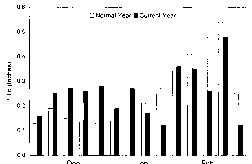
Chart shows ETo variation from normal over last three months.
Issues: Conference to include sponsor exhibits, networking
from Page 5
who preregister by April 20. Student discounts and discounts for additional registrants from the same company are also available. The registration fee includes admission to all sessions and sponsor exhibits, the vineyard tour, refreshments on both days, two lunches, and a program booklet. The Santa Maria Airport Regency is also offering a special room discount for participants.
On May 4, participants will have an opportunity to network with other participants, organizers, sponsors and presenters at a local area restaurant (for an additional fee).
To request a registration flyer, contact VERC at (559) 278-2089. For information on becoming an event sponsor, contact Cynthia Wood at (559) 278-7135 or email cynthia_wood@csufresno.edu. Checks and/or credit card (Visa or MasterCard) will be accepted.
Filter: further tests will measure nitrogen conten in soil, water
from Page 4
filter in the system for irrigating the half-acre plot on the Fresno State campus. In spite of regular backflushing, the filter became too clustered with fibers to be effective.
In June 1999 the screen filter was replaced with a sand media fiter using #20 feldspar media underlain by 19mm crushed gravel. Backflushing occurred every 15 minutes of operation. System flow rate measurements over the course of the summer indicated that plugging of emitters did not occur. Partial-year yield from the summer months “compares favorably with commercial growers yields,” Norum stated. He added that no attempts were made to increase yields using fertilizers because of the high nitrogen content of the irrigation water.
Initial tests of hay quality ranged from low to good, he reported.
“The crop is picking up high levels of nitrogen, as would be anticipated.”
During the coming season, further adjustments of the irrigation system will be made, and more specific measurements of nitrogen content in the soil and water will be taken. General crop management should yield better results, as researchers can pay more attention to agronomic aspects of the project, Norum said.
Details of the project, including this summer’s trials, will be provided at the sixth international Micro-Irrigation Congress, sponsored by the International Committee on Irrigation and Drainage, in Cape Town, South Africa, in October.
CATI on the Web!
For timely information about CATI, its research projects or centers, or to view text of research publications, visit us at cati.csufresno.edu.
Center for Agricultural Business (CAB) – cati.csufresno.edu/cab
Center for Food Science and Nutrition Research (CFSNR) – cati.csufresno.edu/cfsnr
Center for Irrigation Technology (CIT) – cati.csufresno.edu/cit
Viticulture and Enology Research Center (VERC) – cati.csufresno.edu/verc
Agricultural Technology Information Network (ATI-Net) – cati.csufresno.edu/atinet
Publications available
(These publications may be viewed in their entirety on CATI’s World Wide Web pages, located at cati.csufresno.edu. Single copies are also available by mail at no charge)
- Dermal Absorption of Pesticides in Farm Workers, by Michael Thomas and Robert Krieger. Pub. #000301.
- Establishment of the Molecular Marker Laboratory at the Viticulture and Enology Research Center, by James P. Prince. Pub. #990702.
Ordering Information:
Check the publication(s) desired and mail or fax form to:
CATI
California State University, Fresno
2910 E. Barstow Ave. M/S OF115
Fresno, CA 93740-8009
Fax: (559) 278-4849
Name
Company
Mailing Address
City State Zip
Plantlet growth achieved in hibiscus project
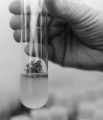
An important step in a plant breeding project was reached this past year when research scientist Maria Jenderek observed Eastern hibiscus (Hibiscus syriacus) plantlets growing from callus tissue in laboratory test tubes.
The successful regeneration of plants from callus tissue is part of a larger project being conducted by Jenderek with the help of plant science professor Arthur Olney. Their goal is to develop a new hibiscus hybrid that will thrive in hot, dry areas such as the San Joaquin Valley and produce large, showy flowers like those of the tropical hibiscus (H. rosa-sinensis) grown along California’s coast. Valley winters are typically too cold for the tropical hibiscus.
The researchers ultimately want to use a fusion technique to recombine DNA of the two varieties, obtaining the best characteristics of both: large, colorful flowers and the ability to withstand freezing temperatures.
Jenderek was successful this past year in finding an aseptic media in which callus tissue from the Eastern hibiscus would grow. Callus is a soft tissue that can grow from parts of the original plant. Under the right conditions, new plants will grow from the callus tissue, Jenderek explained.
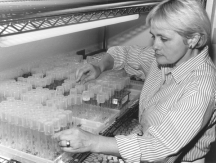
“This was a major step toward accomplishing the final step of protoplast fusion,” since any plant cells that have been altered by the fusion process must have a media in which they can grow into a new plant, she said.
Jenderek presented her callus findings in a poster at the 96th Annual International Conference of the American Society for Horticultural Science last summer. The poster title was “High regeneration ability of benzyl adenine and naphthalene acetic acid induced callus of Eastern hibiscus.”
Work toward the fusion portion of the project is continuing this year. Original project funding was through the Center for Irrigation Technology.
Symposium: Registration discounts offered
from Page 3
supervisors, farm labor contractors, custom harvesters, and labor relations and human resource professionals.
The event will be held at the Special Events Center of the California Mid-State Fairgrounds. General registration fee is $75, discounted to $55 for members of the Vintners and Growers Association. Additional discounts to $70 and $50, respectively, are available for registrations postmarked on or before April 21, 2000.
For registration information, call (559) 278-4405 or visit the CAB web site at cati.csufresno.edu/cab.
Update: Spring 2000
Update is published quarterly by the California Agricultural Technology Institute
College of Agricultural Sciences and Technology
California State University, Fresno
Spring 2000
CATI Publication #000401
Voice number: (559) 278-2361
Fax number: (559) 278-4849
Director of Operations: Joe Bezerra
Publications Editor: Steve Olson
Address Service Requested
California State University, Fresno
2910 E. Barstow Ave. M/S OF115
Fresno, California 93740-8009
Non Profit Organization
U.S. Postage PAID
Fresno, CA
Permit No. 262
This HTML version was generated with AI assistance and may contain errors or omissions. The original approved PDF remains the official document of record. An alternative accessible format is available upon request from the document creator in accordance with Title II of the ADA.