Update: Summer 1999
CALIFORNIA AGRICULTURAL TECHNOLOGY INSTITUTE
California State University, Fresno
SUMMER 1999
Researchers eye water use issues in new projects
Bringing improvements in crop production and product processing are among the goals of California State University, Fresno scientists who will begin new agricultural research projects this year. With financial support from the California Agricultural Technology Institute (CATI), private industry and other agencies, researchers will test new methods of irrigating grapevines, freezing processed peaches, and fertilizing with “sewer sludge.”
Experiments will be conducted at Fresno State’s University Farm Laboratory and in privately-owned fields and processing plants throughout central California.
The new projects reveal CATI’s continuing focus on applied research, offering results that can be quickly employed by California’s agriculture and agribusiness industries to increase efficiency, productivity, and profits.
Dissemination of research results will be accomplished through written technical reports; through conferences, workshops and seminars; in the CATI Update newsletter; and electronically through the World Wide Web.
CATI projects are conducted through four major research centers, all located on the Fresno State campus. They include the Center for Agricultural Business (CAB), the Center for Agricultural Science and Nutrition Research (CFSNR), the Center for Irrigation Technology (CIT), and the Viticulture and Enology Research Center (VERC).
See Projects, Page 7
Emitter Talk...
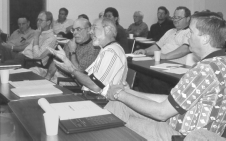

CIT Director David Zoldoske (left) exchanges ideas with participants at recent emitter plugging conference.
Irrigation industry leaders gather to address emitter plugging issues, prospects for testing
Manufacturers and sellers of drip irrigation equipment gathered at the Center for Irrigation Technology (CIT) last month to seek consensus on an issue that has brought both great interest and some confusion to the industry during recent years.
The issue is emitter plugging and how to test effectively for it, so when a manufacturer makes claims about its own product, buyers will know they are getting the quality they expect.
“We get a lot of questions from growers about which product is better. How do we answer that?”
“We get a lot of questions from growers about which product is better. How do we answer that?” asked CIT Director David Zoldoske to open the half-day session, attended by more than 40 representatives of leading drip line and emitter manufacturing companies in the United States.
Participants agreed they place high value on a product that has “passed” efficiency or other types of tests conducted by CIT.
However, a set of universal standards for rating emitter plugging resistance has remained elusive because of so many variables in drip irrigation, Zoldoske told participants. With a lack of standards to test against, buyers have found it difficult to discern which equipment traits might be best suited to their particular needs. They have often been forced to base purshasing decisions on unproven claims made by sellers or manufacturers.
“We ought to be able to come up with a procedure to quantify those claims if we’re going to make them,” Zoldoske said.
See Emitter, Page 7
From the director
Who will chart course for 21st century agriculture?
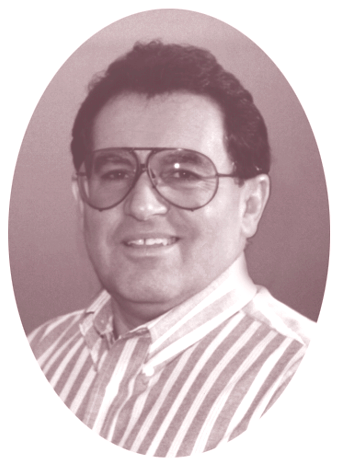
Joe Bezerra
We discussed the need for a state and/or national agricultural industry strategic plan in the CATI spring Update newsletter. This Update, we will explore this writer’s vision of the probable California agricultural landscape changes through the next half-century or so.
The only undisputed given when discussing this topic is that it will look different, probably very different. Therefore, since only weathermen and economists have the luxury of consistently making wrong predictions, prior to this writing I consulted with colleagues whom I hold in high regard both from the educational community and the industry. Surprisingly, they agreed in part or in total. So here goes.
H.G. Wells once wrote, “those who ignore history are doomed to repeat it.” Therefore, before glancing into the agricultural crystal ball, it’s probably a good idea to consider events and realities of at least the recent past and the likely catalysts that will most significantly impact future change.
For the most part, the catalysts are pretty well known. Some are so new they seem like science fiction, but most are predictable and manageable while yet others are really based on value judgements. Which stakeholders’ values are used in developing a strategic plan and/or public policy becomes a significant issue in itself (topic for a different discussion) and predisposes very different outcomes.
It is important to understand that change itself is not necessarily a bad thing and that a single action alone rarely causes meaningful change. Rather, change is brought about by the long-term cause and effect reaction between all the influencing catalysts. Having said that, however, some are more influential than others. The three most significant of these in the western United States are well known to most Californians. They are water, water and water — agricultural water, urban water and environmental water. Land use planning, population growth, environmental restoration, bioengineering, food safety, food security, air quality, expanding export markets and changing consumer preferences will also dominate the 21st Century agricultural forefront. But in the end, water policy is king in California and the western United States.
The State’s rapidly increasing population, especially in the central San Joaquin Valley, and the general public’s continued acceptance of environmental restoration will progressively intensify the competition for the state’s limited developed water and developable land. The resulting supply/demand pressures will progressively drive up the price of both and inevitability out of profitable reach for the production of many traditional commodities. Add to this the additional costs of a proliferation of new regulatory requirements, downward commodity price pressure from domestic surpluses and cheap imports and continuously changing consumer preferences, and expect the industry to aggressively pursue higher margin alternatives.
There will be a slow but increasing industry migration to high-value, high-risk permanent plantings, vegetables and genetically engineered crops. Producers will also become more vertically integrated in order to capitalize on value-added processing profits and to maintain quality control of their products from field to consumer. They will become marketers of single-serving-size consumer products rather than bulk commodities.
Change of this magnitude will certainly impact the economic capability of small, medium and large size farms. Each will survive, at least if we use the USDA’s definition of a farm. However, clearly a relatively small portion of large and medium size farms will produce the preponderance of food and fiber on less land. What each farm will produce and how they will produce and market their products will differ significantly.
Small farms may slightly increase in number and will fall into two basic classifications: very labor-intensive, specialized high-value truck crops marketed directly in local markets by extended families or farms, which are, in essence, extended rural residential home sites substantially supported by off-farm income. Generally, medium-sized farms will continue to diminish in number and be more vulnerable to cost price squeezes and diminishing returns. The need to capitalize on value-added processing and marketing returns will kindle an increased interest in processing and marketing cooperatives and/or limited liability partnerships to generate economies of scale while controlling individual members’ financial risk and maintaining their respective independence. Large farms will become fewer and larger as well as more independently vertically integrated.
The good news is that, while California agriculture may look very different by the end of the next half-century or so, it will survive, it will be vibrant and it will provide tremendous opportunity on and off the farm for the next generation of agriculturists. A basic industry strategic plan could be significantly helpful in charting a course, marking milestones, and providing for necessary plan adjustments. What do you think?
Center for Agricultural Business
Industry confirms support of ag safety program
Companies’ financial backing helps CAB to continue monthly safety breakfast meetings
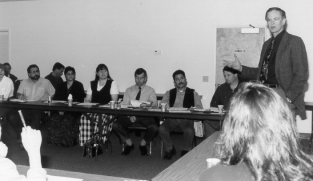
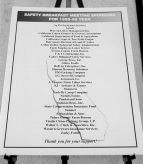
Support from a group of private companies has helped a public agency continue to bring the issue of agricultural safety to the forefront of many businesses in California and elsewhere.
The public agency in this case is the Center for Agricultural Business (CAB).
The private arm of support includes 36 companies and organizations that provide financial backing to CAB’s Agricultural Safety Breakfast program.
“We had met our original goal for this program last year, which was to bring safety professionals together to get information and to share and exchange ideas,” reported Kimberly Naffziger, program development specialist for CAB and coordinator of the monthly safety breakfast meetings. “We wanted to continue in this format, with no charge to attend the meetings, but we realized that to do this we would need some outside financial help.”
Naffziger set up a system where outside agencies could help cover the meeting costs and also get some public recognition. The format includes a listing of all sponsors on safety breakfast mail flyers and on other signs and documents related to the program. Sponsorship fee is $60 per year.
The last meeting for the 1998-99 fiscal year was held June 9. The topic was “CAL/OSHA Is Coming to Your Workplace Are You Prepared?”
Following a two-month summer break, a new series will begin in September. Meetings are from 7:30 to 9:30 a.m. on the second Wednesday of each month. The format, in addition to bagels, cream cheese and coffee, includes a presentation by a safety specialist followed by information and idea exchange among the participants.
For sponsor information, call CAB at (559) 278-4405. Summaries of past safety breakfast meetings, along with research and other information, are on CAB’s Internet web site located at www.atinet.org/cati/cab.
Upcoming events
- July 29 – California Agricultual Safety Certificate Program, modules 1 and 2, from 8 a.m. to noon and 1 to 5 p.m, in Exeter, California. Details: call (559) 278-4404.
- August 31 – California Agricultual Safety Certificate Program, modules 3 and 4, from 8 a.m. to noon and 1 to 5 p.m, in Exeter, California. Details: call (559) 278-4404.
- November 4 – 18th Annual Agribusiness Management Conference: Issues and Outlook for 2000, at the Radisson Hotel in Fresno. Details: call (559) 278-4405.
Mason takes labor relations post
Following nine years of service as director of the Center for Agricultural Business (CAB) at California State University, Fresno, Bert Mason has accepted a position on the California Agricultural Labor Relations Board. Mason was appointed to the board in May by Governor Gray Davis.
Mason has been a member of the Fresno State faculty since 1983, serving as chair of the Department of Agricultural Economics from 1984 to 1990.
As an agricultural economics professor he taught classes in agricultural labor management and developed a research and outreach program on personnel management and agricultural safety. He has been involved in farm labor research since the early 1970s and has participated in several research projects sponsored by the U.S. Department of Labor, the Commission on Agricultural Workers, and the Employment Development Department.
He was appointed CAB director in 1990; during his tenure he guided the center into a leadership position for research and service in the areas of agribusiness management, agricultural labor management, and agricultural safety.
Mason’s appointment to the ALRB is subject to confirmation by the state senate; he will be on professional leave from the university during the 1999-2000 academic year. The board’s central offices are located in Sacramento.
Center for Irrigation Technology
Halophytes: Will they solve salt problem?
Researcher continues search for plants that will thrive on West-side drainage water
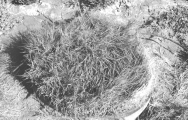
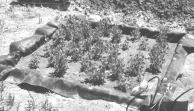
Saltgrass (left) and atriplex (above) are halophytes shown in different lysimeters, where plant water use can be measured.

Sharon Benes
Scientists from the U.S. Department of Agriculture, California Department of Water Resources, University of California and other agencies are working side by side with a Fresno State researcher in the study of drainage water reuse on the west side of California’s San Joaquin Valley.
Of the many specialists involved in the work, Fresno State plant science professor Sharon Benes is in her third year tracking the growth and water use (ET) of highly salt-tolerant plants called halophytes. She is completing a report on specific research funded by the California Agricultural Technology Institute (CATI) in 1998-99. Her study focused on the growth of saltgrass (Distichlis spicata) irrigated with saline drainage water also containing high levels of boron and selenium.
The West Side San Joaquin Valley has been for years an agriculturally rich area. However, soil salinity and drainage problems are common. West-side soils tend to be saline, and salinity problems are exacerbated by slowly-permeable soils and a high water table which often prevents successful leaching of salts.
An environmentally responsible system for drainage water management is to use the water for irrigation in a sequential reuse system that applies the saline water to progressively more salt tolerant crops and finally to halophytes as the drainage becomes progressively concentrated in salinity through reuse.
Benes’ study has focused on the saline water use of saltgrass and other halophytes; and there is some good news: The saltgrass appears to be thriving under irrigation with drainage water about two-thirds the salt content of sea water. Daily water use has been about 60 percent of the water use of a common fescue grass irrigated with high quality (nonsaline) water.
“That’s pretty good water usage, in our opinion,” Benes stated in regard to the figures.
The saltgrass water use was determined by growing it in lysimeters, custom-made from the bottom of 55-gallon drums. They are filled with sand and buried so the plants growing in them are level with the surrounding soil surface. Plant water use in the lysimeters is measured and compared to a reference ET (ETo) figure, which represents the water use of a well-watered turfgrass (fescue) under non-saline conditions.
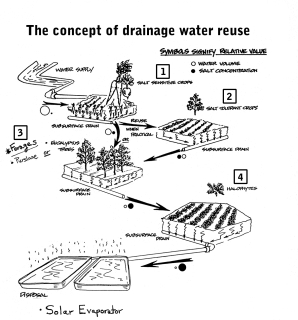
There is still much work to be done in the area of drainage water reuse, Benes said. Additional salt tolerant forages and halophytes need to be evaluated. Research results will be used to guide the selection of the most appropriate crop and plant species for on-farm drainage water reuse and management. Soil management methods must also be developed because over the long term, applications of high sodium drainage water will degrade the physical structure of the soil.
Benes provided details of her work at a series of workshops around the valley during May and June. Details also may be obtained from her report to be published by CATI this fall. It will be made available on the CATI Internet web site at www.atinet.org/cati. Single hard copies also may be requested by using the publications order form on Page 7.
Viticulture and Enology Research Center
Research shows promise for new resin applications
New filtration materials tested by a Fresno State chemistry professor have shown that synthetic resins have promise for use by wineries to clarify wines.
Positive results in earlier tests prompted Professor Barry Gump and graduate student Joyce Huang to increase volumes of grape juice and white wines in the testing of three resins for protein and polyphenol removal.
Unstable proteins are the most common factor in the formation of haze in juice or wine, Gump writes in a new research report published by the California Agricultural Technology Institute.
Unstable protein can be removed by a variety of methods, Gump said. The general process is called “fining.” The most common fining method is to mix a natural clay called bentonite in batches of wine. The bentonite collects proteins and other molecules which can lead to haze formation.
Unfortunately for the wine industry, new environmental safety regulations are making it more costly to deal with the solid waste material produced through the bentonite fining method.
“In the past, the solid waste would go back into the vineyard, as fertilizer,” Gump noted. “Now anything containing alcohol is considered a hazardous waste and needs to be specially disposed.”
Adsorbent resins are already used by the food industry for a variety of tasks, including to stabilize and decolorize sugar juices.
“They are promising materials for replacing bentonite in the fining process,” Gump said.
Tests conducted at the Viticulture and Enology Research Center (VERC), with support from the American Vineyard Foundation, focused on three commercially available resins. Wine and juice samples were pumped through columns of resin, then heated and analyzed for haze formation, as well as for protein and phenolic content.
All three resins were found to have “effectively stabilized the grape juices and wine,” the authors found. Resin treatments did not affect pH or titratible acidity levels, and the sugar content of the grape juice also was unchanged.
A panel of wine tasters ranked one of the resin-treated samples above the conventional bentonite-treated sample.
This “shows promise for resin applications in the juice and wine industries,” the authors concluded.
Details of this study are contained in the new publication, called “Removal of Unstable Protein in Grape Juice and Wine by Adsorbent Resins.” It can be viewed on the VERC Internet web site at www.atinet.org/cati/verc. Single hard copies also may be ordered using the publications order form on Page 7.
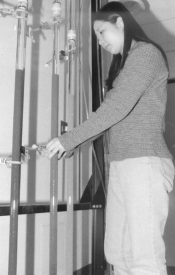
Graduate student Joyce Huang examines glass columns filled with adsorbent resins. The resins were tested as molecular filters for grape juice and wine.
Mite study results lead scientists to next question
Spider mites have long been known as an important pest to grape vineyards in California. Their sucking of juices weakens the plant and can cause delayed fruit maturity, lowered sugar levels and reduced yields.
But is it really the mites that are causing problems for a normally healthy vine, or is it perhaps a “sick” vine that draws the mites to it? That’s the question Fresno State researcher Mark Mayse hopes to eventually answer through studies supported by the university’s integrated pest management (IPM) program.
In a new research report to be published next month by the California Agricultural Technology Institute, Mayse details a study of mite populations in a commercial Chardonnay vineyard. The study tracked aspects of vine growth and production under known mite infestations. Results showed several clear correlations — among them that when mite levels were higher, grape sugar content and overall yields were lower.
The consistency of correlations with the results of some prior studies should lead researchers into the next realm of questioning — whether mites attack healthy vines and cause the production problems, or whether they are drawn to unhealthy vines and exacerbate existing conditions.
“Further studies will be needed to determine how these two relationships typically impact vineyard production systems,” Mayse said.
The new publication is titled “Relationships Between Mite Density and Grape Production” and can be ordered using the form on Page 7. It also may be viewed on the VERC web site at www.atinet.org/cati/verc.
California Irrigation Management Information System
CIMIS develops new ETo zone map

CIMIS and the University of California, Davis, have developed a new reference evapotranspiration (ETo) zone map for California. The map is based on average monthly ETo values for several sites throughout California and consists of the following 18 zones:
- Coastal Plains Heavy Fog Belt. This zone has the lowest ETo in California and is characterized by dense fog.
- Coastal Mixed Fog Belt. Higher ETo than zone 1 and less fog.
- Coastal Valleys and Plains and North Coast Mountains. More sunlight than zone 2.
- South Coast Inland Plains and Mountains North of San Francisco. More sunlight and higher summer ETo than zone 3.
- Northern Inland Valleys. Valleys north of San Francisco.
- Upland Central Coast and Los Angles Basin. Higher elevation coastal areas.
- Northeastern Plains.
- Inland San Francisco Bay Area. Inland area near San Francisco with some marine influence.
- South Coast Marine to Desert Transition. Inland area between marine and desert climates.
- North Central Plateau and Central Coast Range. Cool, high elevation areas with strong summer sunlight. This zone has limited climate data and the zone selection is somewhat subjective.
- Central Sierra Nevada. Sierra Nevada Mountain valleys east of Sacramento with some influence from the delta breeze in summer.
- East Side Sacramento-San Joaquin Valley. Low winter and high summer ETo with slightly lower ETo than zone 14.
- Northern Sierra Nevada. Northern Sierra Nevada mountain valleys with less marine influence than zone 11.
- Mid-Central Valley Southern Sierra Nevada, Tehachapi and High Desert Mountains. High summer sunshine and wind in some locations.
- Northern and Southern San Joaquin Valley. Slightly lower winter ETo due to fog and slightly higher summer ETo than zones 12 and 14.
- Westside San Joaquin Valley and Mountains East and West of Imperial Valley.
- High Desert Valleys. Valleys in the high desert near Nevada and Arizona.
- Imperial Valley, Death Valley and Palo Verde. Low desert areas with high sunlight and considerable heat advection.
Because there is a limited supply, the map will be distributed mainly to local and private agencies.
Visit the CIMIS home page at the following address: http://wwwdpla.water.ca.gov/cgi-bin/cimis/cimis/hq/main.pl
For more CIMIS information...
CIMIS information is published quarterly in the CATI Update newsletter. Articles are provided by the California Department of Water Resources, CIMIS program staff.
For more information about CIMIS or its programs, contact any of the following representatives at these offices:
- Northern District
Eugene Pixley
(916) 529-7392
pixley@water.ca.gov - San Joaquin District
Kent Frame
(559) 230-3334
kframe@water.ca.gov - Central District
Mark Rivera
(916) 227-7603
mrivera@water.ca.gov - Southern District
Sergio Fierro
(818) 543-4601 ext. 297
sergiof@water.ca.gov
If you are unable to reach a CIMIS representative near you, call the CIMIS Helpline at 1-800-922-4647.
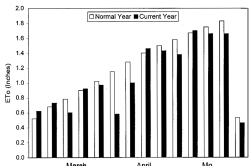
Weekly ETo Comparisons for Fresno
Fresno: 3/01/98 – 5/31/99
CIMIS Station #80
Fresno State
Chart shows ETo variation from normal over last three months.
Emitter: Standard tests would help to quantify claims
from Page 1
Emitter plugging can be caused by the growth of organic substances such as bacteria or mold, by the accumulation of inorganic matter such as sand or silt, or by the combination of chemical elements such as salts and minerals.
Over the past two years CIT has conducted privately-funded emitter plugging tests focusing on the effect of inorganic particulates in the water. Problems arose when results were extrapolated beyond the narrow confines of the test parameters. Some manufacturer representatives at the meeting suggested no testing results be made public until industry-wide standards have been established.
Many participants asked that CIT assert more control over companies’ use of private test data.
In response, Zoldoske said, he would begin drafting criteria that could be used to help control the use of information provided to companies funding private CIT tests. Secondly, he called for a committee to develop minimum emitter-plugging standards. Thirdly, CIT will place a moratorium on all public plugging tests until the committee has reached agreement on the issue of standards development.
There was high interest among the participants to make this type of meeting an annual event at CIT. Developing emitter-plugging standards is expected to take years.
Projects: Ag labor concerns spark new survey of workers
from Page 1
Each center oversees specific CATI-funded projects, as well as research requested and funded by other public and private agencies.
Following are summaries of projects funded through CATI for the 1999-2000 fiscal year and the names of the principal investigators:
Center for Agricultural Business
Social sciences professor Andrew Alvarado will lead a research team in a labor force survey. Information to be obtained includes demographics of the farm labor force in the western region, availability of workers, recruiting methods of employers, legal status, living arrangements and earning of workers.
Agricultural economics professor Lynn Williams will conduct economic feasibility studies of several different raisin production operations in the San Joaquin Valley. The goal is to determine whether systems using mechanized drying and harvesting offer more economic promise than traditional hand-labor systems.
Animal Science professor Michael Thomas will continue studies of a new polymer-based hand lotion that may protect field workers from pesticide-related chemicals absorbed through the hands when the workers harvest crops.
Agricultural economics professor James Cothern plans to develop a professional educational portfolio using computer and Internet programming to analyse risk management in agricultural production. The portfolio will be offered in a seminar series next year.
CAB’s Agricultural Safety Program is slated to continue again this year sponsoring events and services such as the annual AgSafe Conference, regional safety meetings, the Agricultural Safety Certificate Program, and human resource management training seminars.
Center for Food Science and Nutrition Research
Industrial technology professor Tony Au and food science specialist Carter Clary will work with specialists from Wawona Frozen Foods of Clovis, California in an effort to improve freeze processing of peaches. Their work will focus on ways to more quickly freeze 40-pound cartons of peaches following heat processing.
Center for Irrigation Technology
Plant science professor Sharon Benes will track the growth and fruit production of apricot trees fertilized with “biosolids,” the solid materials left over after raw sewage is treated at wastewater treatment plants. Biosolids contain desirable fertilizer elements such as nitrogen and organic materials, but they also can contain pathogenic organisms and chemical pollutants, which in high amounts could prove harmful to trees and/or soil.
Viticulture and Enology Research Center
Viticulture research scientist Sanliang Gu will conduct studies to determine if a new method of vineyard irrigation called partial rootzone drying (PRD) will enhance grape production and wine quality. One test will feature use of two above-ground drip lines for each row of grapevines — with one drip line on each side of the vine. Irrigation scheduling will include alternating drip line operation. Another study will feature a similar approach using subsurface drip lines. The process has promise for reducing vine water use, controlling vine vigor and canopy density while maintaining crop yields.
In another viticulture study, Gu will apply different production methods to Chardonnay grapevines in an experimental plot in the San Joaquin Valley. He will attempt to measure wine chemistry and quality in relation to mechanical pruning on three Chardonnay clones grafted onto three different rootstocks.
At the molecular level of grape study, biology professor James Prince will investigate a new DNA fingerprinting system that could bring more certainty to the practice of cultivar identification. The system will focus on ribosomal RNA genes, for the production of “fingerprints” at the cultivar level.
Plant science professor Mark Mayse will continue integrated pest management (IPM) studies in three areas: 1) comparing the strengths and limitations of organic and conventional winegrape production systems; 2) exploring the ecological roles of parasitic wasps in cover-cropped vineyards; and 3) investigating non-chemical tactics for managing Erythroneura leafhopper pests such as western grape leafhopper and variegated leafhopper.
The process of winemaking will be the focus of continued study for associate enology professor Ken Fugelsang. In a follow-up to prior work, Fugelsang will examine the growth rates of 10 strains of Brettanomyces intermedius yeast in Pinot Nior wine in an effort to determine the organism’s ability to enhance wine flavor, aroma and complexity.
In a special World Wide Web project, CATI’s Advanced Technology Information Network (ATI-Net) will develop, build and evaluate a new type of Internet search engine — one that will search specifically in California for ag-related information. There are currently no known search engines that offer that service to agricultural interests in or outside of California.
In addition to the above-mentioned projects, CATI research centers oversee many other research-related activities. For more information on CATI or its research centers call (559) 278-2361.
Publications available
(These publications may be viewed in their entirety on CATI’s World Wide Web pages. Single copies are also available by mail at no charge)
- Removal of Unstable Protein in Grape Juice and Wine by Adsorbent Resins by Barry H. Gump and Chiao-Fang Huang. Pub. #990402.
- Integrated On-farm Drainage Management: Using Plant Transpiration to Reduce Drainage Volumes by Sharon Benes. Pub. #990602.
- Relationships Between Mite Density and Grape Production by Mark Mayse and Sanjay Witharana. Pub. #990601.
Ordering Information:
Check the publication(s) desired and mail or fax form to:
CATI
California State University, Fresno
2910 E. Barstow Ave. M/S OF115
Fresno, CA 93740-8009
Fax: (209) 278-4849
Name
Company
Mailing Address
City State Zip
CATI on the Web!
For timely information about CATI, its research projects or centers, or to view text of research publications, visit us at www.atinet.org/cati.
Studies: Environmental issues to be addressed
from Page 7
CATI’s Advanced Technology Information Network (ATI-Net) will develop, build and evaluate a new type of Internet search engine — one that will search specifically in California for ag-related information. There are currently no known search engines that offer that service to agricultural interests in or outside of California.
Center for Irrigation Technology
Plant science professor Sharon Benes will track the growth and fruit production of apricot trees fertilized with “biosolids,” the solid materials left over after raw sewage is treated at wastewater treatment plants.
Biosolids contain desirable fertilizer elements such as nitrogen and organic materials, but they also can contain pathogenic organisms and chemical pollutants, which in high amounts could prove harmful to trees and/or soil.
Viticulture and Enology Research Center
Viticulture research scientist Sanliang Gu will conduct studies to determine if a new method of vineyard irrigation called partial rootzone drying (PRD) will enhance grape production and wine quality.
One test will feature use of two above-ground drip lines for each row of grapevines – with one drip line on each side of the vine. Irrigation scheduling will include alternating drip line operation.
Another study will feature a similar approach using subsurface drip lines. The process has promise for reducing vine water use, controlling vine vigor and canopy density while maintaining crop yields.
In another viticulture study, Gu will apply different production methods to Chardonnay grapevines in an experimental plot in the San Joaquin Valley. He will attempt to measure wine chemistry and quality in relation to mechanical pruning on three Chardonnay clones grafted onto three different rootstocks.
At the molecular level of grape study, biology professor James Prince will investigate a new DNA fingerprinting system that could bring more certainty to the practice of cultivar identification. The system will focus on ribosomal RNA genes, for the production of “fingerprints” at the cultivar level.
Plant science professor Mark Mayse will continue integrated pest management (IPM) studies in three areas:
- Comparing the strengths and limitations of organic and conventional winegrape production systems.
- Exploring the ecological roles of parasitic wasps in cover-cropped vineyards.
- Investigating non-chemical tactics for managing Erythroneura leafhopper pests such as western grape leafhopper and variegated leafhopper.
The process of winemaking will be the focus of continued study for associate enology professor Ken Fugelsang.
In a follow-up to prior work, Fugelsang will examine the growth rates of 10 strains of Brettanomyces intermedius yeast in Pinot Noir wine in an effort to determine the organism’s ability to enhance wine flavor, aroma and complexity.
In a special World Wide Web project, CATI’s Advanced Technology Information Network (ATI-Net) will develop, build and evaluate a new type of Internet search engine – one that will search specifically in California for agriculture-related information.
There are currently no known search engines that offer that service to agricultural interests in or outside of California.
In addition to the above-mentioned projects, CATI research centers oversee many other research-related activities.
For more information on CATI or its research centers, call (559) 278-2361.
Update is published quarterly by the California Agricultural Technology Institute,
School of Agricultural Sciences and Technology, California State University, Fresno
Summer 1999
CATI Publication #990701
Voice number: (559) 278-2361
Fax number: (559) 278-4849
Director of Operations: Joe Bezerra
Publications Editor: Steve Olson
Address Service Requested
California State University, Fresno
2910 E. Barstow Ave. M/S OF115
Fresno, California 93740-8009
Non Profit Organization
U.S. Postage PAID
Fresno, CA
Permit No. 262

This HTML version was generated with AI assistance and may contain errors or omissions. The original approved PDF remains the official document of record. An alternative accessible format is available upon request from the document creator in accordance with Title II of the ADA.