Promoting Undergraduate Research in Agriculture: Opportunities for Experiential Learning and a Pathway to Graduate Studies Project Evaluation Report
Promoting Undergraduate Research in Agriculture: Opportunities for Experiential Learning
and a Pathway to Graduate Studies Project
at California State University, Fresno
Evaluation Report
December 8, 2017
From:
Murari Suvedi, PhD
Independent Evaluator
926 Harrington Lane
East Lansing, MI 48823, USA
Table of Contents
- Executive Summary
- Introduction
- Evaluation Goals and Objectives
- Evaluation Methods
- Evaluation Results
- Intern Survey
- Mentor Survey
- PI/CO-PI Survey
- Conclusions and Recommendations
- Appendix - Survey Questionnaire
Promoting Undergraduate Research in Agriculture: Opportunities for Experiential Learning
and a Pathway to Graduate Studies Project
California State University, Fresno
Executive Summary
Demand for agricultural professionals with research skills and strong interpersonal skills who can successfully work in diverse environments is on the rise. Responding to this demand, California State University (CSU), Fresno, has been working to provide its students exposures to cutting-edge technologies, interdisciplinary research, help nurture innovations, and prepare them to embrace modernization, sustainable development, and research-based careers. Within this context, starting in 2016-2017, CSU has been implementing a USDA-funded project, “Promoting undergraduate research in agriculture: opportunities for experiential learning and a pathway to graduate studies.”. The project’s activities were to: familiarize undergraduate students with relevant, real-world research at land-grant institutions, and federal and state research institutions; stimulate their interest in pursuing research-oriented careers; motivate them to enter graduate school in an agricultural science; and create a skilled workforce for the USDA and other agricultural institutions. This report presents findings of an evaluation of this project’s activities.
The objectives of the evaluation are: to seek interns’ perspectives on the effectiveness of the research methodology course, the effectiveness of research mentoring during internships, the outcome and impact of the research internship on developing research skills and interns’ preparation to join graduate schools; to solicit mentors’ and/or supervisors’ opinions on the research internship program, including its outcomes and impacts; and to examine PI/co-PIs’ perspectives of the outcomes and sustainability of lessons learned from the research internship program.
This was a census cross-sectional study conducted among seven mentors, four PI/Co-PIs, and 16 student interns participating in the undergraduate research internship offered during summer semester. The data were collected during September-October 2017 using an online survey. The survey was completed by 14 student interns, seven PI/Co PIs (some of whom also served as internship mentors), and three mentors. Data were analyzed using descriptive and inferential statistics. Open-ended responses were collated and coded thematically. This evaluation also utilized some secondary data. Reponses from 24 respondents were used for analysis.
Interns: Interns (n=14) were on average 26 years old. Eight were in their senior year; the rest were juniors. Seven were females, five were males, and one identified gender as “other”. All interns were in-state students. The majority (n=7) came from an urban area, two each came from farms in a rural area, a rural area but not on a farm, and from a suburban area. Six indicated being Hispanics, three each as white and Asian-American, and one as “other.” Academic advisors or mentors were the key sources to students learning about the research program. The opportunity to learn research methodology tops the list of the motivating factors to participation, followed by the opportunity for hands-on learning.
With regard to the impact of the internship, “learned hypothesis-based research” received the highest rating (4.25) on a 1-5 scale; ability to utilize research facilities at on- and/or off-campus locations received positive but the lowest rating (3.75).
Interns used both CSU and outside (e.g., University of California campuses and others) institutions for their internships. This indicates strong collaborative research efforts from CSU PIs.
Interns gave positive ratings to mentoring. “Accessibility of mentor” was the strongest part; teaching to prepare research publications/journal articles, and mentoring to analyze and interpret data and write research reports were perceived as the weakest parts of the internship.
As envisioned by the project, most interns stated that doing farm-based research or acquiring research-based jobs was their professional goal. Interns acknowledged that fieldwork (hands-on) opportunities helped them to get not only real-life experiences on technical aspects of their subjects but also soft skills.
One-fifth (21%) of the interns said they prepared a research article, research report or research video articulating their research work. Half (seven of 14) of the respondents were able to present their research work at scientific meetings or conferences. Of 14 interns, three (21%) published or planned to publish their research work in the Jordan College of Agriculture Science and Technology (JCAST) undergraduate research journal. All the interns were considering pursuing graduate studies. Four of them took the Graduate Record Examination (GRE) how, and the rest planned to take this exam.
Mentors: All the mentors agreed to accept future interns. Mentors perceived “financial/logistical support for interns,” “mentoring and supervision of interns,” and “length of internship” as good. However, “their participation in the selection of interns” and “communication between JCAST faculty advisor and internship supervisor” and “academic preparedness of interns” were either average or below average.
Mentors found interns motivated to learn research skills. Like interns, mentors said that preparing students for advanced graduate studies was one of the strengths of the internship.
PI/co-PI: They acknowledged that they assisted interns to prepare research publications, encouraged and supported them to take the GRE, advised them to prepare for graduate school application, and advised them how to find research-related jobs, but the majority refuted the statement that the project helped design and offer a course on research methodology as a special topic.
Overall, the project has been very impactful – many student interns plan to pursue graduate school, they have honed their research skills and they are interested in research-based jobs. The project has also strengthened the collaboration between Fresno State faculty and industry partners.
Following are the areas needing improvement for the undergraduate research internship program at CSU, Fresno:
- Provide interns more opportunities for presentations of research work and more learning opportunities for writing research papers and journal articles.
- Formalize/institutionalize the research methods course in the regular curriculum.
- Encourage and target students from rural or suburban backgrounds to participate in research internships.
- Partner and/or collaborate with industries and other stakeholders to fund the research internship program and pursue applied research activities.
Promoting Undergraduate Research in Agriculture: Opportunities for Experiential Learning
and a Pathway to Graduate Studies Project
California State University, Fresno
Introduction
California State University (CSU), Fresno, strives to provide a world-class education that exposes its students to cutting edge-technologies, interdisciplinary research, and innovations and training, and educates them to face world challenges such as modernization, sustainable development, and research-oriented and impact-based careers.
Farmers and other agricultural value chain stakeholders are facing new and more complex problems than ever before. Addressing such problems requires research and innovation-focused agricultural scientists. The farming population and agriculture-based and agriculture-related business population are becoming increasingly diverse. Therefore, employers are seeking an agricultural workforce that is aware of and offers services employing appropriate methods and technologies that diverse populations value. Representation of minority groups in services and industries has been limited, and it has become imperative to encourage youths with minority backgrounds to pursue agricultural education and join the agricultural workforce.
Agricultural industries are demanding an agricultural workforce with high-level skills, knowledge, and competencies, such as those acquired by pursuing master’s degrees, and workers who can successfully work in diverse environments within organizations. Industries are also looking for workers with both technological and strong interpersonal skills such as writing and presentation skills.
The Provost Undergraduate Research Grant had been ongoing for the past few years, but it needed to be scaled up to reach a larger student population and generate more impact. A new course on research methodology articulating the current demand of the industry had long been due.
To articulate and transform the above-mentioned needs into action, California State University, Fresno, with financial support from the USDA, and in collaboration with the University of California campus and extension centers as well as with local USDA stations, launched a project entitled “Promoting undergraduate research in agriculture: opportunities for experiential learning and a pathway to graduate studies.” The project’s activities were designed to: familiarize undergraduate students with relevant, real-world research at land-grant institutions and federal and state research institutions; stimulate students’ interest in pursuing research-oriented careers; motivate them to enter graduate school in an agricultural science; and create a skilled workforce for the USDA and other agricultural institutions. This report presents finding of an evaluation of this project activities. The report begins with background information on the project, followed by study objectives, methods, results, conclusions, and recommendations. The results section consists of two parts: the first section on interns, and the second on mentors, principal investigators (PIs) and co-principal investigators (co-PIs).
Evaluation Goals and Objectives
The overarching goal of the evaluation is to assess outcomes and impact of the “Promoting undergraduate research in agriculture: opportunities for experiential learning and a pathway to graduate studies” project pertaining to its contribution to training and educating select undergraduate students at Fresno State on research methods, and their pursuit of graduate studies and research-based careers. Specific objectives of the evaluation are:
- To seek interns’ perspectives on the effectiveness of the research methodology course, the effectiveness of research mentoring during internships, and the outcome and impact of research internships on developing research skills and interns’ preparation for graduate school.
- To solicit mentors’ and/or supervisors’ opinions on the research internship program, including its outcomes and impacts.
- To examine PIs’/co-PIs’ perspectives of the outcomes and sustainability of lessons learned from the research internship program.
Evaluation Methods
Seven mentors, four PIs and co-PIs, and 16 interns (details [emails, names)] of whom PIs provided) made up the study population. This was a census cross-sectional study employing a web-based survey in Qualtrics. The expert-designed survey was used to collect data during September-October 2017. The appendix contains 61 numbered questions. Question one was used to screen respondents into the appropriate groups. Separate sets of questions were used for each of the three groups: interns were directed to questions 2-39, mentors to questions 41-51, and PIs/co-PIs to questions 52-61. Question 40 does not appear in the questionnaire appendix. In addition to the first email, three follow-up reminders were sent to non-respondents at four- to five-day intervals. Data were analyzed using descriptive and inferential statistics. Open-ended responses were collated and coded thematically.
This evaluation also sought information from secondary sources related to the project, such as progress reports from PI offices. Therefore, preceding the evaluation results is the brief note on project progress of the past year (CSU, 2017).
A collaborative research internship program was established, and eight students were recruited as interns in, 2016-2017. Two of the students worked with researchers at CSU, Fresno; four students worked with researchers at the University of California (UC) Kearney Agricultural Research and Extension Center, Parlier, California; one student worked with a researcher at the UC West Side Research and Extension Center, Five Points, California; and one student with Fresno Food Commons (a non-governmental organization [NGO]). The intern hosts shared their expertise and facilities and helped students develop research hypotheses and conduct field and/or lab research. The student interns collected data, analyzed the data with help from mentors and project PIs, and presented their research in professional meetings in California and beyond. One student prepared a 90-second video on challenges to agriculture in a changing climate. Two interns took the Graduate Record Exam (GRE) and applied for master’s degree programs. An undergraduate student research journal was developed and two issues – spring and fall – published (JCAST, 2017).
Evaluation Results
Twenty-five individuals responded to the survey (Figure 1). Responses from one intern were largely incomplete, so they
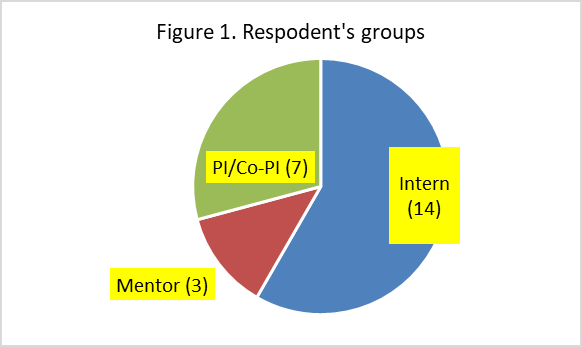
were excluded, and responses from 24 respondents were used for analysis.
Intern Survey
Interns (n=14) were on average 26 years old. Eight were in their senior year; the rest were juniors. Thirteen indicated their gender: seven were females, five males and one identified gender as “other”. All interns were in-state students. The majority (n=7) came from an urban area, two each came from rural farm households, non-farm rural households, and a suburban area. Six indicated they were Hispanics, three each as white and Asian-American, and one as “other.”
Nine interns were pursuing plant science and/or plant pathology, and one each was in agricultural ecology, food science, industrial technology and viticulture. Three indicated taking a second major – one each in plant pathology, plant science and culinology.
Motivation for and Information about research methodology course
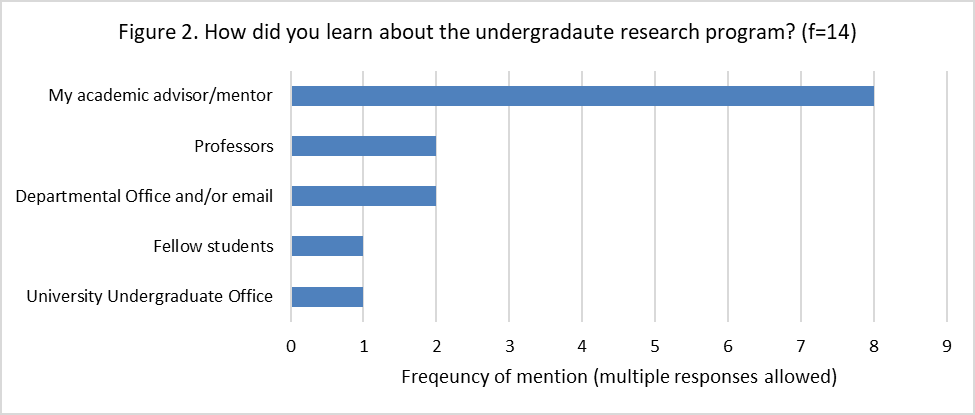
As can be seen in Figure 2, the majority (eight of 14) indicated that they learned about the research course from their academic advisors or mentors. Two each indicated other professors and the departmental office and/or email sent to students in their majors, and one each wrote “fellow students” and “university undergraduate office.”
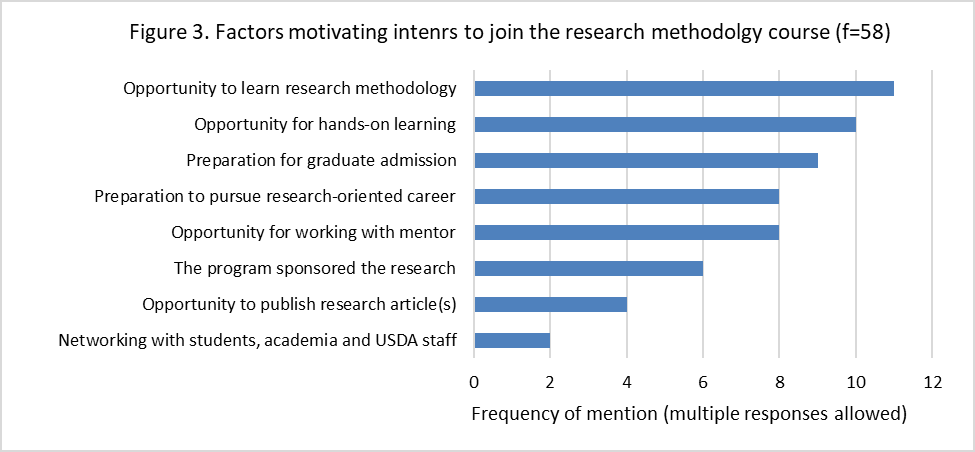
Opportunity to learn research methodology tops the list of motivating factors (f=11), followed by opportunity for hands-on learning (f=10) (Figure 3). Networking with students, academia, and USDA staff members was the least mentioned factor (f=2).
It was surprising to find that half of the interns (n=7) did not know about the Provost Undergraduate Research Grant that Fresno State has been promoting for years. Only three of those saying they knew about this research grant replied that they applied and received the grant as well. All three of them expressed that the grant was very useful or useful to improve their research skills.
Research Methodology Course
Nine of 14 interns indicated that they enrolled in the research methodology course. As can be seen in Table 1, learning hypothesis-based research received the highest rating (4.25); being able to utilize research facilities at on- and/or off-campus locations received a positive but the lowest rating (3.75).
| Aspects of the research methodology course (i.e., Plant 99, Plant 180) | N | Mean | SD |
|---|---|---|---|
| I learned hypothesis-based research. | 8 | 4.25 | .71 |
| I conducted hypothesis-based research. | 7 | 4.14 | .69 |
| It introduced me to the literature databases (e.g., AGRICOLA, BIOSIS). | 8 | 4.00 | 1.2 |
| I conducted literature review using library resources. | 8 | 4.00 | 1.07 |
| I was able to utilize research facilities at on- and/or off-campus locations. | 8 | 3.75 | 1.04 |
Scale: 1 = strongly disagree, 2 = disagree, 3 = Neither agree nor disagree, 4 = agree, 5 = strongly agree
Research Internship
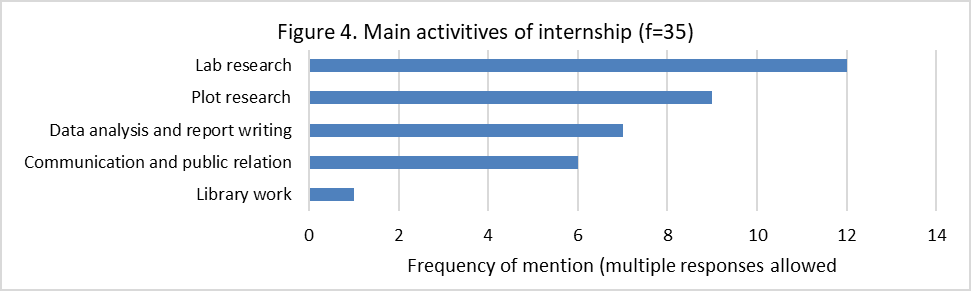
Nine students had their internships at University of California campuses, and five interns did their internships in either or at UOC campuses—both on U of C campus and through private organization, Fresno State campus, UC agricultural research and extension center, and UC Kearny research center. Laboratory research and plot research dominated the activities -- 12 of the interns said they were involved in such activities during internships. Only one intern mentioned being involved in library work (Figure 4).
Mentoring
Slightly more than half of the respondents indicated that mentoring was excellent, one-third said it was very good, and a few (15%) indicated it was fairly good.
Interns agreed or strongly agreed with most of the statements on research mentoring listed in Table 2 except “My mentor taught me how to prepare research publications/journal articles” (3.36). Other statements receiving relatively low ratings were “My mentor taught me how to analyze data” (3.62) and “My mentor taught me how to interpret data and write research reports” (3.64). Receiving the highest rating was “My mentor was easily accessible” (4.36), followed by “My mentor guided me how to conduct scientific research” (4.21).
| Aspects of mentoring | N | Mean | SD |
|---|---|---|---|
| My mentor was easily accessible. | 14 | 4.36 | .84 |
| My mentor helped me with summer internship problems. | 13 | 3.92 | .76 |
| My mentor referred me to helpful resources when I needed them. | 13 | 4.15 | .69 |
| My mentor encouraged me to attend meetings, workshops, and conferences. | 13 | 4.00 | 1.22 |
| My mentor guided me how to conduct scientific research. | 14 | 4.21 | 1.12 |
| My mentor taught me how to analyze data. | 13 | 3.62 | 1.12 |
| My mentor taught me how to interpret data and write research reports. | 14 | 3.64 | 1.08 |
| My mentor taught me how to prepare research publications/journal articles. | 14 | 3.36 | 1.15 |
| My mentor helped me to prepare presentations. | 14 | 3.71 | 1.20 |
| My mentor encouraged me to pursue graduate studies. | 14 | 4.14 | .95 |
Scale: 1 = strongly disagree, 2 = disagree, 3 = neither agree nor disagree, 4 = agree, 5 = strongly agree
Impact of Summer Internship
Professional goals: Interns (n=13) pursuing the research methodology course through the summer undergraduate research internship program had varied professional goals. Four indicated doing farm-based research or acquiring research-based jobs, three indicated serving in extension and advisory services, one each had plans to be an agricultural commissioner, a university professor, and an IT operator. Two did not have other things in mind than pursuing and getting master’s degrees. One respondent said she/he would like to be a farmer and use scientific farming methods that he/she has learned at college.
Internship accomplishments: Following are the most important accomplishments mentioned by interns (n=14) from their participation in summer internship. These responses illustrate how the summer internship greatly and positively affected interns. Interns acknowledged that field work opportunities helped them to get not only real-life experiences in technical aspects of their subjects but also to improve soft skills such as communicating with stakeholders and presenting their research among farmers and other professionals. Interns indicated that being part of the research course was a great learning experience, and that they could understand the phenomena -- what, why, and how -- that they were part of.
- Becoming more confident in myself when performing lab task.
- Being able to understand the intricate connections between sensors that allow them to speak so that I could gain a better understanding of how using [Internet of Things] IoT can be beneficial to data collection.
- Gain a mentor.
- Garnering a greater understanding of the waterways of California and different testing methodologies for pathogenicity.
- Get hands-on experience with lab materials.
- Hands-on field work with the public.
- I was able to gain a better understanding of the connection between the farmer and the scientist. I realized that a farmer has to be both.
- Learning effective ways to communicate the research conducted with an audience.
- My research won several awards.
- Presenting a poster.
- Presenting information to farmers and other researchers.
- Seeing the end product and being able to share my findings with others in my field.
- Seeing the numerical data in a spreadsheet.
Standing out among the above statements is the quote by an intern, “I was able to gain a better understanding of the connection between the farmer and the scientist. I realized that a farmer has to be both.” Farmers constantly face many issues and problems in farming, and addressing them on time is paramount to sustaining their farming. They may not always have access to researchers and/or research findings, and/or researchers may not have the solutions to the problems farmers have been facing. Therefore, farmers have to do (have been doing) their own research and decide their own course of action. An undergraduate intern revealing that that he/she has learned that farmers have to be vigilant in their farming and act with appropriate technologies to sustain their farming is itself a significant learning impact of the summer research course he/she attended.
One-fifth (21%) of the interns said they prepared a research article, research report or research video articulating their research work. Only three interns shared the subjects of their research output:
- Botrespheriacias family of plant pathogens.
- Organic produce vs. traditional in taste, texture, appearance, mouth feel, and smell comparison.
- Effects of walnut and pistachio sap on the mycelial growth and spore germination of four fungal species.
Two interns developed one product, and one produced two products. It is worthy to note that half (seven of 14) of the respondents were able to present their research at scientific meetings or conferences.
Seven interns gave the details of their presentations:
- Research poster at the ASA conference in Tampa, Florida, presenting this October.
- California Soil Science meeting, presented a poster.
- Food Safety Symposium in Long Beach, California, Salmonella Sanitation of Whole Mangoes through Hot Water Submersion.
- 2 presentations.
- I presented my research on pesticide effects on microbial activity in nectar at the Pacific Coast branch, ESA.
- One, at UC, Davis. My research testing if the cover crop Crotalaria is a host for root-lesion nematodes.
- Presented three times at Fresno State, Oregon, and Monterey weed conference on Insects and weed interaction on Southeast Asian cropping system.
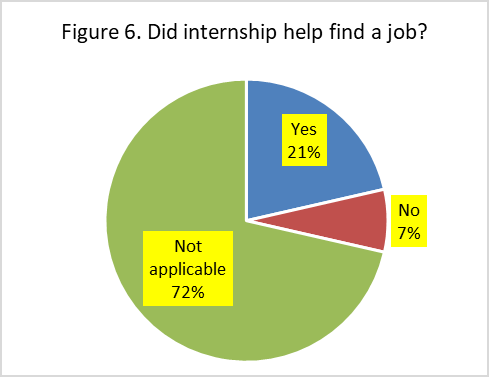
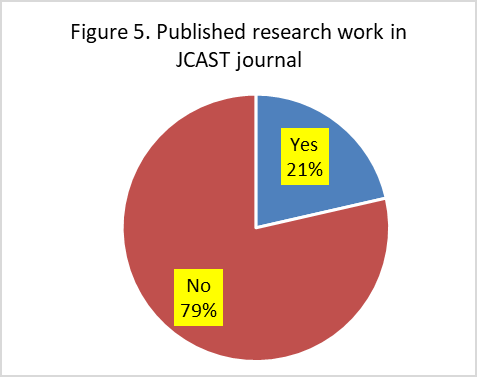
Of 14 interns, three (21%) indicated that they published or planned to publish their research work in the JCAST undergraduate research journal (Figure 5). Among 14 respondents answering whether participation in internships helped them find a job (Figure 6), the majority (72%) said “not applicable” to them; three (21%) said “yes,” it helped them find a job; only one said “no,” the internship was not helpful in finding a job. Importantly, all but one intern responded that participating in the summer research course motivated them to pursue graduate studies.
Path to Graduate School
All the interns indicated that they were considering pursuing graduate studies. Four of them said that they took the GRE, and the rest planned to take this exam. Two interns said that they had already applied to and received admission to graduate school. The rest planned to apply.
Leaning Outcomes
As can be seen in Table 3, interns agreed that they could analyze research data, interpret research results, and present research work at professional meetings and conferences. Receiving positive but lower ratings was the statement that they could write research reports and/or journal articles for publication.
| Learning outcomes | N | Mean | SD |
|---|---|---|---|
| I can design scientific experiments. | 14 | 3.86 | 1.03 |
| I can develop data collection instruments. | 14 | 3.93 | .83 |
| I can analyze research data. | 12 | 4.33 | .65 |
| I can interpret research results. | 14 | 4.29 | .61 |
| I can write research reports and/or journal articles for publication. | 13 | 3.62 | .87 |
| I can present research work at professional meetings and conferences. | 14 | 4.00 | 1.11 |
Scale: 1 = strongly disagree, 2 = disagree, 3 = Neither agree nor disagree, 4 = agree, 5 = strongly agree.
Communication Skills
Facebook was the only social medium used to communicate their research work while they were interns. Nobody indicated that they used blogs or Twitter for communicating about their research work.
Mentor Survey
Three mentors fill out the survey. Table 4 shows the results. All of the three said that they would accept future interns. Mentors indicated that “financial/logistical support for interns,” “mentoring and supervision of interns,” and “length of internship” were good. However, “their participation in the selection of interns” and “communication between JCAST faculty advisor and internship supervisor” and “academic preparedness of interns” were either average or below average.
| Elements of research internship | N | Mean | SD |
|---|---|---|---|
| My participation in the selection of interns | 3 | 2.67 | .58 |
| Academic preparedness of interns | 3 | 3.33 | .58 |
| Matching of placement of interns | 3 | 3.67 | 1.53 |
| Financial/logistical support for interns | 3 | 4.00 | 1.00 |
| Mentoring and supervision of interns | 3 | 4.00 | 1.00 |
| Communication between JCAST faculty advisor and internship supervisor | 3 | 3.00 | 1.00 |
| Length of internship | 3 | 4.00 | .00 |
Scale: 1=very poor, 2=poor, 3=average, 4=good, 5=high.
With regard to learning outcomes of interns as indicated by mentors (see Table 5), “interns are motivated to learn research skills” received the highest rating, followed by “interns can design scientific experiments,” “interns can present research work at professional meetings and conferences,” and “interns follow directions from the supervisors,” each with an “agree” rating. Receiving the lowest ratings were “interns can write research reports and/or journal articles for publication,” followed by “interns can analyze research data,” and “interns can interpret research results.”
| Anticipated learning outcomes | N | Mean | SD |
|---|---|---|---|
| Interns can design scientific experiments. | 3 | 4.00 | .00 |
| Interns can develop data collection instruments. | 3 | 3.33 | 1.16 |
| Interns can analyze research data. | 3 | 3.00 | 1.00 |
| Interns can interpret research results. | 3 | 3.00 | 1.00 |
| Interns can write research reports and/or journal articles for publication. | 3 | 2.67 | 1.16 |
| Interns can present research work at professional meetings and conferences. | 3 | 4.00 | .00 |
| Interns are motivated to learn research skills. | 3 | 4.67 | .58 |
| Interns are academically prepared to participate in research work. | 3 | 3.67 | 1.16 |
| Interns follow directions from the supervisors. | 3 | 4.00 | 1.73 |
Scale: 1 = strongly disagree, 2 = disagree, 3 = Neither agree nor disagree, 4 = agree, 5 = strongly agree.
As can be seen in Table 6, mentors agreed or strongly agreed to all six statements depicting objectives of the JCAST undergraduate research internship program, with “preparing students for advanced graduate studies” receiving the highest rating.
| Statements about the JCAST undergraduate research internship program | N | Mean | SD |
|---|---|---|---|
| Developing collaboration with research organizations or institutions. | 2 | 4.00 | .00 |
| Creating a new research methodology course. | 2 | 3.50 | .71 |
| Complementing the existing Fresno State undergraduate research program. | 2 | 4.00 | .00 |
| Encouraging students to share their research through undergraduate research journal and social media. | 2 | 3.50 | .71 |
| Helping undergraduate students develop agricultural research competency. | 2 | 4.00 | .00 |
| Preparing students for advanced graduate studies. | 2 | 4.50 | .707 |
Scale: 1 = strongly disagree, 2 = disagree, 3 = neither agree nor disagree, 4 = agree, 5 = strongly agree.
Problems and Suggestions
Even though they came from only one mentor, the statements below indicate that interns were in difficulty financially, and because they had to work to meet their daily needs, they could not concentrate on research work.
Problem: My particular intern was simply too busy during the summer to get the most out of her internship. She was also working at the USDA three days a week, and so only had two days a week to do internship activities.
Suggestion: Perhaps more financial support for the students could help them limit their activities to only the internship research during the summer.
PI/CO-PI Survey
Table 7 presents activities/programs initiated through this USDA-funded grant at JCAST as indicated by PIs and co-PIs of the project. They all agreed that they assisted interns to prepare research publications, encouraged and supported them to take the GRE, advised them to prepare for graduate school application, and advised them to find research-related jobs. On the contrary, the majority of them (66.67%) disagreed that the project “designed and offered a course on research methodology as a special topic.”
| Activities/programs initiated through this USDA-funded grant | Yes | No | Total |
|---|---|---|---|
| Created internship recruitment materials and made announcement within JCAST departments. | 5 | 2 | 7 |
| Developed collaborations with research institutions/organizations. | 6 | 1 | 7 |
| Invited internship supervisors in the selection of interns matching the research projects. | 5 | 1 | 6 |
| Collaborated with Provost’s Undergraduate Research Grant Program at Fresno State. | 4 | 2 | 6 |
| Designed and offered a course on research methodology as a special topic. | 2 | 4 | 6 |
| Established an undergraduate science research journal. | 4 | 2 | 6 |
| Assisted interns to prepare research publications. | 7 | 0 | 7 |
| Encouraged and supported interns to take the GRE. | 7 | 0 | 7 |
| Advised interns to prepare for graduate school application. | 7 | 0 | 7 |
| Advised interns to find research-related jobs. | 7 | 0 | 7 |
Overall Success of the Project
PI/CO-PIs indicated that the USDA-funded undergraduate summer research internship project was successful (42.9%) or highly successful (57.1%) (mean=4.57, SD=0.54). Additionally, respondents mentioned the project as being somewhat sustainable (n=2) and sustainable (n=5). It appeared from the PI/CO-PIs responses that the objectives of the project were met to a great extent (Table 8).
| Project objectives | N | Mean | SD |
|---|---|---|---|
| Mentoring undergraduate students for agricultural research | 7 | 4.00 | .00 |
| Promoting student research product | 7 | 3.86 | .38 |
| Preparing students for graduate schools | 7 | 3.86 | .38 |
Scale: 1=not at all, 2=very little, 3=somewhat, 4=to a great extent.
Criteria for Selecting Students
PI and CO-PIs mentioned following criteria to select interns.
- Grades, motivation, interest in pursuing research and graduate studies.
- Interest in research expressed by student's statement; letter of recommendations; acceptance of the student as one of the interns.
- Interests in agriculture and microbiology.
- Professors or lecturers at CSU, Fresno, suggested names, I attended different classes and made the announcement, and a group of students were then interviewed.
- Research interests and long-term plans to stay in a research setting.
- The students were registered in an existing course (Plant 180).
Resources Require to Continue the Course
Fresno State strives to offer research-focused course to students and help students gain critical thinking, analytical, inquiring, and writing skills, among other. It was therefore important to know whether and how the research methodology course launched through this USDA project could be continued. PIs/CO-PIs told the following resources being essential to continue the course.
- Funds for student stipends in summer and other funded research projects for faculty.
- One individual and about $7,000 to continue this research.
- Release time for teaching faculty involved in research; additional funds for research-related expenses including more compensation for student hours spent on project staff, funding, time.
- There is an existing course called Plant 180, Undergraduate Research. The project objectives were met through this course.
- USDA - SCRI continued research funding.
Lessons learned from the Project
- Great experience. Impact has been tremendous so far.
- Mentoring and student advising requires a lot more time than originally expected; undergrad students are very innovative and have the ability to devise excellent research questions when given the proper guidance....and they are so enthusiastic about research!
- Not only the interns but their supervisors also benefited from this project. Minority students also had the potential to go on to graduate school with good supervision.
- That there are students out there at state universities who work hard and do great work and have good understanding of agriculture and environmental issues.
- Value of working with students of non-academic family backgrounds (many of the student interns were the first in their family to attend college).
Strategies to Self-Sustain the Program (n=6)
- Continuing federal funding. Support from state funding.
- Continued financial support.
- Dedicated mentors to be duly compensated for advising time. Involvement of other stakeholders in the agricultural industry in an effort to promote a lot more applied research.
- Go for more USDA/other federal sources for funding work on establishing a doctoral program at Fresno State, possibly.
- Involvement of collaborators, industry.
- The intern hosts advertise and recruit students from Jordan College when they have funds to do so. The provost's grant continues to support undergraduate student research.
Additional Insights about the Program (n=4)
- Empowers students to explore avenues otherwise not very promising for them, like careers in USDA.
- I am a UC, Berkeley, professor at a field station near CSU, Fresno, so I am not connected with the program other than sponsoring the interns.
- Nothing at this... just thankful for the opportunity provided by this grant.
- This is a great way to bring land-grant university researchers with students of state universities.
Conclusions and Recommendations
The program greatly motivated interns to pursue graduate studies. Interns acknowledged that they learned hypotheses-based research and got exposure to real-world cases through hands-on classes. Research internships offered an excellent opportunity for interns to learn soft skills, too—communication, presentation, and teamwork, among others. Publication of the Jordan College of Agricultural Sciences and Technology Student Research Journal is a great accomplishment for interns and an excellent forum to showcase their research work and other related research activities. Importantly, evaluation revealed that interns are being recognized for their performance and skills through professional awards and recognitions.
Mentors found interns highly interested in learning and employing research skills but falling short on gaining skills to write research reports and/or journal articles, and analyze and interpret research data. Co-PIs indicated that though the USDA project helped interns in preparing publications and encouraged and supported them to pursue graduate studies, the project is yet to design and offer a course on research methodology as a special topic. Strengthening collaborative research by linking land-grant universities with state universities happened to be an outcome that could have long-term impact on agricultural education and training.
Areas needing improvement are:
- Interns need more opportunities for presentations of research work.
- Interns need more learning opportunities on writing research papers and journal articles.
- Encouragement and promotion of the use of social media to communicate research and learning.
- Formalization/institutionalization of research methods course in the regular curriculum.
- Encouragement of students from rural or suburban backgrounds to participate in research internships.
- Partnership and/or collaboration with industries and other stakeholders to fund the research internship program and pursue applied research activities.
References
California State University. (2017). Progress Report.
JCAST (Jordan College of Agricultural Sciences and Technology) (2017). Undergraduate Student Research Journal. http://fresnostate.edu/jcast/research/student-research-journal.html
Appendix - Survey Questionnaire
Student Intern Survey
Q1. What was your role in the USDA-funded project?
- Student intern [Continue to Q2 up to Q 39]
- Mentor of an intern [Skip to Q 41]
- PI or Co-PI of grant [Skip to Q 52]
Q2. How did you learn about this undergraduate research internship program you participated? Check all that apply.
- From my academic advisor
- From University Undergraduate Office
- From fellow students
- From Student Services Office
- Other [specify] ________________________________________________
Q3. What motivated you to join this program? Check all that apply.
- Opportunity for hands-on learning
- Opportunity to learn research methodology
- Opportunity for working with mentor
- The program sponsored the research
- Networking with students, academia and USDA staff
- Opportunity to publish research article(s)
- Preparation for graduate admission
- Preparation to pursue research-oriented career
Q4. Did you know about the Provost’s undergraduate research grant at Fresno State?
- Yes
- No [Skip to Q8]
Q5. Did you apply for this grant?
- Yes
- No (2) [Skip to Q8]
Q6. Were you able to get the grant?
- Yes
- No [Skip to Q8]
Q7. How useful was the grant to develop your research skills?
- Not useful
- Somewhat useful
- Useful
- Very useful
Q8. Research Methodology Course (e.g., Plant 99, Plant 180): Did you enroll in Research Methodology course offered by JCAST?
- Yes
- No [Skip to Q10]
Q9. Please indicate your agreement or disagreement to the following aspects of the Research Methodology (e.g., Plant 99, Plant 180) course.
| Statement | Strongly disagree | Disagree | Neither agree nor disagree | Agree | Strongly agree |
|---|---|---|---|---|---|
| Learned hypothesis based research. | o | o | o | o | o |
| I conducted hypothesis based research. | o | o | o | o | o |
| It introduced me to the literature databases (e.g., AGRICOLA, BIOSIS). | o | o | o | o | o |
| I conducted literature review using library resources. | o | o | o | o | o |
| I was able to utilize research facilities at on- and/or off-campus locations. | o | o | o | o | o |
Q10. Research Internship: Where did you do your research internship?
- University of California campuses
- USDA field research stations
- Private sector food labs/research centers
- Other (specify) _______________________________________________
Q11. What were the main activities of your internship? Check all that apply.
- Plot research
- Library work
- Lab research
- Data analysis and report writing
- Communication and public relation
- Other (specify) ______________________________________________
Q12. How do you rate the quality of mentoring of your mentor that you worked with?
- Excellent
- Very good
- Average
- Fair
- Poor
Q13. Please indicate your agreement or disagreement to the following aspects of the research mentoring during internship.
| Statement | Strongly disagree | Disagree | Neither agree nor disagree | Agree | Strongly agree |
|---|---|---|---|---|---|
| My mentor was easily accessible. | o | o | o | o | o |
| My mentor helped me with summer internship problems. | o | o | o | o | o |
| My mentor referred me to helpful resources when I needed them. | o | o | o | o | o |
| My mentor encouraged me to attend meetings, workshops, and conferences. | o | o | o | o | o |
| My mentor guided me how to conduct scientific research. | o | o | o | o | o |
| My mentor taught me how to analyze data. | o | o | o | o | o |
| My mentor taught me how to interpret data and write research reports. | o | o | o | o | o |
| My mentor taught me how to prepare research publications/journal articles. | o | o | o | o | o |
| My mentor helped me to prepare presentations. | o | o | o | o | o |
| My mentor encouraged me to pursue graduate studies. | o | o | o | o | o |
Q14. Impact of Summer Internship: What is your professional goal? (What kind of work
do you want to do in life?)
_________________________________________________________________________________
Q15. What was the most important accomplishment of your internship experience? Please
describe.
_________________________________________________________________________________
Q16. Did you prepare a research article or a research report or a research video?
- Yes
- No [Skip to Q19]
Q17. What were those article, report, and video about?
_________________________________________________________________________________
Q18. How many articles, reports or videos did you develop?
_________________________________________________________________________________
Q19. Did you make presentations of your internship-based work at a scientific meeting, or a conference?
- Yes
- No [Skip to Q21]
Q20. How many, where, what did you present?
________________________________________________________________
Q21. Did you publish or plan to publish your internship-based work in JCAST Undergraduate Research Journal?
- Yes
- No [Skip to Q23]
Q22. What is the title of your publication?
_______________________________________________________________________________
Q23. Did participation in internship help you find a job?
- Yes
- No
- No applicable (I was not looking for a job.)
Q24. Did participation in internship motivate you to pursue graduate studies?
- Yes
- No
Q25. Path to Graduate School: Are you considering to pursue graduate studies?
- Yes
- No
Q26. Did you take GRE test?
- Yes
- No
- I plant to take it.
Q27. Did you apply to a graduate school?
- Yes
- No [Skip to Q 29]
- I plan to apply.
Q28. Were you admitted to the graduate school?
- Yes
- No
- My application is under review.
Q29. Learning Outcomes: Please rate your agreement or disagreement to the following learning outcomes anticipated from your participation in the above stated summer internship program.
| Statement | Strongly disagree | Disagree | Neither agree nor disagree | Agree | Strongly agree |
|---|---|---|---|---|---|
| I can design scientific experiments. | o | o | o | o | o |
| I can develop data collection instruments. | o | o | o | o | o |
| I can analyze research data. | o | o | o | o | o |
| I can interpret research results. | o | o | o | o | o |
| I can write research reports and/or journal articles for publication. | o | o | o | o | o |
| I can present research work at professional meetings and conferences. | o | o | o | o | o |
Q30. Communication Skills: Which of the following social media have you used to communicate your research works while you were an intern? Check all that apply.
- Discussion blogs
- Other (specify) ________________________________________________
Q31. Demographics: What is your primary major?
_______________________________________________________________
Q32. Do you have a second major or specialization?
- Yes
- No [Skip to Q34]
Q33. List the second major/specialization.
______________________________________________________________
Q34. What was your years in college while you were a JCAST intern funded by USDA?
- Sophomore
- Junior
- Senior
Q35. What is your ethnicity?
- White
- Hispanic
- African American
- Asian American
- Other (specify) ________________________________________________
Q36. Where did you reside before coming to California State University, Fresno?
- In a rural area with a farm
- In a rural area without farm
- In a sub-urban area
- In an urban area
Q37. Which category best describes your residency?
- In-state student
- Out-of-state student
- International student
Q38. What is your age in years?
________________________________________________________________
Q39. What is your gender?
- Male
- Female
- Other
- Prefer not to answer
You have reached the end of the survey.
You may now go back by checking “<<” to review your answers or click “>>” to finish and submit this survey.
MENTOR SURVEY:
Q41. How would you rate the following aspects of Undergraduate Summer Research Internship?
| Aspect | Very poor | Poor | Average | Good | Very good |
|---|---|---|---|---|---|
| My participation in the selection of interns | o | o | o | o | o |
| Academic preparedness of interns | o | o | o | o | o |
| Matching of placement of interns | o | o | o | o | o |
| Financial/logistic support for interns | o | o | o | o | o |
| Mentoring and supervision of interns | o | o | o | o | o |
| Communication between JCAST faculty advisor and internship supervisor | o | o | o | o | o |
| Length of internship | o | o | o | o | o |
Q42. Would you be interested to host future JCAST interns?
- Yes
- No [If "No" why?] ________________________________________________
Q43. Please rate your agreement or disagreement to the following learning outcomes anticipated from your participation in the above stated summer internship program.
| Statement | Strongly disagree | Disagree | Neither agree nor disagree | Agree | Strongly agree |
|---|---|---|---|---|---|
| Interns can design scientific experiments. | o | o | o | o | o |
| Interns can develop data collection instruments. | o | o | o | o | o |
| Interns can analyze research data. | o | o | o | o | o |
| Interns can interpret research results. | o | o | o | o | o |
| Interns can write research reports and/or journal articles for publication. | o | o | o | o | o |
| Interns can present research work at professional meetings and conferences. | o | o | o | o | o |
| Interns are motivated to learn research skills. | o | o | o | o | o |
| Interns are academically prepared to participate in research work. | o | o | o | o | o |
| Interns follow directions from the supervisors. | o | o | o | o | o |
Q44. Please indicate your agreement or disagreement with the following statements about the JCAST Undergraduate Research Internship program?
| Statement | Strongly disagree | Disagree | Neither agree nor disagree | Agree | Strongly agree | N/A or Does not apply |
|---|---|---|---|---|---|---|
| Developing collaboration with research organization or institutions. | o | o | o | o | o | o |
| Creating a new research methodology course. | o | o | o | o | o | o |
| Complementing the existing Fresno State undergraduate research program. | o | o | o | o | o | o |
| Encouraging students to share their research through undergraduate research journal and social media. | o | o | o | o | o | o |
| Helping undergraduate students develop agricultural research competency. | o | o | o | o | o | o |
| Preparing students for advanced graduate studies. | o | o | o | o | o | o |
Q45. List problems or issues that you have experienced while hosting interns sponsored
by the JCAST Undergraduate Research Internship project?
_________________________________________________________________________________
Q46. How can the JCAST Undergraduate Research Internship program be improved?
_________________________________________________________________________________
Q47. Demographics: University/Organization:
_________________________________________________________________________________
Q48. College/Office:
_________________________________________________________________________________
Q49. Your expertise of work and/or teaching:
_________________________________________________________________________________
Q50. Years in service:
_________________________________________________________________________________
Q51. Your gender:
- Male
- Female
You have reached the end of the survey.
You may now go back by checking “<<” to review your answers or click “>>” to finish and submit this survey.
PI AND/OR CO-PI SURVEY:
Q52. Please indicate which of the following activities/programs were initiated through this USDA-funded grant?
| Activity/program | Yes | No |
|---|---|---|
| Created internship recruitment materials and made announcement within JCAST departments. | o | o |
| Developed collaborations with research institutions/organizations. | o | o |
| Invited internship supervisors in the selection of interns matching the research projects. | o | o |
| Collaborated with Provost’s Undergraduate Research Grant Program at Fresno State. | o | o |
| Designed and offered a course on Research Methodology as a special topic. | o | o |
| Established an Undergraduate Science Research Journal. | o | o |
| Assisted interns to prepare research publications. | o | o |
| Encouraged and supported interns to take GRE test. | o | o |
| Advised interns to prepare for graduate school application. | o | o |
| Advised interns to find research related jobs. | o | o |
Q53. Mentoring undergraduate students for agricultural research, promoting their research products and preparing/motivating them to join graduate schools were the key objectives of this project. To what extent were these objectives met by this project?
| Project objective | Not at all | Very little | Somewhat | To a great extent |
|---|---|---|---|---|
| Mentoring undergraduate students for agricultural research | o | o | o | o |
| Promoting student research product | o | o | o | o |
| Preparing students for graduate schools | o | o | o | o |
Q54. How would you rate the overall success of this USDA-funded project?
- Not at all successful
- Not successful
- Somewhat successful
- Successful
- Highly successful
Q55. In light of the resources (i.e., staff time and $) required to manage project activities how would rate the sustainability of this project?
- Not at all sustainable
- Not sustainable
- Somewhat sustainable
- Sustainable
- Highly sustainable
Q56. Has the Undergraduate Research Methodology course developed through this USDA-funded project been formalized or institutionalized by Fresno State?
- Yes, it has been formalized/institutionalized.
- No, it has not been formalized/institutionalized.
- Institutionalization of the course has been initiated.
Q57. What were the criteria for selecting students for this research course?
_________________________________________________________________________________
Q58. What resources (staff, $, time, etc.) are needed to continue this course beyond
USDA-funded project period?
_________________________________________________________________________________
Q59. What lessons did you learn from this project?
_________________________________________________________________________________
Q60. How can this program be self-sustained? List two strategies.
_________________________________________________________________________________
Q61. Please provide additional insights about this initiatives?
_________________________________________________________________________________
You have reached the end of the survey.
You may now go back by checking “<<” to review your answers or click “>>” to finish and submit this survey.
This HTML version was generated with AI assistance and may contain errors or omissions. The original approved PDF remains the official document of record. An alternative accessible format is available upon request from the document creator in accordance with Title II of the ADA.